

English Language Idioms: What They Are and How to Use Them Like a Native Speaker
Have you ever heard someone say “it’s raining cats and dogs” and wondered if they were serious? Or maybe a colleague told you to “break a leg” before a presentation, and you felt confused. You are not alone.
Idioms are everywhere in the English language. They appear in conversations, movies, books, and workplace emails. But for many learners, they create real confusion. The words do not match the meaning. This makes idioms one of the trickiest parts of learning English.
The good news is that idioms are not as difficult as they seem. Once you understand how they work and learn the most common ones, you will start noticing them everywhere. You will also feel more confident using them yourself.
This guide explains everything you need to know about English language idioms. You will learn what they are, why they matter, and how to use them correctly. You will also discover the most useful idioms for everyday situations.
What Exactly Are English Language Idioms?
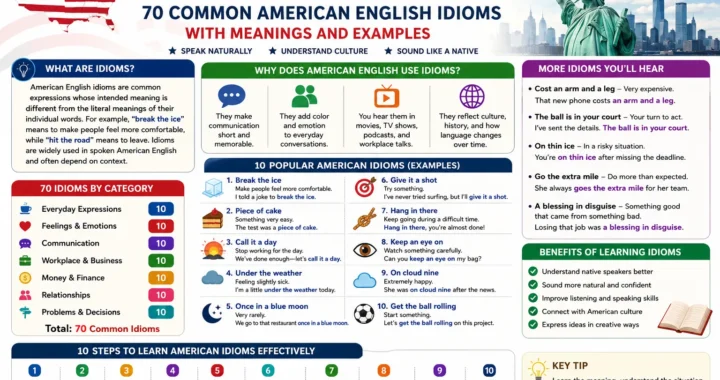
English language idioms are expressions where the meaning cannot be understood from the individual words. Instead, the phrase has a figurative meaning that native speakers understand through common usage.
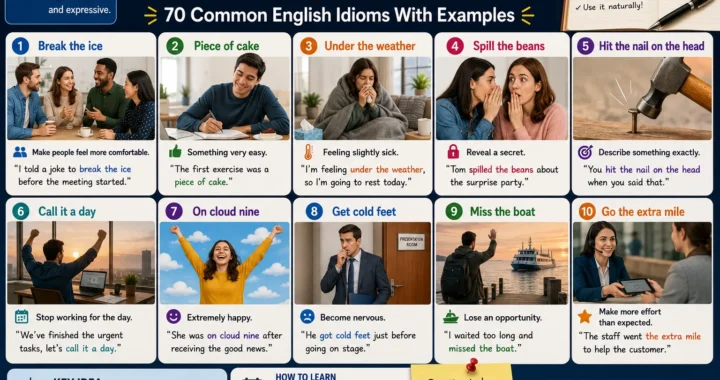
Example: “Spill the beans” does not mean dropping beans on the floor. It means revealing a secret.
Idioms are part of everyday language. They make speech more colorful and interesting. Without idioms, English would sound flat and mechanical.
Image Suggestion: A collage of common idiom illustrations, like a cat and dog falling from clouds, someone with a chip on their shoulder, and a person letting the cat out of the bag.
Why English Uses So Many Idioms
Idioms exist in every language. But English has an unusually large number of them. This happened for several reasons.
The Influence of Different Cultures
English borrowed from many languages over centuries. Latin, French, German, and Scandinavian languages all contributed words and phrases. Many idioms came from these influences and stuck around.
The Role of Storytelling
For hundreds of years, people shared stories orally. Idioms helped make stories more vivid and memorable. A phrase like “bury the hatchet” paints a clear picture that plain words cannot match.
Natural Language Evolution
Languages change constantly. New idioms appear as culture changes. Older ones fade away. This natural process keeps English fresh and relevant.
The Human Love for Metaphor
People naturally think in metaphors. We compare new concepts to things we already understand. Idioms are simply shared metaphors that a whole culture agrees on.
Common Types of English Language Idioms
Not all idioms work the same way. Understanding the different types helps you recognize them more easily.
Pure Idioms
These are completely figurative. The words give no clue about the meaning.
Examples:
- “Kick the bucket” (to die)
- “Hit the sack” (to go to sleep)
- “Bite the bullet” (to face something difficult)
Binomial Idioms
These use two words joined by “and” or “or.” The order usually stays fixed.
Examples:
- “Back and forth”
- “Black and white”
- “Pros and cons”
Prepositional Idioms
These combine verbs with specific prepositions to create new meanings.
Examples:
- “Look after” (to care for)
- “Run into” (to meet unexpectedly)
- “Get over” (to recover from)
Euphemistic Idioms
These replace unpleasant or sensitive topics with gentler phrases.
Examples:
- “Pass away” (to die)
- “Let someone go” (to fire someone)
- “In between jobs” (unemployed)
Image Suggestion: A colorful mind map or flowchart showing different types of idioms with example phrases branching out.
Why Learning Idioms Matters
Some learners avoid idioms because they seem difficult. But skipping them creates problems.
You Will Understand Native Speakers Better
Native speakers use idioms constantly. If you do not know them, you will miss the real meaning of conversations. Understanding idioms helps you follow along naturally.
Your Speech Will Sound More Natural
Using idioms makes you sound like a confident English speaker. Without them, your language may feel stiff or textbook-like. Idioms add personality and warmth to your speech.
You Will Enjoy Media More
Movies, TV shows, and books are full of idioms. When you understand them, you enjoy the content more. You also notice humor and cultural references that previously went over your head.
You Will Build Deeper Connections
Sharing common expressions creates bonds with native speakers. When you use an idiom correctly, people respond positively. They see you as someone who understands the culture, not just the language.
Idioms Reflect Cultural Values
Many idioms reveal what a culture values. For example, English has many idioms about time and money. This reflects how important these concepts are in English-speaking countries.
Expert Insights: The Psychology of Idiom Learning
Understanding how the brain processes idioms helps you learn them more effectively.
The Brain Treats Idioms as Whole Units
Research shows that fluent speakers process idioms as single units, not individual words. Your brain stores “kick the bucket” as one complete idea. This is why learning idioms as whole phrases works better than learning each word separately.
Context Speeds Up Learning
You will remember an idiom better when you encounter it in a real situation. Reading or hearing idioms in context helps your brain connect the phrase to its meaning. This is more effective than memorizing lists.
Emotion Increases Retention
Idioms often carry emotional weight. When you learn an idiom through an emotional experience, you are more likely to remember it. Watching a movie where a character uses an idiom with strong feeling can be very effective.
Repetition Builds Automaticity
The more you hear and use an idiom, the more automatic it becomes. Eventually, you stop translating it mentally. You simply understand it. This takes time, so be patient with yourself.
Image Suggestion: A person listening to an audio lesson or watching a language learning video, smiling and nodding in understanding.
Common Mistakes Learners Make with Idioms
Idioms confuse many learners. Avoid these errors to sound more natural.
Mistake 1: Trying to Translate Literally
Why it is incorrect: English idioms do not translate directly into other languages. Translating word for word leads to confusion and nonsense.
The correct approach: Learn the meaning of the whole idiom. Forget the individual words. Focus on the situation where people use the phrase.
Mistake 2: Using Idioms Too Often
Why it is incorrect: Even native speakers do not use idioms in every sentence. Overusing idioms makes you sound unnatural or like you are trying too hard.
The correct approach: Use idioms sparingly. A few well-placed idioms sound better than constant figurative language.
Mistake 3: Using Outdated Idioms
Why it is incorrect: Some idioms are old-fashioned. Younger speakers may not use them at all. Using these can make you sound like someone from another era.
The correct approach: Learn current idioms from recent media. Watching modern TV shows and reading contemporary books helps you stay up to date.
Mistake 4: Mixing Up Similar Idioms
Why it is incorrect: Many idioms sound alike. “Beat around the bush” and “beat the bushes” are different phrases with different meanings. Mixing them confuses listeners.
The correct approach: Practice idioms as complete phrases. Say the whole phrase out loud. This helps your brain remember the exact wording.
Mistake 5: Using Idioms in Formal Writing
Why it is incorrect: Most idioms are informal. Academic or professional writing often avoids figurative language. An idiom that works in conversation may seem unprofessional in a report.
The correct approach: Save idioms for spoken English and informal writing. In formal contexts, use direct, literal language.
50 Essential English Language Idioms for Daily Use
Here are the most useful idioms organized by situation. Learning these will prepare you for most conversations.
Idioms for Work and Business
| Idiom | Meaning | Example |
|---|---|---|
| Think outside the box | Think creatively | “We need to think outside the box to solve this problem.” |
| Get the ball rolling | Start something | “Let’s get the ball rolling on this project.” |
| Call it a day | Stop working | “We’ve done enough. Let’s call it a day.” |
| Cut corners | Do something poorly to save time | “The company cut corners on safety.” |
| Back to the drawing board | Start over | “The plan failed. Back to the drawing board.” |
Idioms for Social Situations
| Idiom | Meaning | Example |
|---|---|---|
| Break the ice | Make people comfortable | “He told a joke to break the ice.” |
| Hit it off | Get along well immediately | “We hit it off at the party.” |
| Let your hair down | Relax and enjoy yourself | “It’s the weekend. Time to let your hair down.” |
| Make small talk | Talk about unimportant things | “We made small talk while waiting.” |
| Have a blast | Have a great time | “The party was amazing. We had a blast.” |
Idioms About Emotions
| Idiom | Meaning | Example |
|---|---|---|
| Under the weather | Feel sick | “I’m feeling under the weather today.” |
| Over the moon | Extremely happy | “She was over the moon about her promotion.” |
| Down in the dumps | Sad | “He’s been down in the dumps all week.” |
| Have butterflies | Feel nervous | “I have butterflies before every presentation.” |
| Lose your cool | Become angry | “He lost his cool during the meeting.” |
Idioms About Money
| Idiom | Meaning | Example |
|---|---|---|
| Break the bank | Cost too much | “Dinner won’t break the bank.” |
| Cost an arm and a leg | Very expensive | “The repairs cost an arm and a leg.” |
| Save for a rainy day | Save for the future | “I always save for a rainy day.” |
| Money talks | Money gives power | “In business, money talks.” |
| Feel the pinch | Experience financial difficulty | “Many people are feeling the pinch now.” |
Idioms About Time
| Idiom | Meaning | Example |
|---|---|---|
| Beat the clock | Finish before the deadline | “We beat the clock and finished early.” |
| Kill time | Waste time | “We killed time at the café.” |
| Once in a blue moon | Very rarely | “I visit my hometown once in a blue moon.” |
| Time flies | Time passes quickly | “Time flies when you are having fun.” |
| Call time | Decide something is finished | “The referee called time on the match.” |
Idioms About Decisions and Actions
| Idiom | Meaning | Example |
|---|---|---|
| Bite the bullet | Do something difficult | “I need to bite the bullet and call the dentist.” |
| Play it by ear | Decide as you go | “We don’t have a plan. Let’s play it by ear.” |
| Take it with a grain of salt | Do not fully believe it | “Take his advice with a grain of salt.” |
| Jump on the bandwagon | Join a popular trend | “Everyone joined the trend. I jumped on the bandwagon.” |
| The ball is in your court | It is your decision | “I’ve made my offer. Now the ball is in your court.” |
Idioms About Problems and Challenges
| Idiom | Meaning | Example |
|---|---|---|
| Face the music | Accept consequences | “I made a mistake. Now I have to face the music.” |
| Cut someone some slack | Give someone a break | “He’s new. Cut him some slack.” |
| Make matters worse | Make a problem worse | “Don’t make matters worse by arguing.” |
| See the light | Understand something clearly | “He finally saw the light and apologized.” |
| Put out fires | Deal with urgent problems | “I spent the whole day putting out fires.” |
Idioms About Communication
| Idiom | Meaning | Example |
|---|---|---|
| Get straight to the point | Say exactly what you mean | “Let’s get straight to the point.” |
| Beat around the bush | Avoid saying directly | “Stop beating around the bush.” |
| Speak your mind | Say what you think | “I like people who speak their mind.” |
| Read between the lines | Understand hidden meaning | “The letter seemed nice, but read between the lines.” |
| Keep me in the loop | Tell me what is happening | “Please keep me in the loop about the project.” |
Image Suggestion: Two colleagues in a modern office having a friendly conversation, with a whiteboard showing idiom examples in the background.
Practical Steps to Learn English Language Idioms Effectively
Follow this framework to build your idiom knowledge steadily.
Step 1: Start with the Most Common Idioms
Do not try to learn hundreds at once. Begin with 10 to 20 very common idioms. The list above is a great starting point. Practice these until they feel natural.
Step 2: Learn Idioms in Context
Read books, watch movies, and listen to podcasts. Notice how native speakers use idioms. Pay attention to the situation and the tone. Context helps you remember both the meaning and the usage.
Step 3: Create Personal Examples
Write sentences using each new idiom. Make the examples personal so they are easier to remember.
Example: “I had butterflies before my job interview last week.”
Step 4: Use Idioms in Conversation
Try using one new idiom each day. Start with friends or family who understand you are learning. Practice makes perfect.
Step 5: Keep a Learning Journal
Write down new idioms you encounter. Note the meaning and an example. Review this journal regularly.
Step 6: Test Yourself
Use flashcard apps like Anki or Quizlet. These make reviewing idioms easy and fun. Regular testing helps move idioms into long-term memory.
Step 7: Be Patient
Learning idioms takes time. You will make mistakes. That is normal. Keep practicing and you will improve steadily.
Common Questions About English Language Idioms
Q: What exactly are idioms in the English language?
A: Idioms are fixed expressions where the meaning is different from the literal meanings of the individual words. For example, “kick the bucket” means to die, not to actually kick a bucket. Native speakers learn these through repeated exposure.
Q: Why are idioms so difficult to understand?
A: Idioms are difficult because they do not follow literal rules. The meaning comes from cultural agreement, not from the words themselves. Non-native speakers often try to translate word by word, which leads to confusion. The key is learning the whole phrase.
Q: How many English language idioms exist?
A: English has more than 25,000 known idioms. Many new ones appear each year. However, you only need to learn about 100 to 200 common ones to handle most everyday conversations effectively.
Q: Are English language idioms the same in all English-speaking countries?
A: Not always. British English and American English have some different idioms. Australians and Canadians also have their own phrases. However, many idioms are understood across all English-speaking countries.
Q: Where can I find an English language idioms list with meanings?
A: Dictionaries, language learning apps, and educational websites offer excellent lists. Many include examples to help you understand usage. Online resources are constantly updated with new idioms too.
Q: Why should I use idioms in English?
A: Idioms help you sound more fluent and natural. They also help you understand native speakers more easily. People appreciate when you use their common expressions. It shows cultural understanding.
Q: Can I use idioms in formal writing?
A: Most idioms work best in spoken English and informal writing. Academic essays, legal documents, and professional reports usually avoid idioms. In these contexts, direct language communicates more clearly.
Q: What is the most common English idiom?
A: “Break a leg” is very common, especially in performing arts. “Under the weather” appears frequently in daily conversation. “Cost an arm and a leg” is also widely used. The most common idiom depends on your situation and location.
Final Thoughts
English language idioms add color and personality to communication. They make conversations more interesting and help people connect. But they also require effort to learn and use correctly.
Start small. Focus on the most common idioms first. Practice them in real situations. Pay attention to how native speakers use them. Over time, idioms will become a natural part of your English.
Remember that every fluent speaker started where you are now. Mistakes are part of learning. Each error teaches you something valuable. Keep practicing and you will see steady improvement.
Read more: Break the Ice Idiom: Meaning & Examples