


Idioms Sentences: 70 Common English Idioms With Examples
Learning an idiom is much easier when you see it in a real sentence. A definition can tell you that “break the ice” means to make people feel more comfortable, but a sentence shows you how the expression actually works in conversation.
This is why idioms sentences are so useful for English learners. They connect the phrase with a situation, meaning, grammar, and natural usage at the same time. Instead of memorizing a long list of expressions, you can see how people might actually use them when talking about work, money, relationships, feelings, problems, and everyday life.
Idioms can be confusing because their meanings are often different from the literal meanings of their words. For example, “spill the beans” does not normally mean dropping beans on the floor. It means revealing a secret.
The best way to learn an idiom is therefore to study the complete expression, understand its simple meaning, and then read several sentences using it naturally.
What Are Idioms Sentences?
Idioms sentences are example sentences that show how an English idiom is used in real language. They help learners understand an idiom’s meaning, grammar, tone, and context. For example, “I told a joke to break the ice” shows that “break the ice” means helping people feel more comfortable in a social situation.
An idiom is a group of words with a meaning that is different from the literal meanings of the individual words.
For example:
Idiom: A piece of cake
Meaning: Something very easy
Sentence: “The first question was a piece of cake.”
The sentence gives you information that a definition alone cannot always provide.
You can see who is using the expression, what happened before it, and what kind of situation makes the idiom sound natural.
Why Learn Idioms Through Sentences?
Example sentences make idioms easier to understand because they place the expression inside a real situation.
Consider the idiom:
A definition tells you:
Meaning: Feeling slightly ill.
A sentence gives you more:
“I am feeling under the weather, so I am going to stay home today.”
Now you can see how the phrase works in conversation.
Sentences also show grammar. You learn that people say “I’m under the weather”, not simply “under weather.”
Another benefit is context. Some idioms are common in casual speech but may sound too informal for academic or professional writing.
For example:
“The test was a piece of cake.”
This sounds natural in casual conversation.
In a formal report, however, “The test was relatively easy” may be a better choice.
Learning idioms through sentences therefore helps you understand not just what an expression means, but when to use it.
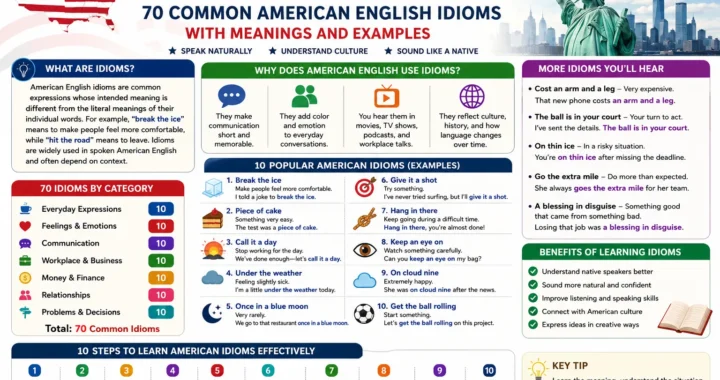
70 Common Idioms Sentences With Meanings
The examples below focus on common expressions that are useful in everyday English.
Idioms About Everyday Life
1. Break the ice
Meaning: Make people feel more comfortable.
Sentence:
“I asked everyone a simple question to break the ice before the meeting.”
2. Piece of cake
Meaning: Something very easy.
Sentence:
“The first exercise was a piece of cake.”
3. Call it a day
Meaning: Stop working for the day.
Sentence:
“We have finished the important tasks, so let’s call it a day.”
4. Under the weather
Meaning: Feeling slightly sick.
Sentence:
“I am feeling under the weather today, so I will rest at home.”
5. Once in a blue moon
Meaning: Very rarely.
Sentence:
“We eat at that expensive restaurant once in a blue moon.”
6. Better late than never
Meaning: Doing something late is better than not doing it.
Sentence:
“She finally started learning English at 30, and better late than never.”
7. So far, so good
Meaning: Everything is going well until now.
Sentence:
“How is the new job?”
“So far, so good.”
8. Give it a shot
Meaning: Try something.
Sentence:
“I have never cooked this dish before, but I will give it a shot.”
9. Hang in there
Meaning: Keep going during a difficult time.
Sentence:
“Hang in there. The course will get easier with practice.”
10. Keep an eye on
Meaning: Watch something carefully.
Sentence:
“Can you keep an eye on my bag while I get some water?”
Idioms About Feelings and Emotions
11. On cloud nine
Meaning: Extremely happy.
Sentence:
“She was on cloud nine after receiving the good news.”
12. Over the moon
Meaning: Very happy or excited.
Sentence:
“His parents were over the moon when he passed the exam.”
13. Get cold feet
Meaning: Become nervous before doing something important.
Sentence:
“He got cold feet just before the interview.”
14. Lose your cool
Meaning: Become very angry.
Sentence:
“She lost her cool when the customer started shouting.”
15. Keep your chin up
Meaning: Stay positive during a difficult time.
Sentence:
“Keep your chin up. You have handled difficult situations before.”
16. Blow off steam
Meaning: Release stress or anger.
Sentence:
“I go for a long walk to blow off steam after a stressful day.”
17. Green with envy
Meaning: Very jealous.
Sentence:
“He was green with envy when he saw his friend’s new car.”
18. Have a soft spot for
Meaning: Have a special liking for someone or something.
Sentence:
“I have a soft spot for old bookstores.”
19. Jump for joy
Meaning: Show great happiness.
Sentence:
“The children jumped for joy when they heard the news.”
20. Have mixed feelings
Meaning: Have both positive and negative feelings.
Sentence:
“I have mixed feelings about moving to another city.”
Idioms About Communication
21. Beat around the bush
Meaning: Avoid speaking directly.
Sentence:
“Stop beating around the bush and tell me what happened.”
22. Speak your mind
Meaning: Say honestly what you think.
Sentence:
“She is never afraid to speak her mind.”
23. Read between the lines
Meaning: Understand an implied or hidden meaning.
Sentence:
“If you read between the lines, the message sounds like a polite rejection.”
24. Get straight to the point
Meaning: Talk directly about the main issue.
Sentence:
“Let’s get straight to the point and discuss the problem.”
25. Let the cat out of the bag
Meaning: Reveal a secret.
Sentence:
“Sarah let the cat out of the bag about the surprise party.”
26. Put words in someone’s mouth
Meaning: Say that someone said something they did not actually say.
Sentence:
“Don’t put words in my mouth. I never said the plan was useless.”
27. Hear it through the grapevine
Meaning: Hear information through informal communication.
Sentence:
“I heard through the grapevine that the company is moving.”
28. Put in a good word
Meaning: Say something positive about someone to help them.
Sentence:
“Could you put in a good word for me with the manager?”
29. Keep someone in the loop
Meaning: Keep someone informed.
Sentence:
“Please keep me in the loop if the schedule changes.”
30. Give someone the cold shoulder
Meaning: Ignore someone or act unfriendly toward them.
Sentence:
“He gave me the cold shoulder after our disagreement.”
Idioms About Work and Success
31. Go the extra mile
Meaning: Make more effort than expected.
Sentence:
“Our teacher went the extra mile to help us prepare for the exam.”
32. Get the ball rolling
Meaning: Start something.
Sentence:
“Let’s get the ball rolling by introducing the team.”
33. Learn the ropes
Meaning: Learn how a job or activity works.
Sentence:
“It took me a few weeks to learn the ropes at my new job.”
34. Pull your weight
Meaning: Do your fair share of the work.
Sentence:
“Everyone needs to pull their weight if we want to finish on time.”
35. Keep your eye on the ball
Meaning: Stay focused on the main goal.
Sentence:
“There are many distractions, so keep your eye on the ball.”
36. Get off the ground
Meaning: Begin successfully.
Sentence:
“It took several months to get the project off the ground.”
37. Back to square one
Meaning: Return to the beginning after a failed attempt.
Sentence:
“The first plan failed, so we are back to square one.”
38. Put your best foot forward
Meaning: Make a good first impression.
Sentence:
“Try to put your best foot forward during the interview.”
39. Go back to the drawing board
Meaning: Start planning again after an idea fails.
Sentence:
“The design did not work, so the engineers went back to the drawing board.”
40. Hit the nail on the head
Meaning: Describe something exactly.
Sentence:
“You hit the nail on the head when you said poor communication caused the problem.”
Idioms About Money and Business
41. Make ends meet
Meaning: Have enough money to cover basic expenses.
Sentence:
“It is becoming harder for many families to make ends meet.”
42. Cost an arm and a leg
Meaning: Be extremely expensive.
Sentence:
“That new laptop cost an arm and a leg.”
43. Tighten your belt
Meaning: Spend less money.
Sentence:
“We need to tighten our belts until business improves.”
44. Break even
Meaning: Reach a point where income equals costs.
Sentence:
“The store expects to break even by the end of the year.”
45. A ballpark figure
Meaning: A rough estimate.
Sentence:
“Can you give me a ballpark figure for the repair cost?”
46. Cut corners
Meaning: Do something poorly by skipping necessary steps.
Sentence:
“The company cut corners during construction, and the building needed repairs later.”
47. In the black
Meaning: Making a profit or having positive finances.
Sentence:
“The business is finally in the black after a difficult year.”
48. In the red
Meaning: Losing money or owing money.
Sentence:
“The company has been in the red for several months.”
49. The bottom line
Meaning: The most important fact or final result.
Sentence:
“The bottom line is that we need to reduce unnecessary costs.”
50. In the same boat
Meaning: Be in the same difficult situation.
Sentence:
“We are all in the same boat, so let’s work together.”
Idioms About Relationships
51. Get along
Meaning: Have a friendly relationship.
Sentence:
“My two brothers get along very well.”
52. See eye to eye
Meaning: Agree with someone.
Sentence:
“We do not always see eye to eye on financial matters.”
53. Have someone’s back
Meaning: Support someone.
Sentence:
“Don’t worry. I have your back.”
54. Give someone a hand
Meaning: Help someone.
Sentence:
“Can you give me a hand with these boxes?”
55. Be on good terms
Meaning: Have a friendly relationship.
Sentence:
“She is still on good terms with her former manager.”
56. Rub someone the wrong way
Meaning: Annoy someone or create a bad impression.
Sentence:
“His rude tone rubbed me the wrong way.”
57. Know someone inside out
Meaning: Know someone extremely well.
Sentence:
“I have worked with her for years, so I know her inside out.”
58. Break someone’s heart
Meaning: Cause someone deep emotional pain.
Sentence:
“It broke his heart when his best friend moved away.”
59. Go your separate ways
Meaning: Stop doing something together.
Sentence:
“After graduation, the two friends went their separate ways.”
60. A people person
Meaning: Someone who enjoys interacting with people.
Sentence:
“She is a real people person, so she is excellent at customer service.”
Idioms About Problems and Risk
61. A tough nut to crack
Meaning: A difficult problem or difficult person.
Sentence:
“This software problem is a tough nut to crack.”
62. Take the bull by the horns
Meaning: Deal with a difficult situation directly.
Sentence:
“She decided to take the bull by the horns and speak to the director.”
63. In hot water
Meaning: Be in trouble.
Sentence:
“He is in hot water after missing the deadline.”
64. On thin ice
Meaning: Be in a risky situation.
Sentence:
“You are on thin ice after ignoring the rules twice.”
65. Play it safe
Meaning: Avoid unnecessary risk.
Sentence:
“We decided to play it safe and leave early.”
66. Take a chance
Meaning: Accept some risk.
Sentence:
“I decided to take a chance and apply for the job.”
67. A blessing in disguise
Meaning: Something that seems bad at first but leads to a positive result.
Sentence:
“Losing that job was a blessing in disguise because I found a better career.”
68. When push comes to shove
Meaning: When a situation becomes serious and action is needed.
Sentence:
“When push comes to shove, she always takes responsibility.”
69. The ball is in your court
Meaning: It is your responsibility to act next.
Sentence:
“I have sent you the proposal, so the ball is in your court.”
70. Up in the air
Meaning: Still undecided or uncertain.
Sentence:
“Our travel plans are still up in the air.”
How to Write Your Own Idiom Sentences
Writing your own examples is one of the best ways to turn an idiom from passive knowledge into usable English.
Start with the meaning.
Suppose the idiom is:
Get cold feet = become nervous before an important event.
Now create a situation:
You have a job interview tomorrow.
Your sentence could be:
“I got cold feet before my first job interview, but I went anyway.”
That sentence is useful because it connects the idiom to a realistic event.
You can also create sentences based on your daily life.
For make ends meet:
“My family is trying to make ends meet while we save for a new house.”
For keep someone in the loop:
“Please keep me in the loop if the meeting time changes.”
For call it a day:
“We have finished the report, so let’s call it a day.”
Personal examples are often easier to remember because they connect new language to experiences you already understand.
Expert Insights: Why Example Sentences Matter
A dictionary definition gives you the meaning of an idiom, but a sentence shows you how the meaning behaves in real communication.
This difference is easy to overlook.
Take “the ball is in your court.”
A basic definition is:
Meaning: It is your turn to act.
But that does not explain why someone would choose the expression.
Consider:
“I’ve given you all the information you need. The ball is in your court now.”
The sentence makes the situation clear. One person has completed their part, and the other person must decide what to do next.
Example sentences also teach natural grammar.
Consider:
“She went the extra mile to help us.”
You learn that go the extra mile can be followed by a purpose such as to help us.
Another benefit is learning tone.
A phrase such as piece of cake is natural in casual conversation. A direct expression such as very easy may work in almost any setting.
That distinction matters because good English is not just about choosing a grammatically correct phrase. It is also about choosing an expression that fits the audience and situation.
For this reason, learners should study idioms through realistic sentences rather than memorizing long lists without context.
Idioms Sentences for Different Situations
An idiom may have a general meaning, but the sentence should fit a specific situation.
At School
“The science test was a piece of cake.”
“I got cold feet before presenting my project.”
“Our teacher went the extra mile to explain the difficult topic.”
At Work
“Let’s get the ball rolling with the first task.”
“Please keep me in the loop about the new deadline.”
“We need to make sure everyone is on the same page.”
With Friends
“We only visit that restaurant once in a blue moon.”
“I was on cloud nine after hearing the news.”
“Let’s call it a day and meet again tomorrow.”
During an Argument
“Stop beating around the bush and tell me what you mean.”
“She lost her cool during the discussion.”
“We do not always see eye to eye.”
When Talking About Money
“That vacation cost an arm and a leg.”
“We need to tighten our belts this month.”
“The business is finally in the black.”
The situation helps you decide whether the idiom sounds natural.
Common Mistakes When Writing Idiom Sentences
1. Using an Idiom in the Wrong Context
A learner may know the meaning but place the idiom in an unrealistic sentence.
Why it causes a problem: The sentence may be grammatically correct but still sound unnatural.
Better approach: Imagine a real conversation where someone would actually say the phrase.
2. Changing the Idiom Too Much
Idioms are usually established expressions.
Why it causes a problem: Changing important words can make the phrase unfamiliar or incorrect.
Better approach: Learn the standard form first.
3. Using an Idiom Just to Sound Advanced
An unusual expression does not automatically improve writing.
Why it causes a problem: The sentence can sound forced.
Better approach: Use an idiom only when it communicates the idea naturally.
4. Forgetting Formality
Some idioms are strongly conversational.
Why it causes a problem: A phrase that works with friends may sound inappropriate in a formal report.
Better approach: Match the idiom to the audience and purpose.
5. Translating From Your First Language
A similar expression may not exist in English, or the English equivalent may be completely different.
Why it causes a problem: Direct translation can produce unnatural English.
Better approach: Learn the English idiom as a complete expression.
A Practical 7-Step Method for Learning Idioms Through Sentences
- Choose five common idioms. Start with expressions you are likely to hear often.
- Learn the simple meaning. Make sure you understand the idea before memorizing the words.
- Read two example sentences. Notice how the idiom works in different situations.
- Underline the important pattern. For example, notice how “go the extra mile” is used with a person and often followed by a purpose.
- Write a personal sentence. Connect the idiom to school, work, family, travel, or another familiar part of your life.
- Say your sentence aloud. This helps you become comfortable using the expression in conversation.
- Review later without looking at the definition. See whether you can remember the meaning and create a new sentence yourself.
This method is more useful than memorizing a large vocabulary list without practice.
Idiom Sentences vs. Literal Sentences
Sometimes the easiest way to understand an idiom is to compare it with a literal sentence.
| Idiom sentence | Meaning | Literal alternative |
|---|---|---|
| “Let’s break the ice.” | Let’s make everyone comfortable. | “Let’s start with a friendly conversation.” |
| “The test was a piece of cake.” | The test was very easy. | “The test was very easy.” |
| “He spilled the beans.” | He revealed the secret. | “He revealed the secret.” |
| “I am under the weather.” | I feel unwell. | “I feel unwell.” |
| “The ball is in your court.” | It is your turn to act. | “It is your responsibility to decide.” |
The literal versions are often simpler and more direct. The idiomatic versions can sound more conversational or vivid when they fit the situation.
How Many Idioms Should You Learn?
There is no fixed number that guarantees good English.
Learning 20 idioms that you understand and can use naturally is more useful than memorizing 200 expressions that you cannot use correctly.
A practical progression is:
Beginner: Learn common idioms for everyday conversation.
Intermediate: Add expressions for work, communication, emotions, and relationships.
Advanced: Study differences in tone, context, regional usage, and more specialized expressions.
The goal is practical communication, not the size of your vocabulary list.
Frequently Asked Questions About Idioms Sentences
Q: What are idioms sentences?
A: Idiom sentences are example sentences that show how idioms are used in real English. They help learners understand more than the definition alone by showing grammar, context, and tone. For example, “I told a joke to break the ice” shows that “break the ice” means making people feel more comfortable.
Q: Why should I learn idioms with sentences?
A: Sentences show how an idiom works in real communication. They tell you who might use the expression, what situation it fits, and how it behaves grammatically. This makes learning more practical than memorizing an idiom and a short definition without seeing any examples.
Q: How can I make my own idiom sentence?
A: Start with the idiom’s meaning, then choose a situation from your real life. For example, if “call it a day” means stop working, you could write, “We finished the report at six, so we decided to call it a day.” Personal situations make examples easier to remember.
Q: Are idioms good for English speaking practice?
A: Yes, especially when you learn common expressions and practice them in realistic situations. Speaking your own sentences helps you move from recognizing an idiom to producing it naturally. Start with a few expressions and use them when they genuinely fit instead of trying to add an idiom to every sentence.
Q: Can I use idioms in formal writing?
A: Some idioms can appear in formal writing, but many are more natural in casual conversation or informal writing. Academic, legal, and technical writing often benefits from clear, direct wording. Always consider your audience and purpose before choosing an idiomatic expression.
Q: Why are idioms hard for beginners?
A: Idioms are difficult because the meaning often cannot be guessed from the individual words. A beginner may know the words “ball” and “court” but still not understand “the ball is in your court.” Repeated exposure to example sentences helps connect the phrase with its real meaning.
Q: Should I memorize 100 idioms at once?
A: No. A smaller set is easier to understand, review, and use correctly. Start with five or ten common expressions and practice them through example sentences. Add more as you become comfortable. Learning fewer idioms well is usually more useful than memorizing a very large list without practice.
Q: What is the best way to remember an idiom?
A: Learn the idiom with its meaning, a complete example sentence, and a situation you can imagine or have experienced. Say it aloud and write your own sentence. Reviewing the expression later without looking at the answer also helps you test whether you can actually recall it.
Final Thoughts
The most effective way to learn English idioms is to see them in idioms sentences that resemble real communication.
A definition can tell you that “break the ice” means helping people feel comfortable, but a sentence such as “I asked everyone a simple question to break the ice” shows exactly how the expression works.
The same is true for piece of cake, under the weather, go the extra mile, keep someone in the loop, and the ball is in your court. The example gives the phrase a situation and makes the meaning easier to remember.
Do not focus on memorizing the biggest possible list. Choose useful idioms, study their meanings, read several examples, and create sentences connected to your own life.
Pay attention to tone as well. Some expressions sound natural with friends but may not suit a formal report or academic paper.
The goal is not to fill every sentence with an idiom. The goal is to recognize common expressions quickly and use the right one when the situation calls for it.
A good idiom becomes much easier to remember when it is no longer just a definition on a page, but a sentence you can understand, say, and use yourself.
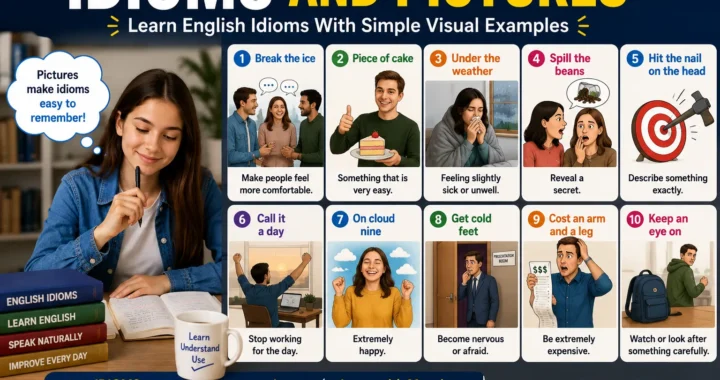
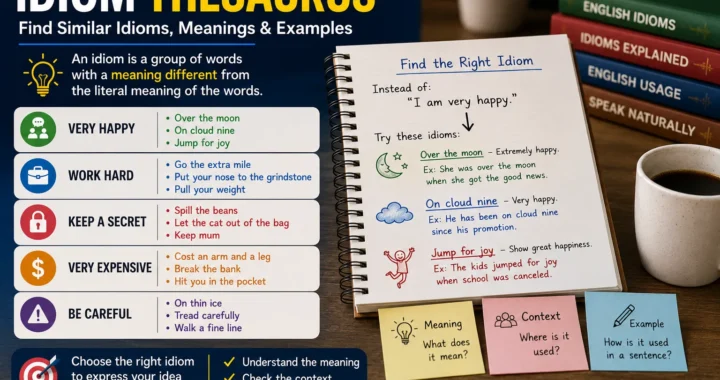
Read More: Learn English Idioms with Simple Pictures & Visuals

[…] Read More: 70 Common Idioms Sentences: Meanings & Examples […]