


Idiom Simple Definition: Meaning, Examples, and How Idioms Work
An idiom simple definition is easy to remember: an idiom is a group of words that has a meaning different from the literal meaning of the individual words. For example, “break the ice” does not mean breaking a piece of ice. It means helping people feel more comfortable when they meet or start talking.
Idioms are common in everyday English. People use them in conversations, stories, movies, workplace discussions, books, and informal writing. This can make English confusing for learners because knowing the meaning of each individual word is sometimes not enough to understand the sentence.
Imagine someone says, “I’m feeling under the weather.” A beginner might wonder how the weather could be above or below a person. In natural English, however, the expression means the person is feeling slightly sick or unwell.
Understanding idioms becomes easier when you stop trying to translate every word literally. Instead, learn the expression as one complete unit and pay attention to the situation in which people use it.
Idiom Simple Definition
An idiom is a fixed or commonly used group of words whose meaning is different from the literal meanings of the individual words. For example, “let the cat out of the bag” means to reveal a secret, not to release a cat from a bag. Cambridge Dictionary and Oxford Learner’s Dictionaries define idioms in similar terms.
That simple idea explains why idioms can be difficult at first.
When you hear “piece of cake,” the words refer literally to a piece of dessert. In common conversation, however, the expression can mean that something is very easy.
The meaning belongs to the phrase as a whole.
What Does an Idiom Mean in Simple English?
An idiom is a special expression that people understand as one idea rather than by adding up the meanings of each word.
Consider these examples:
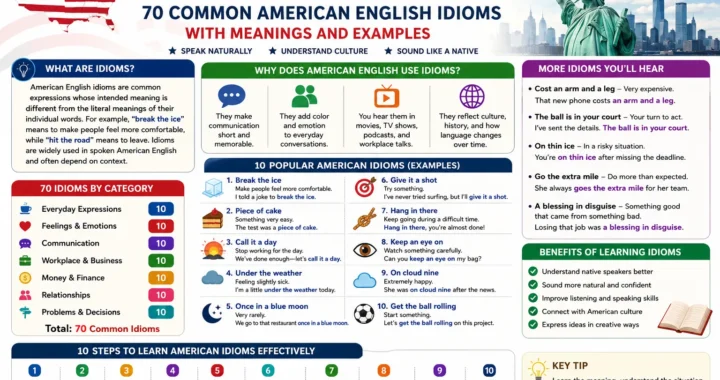
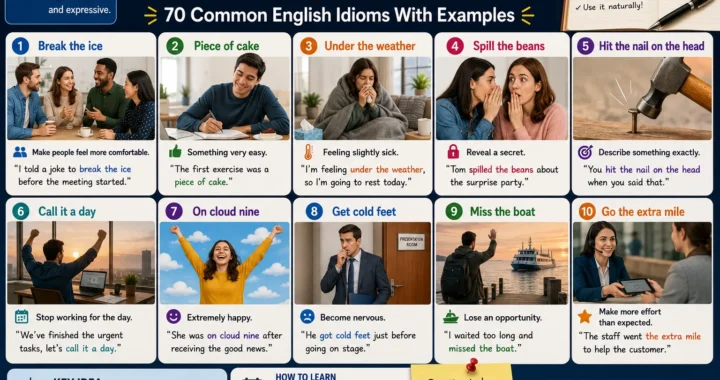
- Break the ice = make people feel more comfortable
- Piece of cake = very easy
- Under the weather = feeling unwell
- Spill the beans = reveal a secret
- Hit the nail on the head = describe something exactly
The literal words can create a picture in your mind, but the intended meaning is different.
This is the main feature that separates an idiom from an ordinary phrase. Oxford defines an idiom as a group of words whose meaning differs from the meanings of the individual words.
Not every group of words is an idiom.
For example, “a red car” is a normal phrase. The meaning is easy to understand because red and car keep their usual meanings.
By contrast, “spill the beans” is idiomatic because the intended meaning is not literally about spilling beans.
That difference is the key idea to remember.
Why Are Idioms Difficult for English Learners?
Idioms can be difficult because English speakers often assume that listeners already recognize common expressions.
A beginner may hear:
“We need to call it a day.”
The words call, it, and day are familiar, but their combination may not be.
The speaker is usually saying that it is time to stop working for the day.
This is one reason learners sometimes understand individual words but still struggle to understand natural conversation. The problem is not necessarily vocabulary. It is recognizing the meaning of a complete expression.
Another challenge is that idioms can depend heavily on context.
For example, “on thin ice” can refer to a risky situation:
“You are on thin ice with your manager.”
The speaker is not talking about walking on frozen water. The phrase means that the person’s position is dangerous and another mistake could cause trouble.
Context gives the listener the clue.
Pronunciation and listening speed can make things harder too. Someone who has only seen an idiom in a vocabulary list may not immediately recognize it when a fluent speaker says it quickly.
Learning the entire phrase instead of its separate words helps solve this problem.
Common Examples of Idioms
A few clear examples make the idea much easier to understand.
| Idiom | Simple meaning | Example |
|---|---|---|
| Break the ice | Make people comfortable | “I told a joke to break the ice.” |
| Piece of cake | Very easy | “The test was a piece of cake.” |
| Under the weather | Feeling unwell | “I’m a little under the weather.” |
| Spill the beans | Reveal a secret | “She spilled the beans about the surprise.” |
| Hit the nail on the head | Describe something exactly | “You hit the nail on the head.” |
| Call it a day | Stop working | “Let’s call it a day.” |
| Cost an arm and a leg | Be very expensive | “That car costs an arm and a leg.” |
| Keep an eye on | Watch carefully | “Can you keep an eye on my bag?” |
| Get cold feet | Become nervous | “He got cold feet before the wedding.” |
| The ball is in your court | It is your turn to act | “I sent the proposal, so the ball is in your court.” |
These examples show an important point: idioms are useful because they express an idea quickly.
Instead of saying:
“I want everyone to feel less uncomfortable when we begin the meeting.”
A speaker might simply say:
“Let’s break the ice.”
The shorter expression carries a familiar meaning for people who know the idiom.
Idiom vs. Literal Phrase: What Is the Difference?
The easiest way to understand an idiom is to compare it with literal language.
Literal phrase
A literal phrase means what the words normally say.
“She opened the door.”
There is no hidden meaning. She physically opened a door.
Idiomatic phrase
An idiomatic phrase has a meaning that cannot be understood fully from the individual words.
“She opened the door to new opportunities.”
Here, “opened the door” can be used figuratively to mean creating a possibility or opportunity.
An even clearer example is:
“He spilled the beans.”
Literally, that could mean beans fell from a container.
Idiomatic meaning:
He revealed a secret.
Cambridge Dictionary describes an idiom as a group of words in a fixed order with a meaning that differs from the meanings of the words on their own.
This is why translating idioms word for word often causes confusion.
Are Idioms the Same as Expressions or Phrases?
The words phrase, expression, and idiom are related, but they do not mean exactly the same thing.
A phrase is a group of words that work together.
An expression is a word or group of words used to communicate an idea.
An idiom is a more specific kind of expression in which the meaning of the whole is different from the meanings of the individual words.
Oxford makes this distinction by describing a phrase as a group of words with a particular meaning when used together, while defining an idiom as a group of words whose meaning is different from the individual words.
For example:
Phrase:
“in the morning”
Expression:
“See you later.”
Idiom:
“Hit the nail on the head.”
The boundaries can sometimes overlap in everyday language, but the special figurative meaning is what makes an idiom an idiom.
Common Types of Idioms
Idioms can be grouped by the situations where they are commonly used.
Idioms About Time
These expressions describe schedules, delays, or the passage of time.
Call it a day means stop working for the day.
Better late than never means doing something late is better than not doing it.
Once in a blue moon means something happens very rarely.
Example:
“We only eat there once in a blue moon.”
Idioms About Feelings
These idioms describe emotions in a vivid way.
On cloud nine means extremely happy.
Get cold feet means become nervous before an important event.
Lose your cool means become angry.
Example:
“She lost her cool during the argument.”
Idioms About Work
These expressions are common in offices and professional conversations.
Go the extra mile means make an extra effort.
Learn the ropes means learn how a job or activity works.
On the same page means have the same understanding.
Example:
“Before we start, let’s make sure we’re on the same page.”
Idioms About Money
These expressions describe cost, finances, and spending.
Cost an arm and a leg means cost a great deal of money.
Make ends meet means have enough money to pay for basic expenses.
Tighten your belt means spend less because money is limited.
Example:
“We are tightening our belts until the business improves.”
Idioms About Communication
These describe how people talk, listen, or share information.
Speak your mind means say honestly what you think.
Beat around the bush means avoid saying something directly.
Read between the lines means look for a meaning that is not directly stated.
Example:
“Read between the lines and you can see what the message really means.”
Organizing idioms by topic makes them easier to remember because the expressions become connected to situations rather than existing as a random vocabulary list.
Expert Insights: The Best Way to Understand an Idiom
One of the most useful habits in learning idioms is to study more than the definition.
Suppose you learn:
Break the ice = make people feel comfortable.
That is correct, but it does not answer several practical questions.
When do people use it?
Who normally uses it?
Is it formal or casual?
Can the grammar change?
What situations make it sound natural?
A better way to learn it is:
Idiom: Break the ice
Meaning: Make people feel more comfortable
Context: Meetings, introductions, social situations
Example: “I asked everyone a simple question to break the ice.”
This gives you a fuller understanding.
Another useful technique is to connect an idiom with a real situation from your own life.
If you have recently started a new job, you could learn:
“I tried to break the ice with my new colleagues.”
That sentence is easier to remember because it relates to something you may actually experience.
It is also helpful to notice that not every idiom sounds natural everywhere. Cambridge uses the word idiomatic to describe language that contains expressions that are natural and correct for fluent speakers.
That means learning idioms is not only about memorizing meaning. It is also about learning natural usage.
For that reason, a good dictionary can be more useful than a simple vocabulary list. Cambridge and Oxford provide meanings, examples, grammar information, and usage details that help learners understand how an expression works in real English.
Common Mistakes When Learning Idioms
1. Taking an Idiom Literally
A learner hears “spill the beans” and thinks the speaker is talking about food.
Why this is a mistake: The phrase has a figurative meaning.
Better approach: Learn the whole expression and its intended meaning together.
2. Translating Word by Word
A learner may try to translate each word into another language.
Why this is a mistake: The resulting sentence may sound strange or may lose the idiom’s meaning.
Better approach: Find the natural meaning of the complete English expression.
3. Using Too Many Idioms
Some learners think fluent English requires an idiom in almost every sentence.
Why this is a mistake: Natural speakers use both literal and idiomatic language.
Better approach: Use an idiom when it fits naturally.
4. Ignoring Context
Knowing the definition of an idiom does not mean you know when to use it.
Why this is a mistake: Tone, formality, and situation affect whether an expression sounds appropriate.
Better approach: Learn at least one realistic example with every new idiom.
5. Changing the Words Too Much
Idioms are often conventional expressions, so changing their wording can make them sound unnatural.
Why this is a mistake: The established form is what listeners recognize.
Better approach: Learn the phrase as a complete chunk before experimenting with variations.
How to Learn Idioms Step by Step
Learning idioms does not have to involve memorizing hundreds of expressions.
Step 1: Start with common idioms
Choose expressions that you are likely to hear or use regularly.
For example:
- Break the ice
- Piece of cake
- Call it a day
- Under the weather
- Keep an eye on
Step 2: Learn the simple meaning
Write the meaning in clear English.
For example:
Keep an eye on = watch something carefully.
Step 3: Learn a complete sentence
“Can you keep an eye on my bag?”
This teaches you how the expression works in real language.
Step 4: Connect it to your life
Create your own sentence.
“I need to keep an eye on the oven while I’m cooking.”
Personal examples are often easier to remember than unrelated dictionary sentences.
Step 5: Say the idiom aloud
This helps you become familiar with its pronunciation and rhythm.
Step 6: Look for it in real English
When you read a book, watch a program, or listen to a conversation, pay attention to familiar idioms.
Step 7: Use it when the situation fits
Do not force the expression into a conversation. Wait for a natural opportunity.
This approach helps move an idiom from something you recognize to something you can actually use.
Why Idioms Make English More Interesting
Idioms give speakers a short and vivid way to communicate ideas.
Compare these two sentences:
“He became very angry.”
and:
“He lost his cool.”
The first is direct and literal. The second gives the sentence a more conversational feel.
Similarly:
“The task was easy.”
can become:
“The task was a piece of cake.”
The idiom adds a particular tone.
However, idioms are not always better than direct language. In formal writing, simple and precise wording can be more effective.
This is especially important for students and professionals. An idiom may be excellent in a conversation but unnecessary in a formal report.
The goal is not to make every sentence figurative. The goal is to recognize what sounds natural in a particular setting.
Practical Examples of Idioms in Real Situations
Understanding an idiom becomes much easier when you see why someone would use it.
Situation: A new team meets for the first time
“We started with a simple question to break the ice.”
Meaning: The question helped everyone feel more comfortable.
Situation: Someone wants to stop working
“We’ve finished the urgent tasks. Let’s call it a day.”
Meaning: Let’s stop working for today.
Situation: Someone is unsure about a decision
“I’m still on the fence about moving.”
Meaning: I’m still undecided.
Situation: Someone makes an exact observation
“You hit the nail on the head.”
Meaning: You identified the issue exactly.
Situation: Someone reveals confidential information
“He spilled the beans about the surprise.”
Meaning: He revealed the secret.
These examples show why context matters. The meaning becomes clearer because the situation gives the listener a reason to interpret the phrase correctly.
Frequently Asked Questions About Idioms
Q: What is an idiom in simple words?
A: An idiom is a group of words that has a meaning different from the literal meaning of the individual words. For example, “piece of cake” can mean something is very easy. The phrase is understood as one complete idea rather than by interpreting each word separately.
Q: What is a simple example of an idiom?
A: “Break the ice” is a simple example. It means to make people feel more comfortable when they first meet or begin talking. The words do not mean that someone is physically breaking ice. This difference between literal and intended meaning is a basic feature of idioms.
Q: Are idioms phrases?
A: Yes, idioms are a type of phrase or expression, but not every phrase is an idiom. An ordinary phrase may have a literal meaning, while an idiom has a meaning that differs from the meanings of its individual words. Oxford makes this distinction in its dictionary definition of the word idiom.
Q: Why do people use idioms?
A: People use idioms because they provide familiar and often vivid ways to express ideas. An expression such as “on cloud nine” quickly communicates strong happiness to someone who knows the phrase. Idioms can also make everyday speech sound more natural and conversational.
Q: Are idioms difficult to learn?
A: They can be difficult at first because their meanings are often not literal. The best way to learn them is to study each phrase as a complete unit, together with its simple meaning, context, and an example sentence. Regular exposure makes common idioms easier to recognize.
Q: Should beginners learn idioms?
A: Yes, but beginners should start with common and useful expressions rather than trying to memorize hundreds at once. Learning five or ten practical idioms and using them correctly is more helpful than collecting a long list without understanding when the phrases belong in a conversation.
Q: Can idioms be used in formal writing?
A: Some can, but you should be selective. Many idioms are common in conversation and informal writing, while formal academic or technical writing usually benefits from direct and precise language. Think about your audience, purpose, and tone before choosing an idiomatic expression.
Q: What is the difference between an idiom and a proverb?
A: An idiom is an expression whose overall meaning differs from the individual words. A proverb is usually a traditional saying that expresses advice, wisdom, or a general observation. “Break the ice” is an idiom, while “Actions speak louder than words” is commonly treated as a proverb.
Final Thoughts
The easiest idiom simple definition to remember is this: an idiom is a group of words that means something different from what the individual words literally say.
Once you understand that idea, many confusing English expressions become easier to recognize.
When someone says “break the ice,” they usually mean making people feel more comfortable. When someone says “piece of cake,” they usually mean something is easy. When someone says “the ball is in your court,” they mean it is your responsibility to take the next action.
The best way to learn these expressions is to avoid memorizing definitions alone. Learn the phrase, simple meaning, context, tone, and a complete example together.
Start with a few common idioms and use them naturally. Pay attention when you hear them in conversations and when you see them in reliable dictionaries such as Cambridge Dictionary and Oxford Learner’s Dictionaries.
An idiom may look strange when you first meet it, but once you learn the idea behind the phrase, it becomes much easier to understand. The words may be unusual, but the message is usually simple.


[…] Read More: Idiom Simple Definition: Meaning, Examples & How They Work […]