

Idiom Thesaurus: Find Similar Idioms, Meanings, and Examples
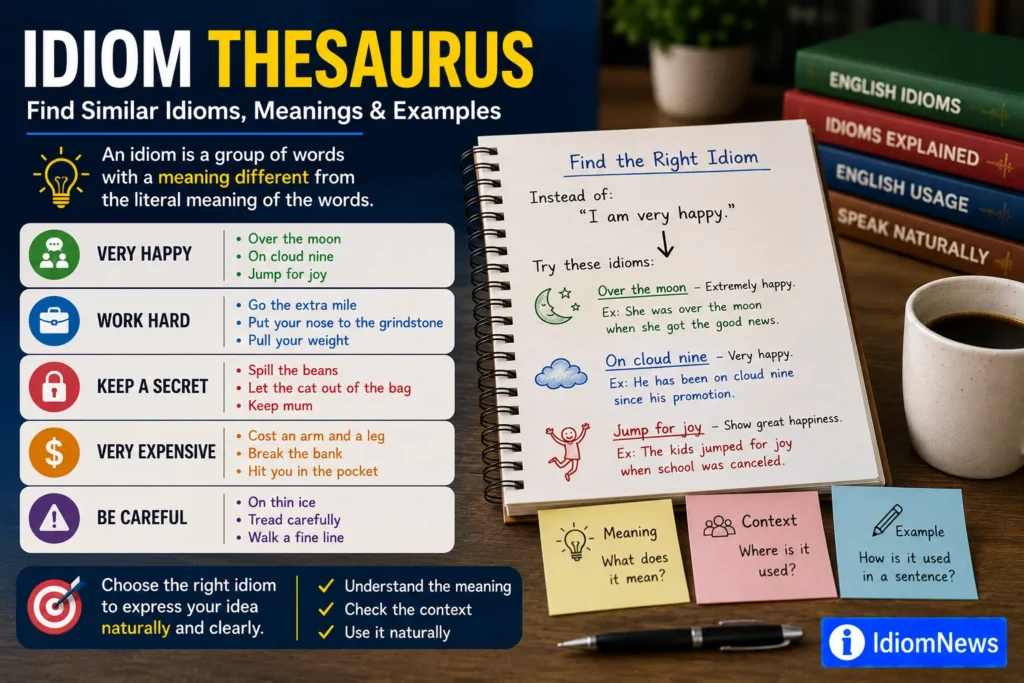
Finding the right expression can be harder than knowing what you want to say. You may understand an idea such as being very happy, working very hard, or keeping a secret, but you may want a more natural English expression than the first words that come to mind. An idiom thesaurus can help by connecting an idea with related idioms, phrases, and expressions.
Unlike a traditional thesaurus, which mainly helps you find synonyms and antonyms for individual words, an idiom thesaurus is useful when you are looking for a complete expression. Thesaurus.com describes a thesaurus as a reference source for synonyms and antonyms, while its phrase entries show that words such as expression and idiom can be related when discussing groups of words.
This is particularly useful for English learners, writers, teachers, and anyone who wants their English to sound more natural. Instead of searching only for the word happy, for example, you might look for an idiomatic way to express extreme happiness and find phrases such as on cloud nine or over the moon.
The key is knowing what an idiom is, how idioms differ from ordinary synonyms, and how to choose an expression that actually fits the sentence.
What Is an Idiom Thesaurus?
An idiom thesaurus is a tool or reference approach for finding idioms and related expressions that communicate a similar idea. Instead of replacing one word with another, it helps you find complete phrases that express feelings, actions, situations, or ideas in a more natural or colorful way.
An idiom itself is a group of words with a meaning that differs from the meanings of the individual words. Cambridge Dictionary gives the example of “bite off more than you can chew,” where the intended meaning is different from the literal action described by the words.
The phrase idiom thesaurus is therefore best understood as a practical search concept rather than a completely separate type of dictionary. You may use a dedicated idiom reference, a dictionary with idiom entries, a thesaurus that includes phrases, or several trusted language resources together.
The goal is simple: start with an idea and find a natural English expression that communicates it.
How an Idiom Thesaurus Differs From a Regular Thesaurus
The main difference is the type of language you are looking for.
A regular thesaurus is primarily concerned with relationships between words. For example:
Happy
Possible related words include glad, cheerful, pleased, and joyful.
An idiom-focused search goes a step further:
Very happy
Possible idiomatic expressions include:
- On cloud nine
- Over the moon
- Jump for joy
These expressions are not simply single-word synonyms. They are established phrases with their own meanings, grammar, tone, and typical contexts.
Thesaurus.com describes a thesaurus as a dictionary of synonyms and antonyms, and its phrase search results include related terms such as expression and idiom.
That distinction matters because replacing a word with a synonym does not always produce the natural expression you actually need.
For example, if you write:
“She was extremely happy.”
You could replace happy with delighted.
But if the context is casual conversation, you could instead say:
“She was over the moon.”
Both sentences communicate happiness, but they do not have exactly the same style.
That is where idiom searching becomes useful.
Why Use an Idiom Thesaurus?
An idiom thesaurus can be helpful when you know the idea but do not know the expression.
This happens in several situations.
When You Want to Avoid Repetition
Suppose you have written the word difficult several times.
You could search for single-word alternatives such as challenging, hard, or demanding.
But sometimes the sentence calls for a phrase:
“This problem is a tough nut to crack.”
That gives the reader a different kind of expression while keeping the main idea.
When You Want More Natural Conversation
English learners often know grammatically correct sentences that sound more formal than ordinary speech.
Instead of:
“I am feeling slightly unwell.”
A casual speaker might say:
“I’m feeling a little under the weather.”
Cambridge notes that idiomatic language can refer to expressions that are natural and correct in a language.
This does not mean idioms are always better. It means they can be useful when the situation calls for a familiar conversational expression.
When You Need the Right Tone
Two expressions can have similar meanings but very different tones.
Compare:
“He became angry.”
and:
“He lost his cool.”
The second expression sounds more conversational.
In formal writing, the first may be preferable. In friendly conversation, the second can sound more natural.
A useful idiom thesaurus approach therefore considers not only meaning, but also tone and context.
Common Ideas and Their Related Idioms
A practical way to understand an idiom thesaurus is to organize idioms around common ideas.
Idioms for Happiness
When the basic idea is very happy, you have several choices.
On cloud nine
Meaning: Extremely happy.
Example:
“She was on cloud nine after receiving the good news.”
Over the moon
Meaning: Extremely pleased or happy.
Example:
“Her parents were over the moon when she got the scholarship.”
Jump for joy
Meaning: Show great happiness.
Example:
“The children were jumping for joy when they heard about the holiday.”
These expressions are related, but they are not interchangeable in every sentence. Jump for joy describes a visible reaction more directly, while on cloud nine and over the moon describe a strong emotional state.
Idioms for Difficulty
If you want to describe something difficult, a thesaurus may give you ordinary synonyms, but an idiom search may give you more vivid expressions.
A tough nut to crack
Meaning: A difficult problem or person to understand.
Example:
“This software problem is a tough nut to crack.”
A long shot
Meaning: Something unlikely to succeed.
Example:
“Winning the contract is a long shot, but we should still apply.”
Up against it
Meaning: In a very difficult situation.
Example:
“We are up against it with only two days left.”
These phrases describe different kinds of difficulty, which is why simply treating them as synonyms would be misleading.
Idioms for Hard Work
Go the extra mile
Meaning: Make more effort than expected.
Example:
“She always goes the extra mile for her customers.”
Put your nose to the grindstone
Meaning: Work hard and stay focused.
Example:
“We need to put our noses to the grindstone if we want to finish this week.”
Pull your weight
Meaning: Do your fair share of the work.
Example:
“Everyone needs to pull their weight on this project.”
The important lesson is that related idioms often describe different parts of the same general idea.
Idiom Thesaurus Examples by Meaning
The following groups can help you see how an idiom thesaurus works in practice.
| Basic idea | Idiom | Simple meaning |
|---|---|---|
| Make people comfortable | Break the ice | Help people relax |
| Very easy | Piece of cake | Very easy |
| Very happy | On cloud nine | Extremely happy |
| Rarely | Once in a blue moon | Very rarely |
| Reveal a secret | Spill the beans | Tell a secret |
| Stop working | Call it a day | Finish work for the day |
| Be careful | Keep an eye on | Watch carefully |
| Become nervous | Get cold feet | Become afraid or nervous |
| Be in trouble | In hot water | Be in trouble |
| Agree | See eye to eye | Agree with someone |
| Avoid a subject | Beat around the bush | Avoid speaking directly |
| Stay informed | Keep someone in the loop | Keep someone updated |
| Make extra effort | Go the extra mile | Make additional effort |
| Lose an opportunity | Miss the boat | Be too late |
| Deal with a problem | Take the bull by the horns | Act directly and confidently |
| Be undecided | Sit on the fence | Avoid choosing a side |
| Be in a risky position | On thin ice | Be close to trouble |
| Be expensive | Cost an arm and a leg | Cost a lot |
| Support someone | Have someone’s back | Support them |
| Stop worrying about something | Let it go | Stop dwelling on it |
The table is useful as a starting point, but an idiom should not be selected only because its broad meaning appears to match a word.
Context still matters.
How to Find the Right Idiom
Searching for an idiom works best when you begin with the idea you want to communicate.
Suppose your intended meaning is:
“I do not know what will happen.”
Searching for individual synonyms may produce words such as uncertain or unsure.
An idiom search might lead you to:
Up in the air
Example:
“Our travel plans are still up in the air.”
That is a much more natural match when you are describing an undecided plan.
Another example:
Basic idea: Someone is not telling you the truth directly.
Possible expression:
Beat around the bush
Example:
“Stop beating around the bush and tell me what you really think.”
The process is:
- Identify the exact idea.
- Search for related idioms.
- Check the meaning.
- Check the example sentences.
- Check the tone and level of formality.
- Choose the phrase that fits the situation.
This is much safer than choosing the first idiom that looks similar.
Expert Insights: Meaning Alone Is Not Enough
One of the biggest mistakes in using idiom resources is assuming that two expressions with similar meanings can always replace one another.
They often cannot.
Consider “under the weather” and “sick as a dog.” Both can describe illness, but they are not equal in tone or strength.
Under the weather is a common informal way to say that someone feels unwell.
Sick as a dog is a more vivid informal expression that usually suggests someone feels quite sick.
A good idiom thesaurus should therefore be treated as a starting point, not a replacement for context.
Dictionaries can help because they provide information about meaning and usage. Cambridge’s idiom entry, for example, identifies idioms as fixed groups of words with meanings that differ from their separate words. Its broader dictionary resources also identify idioms and idiomatic expressions as part of English language usage.
Another important point is that idioms can vary by region and context. Some expressions are widely understood across English varieties, while others may be more common in particular countries, communities, or age groups.
There is also a difference between understanding an idiom and using it.
A learner may understand:
“The ball is in your court.”
but still feel unsure about saying it.
That is normal. Recognition usually comes before confident production.
The best practice is to keep a short personal list of idioms you actually encounter and need. Record the phrase, meaning, tone, and one useful example.
Common Mistakes When Using an Idiom Thesaurus
1. Treating Every Idiom as a Perfect Synonym
Two expressions may share a general meaning but differ in strength, tone, or context.
Correct approach: Check the complete definition and examples before replacing one expression with another.
2. Choosing the Most Colorful Idiom
A more dramatic expression is not automatically better.
For example, saying something costs an arm and a leg is colorful, but a professional financial report may simply need to say that something is very expensive.
Correct approach: Match the expression to your audience.
3. Ignoring Grammar
Idioms often have established grammatical patterns.
For example:
“The ball is in your court.”
You should learn the expression in its normal form instead of changing words randomly.
Correct approach: Study several example sentences before trying to modify an idiom.
4. Translating the Idiom Directly
An idiom in English may not have the same image or structure in another language.
Correct approach: Translate the meaning, not necessarily the individual words.
5. Using Too Many Idioms
A sentence does not become better simply because it contains an idiom.
Correct approach: Use idiomatic language when it adds clarity, tone, or naturalness.
How to Use an Idiom Thesaurus Step by Step
- Start with your message. Write the idea in simple English first.
- Identify the key meaning. Decide whether you are describing happiness, difficulty, anger, uncertainty, success, money, relationships, or another idea.
- Search for idioms related to that meaning. A thesaurus or dictionary can help generate possibilities.
- Read the definitions carefully. Look for differences in strength and meaning.
- Check example sentences. Make sure the idiom is used in a situation similar to yours.
- Check the tone. Decide whether the expression is casual, neutral, formal, humorous, or strongly conversational.
- Choose the simplest natural option. Do not select an idiom merely because it sounds impressive.
- Read the sentence aloud. If the phrase feels forced, a simpler expression may be better.
- Save useful expressions. Keep idioms that you expect to use again.
- Practice them in context. Write a few original sentences rather than memorizing definitions alone.
This process turns an idiom thesaurus from a list of interesting expressions into a practical writing and learning tool.
Idiom Thesaurus vs. Dictionary vs. Regular Thesaurus
Each resource has a different job.
| Resource | Best for | Example need |
|---|---|---|
| Dictionary | Meaning, pronunciation, grammar, examples | “What does this idiom mean?” |
| Thesaurus | Related words and alternatives | “What other word can I use?” |
| Idiom-focused resource | Related figurative expressions | “What idiom expresses this idea?” |
| Phrase search | Common word combinations | “What sounds natural in this sentence?” |
This distinction can save time.
If you already know “break the ice” but do not understand it, use a dictionary.
If you know the word happy and want another single-word choice, use a thesaurus.
If you want a colorful expression for very happy, an idiom-focused search makes more sense.
Cambridge’s English Dictionary includes dedicated entries for idioms and related expressions, which makes it useful for checking both meaning and usage.
How Writers Can Use Idiom Resources Without Overdoing Them
Writers can benefit from idioms, but careful selection matters more than quantity.
Suppose you are writing:
“The company faced a difficult problem.”
You might replace it with:
“The company faced a tough nut to crack.”
That may work in a conversational article.
But imagine the sentence appears in a technical document. In that setting, the literal version may be clearer.
This is why good writing is not about using the most unusual expression available. It is about choosing language that fits the reader and purpose.
A useful editing question is:
Does the idiom improve this sentence?
If the answer is no, remove it.
Another useful question is:
Would a normal speaker actually say this here?
Cambridge’s definition of idiomatic includes the idea of language that is natural and correct in expression.
Naturalness should therefore be the goal.
Frequently Asked Questions About Idiom Thesaurus
Q: What is an idiom thesaurus?
A: An idiom thesaurus is a resource or search method used to find idioms that express a particular idea. Instead of giving only single-word synonyms, it helps you discover complete expressions such as “on cloud nine” for being very happy or “break the ice” for helping people feel comfortable. It can be used alongside dictionaries and regular thesauruses.
Q: Is an idiom thesaurus the same as a regular thesaurus?
A: No. A regular thesaurus mainly provides synonyms and antonyms for words, while an idiom-focused resource helps you find complete figurative expressions. The two can overlap because some thesaurus resources include phrases and expressions, but they serve different purposes when you are searching for language.
Q: Can I find idioms in a normal dictionary?
A: Yes. Many major dictionaries include idiom entries and examples. Cambridge Dictionary, for example, has dedicated information about idioms and explains their meanings and usage. A dictionary is often the best place to confirm whether an expression is actually an idiom and whether your intended meaning is correct.
Q: How do I find an idiom for a specific meaning?
A: Start with the simple idea you want to express, such as “very happy,” “very expensive,” or “keep something secret.” Search for related idioms, then compare their definitions, examples, and tone. Choose the expression that fits your particular sentence rather than simply selecting the first result.
Q: Are idioms interchangeable with synonyms?
A: Usually not. Two idioms can express related ideas while differing in tone, strength, grammar, or context. For example, “under the weather” and “sick as a dog” both relate to illness, but they do not communicate exactly the same feeling. Always check usage before treating expressions as replacements.
Q: Is it better to use an idiom or a simple word?
A: It depends on the situation. Idioms can make casual speech and some forms of writing more natural or vivid, while a simple word may be clearer in formal, academic, legal, or technical writing. The strongest choice is usually the one that communicates your meaning clearly to the intended reader.
Q: Can English learners use an idiom thesaurus?
A: Yes. It can be especially useful for learners who understand a basic idea but do not know the natural English expression. Beginners should focus on common idioms, learn them with examples, and check their tone before using them. A smaller collection of familiar idioms is more useful than a huge list that is never practiced.
Q: Why should I check examples before using an idiom?
A: Because knowing a definition does not always tell you how an idiom behaves in real sentences. Examples reveal grammar, tone, typical situations, and common word combinations. They also help you avoid choosing an expression that is technically related to your idea but sounds unnatural in the sentence you are writing.
Final Thoughts
An idiom thesaurus can be a useful tool when you know what you want to say but need a natural English expression to say it.
The most important point is that an idiom is not simply a fancy synonym. It is a complete expression with its own meaning, tone, grammar, and context. Cambridge Dictionary defines an idiom as a group of words with a particular meaning that differs from the meanings of the individual words.
That is why the best approach is to start with your idea, find several possible expressions, and then compare them. Ask which one fits the situation, sounds natural, and communicates your meaning clearly.
Use a regular thesaurus when you need another word. Use a dictionary when you need to confirm meaning and usage. Use an idiom-focused search when you want a complete expression that captures an idea more vividly.
You do not need hundreds of idioms to communicate well. A small collection of expressions that you truly understand and can use naturally is far more valuable.
The right idiom is not the most complicated phrase you can find. It is the one that makes the meaning clear and sounds right when a real person says it.
Read More: Idiom Simple Definition: Meaning, Examples & How They Work


[…] Read More: Idiom Thesaurus: Find Similar Idioms, Meanings & Examples […]