


A student writes “I am agree with you” instead of “I agree with you,” confused about why the correct version sounds so much more natural. That small grammatical mismatch is a perfect entry point into understanding idiomatic expression, a concept that goes beyond simply memorizing idioms.
Idioms and idiomatic expression are often treated as the same thing, but understanding the difference actually helps explain why certain sentences sound right or wrong to native English speakers, even when the grammar looks technically correct.
This distinction matters most for writers, editors, ESL teachers, and advanced learners trying to move past textbook-correct English into language that actually sounds natural to native speakers.
Getting a handle on how idiomatic expression works, separate from idioms specifically, fills in a gap that many idiom-focused resources skip entirely.
By the end of this piece, you’ll understand exactly how idioms and idiomatic expression function grammatically, why they matter beyond simple phrase lists, and how to apply both correctly in your own writing and speech.
What Is the Difference Between an Idiom and an Idiomatic Expression?
An idiom is a specific fixed phrase with a figurative meaning, while idiomatic expression refers more broadly to any language choice that sounds natural to native speakers. Idiomatic expression includes idioms, but also covers correct verb usage, prepositions, and word order that simply “sound right,” even without figurative meaning. For example, saying “depend on” instead of “depend of” is idiomatic, without being an idiom.

How Idiomatic Expression Shows Up in Everyday Grammar
Idiomatic expression often hides in small grammatical choices that don’t seem related to figurative language at all.
Native English speakers say “married to someone,” not “married with someone,” even though “with” might seem logical. There’s no strict grammar rule here. It’s simply the phrasing that sounds correct.
The same applies to verb and preposition pairings, like “interested in” instead of “interested on,” or “good at” instead of “good in.” These patterns aren’t idioms in the traditional sense, but they are idiomatic.
Recognizing this distinction helps explain why some sentences feel “off” to native speakers, even when every individual word and grammar rule seems technically correct on paper.
Idiomatic Expression in Verb Usage
Certain verbs pair naturally with specific words, and swapping them creates sentences that sound distinctly unnatural, even if the meaning stays clear.
- “Make a decision”, not “do a decision.”
- “Take a shower”, not “make a shower.”
- “Have a conversation”, not “do a conversation.”
- “Pay attention”, not “give attention” (though “give attention” is sometimes used, “pay attention” is far more idiomatic).
These verb pairings, sometimes called collocations, are a core part of what makes English sound idiomatic beyond just using recognizable idioms.
Idiomatic Expression in Prepositions
Prepositions are one of the trickiest areas of idiomatic expression, since their correct usage often defies straightforward logic.
- “Good at math”, not “good in math.”
- “Married to someone”, not “married with someone.”
- “Different from” (or “different than” in American English), not “different of.”
- “Afraid of”, not “afraid from.”
Learners frequently translate prepositions directly from their native language, which almost always produces incorrect, non-idiomatic phrasing in English.
How Idioms Function Within Idiomatic Expression
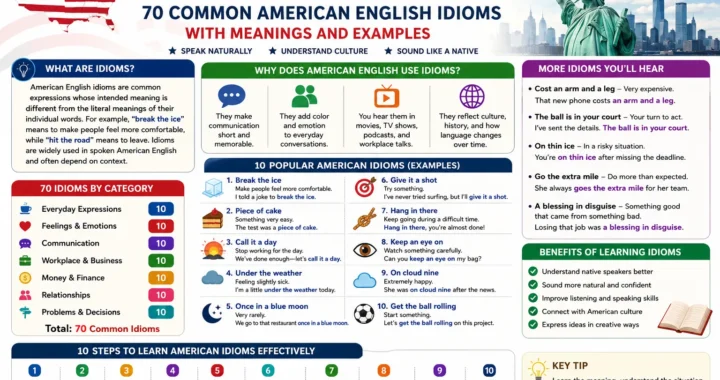
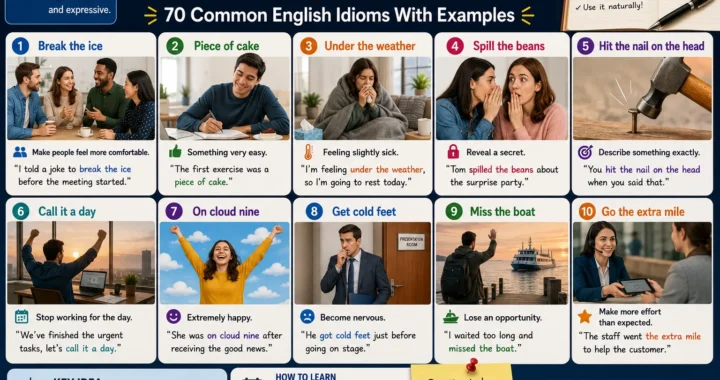
Traditional idioms, like “break the ice” or “spill the beans,” represent just one specific category within the broader concept of idiomatic expression.
While idioms carry figurative meaning, idiomatic expression as a whole includes any phrasing choice a native speaker recognizes as “sounding right,” whether or not it involves figurative language.
This means someone could technically avoid using any traditional idioms in a conversation while still sounding completely fluent and idiomatic, simply by using correct collocations, prepositions, and natural phrasing throughout.
Understanding this relationship helps clarify why idiom lists alone don’t guarantee fluent-sounding English. Idiomatic expression covers far more ground than idioms by themselves.
Expert Insights: Why Idiomatic Expression Is Harder to Teach Than Idioms
Idioms can be taught through direct definitions and example sentences, since they function as fixed, memorizable units. Idiomatic expression, by contrast, resists this kind of direct teaching, since it depends on subtle, often unconscious patterns absorbed through extensive listening and reading.
This is why advanced learners sometimes reach a point where their grammar is technically flawless, yet their sentences still sound slightly unnatural to native speakers. The issue usually isn’t grammar. It’s idiomatic phrasing that doesn’t match common usage patterns.
Language teachers often note that correcting idiomatic expression requires exposing learners to large amounts of authentic language, rather than teaching isolated rules, since native-like phrasing patterns don’t reduce cleanly into memorizable formulas.
This is part of why achieving truly native-sounding English typically takes years of consistent exposure, well beyond the point where grammar and vocabulary already feel solid.
Common Mistakes People Make With Idioms and Idiomatic Expression
Mistake 1: Treating idioms and idiomatic expression as identical concepts
Idioms are one specific category. Idiomatic expression is the broader concept covering natural phrasing overall, including collocations and prepositions.
Mistake 2: Assuming correct grammar guarantees idiomatic phrasing
A sentence can be grammatically correct while still sounding unnatural. Idiomatic expression requires more than just following grammar rules.
Mistake 3: Translating prepositions and verb pairings directly
This is one of the most common sources of non-idiomatic phrasing among learners, since these pairings rarely match across different languages.
Mistake 4: Focusing only on idiom lists while ignoring collocations
Memorizing idioms alone doesn’t build full idiomatic fluency. Verb and preposition pairings matter just as much for natural-sounding English.
Practical Steps to Build Stronger Idiomatic Expression
- Study verb and preposition pairings, not just traditional idioms, since these affect idiomatic accuracy just as much.
- Read and listen to authentic English content regularly, since idiomatic patterns are absorbed through exposure, not memorized rules.
- Avoid translating word for word from your first language, especially for prepositions and verb pairings.
- Keep a running list of collocations you encounter, separate from your idiom list.
- Ask native speakers for feedback on phrasing that feels uncertain, even if the grammar seems correct.
- Practice writing and speaking regularly, since active use reinforces idiomatic patterns far more effectively than passive study alone.
Frequently Asked Questions
Q: What’s the difference between an idiom and idiomatic expression?
A: An idiom is a specific fixed phrase with figurative meaning, like “break the ice.” Idiomatic expression is broader, referring to any natural-sounding language choice, including correct verb pairings and prepositions, whether or not figurative meaning is involved.
Q: Can a sentence be idiomatic without using any idioms?
A: Yes. A sentence can sound completely natural and idiomatic through correct collocations and prepositions alone, without containing a single traditional idiom.
Q: Why does idiomatic expression matter beyond grammar rules?
A: Grammatically correct sentences can still sound unnatural if the word pairings don’t match common usage patterns. Idiomatic expression captures this deeper layer of natural-sounding language.
Q: How can I improve my idiomatic expression in English?
A: Regular exposure to authentic English, through reading, listening, and conversation, builds idiomatic fluency more effectively than memorizing rules. Paying attention to verb and preposition pairings also helps significantly.
Q: Are collocations the same as idioms?
A: No. Collocations are natural word pairings, like “make a decision,” that don’t necessarily carry figurative meaning. Idioms specifically involve figurative meaning that differs from the literal words.
Q: Why do advanced learners still make idiomatic mistakes?
A: Idiomatic patterns are absorbed gradually through extensive exposure, not through grammar study alone. Even advanced learners with strong grammar can still sound slightly unnatural without sufficient exposure to authentic language.
Q: Is idiomatic expression more important than learning individual idioms?
A: Both matter, but idiomatic expression covers more ground overall, since it affects nearly every sentence, while individual idioms appear more occasionally in specific contexts.
Bringing It All Together
Idioms and idiomatic expression are related but distinct concepts. Idioms are specific, memorable phrases with figurative meaning, while idiomatic expression covers the broader pattern of natural-sounding language, including verb pairings and prepositions that don’t involve figurative meaning at all.
Understanding this distinction helps explain why grammatically correct sentences can still sound slightly unnatural, and why building true fluency requires more than memorizing idiom lists alone.
Focus on both areas together, learning traditional idioms while also paying close attention to collocations and prepositions through regular exposure to authentic English.
The next time a sentence feels grammatically correct but somehow slightly off, consider whether idiomatic expression, not grammar, is the actual issue. That awareness alone marks a meaningful step toward more natural, fluent English.
Read More: 100 Idioms and Their Meanings: A Complete Reference List


[…] Read More: Idioms and Idiomatic Expression: How They Function in a Sentence […]