

Someone corrects a sentence and says, “that’s not really an idiom, it’s just a phrase,” leaving the other person confused about what the actual difference is. Fair question. The two terms get used interchangeably so often that most people never stop to consider what separates them.
Idioms and phrases are related but not identical. Every idiom is technically a phrase, but not every phrase qualifies as an idiom. That distinction shapes how each should be learned, taught, and used correctly in everyday English.
This matters for anyone writing, teaching, or studying English seriously, since confusing the two can lead to misunderstandings about how figurative language actually works and why certain expressions carry meaning beyond their literal words.
Getting a clear grasp on how idioms and phrases relate to each other clears up a surprisingly common source of confusion, especially for learners trying to build vocabulary systematically.
By the end of this piece, you’ll understand exactly what separates idioms and phrases, how they work together in real language, and how to use both correctly and confidently.
What’s the Difference Between Idioms and Phrases?
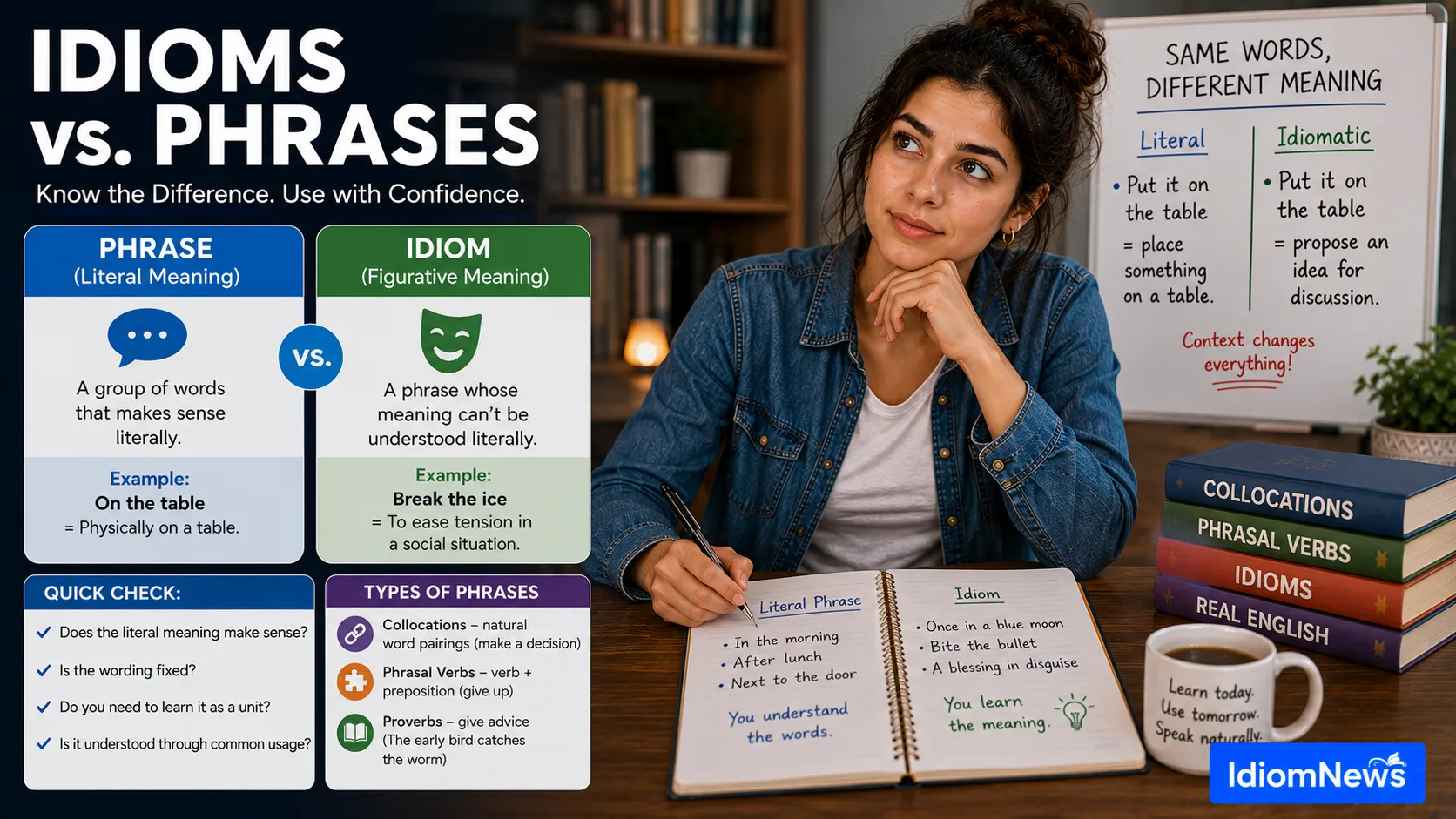
A phrase is any group of words that functions together as a unit, while an idiom is a specific type of phrase whose meaning cannot be understood from its individual words. All idioms are phrases, but most phrases are not idioms. For example, “in the morning” is a phrase with a literal meaning, while “once in a blue moon” is an idiom with a figurative one.
Understanding Phrases Without Figurative Meaning
Most phrases in English are perfectly literal, meaning exactly what the words suggest.
- “On the table” – describing something physically located on a table.
- “After lunch” – referring to the time period following lunch.
- “Next to the door” – describing a location beside a door.
These phrases don’t require any special cultural knowledge to understand. Knowing the individual words is enough to grasp the full meaning.
This is the key difference from idioms, where individual word knowledge alone isn’t sufficient to understand the phrase as a whole.
How Idioms Fit Within the Broader Category of Phrases
Idioms represent a specific, figurative subset within the much larger category of phrases used in English.
While “on the table” is literal, “put something on the table” as an idiom (meaning to propose an idea for discussion) shifts into figurative territory, even though the words themselves are identical to a literal phrase.
This overlap is part of what makes the distinction tricky. The exact same group of words can function as either a literal phrase or an idiom, depending entirely on context.
Recognizing context becomes essential for determining whether a phrase is being used literally or idiomatically in any given sentence.
Other Types of Phrases That Aren’t Quite Idioms
Beyond simple literal phrases and full idioms, English includes several related categories worth understanding.
- Collocations – natural word pairings like “make a decision” or “heavy rain,” which sound correct together without carrying figurative meaning.
- Phrasal verbs – verb and preposition combinations like “give up” or “look forward to,” which sometimes shift meaning figuratively, similar to idioms.
- Proverbs – phrases that offer advice or a life lesson, like “the early bird catches the worm,” distinct from idioms since they teach rather than simply describe.
Phrasal verbs sit closest to idioms, since many carry figurative meaning that can’t be understood from the individual words alone. “Give up,” for example, doesn’t literally involve giving anything upward.
How to Tell If a Phrase Is Actually an Idiom
A few simple checks help determine whether a specific phrase qualifies as an idiom rather than a literal phrase.
- Test the literal meaning. If the literal interpretation doesn’t fit the context, you’re likely dealing with an idiom.
- Check if the wording is fixed. Idioms rarely change their exact structure, while regular phrases often have flexible wording.
- Consider whether cultural knowledge is required. If understanding the phrase depends on knowing a specific expression rather than just vocabulary, it’s probably idiomatic.
Applying these checks consistently makes it much easier to separate idioms from the much larger pool of ordinary English phrases.
Expert Insights: Why This Distinction Matters for Language Learners
Treating every unfamiliar phrase as a potential idiom can slow down comprehension unnecessarily. Many phrases are simply literal combinations of words that don’t require special cultural knowledge to understand.
Learners who develop a habit of testing phrases against literal meaning first tend to progress faster, since they avoid wasting time trying to memorize phrases that were never idiomatic in the first place.
At the same time, dismissing every unfamiliar phrase as “just a phrase” without checking for figurative meaning can lead to genuine misunderstandings, especially with phrasal verbs and idioms that closely resemble literal phrases in structure.
Building this distinction into your learning process, rather than treating all phrases the same way, tends to produce more accurate, efficient vocabulary growth over time.
Common Mistakes People Make With Idioms and Phrases
Mistake 1: Assuming all phrases are idioms
Most phrases in English are literal. Treating every unfamiliar phrase as idiomatic wastes time and creates unnecessary confusion.
Mistake 2: Missing idioms that look like literal phrases
Some idioms use completely ordinary words, like “put it on the table,” making them easy to misread as literal when they’re actually figurative.
Mistake 3: Confusing idioms with proverbs
Proverbs typically offer advice or a lesson, while idioms simply describe a situation or feeling. The two serve different purposes despite both being figurative.
Mistake 4: Ignoring phrasal verbs as a distinct category
Phrasal verbs often function similarly to idioms but deserve separate attention, since their structure and usage patterns differ somewhat from traditional idioms.
Practical Steps to Distinguish Idioms From Regular Phrases
- Test the literal meaning first, checking whether it fits naturally within the context.
- Note whether the wording is fixed or flexible, since idioms typically resist rewording.
- Separate phrasal verbs into their own study category, since they behave differently from both literal phrases and traditional idioms.
- Practice identifying idioms in real reading, rather than relying only on definitions.
- Build vocabulary through both categories, since literal phrases and idioms both contribute to natural, fluent English.
- Review ambiguous phrases in context, since the same words can function literally or idiomatically depending on the situation.
Idioms vs. Phrases at a Glance
| Category | Meaning Type | Example |
|---|---|---|
| Literal phrase | Exactly what the words say | “On the table” (physically) |
| Idiom | Figurative, learned through usage | “Put it on the table” (propose for discussion) |
| Collocation | Natural word pairing, usually literal | “Make a decision” |
| Phrasal verb | Sometimes figurative | “Give up” |
This table offers a quick way to compare how these related categories differ from one another.
Frequently Asked Questions
Q: Is every idiom also a phrase?
A: Yes. Idioms are a specific type of phrase, meaning they always qualify as phrases, but not every phrase qualifies as an idiom. The distinction depends on whether the meaning is literal or figurative.
Q: How can I tell if a phrase is idiomatic or literal?
A: Test whether the literal meaning makes sense in context. If it doesn’t, but the phrase still communicates something clear to native speakers, it’s likely idiomatic rather than literal.
Q: Are phrasal verbs the same as idioms?
A: Not exactly, though they’re closely related. Phrasal verbs combine a verb with a preposition, and many carry figurative meaning similar to idioms, but they’re generally treated as a separate grammatical category.
Q: Why do idioms and phrases get confused so often?
A: The same group of words can function literally in one context and idiomatically in another, which makes the distinction feel blurry without paying close attention to context.
Q: Are proverbs considered idioms?
A: No. Proverbs typically offer advice or a life lesson, while idioms simply describe a situation, feeling, or action without necessarily teaching anything.
Q: Do I need to memorize idioms and phrases differently?
A: Somewhat. Literal phrases are easier to learn through vocabulary alone, while idioms require learning the entire fixed expression as a single unit of meaning, often through repeated exposure in context.
Q: Why does this distinction matter for advanced English learners?
A: Understanding the difference helps learners avoid wasting time treating every unfamiliar phrase as idiomatic, while also catching idioms that closely resemble literal phrasing.
Bringing It All Together
Idioms and phrases are closely related, but understanding their relationship clears up a common point of confusion. Every idiom is a phrase, but only a specific subset of phrases carry the figurative meaning that makes something a true idiom.
This distinction becomes especially useful when a phrase looks completely literal on the surface but actually carries a hidden, figurative meaning depending on context.
Practice testing unfamiliar phrases against their literal meaning, and pay attention to how context shifts a phrase from literal to idiomatic. That habit builds sharper, more accurate language skills over time.
The next time you come across an unfamiliar phrase, ask yourself whether it’s simply descriptive or something more. That question alone will make navigating idioms and phrases feel far less confusing.
Read More: Idioms and Idiomatic Expression: How They Function in a Sentence

[…] Read More: Idioms and Phrases: What Sets Them Apart and Why It Matters […]