

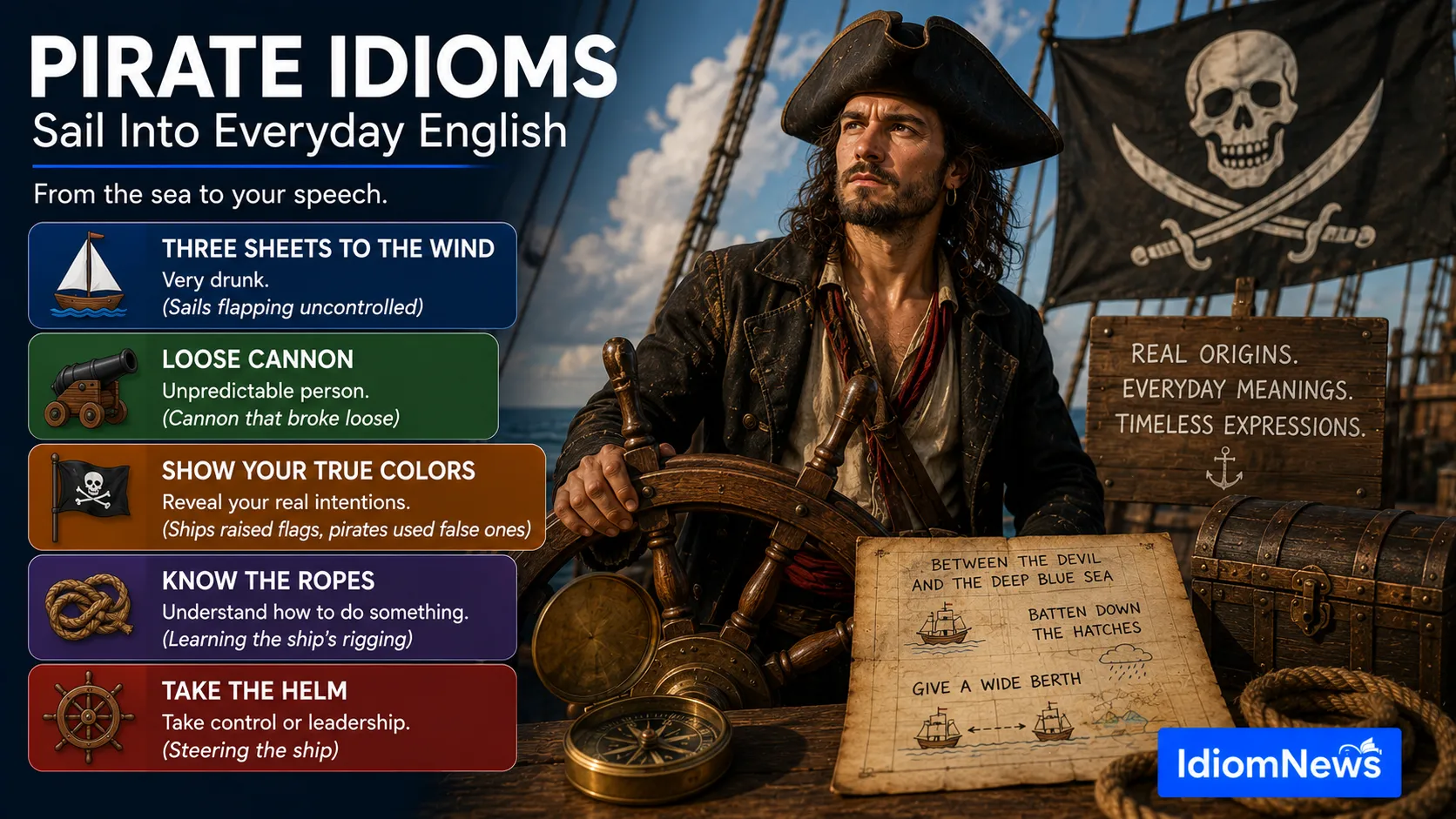
Someone says they’re “three sheets to the wind” after one too many drinks, with no idea they’re quoting sailing terminology centuries old. That phrase, along with dozens of others, sailed straight out of pirate and maritime culture into everyday English, where it’s stayed anchored ever since.
Idioms with pirate origins are more common than most people realize. Long before pirates became cartoonish figures in movies and costumes, real sailors, naval officers, and yes, actual pirates shaped a surprising number of expressions still used in modern conversation.
This connection matters for anyone curious about language history, teachers looking for engaging lessons, or simply readers who enjoy discovering where familiar phrases actually came from.
Nautical life was dangerous, physical, and full of vivid, specific terminology, exactly the kind of language that tends to survive and evolve into idiomatic expressions over time.
By the end of this piece, you’ll recognize several pirate and nautical idioms, understand their original meanings, and see exactly how they drifted into everyday English.
What Are Pirate Idioms?
Pirate idioms are expressions with origins in sailing, naval life, or pirate culture that have carried over into modern English with figurative meanings. Many started as literal descriptions of shipboard activities or dangers before evolving into everyday phrases unrelated to the sea. For example, “three sheets to the wind” originally described a loose, uncontrolled sail, and now means being very drunk.
Idioms About Drinking and Behavior
Sailing life involved long voyages, hard labor, and, often, plenty of drinking during time off. Several idioms reflect this directly.
- “Three sheets to the wind” – Very drunk. Originally referred to a ship’s sails flapping uncontrolled in the wind, similar to someone stumbling without control.
- “Groggy” – Feeling weak or unsteady, often after drinking or lack of sleep. This word comes from “grog,” a watered-down rum ration given to sailors.
- “Loose cannon“ – An unpredictable person who might cause unexpected trouble. This comes from actual cannons that broke loose on ship decks during storms or battles, becoming dangerous and uncontrollable.
These idioms capture the chaos and unpredictability of life at sea, later applied to human behavior on land.
Idioms About Danger and Difficulty
Sailing and pirate life involved constant risk, which shaped several idioms describing dangerous or difficult situations.
- “Between the devil and the deep blue sea” – Facing two equally difficult or dangerous choices. Some believe “the devil” referred to a specific seam on a wooden ship’s hull, a dangerous spot to work on.
- “Show your true colors” – To reveal your real intentions or character, often negative. Ships raised flags, or “colors,” to identify their nationality, and pirates sometimes flew false flags to deceive other ships before attacking.
- “Batten down the hatches” – To prepare for a difficult situation ahead. This came directly from securing a ship’s hatches before a storm.
These idioms show how physical, life-or-death sailing decisions transformed into general expressions about handling difficulty.
Idioms About Money and Treasure
Given how closely pirates are associated with treasure, it’s no surprise several idioms connect to wealth and payment.
- “Pieces of eight” – While not commonly used as an idiom today, this term for Spanish coins became so associated with pirate treasure that it remains a recognizable cultural reference.
- “Walk the plank” – Though often exaggerated in pirate fiction, this phrase is sometimes used figuratively to describe being forced out of a job or situation, similar to being forced into a dangerous, unavoidable outcome.
- “Shiver me timbers” – An exclamation of surprise or shock, likely referencing the way a ship’s wooden timbers would shake during rough seas or impact.
While some of these phrases are used more for pirate-themed fun than serious daily conversation, their origins remain genuinely tied to sailing history.
Idioms About Direction and Decision-Making
Sailors relied heavily on navigation and clear decision-making, which shaped several lasting idioms.
- “Know the ropes” – To understand how to do something, often a new job or task. This came directly from sailors needing to learn the complex rigging system of ropes on a ship.
- “Give a wide berth” – To avoid someone or something, keeping a safe distance. This referred to leaving enough space between ships while anchored, to avoid collisions.
- “Take the helm” – To take control or leadership of a situation. The helm refers to a ship’s steering wheel, controlled by whoever was in charge of navigation.
These idioms reflect how heavily structured and skill-dependent sailing life was, requiring clear roles and careful coordination.
Expert Insights: Why Sailing Idioms Have Lasted So Long
Nautical idioms tend to survive because sailing was such a dominant part of trade, exploration, and daily life for centuries, especially in English-speaking countries with strong maritime histories.
Unlike idioms tied to short-lived trends or technology, sailing terminology described physical, high-stakes situations that people intuitively understood, even without direct sailing experience themselves. This made the figurative meanings easy to grasp and repeat.
Many of these idioms also carry vivid, memorable imagery, ships, storms, ropes, cannons, which makes them naturally easier to recall than plainer expressions, helping them persist through generations long after most speakers stopped having direct contact with sailing life.
This combination of historical dominance and vivid imagery explains why pirate and nautical idioms remain so deeply embedded in everyday English, even in countries and communities with little direct connection to the sea today.
Common Mistakes People Make With Pirate Idioms
Mistake 1: Assuming every pirate-related phrase is a true idiom
Some pirate expressions, like “walk the plank,” are more cultural references or exaggerated fiction than commonly used idioms in everyday conversation.
Mistake 2: Confusing pirate slang with genuine idiomatic English
Phrases like “arrr” or “matey” are pirate-themed speech patterns popularized by fiction, not actual idioms with figurative meaning used in standard English.
Mistake 3: Overstating historical accuracy
Not every claimed pirate idiom has confirmed historical origins. Some phrases are popularly believed to be nautical in origin without strong historical evidence supporting the connection.
Mistake 4: Using nautical idioms without understanding their modern meaning
Some idioms, like “give a wide berth,” have shifted significantly from their literal nautical meaning, so understanding the current figurative use matters more than the historical origin alone.
Practical Steps to Learn and Use Pirate Idioms
- Start with well-documented idioms, like “know the ropes” or “show your true colors,” which have clearer, more reliable nautical origins.
- Learn both the historical meaning and modern usage, since understanding the shift helps the idiom make more sense.
- Use these idioms in appropriate, often informal contexts, since many carry a slightly playful or dramatic tone.
- Explore nautical history casually, since understanding sailing life makes these idioms far more memorable and meaningful.
- Avoid assuming every “pirate” phrase is a genuine idiom, distinguishing between real figurative expressions and pirate-themed fiction or slang.
Frequently Asked Questions
Q: What does “three sheets to the wind” mean?
A: It means being very drunk. The phrase originally described a ship’s sails flapping loosely and uncontrolled in the wind, similar to how a drunk person might stumble without control or balance.
Q: Is “walk the plank” a real idiom?
A: It’s more of a cultural reference tied to pirate fiction than a commonly used modern idiom. While some people use it figuratively to describe being forced out of a situation, it’s not as widely used as other nautical idioms.
Q: Where does “know the ropes” come from?
A: This idiom comes directly from sailing, where sailors needed to learn the complex system of ropes and rigging used to control a ship’s sails. It now means understanding how to do a new job or task.
Q: Why are so many idioms connected to sailing and pirates?
A: Sailing was central to trade, exploration, and daily life for centuries, especially in English-speaking countries with strong maritime histories. This made nautical language a natural, lasting source for idiomatic expressions.
Q: What does “give a wide berth” mean today?
A: It means to avoid someone or something, keeping a safe distance. Originally, it referred to leaving enough space between anchored ships to prevent collisions during rough weather.
Q: Are all pirate-themed phrases historically accurate idioms?
A: No. Some popular pirate phrases are more tied to fiction and entertainment than confirmed nautical history. Not every claimed origin story for these idioms has strong historical documentation.
Q: Can pirate idioms be used in formal writing?
A: Most nautical idioms, like “show your true colors” or “take the helm,” work fine in general writing. More playful, pirate-specific phrases tend to feel too casual for formal or professional contexts.
Bringing It All Together
Idioms with pirate and nautical origins offer a genuinely fascinating window into how everyday language absorbs and transforms specialized, historical vocabulary. Phrases born from ropes, sails, and storms now describe everything from drunkenness to leadership.
Understanding where these expressions came from adds a layer of appreciation to language most people use without ever considering its origin. A phrase like “three sheets to the wind” carries centuries of sailing history behind it.
The next time you hear someone say they’re going to “take the helm” on a new project, you’ll know exactly where that phrase set sail from, and you’ll have a great story to share about it.
Read More: Idioms and Phrases: What Sets Them Apart and Why It Matters

[…] Read More: Idioms With Pirate Origins: Nautical Phrases We Still Use Today […]