

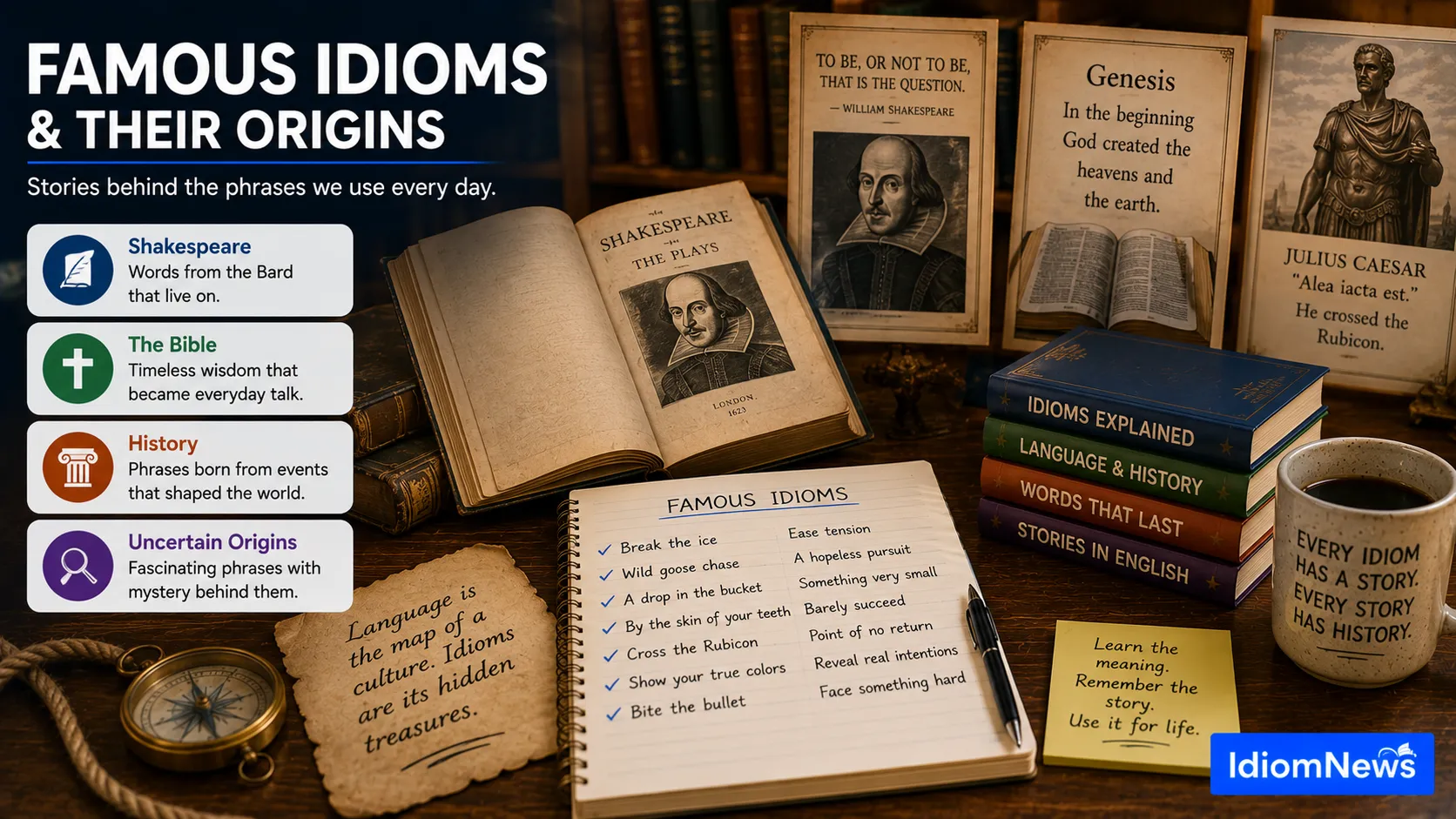
Someone says a plan has “vanished into thin air,” never realizing they’re quoting language that traces back centuries, possibly all the way to Shakespeare. That’s the interesting thing about famous idioms. Their origins are often more traceable and documented than people expect.
Unlike many idioms whose exact origins have faded into uncertain folklore, some of English’s most famous idioms come with genuine, well-documented backstories, tied to specific writers, historical events, or literary works.
This matters for anyone curious about language history, writers looking for interesting content, or teachers wanting engaging material that goes beyond definitions into genuine historical context.
Understanding where these particular idioms came from adds a layer of appreciation that a plain definition alone can’t provide, turning familiar phrases into small pieces of literary and cultural history.
By the end of this piece, you’ll know several famous idioms, their documented origins, and how they made the journey from historical or literary context into everyday modern speech.
What Makes an Idiom “Famous”?
Famous idioms are widely recognized expressions with well-documented origins, often traced back to specific literary works, historical figures, or significant cultural events. Unlike idioms with murky, uncertain backstories, famous idioms typically have a traceable source, making their history part of what makes them interesting beyond their everyday use. Many trace back to Shakespeare, the Bible, or well-known historical events.
Famous Idioms Attributed to Shakespeare
William Shakespeare is credited with either coining or popularizing an unusually large number of idioms still used in modern English.
- “Break the ice” – First appeared in Shakespeare’s writing, describing easing social tension, a meaning still used identically today.
- “Wild goose chase” – Used in Romeo and Juliet, describing a hopeless or pointless pursuit.
- “Vanish into thin air” – Referenced in several of Shakespeare’s plays, describing something disappearing completely and unexpectedly.
- “Green-eyed monster” – Used in Othello, referring to jealousy.
While Shakespeare may not have invented every one of these phrases from scratch, his widely read and performed works played a major role in popularizing them into common English usage.
Famous Idioms From the Bible
Biblical text has contributed significantly to English idioms, many of which remain in everyday use regardless of a speaker’s religious background.
- “A drop in the bucket” – Referencing something insignificant compared to a much larger whole, from the Book of Isaiah.
- “By the skin of your teeth” – Referring to barely escaping or succeeding, from the Book of Job.
- “A wolf in sheep’s clothing” – Describing someone who seems harmless but isn’t, referenced in the New Testament.
- “The writing on the wall” – Referring to a clear warning sign of trouble ahead, from the Book of Daniel.
These idioms demonstrate how deeply religious texts have influenced everyday English, even for speakers unfamiliar with their specific biblical origins.
Famous Idioms From Historical Events
Some famous idioms trace back to specific, documented historical events rather than literary works.
- “Break a leg” – Commonly used in theater to wish someone good luck, with several competing historical theories about its exact origin, though its widespread use in performing arts is well documented.
- “Bite the bullet” – Believed to relate to soldiers biting on a bullet during medical procedures before modern anesthesia existed.
- “Cross the Rubicon” – Referencing Julius Caesar‘s decision to cross the Rubicon River, symbolizing a point of no return.
- “Show your true colors” – Referring to ships historically raising flags, or “colors,” to reveal their nationality.
These idioms connect modern conversation directly to specific historical moments, even when most speakers today have no direct knowledge of the original event.
Famous Idioms With Uncertain but Widely Discussed Origins
Not every famous idiom has a fully confirmed origin, though several carry widely discussed, if debated, historical theories.
- “The whole nine yards” – Multiple competing theories exist, ranging from World War II ammunition belts to sports references, without definitive historical confirmation.
- “Kick the bucket” – Several theories exist regarding its origin, though none are conclusively confirmed by historians.
- “Rule of thumb” – Often mistakenly linked to an outdated legal reference, though most historical linguists dispute this specific origin story.
It’s worth noting when an idiom’s origin is genuinely uncertain, since popular explanations sometimes circulate without solid historical evidence supporting them.
Expert Insights: Why Documented Origins Make Idioms More Memorable
Idioms with clear, traceable origins tend to hold particular fascination for language learners and enthusiasts, since understanding the original context adds meaningful depth beyond simply memorizing a definition.
This is especially true for Shakespearean idioms, since his significant body of widely read and performed work provides unusually strong documentation compared to many idioms whose origins remain uncertain or purely speculative.
However, it’s worth approaching idiom origin stories with some healthy skepticism, since many widely circulated explanations, particularly for older or historical idioms, sometimes lack solid supporting evidence despite being repeated frequently online and in casual conversation.
Prioritizing idioms with genuinely well-documented sources, rather than accepting every popular origin story uncritically, offers a more historically accurate and intellectually satisfying way to explore this topic.
Common Mistakes People Make With Famous Idiom Origins
Mistake 1: Assuming every popular origin story is historically accurate
Many circulated explanations for idiom origins lack strong historical evidence, despite being widely repeated online and in casual conversation.
Mistake 2: Crediting Shakespeare with inventing every idiom associated with his work
Shakespeare often popularized existing phrases rather than inventing them entirely from scratch, a nuance frequently lost in casual retellings.
Mistake 3: Assuming biblical idioms only matter to religious readers
These idioms have become part of secular, everyday English, regardless of a speaker’s personal religious background or beliefs.
Mistake 4: Treating uncertain origin theories as settled fact
Idioms like “kick the bucket” have multiple competing theories, none definitively confirmed, so presenting one explanation as absolute fact misrepresents the historical uncertainty involved.
Practical Steps to Explore Famous Idiom Origins Responsibly
- Look for idioms with strong documentation, like Shakespearean or biblical origins, before exploring idioms with murkier historical backstories.
- Cross-check origin stories across multiple credible sources, since popular explanations sometimes lack solid historical evidence.
- Acknowledge uncertainty where it exists, rather than presenting disputed origin theories as confirmed fact.
- Use famous idioms as a gateway into broader literary or historical interest, connecting language study with history and literature.
- Share origin stories thoughtfully, distinguishing between well-documented history and popular folklore.
Famous Idioms and Their Documented Sources
| Idiom | Source | Meaning |
|---|---|---|
| Break the ice | Shakespeare | Ease social tension |
| A drop in the bucket | The Bible (Isaiah) | Something insignificant compared to the whole |
| Cross the Rubicon | Julius Caesar’s historical decision | A point of no return |
| Show your true colors | Naval flag tradition | Reveal true intentions |
This table highlights idioms with especially strong, well-documented historical sources.
Frequently Asked Questions
Q: Which famous idioms are attributed to Shakespeare?
A: Shakespeare is credited with popularizing idioms like “break the ice,” “wild goose chase,” and “vanish into thin air.” While he may not have invented every phrase entirely from scratch, his widely performed work significantly boosted their popularity.
Q: Are all famous idioms historically documented?
A: No. Some famous idioms, like “kick the bucket,” have multiple competing origin theories without definitive historical confirmation, while others, particularly Shakespearean and biblical idioms, have much stronger documentation.
Q: Why do so many idioms come from the Bible?
A: Biblical text was widely read and referenced for centuries, particularly in English-speaking countries, making it a significant historical source for idiomatic expressions still used in secular, everyday English today.
Q: What does “cross the Rubicon” mean?
A: It means passing a point of no return, referencing Julius Caesar’s historical decision to cross the Rubicon River with his army, an action that made conflict with Rome unavoidable.
Q: Is “break a leg” a documented theatrical idiom?
A: Yes, its use in theater to wish performers good luck is well documented, though the exact historical explanation for why this particular phrase became associated with luck remains debated among historians.
Q: Should I trust every idiom origin story I find online?
A: Not automatically. Many popular explanations for idiom origins lack strong historical evidence, so cross-checking claims across multiple credible sources helps separate documented history from popular folklore.
Q: Why are Shakespearean idioms considered especially significant?
A: Shakespeare’s extensive, widely performed body of work provides unusually strong documentation for idiom origins compared to many other historical sources, making his contributions particularly well studied by linguists and historians.
Bringing It All Together
Famous idioms offer something beyond simple figurative meaning. Many carry genuine, documented history, tracing back to Shakespeare’s plays, biblical text, or specific historical events that continue shaping everyday English centuries later.
Exploring these origins, while staying appropriately skeptical of unconfirmed folklore, adds real depth and appreciation to phrases that might otherwise feel like arbitrary, disconnected expressions.
The next time you use a phrase like “break the ice” or “cross the Rubicon,” take a moment to consider its history. That small piece of context turns a familiar idiom into a genuinely interesting story worth sharing.
Read More: Children’s Idioms: Fun, Easy Expressions Kids Can Actually Understand


[…] Read More: Famous Idioms and the Stories Behind Where They Came From […]