

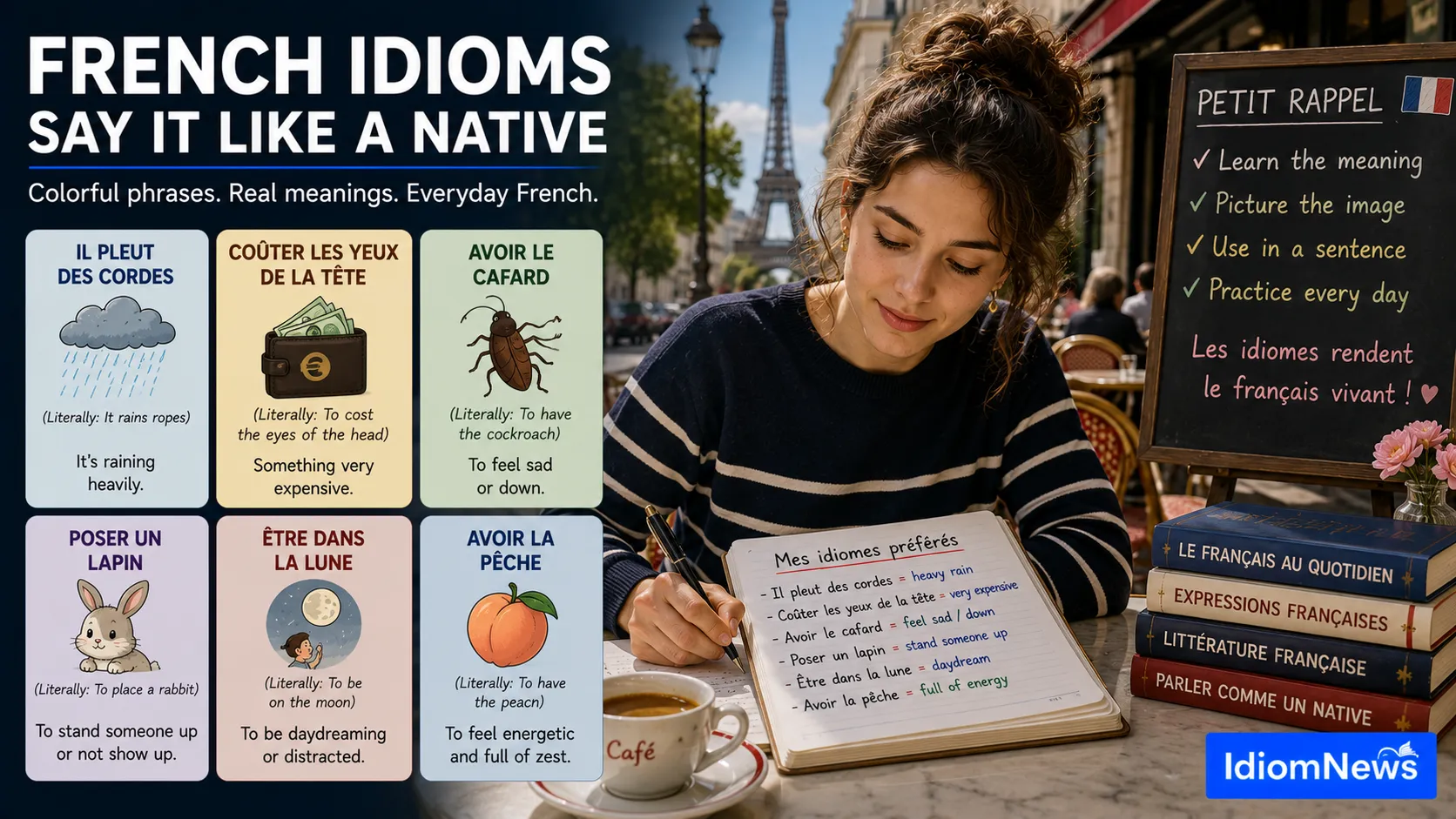
Someone learning French hears “il pleut des cordes” and, translating word for word, pictures ropes literally falling from the sky. Once they learn it simply means it’s raining heavily, the confusion fades, but that brief moment of literal translation captures exactly why French idioms deserve careful attention.
French, much like English, is full of expressions that make no sense when translated word for word. These idioms appear constantly in everyday conversation, French films, literature, and casual writing across France and other French-speaking regions.
For English speakers learning French, understanding these idioms isn’t optional. Skipping them means missing a significant part of how native French speakers actually communicate outside of formal, textbook language.
This becomes especially important given how often idiomatic expressions show up in casual French conversation, sometimes replacing plainer language entirely in everyday speech.
By the end of this piece, you’ll recognize popular French idioms, understand their actual meanings, and know how to use them naturally in real conversations.
What Are French Idioms?
French idioms are fixed expressions used throughout French-speaking regions whose meaning cannot be understood by translating the individual words literally. Like English idioms, they carry a figurative meaning that native speakers learn through common usage rather than direct translation. For example, “il pleut des cordes” literally translates to “it’s raining ropes,” but actually means it’s raining very heavily.
Everyday French Idioms You’ll Hear Constantly
Some French idioms appear so frequently that they’ve become part of ordinary daily conversation.
- “Coûter les yeux de la tête” – Literally “to cost the eyes of the head,” meaning something is very expensive, similar to “cost an arm and a leg” in English.
- “Avoir le cafard” – Literally “to have the cockroach,” meaning to feel sad or down.
- “Poser un lapin” – Literally “to place a rabbit,” meaning to stand someone up or not show up for a planned meeting.
- “Être dans la lune” – Literally “to be on the moon,” meaning to be daydreaming or distracted.
These idioms show up so often in casual conversation that they’re usually among the first ones learners encounter.
French Idioms About Emotions and Reactions
Emotional idioms let French speakers express feelings with more color than plain adjectives allow.
- “Avoir le coeur sur la main” – Literally “to have the heart on the hand,” meaning to be very generous.
- “Avoir la pêche” – Literally “to have the peach,” meaning to feel energetic and full of enthusiasm.
- “Ne pas avoir la langue dans sa poche” – Literally “to not have the tongue in your pocket,” meaning to speak very directly and honestly.
- “Avoir un chat dans la gorge” – Literally “to have a cat in the throat,” meaning to have a scratchy or hoarse voice, similar to the English “frog in your throat.”
These idioms are especially common in personal conversations, where expressive language feels more natural than plain statements.
French Idioms About Daily Life and Effort
These idioms describe ordinary situations, effort, and everyday decisions.
- “Mettre son grain de sel” – Literally “to put in your grain of salt,” meaning to offer an unsolicited opinion.
- “Chercher midi à quatorze heures” – Literally “to look for noon at two o’clock,” meaning to overcomplicate something simple.
- “Avoir un poil dans la main” – Literally “to have a hair in your hand,” meaning to be very lazy.
- “Casser les pieds” – Literally “to break the feet,” meaning to annoy or bother someone.
These phrases reveal how everyday objects and body parts, from salt to feet, get transformed into vivid figurative language.
How French Idioms Vary Across Regions
French is spoken across many countries and regions, and idioms sometimes shift depending on where the language is spoken, just as they do in English.
Metropolitan French, Québécois French, and various African French dialects each carry their own regional expressions that don’t always translate cleanly to other French-speaking areas.
For example, “avoir de la broue dans le toupet,” meaning to be overwhelmed with work, is common in Québécois French but rarely used in France. This kind of regional variation means learning idioms tied to a specific region can be more useful than trying to memorize a single universal list.
Being aware of this regional variation helps learners avoid confusion, especially when consuming media or communicating with French speakers from different regions around the world.
Expert Insights: Why Learning Idioms Speeds Up French Fluency
Idiom fluency tends to separate intermediate French learners from truly conversational speakers. Grammar and vocabulary provide the foundation, but idioms reveal whether someone understands how French is actually spoken in real, everyday situations.
Many French idioms rely on vivid, often food, animal, or body-related imagery, which tends to make them memorable once explained, even though they can seem confusing or even amusing on first encounter.
Learners who prioritize idioms tied to common daily situations, emotions, effort, and everyday conversation tend to build practical conversational skills faster than those who focus only on formal vocabulary and grammar rules.
This is part of why many French language courses now include idiom-focused lessons earlier in the curriculum, rather than saving them exclusively for advanced levels.
Common Mistakes People Make With French Idioms
Mistake 1: Translating idioms word for word
This almost always leads to confusion, since French idioms rarely make literal sense. Learn each idiom as a complete phrase, not as individual translated words.
Mistake 2: Assuming idioms work the same across all French-speaking regions
Regional differences matter. An idiom common in Québec might sound unfamiliar or unused in France or French-speaking African countries.
Mistake 3: Overusing idioms in formal writing
Casual idioms like “poser un lapin” sound too informal for professional or academic French writing. Match the idiom’s tone to the context.
Mistake 4: Confusing similar-sounding idioms
Phrases with similar structure but different meanings, particularly idioms involving body parts or food, can easily get mixed up without careful attention to context.
Practical Steps to Learn French Idioms Effectively
- Start with a short list of common idioms tied to everyday situations, emotions, and daily life.
- Learn the literal translation first, then the actual meaning, since seeing both helps the logic click.
- Practice using one idiom per day in a sentence you create yourself.
- Watch French-language films or listen to podcasts, paying attention to idioms used in context.
- Focus on idioms relevant to your target region, if you’re learning French for a specific country.
- Review idioms regularly, since repeated exposure helps them move from recognition into natural, confident use.
Popular French Idioms at a Glance
| French Idiom | Literal Translation | Actual Meaning |
|---|---|---|
| Coûter les yeux de la tête | To cost the eyes of the head | Something very expensive |
| Avoir le cafard | To have the cockroach | To feel sad or down |
| Être dans la lune | To be on the moon | To be daydreaming |
| Poser un lapin | To place a rabbit | To stand someone up |
| Avoir la pêche | To have the peach | To feel energetic |
This table offers a quick reference for readers who want to compare the literal and actual meanings side by side.
Frequently Asked Questions
Q: What are some common French idioms for beginners?
A: Simple, widely used idioms include “coûter les yeux de la tête” (something very expensive) and “être dans la lune” (to be daydreaming). These phrases appear frequently in everyday conversation and are a good starting point for learners.
Q: Are French idioms the same in every French-speaking country?
A: Not always. While some idioms are widely understood everywhere, many vary by region, with Metropolitan French, Québécois French, and African French dialects each having their own local expressions.
Q: Why do French idioms often reference food and animals?
A: Food and animal idioms are common across many languages, including French, likely because these everyday elements offer vivid, easily visualized imagery for describing emotions, effort, and daily situations.
Q: Can I use French idioms in formal writing?
A: Most French idioms are considered too casual for formal or academic writing. They work best in everyday conversation, casual writing, or informal communication.
Q: How can I remember French idioms more easily?
A: Learning both the literal translation and the actual meaning together often helps the logic behind an idiom make more sense, especially for particularly strange or vivid expressions.
Q: Do French idioms translate directly into English?
A: Rarely. Most French idioms use imagery specific to French-speaking culture, so direct translation usually results in phrasing that doesn’t make sense in English.
Q: What’s the best way to start learning French idioms?
A: Focus on idioms tied to everyday situations, emotions, and common activities first. These appear most frequently in real conversations and offer the most practical value early in your learning process.
Bringing It All Together
French idioms give the language its personality, humor, and cultural depth, turning ordinary statements into vivid, memorable expressions. Learning them takes conversational French far beyond textbook vocabulary and grammar rules.
Understanding both the literal translation and the real meaning behind each idiom makes them far easier to remember, especially for phrases that seem strange or illogical at first glance.
Focus on a handful of idioms tied to daily life, emotions, and common situations, and practice using them in real conversations, films, or writing whenever possible.
The next time someone tells you they’re “dans la lune,” you won’t picture the actual moon. You’ll understand exactly what they mean, and you’ll be one step closer to sounding naturally fluent yourself.
Read More: Famous Idioms and the Stories Behind Where They Came From


[…] Read More: French Idioms: Popular Expressions Explained With English Meanings […]