

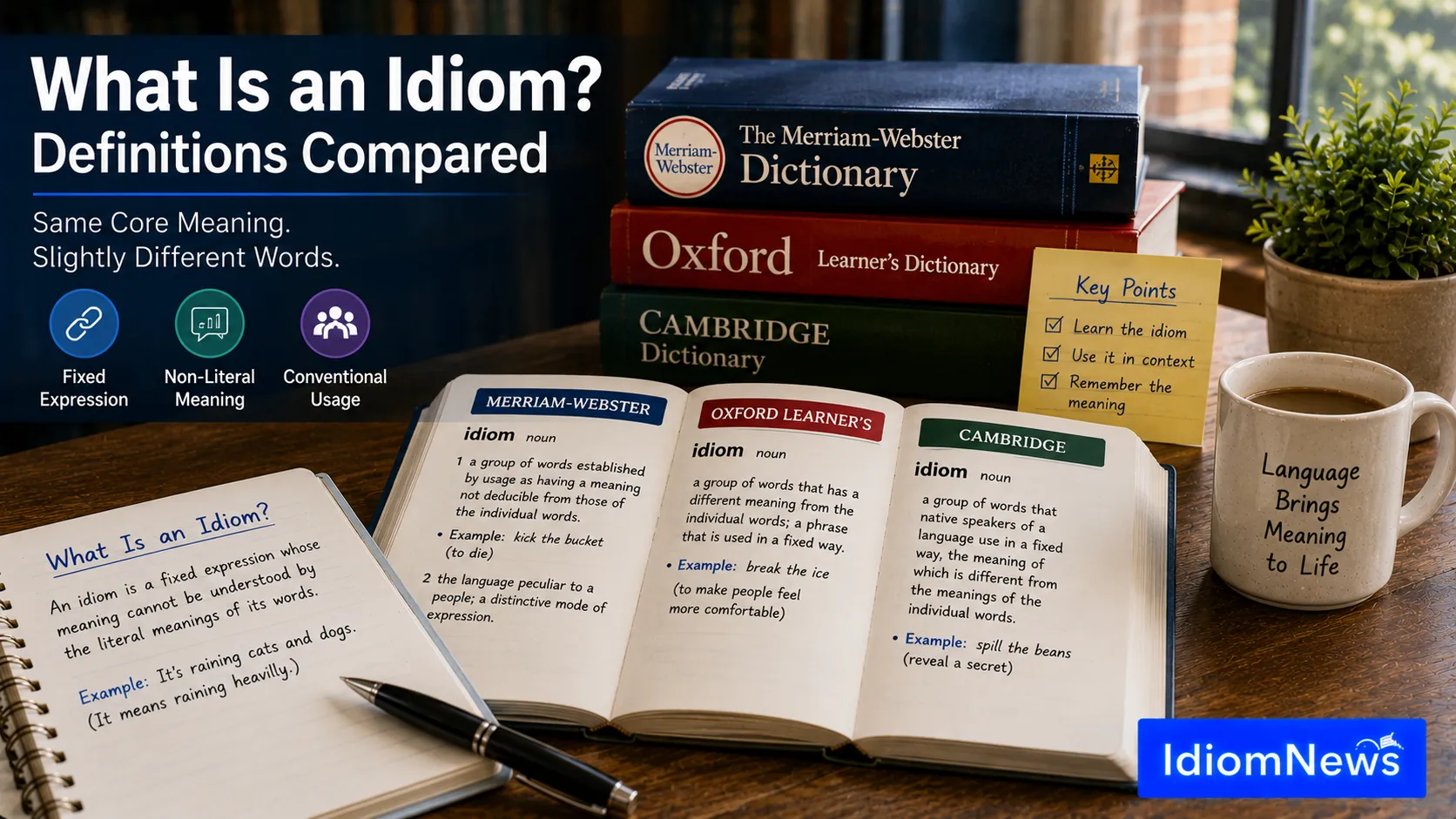
What Is an Idiom? Comparing Definitions From Major Dictionaries
Look up “idiom” in three different dictionaries, and you’ll get three definitions that sound similar but aren’t quite identical. That’s not an error. It reflects genuine, subtle differences in how professional lexicographers choose to word a concept that’s surprisingly tricky to define precisely.
Understanding what is an idiom definition actually looks like across different authoritative sources helps clarify some of the nuance that a single, simplified definition often glosses over.
This matters for students citing sources in academic work, writers double-checking precise usage, and anyone curious about how professional dictionaries approach defining figurative language formally.
Comparing these definitions side by side reveals both the common ground all major dictionaries share and the small, meaningful differences in emphasis between them.
By the end of this piece, you’ll understand how major dictionaries formally define “idiom,” what these definitions have in common, and where they diverge in subtle but meaningful ways.
What Is an Idiom? The Core, Shared Definition
Across major dictionaries, an idiom is consistently defined as a fixed group of words whose overall meaning cannot be determined from the meanings of its individual words. This core definition remains consistent across sources, though specific wording, emphasis, and additional detail vary between different dictionaries and reference works.
How Dictionaries Typically Word This Definition
Formal dictionary definitions of “idiom” generally include a few consistent core elements, even when specific phrasing differs.
- Fixed structure – Most definitions emphasize that idioms are established, conventional expressions, not spontaneously created phrases.
- Non-literal meaning – Nearly every definition specifically notes that the overall meaning differs from what the individual words would suggest literally.
- Cultural or conventional usage – Many definitions specifically mention that this meaning is established through common usage within a language community, not through logical construction.
These shared elements form the backbone of virtually every formal definition, even as the specific wording, examples, and additional detail vary between sources.
Why Dictionary Definitions of “Idiom” Sometimes Differ
Differences between dictionary definitions typically come down to scope and additional detail, rather than fundamental disagreement about the core concept.
Some dictionaries define “idiom” narrowly, focusing specifically on the figurative-phrase sense most people are familiar with. Others include a broader secondary definition, acknowledging the word’s historical use to describe a language’s distinctive character as a whole, a meaning still reflected in related languages like Spanish and Portuguese.
This variation explains why comparing multiple dictionary sources sometimes reveals a fuller picture than relying on just one definition alone.
What Additional Detail Some Dictionaries Include
Beyond the core definition, some dictionaries add helpful clarifying details that others omit or handle differently.
- Grammatical notes – Some definitions specifically mention that idioms often can’t be translated literally into other languages.
- Example phrases – Many dictionaries include a specific example, like “kick the bucket,” directly within the definition entry itself to illustrate the concept.
- Usage labels – Some entries note whether an idiom is considered informal, dated, or regionally specific, providing helpful context for the reader.
- Related term cross-references – Certain dictionaries link “idiom” to related terms like “idiomatic” or “figure of speech” within the same entry.
These additional details tend to appear more consistently in dictionaries with a stronger educational or learner-focused orientation, compared to more compact, general-purpose dictionaries.
How This Definition Fits Into Broader Dictionary Structure
Dictionary entries for “idiom” typically appear alongside related grammatical information, including part of speech (noun), pronunciation guidance, and sometimes a brief etymology tracing the word back to its Greek origins.
This structural consistency, definition, part of speech, pronunciation, and often etymology, reflects standard lexicographic practice across most reputable dictionaries, regardless of which specific publisher produced the reference work.
Understanding this typical structure helps readers know what to expect and where to look when cross-referencing “idiom” definitions across multiple sources for academic or research purposes.
Expert Insights: Why Precise Definitions Matter for Formal Writing
For casual conversation, a simplified, general sense of “idiom” works perfectly well. But for academic writing, linguistics coursework, or professional lexicography, precise definitional language carries more weight, since small differences in wording can reflect genuinely different theoretical approaches to figurative language.
Linguists sometimes distinguish between idioms in the narrowest technical sense, phrases that are both non-literal and fully fixed in structure, and broader colloquial use of the term, which sometimes gets applied more loosely to any commonly used figurative expression.
This distinction matters most in specialized academic contexts, where precise terminology affects how research on figurative language gets categorized and analyzed. For general writing and everyday communication, the shared core definition across major dictionaries provides more than enough clarity and precision.
Cross-referencing multiple dictionary definitions, rather than relying on a single source, offers a more complete, nuanced understanding, particularly useful for anyone citing definitions in formal academic work.
Common Mistakes People Make Citing Idiom Definitions
Mistake 1: Assuming all dictionaries define “idiom” identically
While the core concept remains consistent, specific wording, scope, and additional detail genuinely vary between different dictionary sources.
Mistake 2: Citing only a simplified, general definition in formal academic work
Academic writing often benefits from citing a specific, authoritative dictionary source directly, rather than paraphrasing a general, unattributed definition.
Mistake 3: Ignoring a dictionary’s secondary or historical definition entries
Some dictionaries include a broader historical sense of “idiom” (referring to a whole language) alongside the more common figurative-phrase definition, which can be relevant depending on your specific research context.
Mistake 4: Overlooking usage labels within definition entries
Details noting whether a specific idiom is informal, dated, or regional provide valuable context that’s easy to miss if you only skim the core definition itself.
Practical Steps to Compare Idiom Definitions Effectively
- Check multiple reputable dictionary sources, rather than relying on just one for formal or academic purposes.
- Note the specific wording differences, particularly around scope and additional detail included in each entry.
- Look for a dictionary’s secondary or historical definitions, if researching the word’s broader linguistic history.
- Cite the specific dictionary source directly in academic work, rather than paraphrasing a general, unattributed definition.
- Pay attention to usage labels and example phrases included within each definition entry for added context.
Frequently Asked Questions
Q: What is the standard definition of “idiom” across most dictionaries?
A: Most dictionaries define an idiom as a fixed group of words whose overall meaning cannot be determined from its individual words, established through common usage rather than logical construction.
Q: Do all dictionaries define “idiom” exactly the same way?
A: No. While the core concept remains consistent, specific wording, scope, and additional detail, such as usage labels or historical definitions, vary between different dictionary sources.
Q: Why do some dictionaries include a broader, historical definition of “idiom”?
A: Some dictionaries acknowledge the word’s older sense, referring to a language’s distinctive character as a whole, a meaning still reflected today in related languages like Spanish and Portuguese.
Q: Should I cite a specific dictionary when defining “idiom” in academic work?
A: Yes, generally. Citing a specific, authoritative dictionary source directly provides stronger academic credibility than paraphrasing a general, unattributed definition.
Q: What additional details do learner-focused dictionaries often include?
A: Learner-focused dictionaries frequently add usage labels, indicating whether an idiom is informal or regional, alongside clear example sentences to illustrate natural usage within the definition entry.
Q: Is there a difference between how linguists and general dictionaries define “idiom”?
A: Sometimes. Linguists may use a narrower, more technical definition focused specifically on fixed, non-literal phrases, while general dictionaries sometimes apply the term slightly more broadly in everyday usage.
Q: Where does the word “idiom” typically appear within a dictionary entry’s structure?
A: Standard entries typically include pronunciation, part of speech, the core definition, and often an example phrase, following consistent lexicographic structure across most reputable dictionaries.
Bringing It All Together
Comparing what is an idiom definition across multiple dictionary sources reveals both a strong, consistent core concept and small, meaningful differences in wording, scope, and additional detail. This nuance matters more for academic and formal research than for everyday conversation.
Understanding these subtle differences helps writers, students, and researchers cite definitions accurately and choose the most appropriate source for their specific purpose.
The next time you need a precise, citable definition of “idiom,” consider checking more than one dictionary source. That small extra step often reveals a fuller, more nuanced picture than any single definition alone.
Read More: What Are Idioms? Definition and Examples Explained


[…] Read More: What Is an Idiom? Definitions From Major Dictionaries […]