

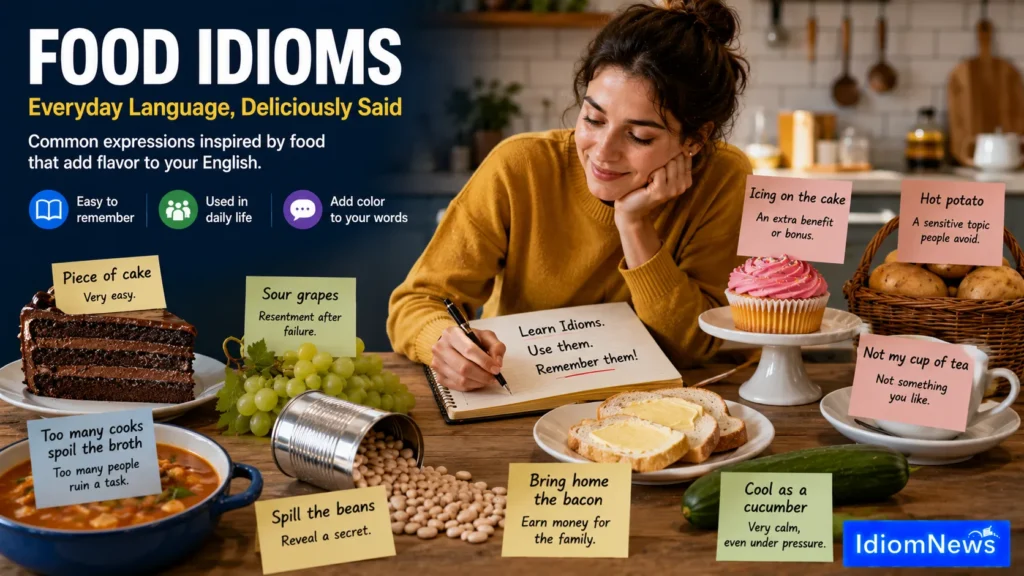
Food Idioms: Common Expressions Cooked Up From Everyday Meals
Someone describes an easy task as “a piece of cake” without ever picturing an actual dessert, and a moment later calls a tense situation “a hot potato” without any real potato in sight. Food idioms work their way into English conversation so naturally that most speakers barely notice how often they’re borrowing kitchen language to describe things that have nothing to do with eating.
These expressions draw on something universally familiar, food, to communicate emotions, situations, and judgments in vivid, easily relatable terms. Because eating is such a shared human experience, food-based idioms tend to translate their imagery intuitively, even for learners encountering them for the first time.
This matters for language learners building practical vocabulary, writers looking for accessible and relatable phrasing, and anyone curious about why English borrows so heavily from the kitchen to describe everyday life.
Understanding these food idioms, what they mean, how they’re used, and why food imagery works so well for figurative language, adds a genuinely useful and enjoyable category to your everyday vocabulary.
By the end of this piece, you’ll recognize common food idioms, understand their actual meanings, and know how to use them naturally in conversation and writing.
What Are Food Idioms?
Food idioms are fixed expressions that use food-related words or imagery to convey a meaning unrelated to actual eating or cooking. For example, “spill the beans” doesn’t involve any real beans; it means revealing a secret. These idioms work well specifically because food is a universal, easily visualized experience that naturally lends itself to vivid, relatable figurative language.
Food Idioms About Ease and Difficulty
Several food idioms describe how easy or difficult a task or situation feels.
- “Piece of cake” – Something very easy. “That test was a piece of cake.”
- “A hard nut to crack” – A difficult problem or person to understand. “This math problem is a hard nut to crack.”
- “A hot potato” – A controversial or sensitive topic that people avoid handling directly. “Immigration policy has become quite a hot potato in this election.”
- “Easy as pie” – Something very simple to accomplish. “Setting up the new software was easy as pie.”
These idioms tend to be among the first food-related expressions learners encounter, thanks to their frequent, everyday use.
Food Idioms About Emotions and Attitudes
Food imagery also shows up frequently when describing how someone feels or reacts to a situation.
- “Sour grapes” – Resentment or bitterness after failing to get something, often accompanied by pretending not to have wanted it. “He said he didn’t want the promotion anyway, but it sounded like sour grapes.”
- “Have a lot on your plate” – Being very busy or overwhelmed with responsibilities. “I can’t take on another project; I already have a lot on my plate.”
- “Cool as a cucumber” – Staying calm, even under pressure. “She stayed cool as a cucumber during the interview.”
- “Full of beans” – Having a lot of energy. “The kids were full of beans after the birthday party.”
These idioms show how food imagery can capture emotional nuance, calmness, resentment, energy, in a way plain adjectives sometimes struggle to match.
Food Idioms About Money and Value
Food idioms also appear frequently when discussing spending, cost, or financial value.
- “Bring home the bacon” – To earn money to support your family. “Both parents work hard to bring home the bacon.”
- “Not my cup of tea” – Something you don’t personally enjoy, sometimes used for things involving cost or value judgments. “That expensive restaurant just isn’t my cup of tea.”
- “The best thing since sliced bread” – Describing something as an excellent, valuable innovation. “This new app is the best thing since sliced bread.”
- “Bread and butter” – Someone’s main source of income or livelihood. “Freelance writing is his bread and butter.”
These idioms connect food, a basic human necessity, to broader themes of financial security and everyday value.
Food Idioms About Honesty and Secrets
Certain food idioms specifically describe truthfulness, deception, or revealing information.
- “Spill the beans” – To reveal a secret, often accidentally. “She spilled the beans about the surprise party.”
- “Take it with a grain of salt” – To view information with some skepticism, not accepting it entirely at face value. “I’d take his story with a grain of salt.”
- “Sugarcoat something” – To make bad news sound better or gentler than it actually is. “Don’t sugarcoat it; just tell me what happened.”
- “Half-baked idea” – A plan or idea that hasn’t been fully thought through. “That’s a half-baked idea; we need more details before moving forward.”
Food Idioms About Relationships and Social Situations
Food also shows up in idioms describing how people interact and relate to one another socially.
- “Icing on the cake” – An additional, welcome benefit on top of an already good situation. “Getting the promotion was great, and the bonus was just icing on the cake.”
- “Too many cooks spoil the broth” – Too many people trying to manage the same task creates confusion or problems. “We couldn’t agree on the plan; too many cooks spoil the broth.”
- “Butter someone up” – To flatter someone, usually to gain a favor. “He’s been buttering up the boss all week before asking for a raise.”
- “Bring home the bacon” (also fits here) – Reinforces the connection between food and family or social provision.
These idioms show how food-based language extends naturally into describing group dynamics and interpersonal relationships.
Expert Insights: Why Food Makes Such Effective Idiom Material
Food idioms tend to remain remarkably stable and widely understood across generations and even across cultures, largely because eating is one of the most universal human experiences, something virtually everyone can relate to directly and intuitively.
This universality gives food-based imagery an advantage over idioms tied to more specialized or historically specific activities, like sailing or particular professions, since food-related concepts require no specialized knowledge to understand immediately.
Linguists studying figurative language often note that food idioms also benefit from sensory richness, taste, texture, temperature, offering vivid, multi-dimensional imagery that plain descriptive language often struggles to match with the same immediacy.
This combination of universal familiarity and sensory vividness helps explain why food idioms remain so consistently common and durable across English and many other languages, rather than fading out of use the way more narrowly specialized idioms sometimes do.
Common Mistakes People Make With Food Idioms
Mistake 1: Taking food idioms literally
New learners sometimes picture the actual food item, leading to confusion. Food idioms should be understood as a complete figurative unit, not broken apart word by word.
Mistake 2: Using food idioms in overly formal writing
Casual idioms like “spill the beans” or “full of beans” can feel out of place in professional or academic writing.
Mistake 3: Confusing similar food idioms
Phrases like “piece of cake” and “icing on the cake” both involve cake but carry different meanings, ease versus an additional bonus, so context matters.
Mistake 4: Overusing food idioms in a single conversation
Packing too many food idioms into one exchange can sound forced or overly cutesy, even to native speakers.
Practical Steps to Learn Food Idioms Effectively
- Start with a small group of common food idioms tied to everyday situations, ease, emotion, or money.
- Practice using one idiom per day in a sentence you create yourself.
- Notice food idioms in real conversations, shows, or reading, paying attention to their context and tone.
- Avoid translating them literally from your native language, since food idioms rarely match directly across languages.
- Review your list regularly, since repeated exposure helps idioms move into confident, natural use.
Food Idioms at a Glance
| Idiom | Meaning |
|---|---|
| Piece of cake | Very easy |
| Sour grapes | Resentment after failure |
| Bring home the bacon | Earn money for the family |
| Spill the beans | Reveal a secret |
| Icing on the cake | An additional, welcome benefit |
This table offers a quick-reference summary of the food idioms covered throughout this piece.
Frequently Asked Questions
Q: What are some common food idioms in English?
A: Frequently used examples include “piece of cake” (very easy), “spill the beans” (reveal a secret), and “bring home the bacon” (earn money for the family). These phrases appear regularly in casual conversation and writing.
Q: Why are there so many food-related idioms in English?
A: Food is a universal human experience, making it easy to visualize and relate to. This universality, combined with food’s rich sensory qualities, makes it especially effective material for vivid figurative language.
Q: Can food idioms be used in professional writing?
A: Some, like “bread and butter” or “icing on the cake,” fit reasonably well in professional contexts. More casual idioms, like “spill the beans,” are better suited for everyday conversation.
Q: What does “take it with a grain of salt” mean?
A: It means to view information with some skepticism rather than accepting it entirely as true. For example, “I’d take his explanation with a grain of salt” suggests some doubt about its accuracy.
Q: Do food idioms exist in other languages besides English?
A: Yes, most languages have their own food-related idioms, though the specific foods and imagery used often differ significantly, reflecting each culture’s unique culinary traditions and staple foods.
Q: What’s the difference between “piece of cake” and “icing on the cake”?
A: “Piece of cake” means something is very easy, while “icing on the cake” describes an additional, welcome bonus on top of an already positive situation. Both involve cake but carry distinct meanings.
Q: How can I remember food idioms more easily?
A: Learning idioms through real example sentences, rather than isolated definitions, helps the meaning stick more effectively. Picturing the literal food imagery alongside the actual meaning also reinforces memory.
Bringing It All Together
Food idioms bring a genuinely relatable, vivid quality to everyday English, borrowing something universally familiar to describe emotions, situations, and relationships that might otherwise require much more explanation. Their staying power comes directly from how naturally food connects to shared human experience.
Learning these idioms adds real texture to your vocabulary, letting you communicate with more color and precision than plain, literal language often allows.
The next time you’re tempted to say something is simply “easy,” consider reaching for “piece of cake” instead. That small shift adds flavor, quite literally, to your everyday communication.
Read More: The Early Bird Catches the Worm Meaning Explained



[…] Read More: Food Idioms: Common Expressions and Meanings […]