

Idiom Definition Simple: The Easiest Explanation You’ll Find
Someone searches for a simple definition of “idiom” and instead finds pages full of complicated words like “figurative,” “compositional,” or “semantic derivation.” That’s not simple. That’s just as confusing as the phrase they were trying to understand in the first place.
An idiom definition simple enough to actually make sense shouldn’t require a dictionary of its own just to read it. It should use plain words, short sentences, and a clear example, nothing more.
This matters for beginners, students, English learners, and honestly anyone who just wants a quick, clear answer without wading through unnecessary complexity.
By the end of this piece, you’ll have the simplest possible definition of idiom, explained in plain language, along with just enough context to actually understand and use it.
Idiom Definition Simple
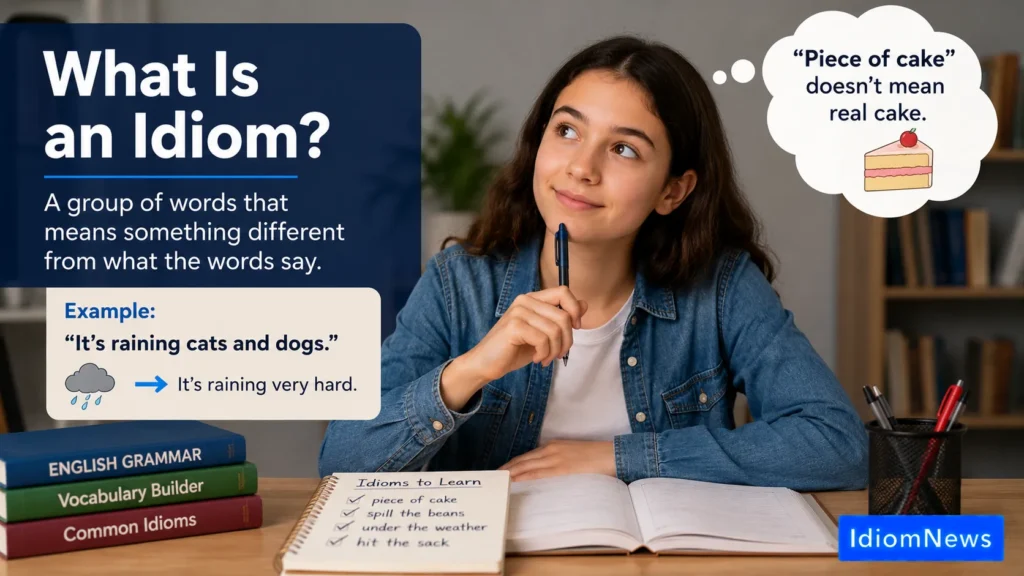
An idiom is a group of words that means something different from what the words actually say. You can’t figure out what it means just by knowing each word. You have to already know the whole phrase. For example, “break the ice” doesn’t mean anything about actual ice. It means to make an awkward situation feel more comfortable.
Why This Definition Is Simple on Purpose
Most definitions of “idiom” use words like “figurative language” or “literal meaning.” Those words aren’t wrong, but they’re not simple either, especially if you’re just starting out.
This definition sticks to plain words: “means something different,” “figure it out,” “already know.” No technical terms required.
The goal isn’t to sound smart. The goal is for the definition to actually make sense the first time you read it.
One Simple Example to Make It Click
- The idiom: “It’s raining cats and dogs.”
- What the words say: Cats and dogs are falling from the sky.
- What it actually means: It’s raining very hard.
That gap, between what the words literally say and what the phrase actually means, is the whole idea behind an idiom. Nothing more complicated than that.
A Few More Simple Examples
- Piece of cake – Something very easy. “That test was a piece of cake.”
- Spill the beans – To tell a secret. “She spilled the beans about the party.”
- Under the weather – Feeling sick. “I’m staying home; I’m under the weather.”
- Hit the sack – To go to sleep. “I’m tired, I should hit the sack.”
Each of these works the same way: the words alone don’t tell you the real meaning. You just have to learn it.
How to Know if a Phrase Is an Idiom
Ask yourself one simple question: does the literal meaning make sense in the sentence?
If someone says “it’s raining cats and dogs” and you look outside expecting animals falling from the sky, that’s the sign. The literal meaning doesn’t fit. That’s an idiom.
If the words mean exactly what they say, like “open the door,” that’s not an idiom. It’s just a regular sentence.
Expert Insights: Why Simple Definitions Actually Work Better for Beginners
People learning a new concept for the first time understand it faster when the explanation uses words they already know, not new vocabulary layered on top of an already unfamiliar idea.
This is why a simple definition, even one that leaves out some technical nuance, often teaches the core concept more effectively than a more “complete” but complicated one.
Once the simple version clicks, adding more detail later, like how idioms differ from proverbs or metaphors, becomes much easier, since the basic idea is already solid.
Common Mistakes People Make With Idioms
Mistake 1: Taking the words literally
If you picture the exact words, you’ll get confused. Think of the whole phrase as one idea, not separate words.
Mistake 2: Changing the wording
Idioms usually stay exactly the same. You wouldn’t say “spill the peas.” It has to be “spill the beans.”
Mistake 3: Using idioms in serious, formal writing
Most idioms sound too casual for formal writing, like a work report or academic paper.
Practical Steps to Learn Idioms the Simple Way
- Learn one idiom at a time, not a big list all at once.
- Read it in a full sentence, not just the phrase by itself.
- Picture the literal meaning, then compare it to the real meaning.
- Try using it in your own sentence.
- Repeat it out loud a few times so it sticks.
Frequently Asked Questions
Q: What is the simplest way to explain what an idiom is?
A: An idiom is a group of words that means something different from what the words say. You have to already know the phrase to understand it.
Q: Can you give a simple example of an idiom?
A: “Piece of cake” is a simple example. It means something is very easy, not an actual cake.
Q: Why can’t I figure out an idiom just by knowing the words?
A: Because idiom meanings aren’t based on logic. They’re learned through hearing the phrase used, not by adding up what each word means.
Q: Is “under the weather” an idiom?
A: Yes. It means feeling sick, which has nothing to do with actual weather.
Q: How do I know if something is an idiom or not?
A: Ask if the literal meaning makes sense. If it doesn’t, but people still understand it, it’s an idiom.
Q: Are idioms hard to learn?
A: Not if you learn a few at a time with real examples. Trying to memorize a huge list at once is what makes it feel hard.
Bringing It All Together
An idiom definition simple enough to actually understand comes down to one idea: the words don’t mean what they say. You just have to already know the phrase.
Once that clicks, everything else about idioms, examples, categories, how to use them, becomes much easier to build on.
The next time you hear a confusing phrase that clearly doesn’t mean what the words literally say, you’ll know exactly what’s going on. It’s just an idiom.
Read More: Idiom Examples in Sentences: Statements & Questions


[…] Read More: Idiom Definition Simple: Easy Meaning & Examples […]