

Idiom Examples in Sentences: Statements, Questions, and Negatives
Someone learns that “under the weather” means feeling sick, writes “I am under the weather” correctly, and then completely freezes trying to ask “are you under the weather?” or say “I’m not under the weather.” Knowing one sentence form isn’t the same as knowing how to flex an idiom across different sentence types.
Idiom examples in sentences work best when they show more than just one straightforward statement. Seeing the same idiom used as a question, a negative, and a statement builds real, flexible command of the phrase, not just recognition of one fixed pattern.
This matters for learners preparing for speaking practice, teachers building worksheet material, and anyone who wants to actually use idioms in real conversation, where statements, questions, and negatives all come up constantly.
By the end of this piece, you’ll have idiom examples shown across multiple sentence types, giving you a genuinely flexible model for using each phrase naturally.
Why One Example Sentence Isn’t Enough
Seeing an idiom only as a statement doesn’t prepare you to use it as a question or a negative, since English sentence structure shifts word order and adds helper words depending on sentence type. For example, “she is under the weather” (statement) becomes “is she under the weather?” (question) and “she isn’t under the weather” (negative), each requiring a different grammatical construction around the same fixed idiom.
“Under the Weather” in Three Sentence Forms
- Statement: “I’m under the weather today.”
- Question: “Are you under the weather?”
- Negative: “I’m not under the weather anymore.”
Notice how the idiom itself, “under the weather,” never changes. Only the surrounding grammar shifts to create each sentence type.
“Spill the Beans” in Three Sentence Forms
- Statement: “He spilled the beans about the surprise.”
- Question: “Did he spill the beans about the surprise?”
- Negative: “He didn’t spill the beans about the surprise.”
Notice the shift to “did” and “didn’t” for the question and negative forms, standard English question and negative construction applied around the fixed idiom.
“Break the Ice” in Three Sentence Forms
- Statement: “She breaks the ice with a joke at every meeting.”
- Question: “Does she break the ice with a joke at every meeting?”
- Negative: “She doesn’t break the ice with a joke at every meeting.”
“Piece of Cake” in Three Sentence Forms
- Statement: “That test was a piece of cake.”
- Question: “Was that test a piece of cake?”
- Negative: “That test wasn’t a piece of cake.”
Notice that “piece of cake” functions as a noun phrase, so the question and negative forms simply move “was” around, rather than adding “did” or “does” the way verb-based idioms require.
“Hit the Sack” in Three Sentence Forms
- Statement: “I’m going to hit the sack early tonight.”
- Question: “Are you going to hit the sack early tonight?”
- Negative: “I’m not going to hit the sack early tonight.”
Why Grammatical Category Affects These Sentence Forms
Idioms don’t all shift the same way across statement, question, and negative forms, since their grammatical category determines exactly which helper words apply.
- Verb-phrase idioms (“spill the beans,” “break the ice”) use “do/does/did” for questions and negatives, following standard verb conjugation rules.
- Adjective-phrase idioms (“under the weather,” “over the moon”) use “is/am/are” or “was/were” directly, since they follow a linking verb rather than functioning as the main verb.
- Noun-phrase idioms (“piece of cake,” “a drop in the bucket”) also use “is/am/are” or “was/were,” since they function as a predicate noun following a linking verb.
Recognizing which category an idiom falls into before constructing questions or negatives prevents common grammatical mistakes.
Expert Insights: Why Sentence-Type Variety Builds Stronger Speaking Skills
Language learners often practice idioms almost exclusively in statement form, since that’s how most textbooks and definitions present them. This creates a real gap: someone may recognize and even correctly state an idiom, yet hesitate noticeably when trying to ask about it or negate it in actual conversation.
Real conversation constantly shifts between statements, questions, and negatives, often within the same short exchange. Practicing an idiom across all three forms specifically prepares learners for that natural conversational flow, rather than only the one-directional pattern most study materials default to.
Speech and language instructors often recommend this kind of structured, multi-form practice specifically for idioms, since the fixed wording combined with shifting surrounding grammar creates a genuinely different challenge than practicing regular vocabulary words, which typically don’t require the same category-specific grammatical awareness.
This is part of why worksheets and practice materials that show only one sentence form per idiom leave a meaningful gap in actual conversational readiness, even when the underlying meaning is fully understood.
Common Mistakes People Make With Idiom Sentence Forms
Mistake 1: Using “do/does/did” with adjective or noun-phrase idioms
Saying “does she under the weather?” instead of “is she under the weather?” mistakenly applies verb-phrase question structure to an idiom that actually needs a linking verb.
Mistake 2: Forgetting to shift helper verbs for negatives
Simply adding “not” without adjusting the helper verb, like saying “she spill not the beans” instead of “she didn’t spill the beans,” creates an ungrammatical sentence.
Mistake 3: Only practicing idioms in statement form
This leaves a real gap in conversational readiness, since real conversation constantly requires questions and negatives, not just statements.
Mistake 4: Changing the idiom’s core wording when forming a question or negative
The fixed part of the idiom should stay exactly the same across all three sentence forms; only the surrounding grammar should shift.
Practical Steps to Practice Idioms Across Sentence Types
- Identify the idiom’s grammatical category first, verb phrase, adjective phrase, or noun phrase, before building sentences.
- Write the statement form first, since it’s usually the easiest starting point.
- Convert it to a question, using the correct helper verb based on the idiom’s category.
- Convert it to a negative, again matching the correct helper verb pattern.
- Say all three forms aloud, reinforcing the natural rhythm of each sentence type.
- Repeat this process with five idioms per week, building genuine flexibility rather than memorizing single, fixed sentences.
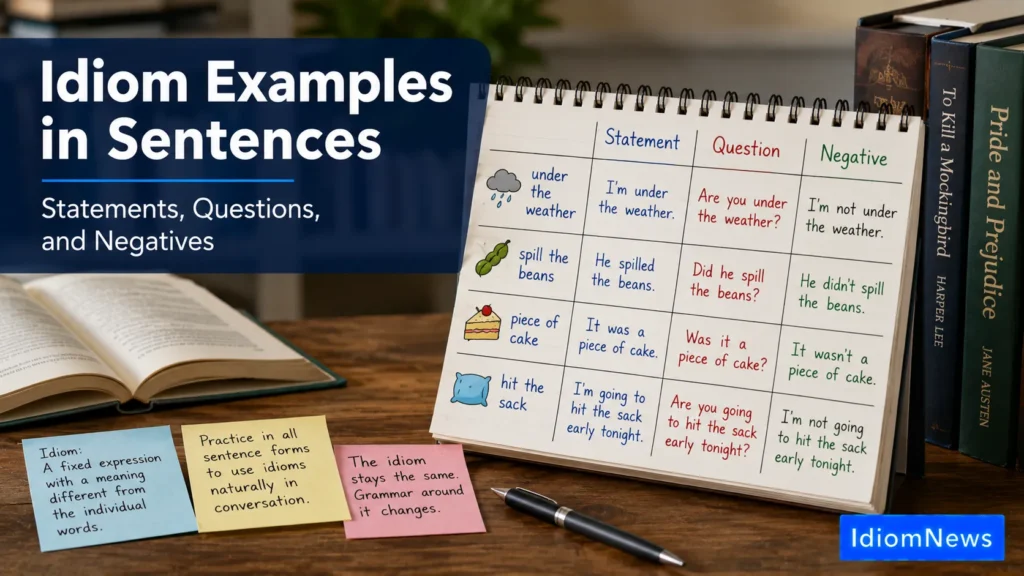
Idiom Sentence Forms at a Glance
| Idiom | Statement | Question | Negative |
|---|---|---|---|
| Under the weather | I’m under the weather. | Are you under the weather? | I’m not under the weather. |
| Spill the beans | He spilled the beans. | Did he spill the beans? | He didn’t spill the beans. |
| Piece of cake | It was a piece of cake. | Was it a piece of cake? | It wasn’t a piece of cake. |
This table offers a quick-reference model showing how each idiom shifts consistently across all three sentence types.
Frequently Asked Questions
Q: Why do idioms need to be practiced in question and negative form, not just statements?
A: Real conversation constantly shifts between statements, questions, and negatives. Practicing only statement form leaves a gap in actual conversational readiness, even if the idiom’s meaning is fully understood.
Q: Does the idiom itself change when forming a question?
A: No, the core wording of the idiom stays exactly the same. Only the surrounding grammar, like adding “do,” “does,” or “is,” shifts to create the question form.
Q: Why do some idioms use “do/does/did” while others use “is/am/are”?
A: This depends on the idiom’s grammatical category. Verb-phrase idioms use “do/does/did,” while adjective-phrase and noun-phrase idioms use “is/am/are” or “was/were” instead.
Q: How can I tell if an idiom is a verb phrase or an adjective phrase?
A: Check whether the idiom follows a subject directly and conjugates for tense (verb phrase), or whether it follows a linking verb like “is” or “was” (adjective or noun phrase).
Q: What’s a common mistake when forming idiom questions?
A: Using “do/does/did” incorrectly with adjective-phrase idioms, like saying “does she under the weather?” instead of the correct “is she under the weather?”
Q: How many idioms should I practice in all three sentence forms per week?
A: Practicing around five idioms per week, each in statement, question, and negative form, tends to build stronger, more flexible usage than trying to cover more idioms with only one sentence form each.
Q: Is this practice method useful for speaking tests or interviews?
A: Yes. Being comfortable using idioms across statements, questions, and negatives builds genuine conversational flexibility, which is particularly useful for speaking assessments or natural, unscripted conversation.
Bringing It All Together
Idiom examples in sentences become far more useful when shown across statement, question, and negative forms, rather than just one fixed pattern. This variety mirrors how idioms actually get used in real, natural conversation, where all three sentence types come up constantly.
Practicing this way builds genuine flexibility, not just recognition, moving you from understanding what an idiom means to confidently using it in whatever sentence structure the conversation actually calls for.
The next time you learn a new idiom, don’t stop at one example sentence. Build all three forms, statement, question, and negative, and you’ll be ready for it wherever the conversation goes.


[…] Read More: Idiom Examples in Sentences: Statements & Questions […]