

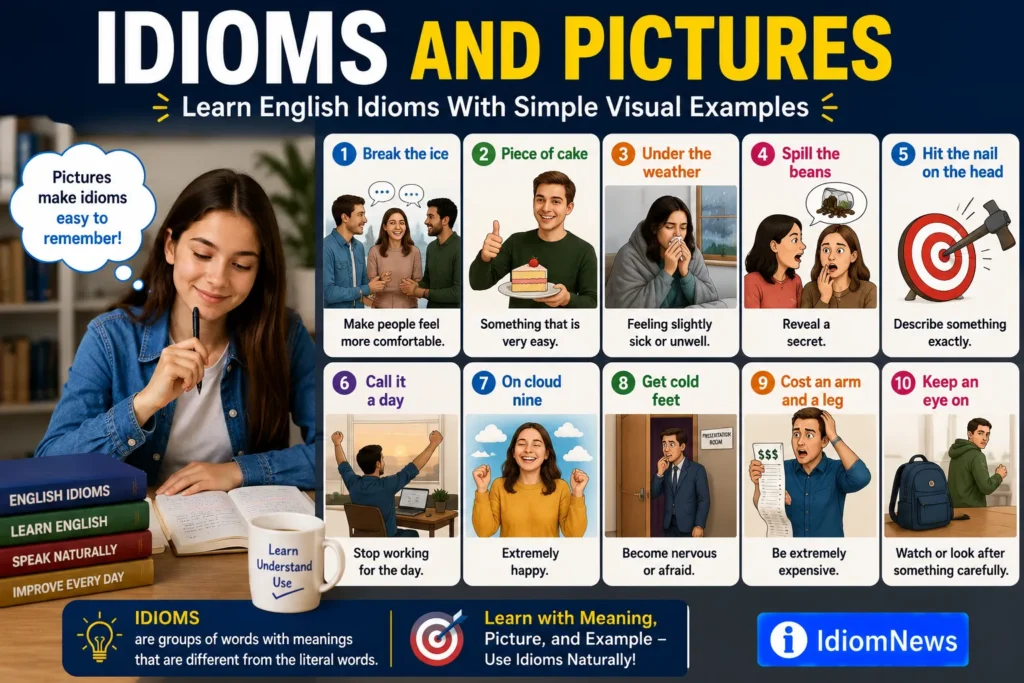
Idioms and Pictures: Learn English Idioms With Simple Visual Examples
Some English expressions make perfect sense when you read them literally. Others seem strange until you understand the idea behind them. When someone says, “She is on cloud nine,” they are usually not talking about a person floating in the sky. They mean that she is extremely happy. This is why learning idioms and pictures can be useful for English learners.
Pictures can create a quick mental connection between an expression and its meaning. Instead of memorizing words alone, learners can connect the phrase with a situation, action, or feeling. That can make unfamiliar expressions easier to recognize and remember.
Idioms are common in everyday conversations, books, television, interviews, social media, and workplace communication. They can also be difficult because their meanings are often different from the literal meanings of the individual words.
For example, “break the ice” does not mean breaking frozen water. It means helping people feel more relaxed when they first meet or begin talking.
Learning an idiom with a simple visual idea can make the meaning clearer. You can imagine people meeting at a party, one person telling a joke, and everyone becoming more comfortable. The picture gives the phrase a situation instead of leaving it as a group of words to memorize.
What Are Idioms and Pictures Used For?
Idioms and pictures are a learning approach in which an English idiom is connected with a visual scene that represents its meaning or situation. The picture helps learners understand the figurative idea behind the phrase, while the idiom provides the language needed to describe that idea naturally.
An idiom is a group of words whose meaning is different from the literal meaning of the individual words. Cambridge Dictionary defines an idiom in terms of this difference between the words themselves and the meaning of the expression as a whole. (dictionary.cambridge.org)
Pictures can make that difference easier to understand.
Consider:
Break the ice
Literal picture:
A person breaking a block of ice.
Meaning picture:
People meeting for the first time, smiling, talking, and becoming more comfortable.
The second picture represents the actual idea behind the idiom.
That is the basic value of combining visual context with language.
Why Pictures Can Help You Learn Idioms
A picture can give an abstract expression a concrete situation.
Imagine trying to memorize:
Spill the beans = reveal a secret.
You may remember the definition for a few minutes. But imagine a picture of a person accidentally telling someone about a surprise birthday party. Suddenly, the expression has a situation attached to it.
That gives you two things to remember:
The phrase: spill the beans
The situation: accidentally reveal secret information
The visual idea does not replace understanding. It supports it.
Pictures are also useful because many idioms contain strong images. Expressions such as under the weather, on thin ice, hit the nail on the head, and cost an arm and a leg naturally create mental pictures.
That makes them particularly suitable for visual learning.
Oxford Learner’s Dictionaries defines an idiom as a group of words whose meaning is different from the meanings of the individual words. (oxfordlearnersdictionaries.com)
When learners see the literal image and then connect it to the figurative meaning, they can better understand why an idiom is not meant to be interpreted word by word.
20 Common Idioms With Simple Picture Ideas
The following examples show how a visual scene can help explain common English idioms.
1. Break the Ice
Meaning: Make people feel more comfortable.
Example:
“I told a joke to break the ice.”
Picture idea:
A group of strangers meeting at a party while one person starts a friendly conversation.
The picture should focus on the social situation, not only on literal ice.
2. Piece of Cake
Meaning: Something very easy.
Example:
“The homework was a piece of cake.”
Picture idea:
A student finishing an easy task while a slice of cake sits nearby.
The cake can represent the expression without becoming the main focus.
3. Under the Weather
Meaning: Feeling slightly sick or unwell.
Example:
“I’m feeling under the weather today.”
Picture idea:
A tired person resting indoors while gray clouds appear outside.
The visual should communicate feeling unwell rather than literally placing weather over someone’s head.
4. Spill the Beans
Meaning: Reveal a secret.
Example:
“Tom spilled the beans about the surprise party.”
Picture idea:
A person accidentally telling another person about a secret celebration while other guests prepare quietly.
5. Hit the Nail on the Head
Meaning: Describe something exactly or identify the main problem.
Example:
“You hit the nail on the head when you said communication was the problem.”
Picture idea:
A person accurately placing a hammer onto a nail while another visual element suggests solving a problem.
6. Call It a Day
Meaning: Stop working for the day.
Example:
“We have finished everything important, so let’s call it a day.”
Picture idea:
Office workers closing laptops and leaving work near the end of the day.
7. On Cloud Nine
Meaning: Extremely happy.
Example:
“She was on cloud nine after receiving the award.”
Picture idea:
A very happy person celebrating with a bright, cheerful sky in the background.
8. Get Cold Feet
Meaning: Become nervous before doing something important.
Example:
“He got cold feet before the presentation.”
Picture idea:
A nervous person standing outside a stage or meeting room, hesitating before entering.
9. Cost an Arm and a Leg
Meaning: Be extremely expensive.
Example:
“That repair cost an arm and a leg.”
Picture idea:
A customer looking shocked at a very high bill.
The visual should communicate expensive pricing rather than showing a literal arm and leg being exchanged.
10. Keep an Eye on
Meaning: Watch or look after something carefully.
Example:
“Can you keep an eye on my bag?”
Picture idea:
A person watching a bag while its owner briefly walks away.
11. On Thin Ice
Meaning: Be in a risky situation.
Example:
“You’re on thin ice after missing another deadline.”
Picture idea:
A person carefully standing on cracked ice.
The literal scene works well because the image clearly represents danger and risk.
12. Go the Extra Mile
Meaning: Make more effort than expected.
Example:
“She went the extra mile to help the customer.”
Picture idea:
A worker helping a customer after completing the normal task.
A road or journey can also represent the idea of going beyond what was expected.
13. See Eye to Eye
Meaning: Agree with someone.
Example:
“We do not always see eye to eye.”
Picture idea:
Two people discussing a decision while both show agreement.
The visual should communicate shared opinions rather than simply showing two eyes.
14. Beat Around the Bush
Meaning: Avoid speaking directly.
Example:
“Stop beating around the bush and tell me the truth.”
Picture idea:
A person walking around a bush instead of walking directly toward another person.
This visual can combine the literal image with the communication meaning.
15. Keep Someone in the Loop
Meaning: Keep someone informed.
Example:
“Please keep me in the loop about the schedule.”
Picture idea:
A team sharing updates in a meeting while one person receives the latest information.
A communication circle can represent the idea without requiring a literal loop.
16. Miss the Boat
Meaning: Lose an opportunity by being too late.
Example:
“I waited too long and missed the boat.”
Picture idea:
A person arriving at a dock just after a boat has left.
This idiom has a strong visual connection between the literal scene and the figurative idea of a missed opportunity.
17. Back to Square One
Meaning: Return to the beginning after a failed attempt.
Example:
“The first plan failed, so we’re back to square one.”
Picture idea:
A board game or project plan showing someone returning to the starting point.
18. In Hot Water
Meaning: Be in trouble.
Example:
“He is in hot water after breaking the rules.”
Picture idea:
A worried person facing a difficult situation while a pot of hot water appears as a visual reference.
The situation should make the figurative meaning clear.
19. Have a Green Thumb
Meaning: Be very good at growing plants.
Example:
“My grandmother has a green thumb.”
Picture idea:
A person successfully caring for healthy plants and flowers.
This is a useful example because the idiom is closely connected with gardening.
20. The Ball Is in Your Court
Meaning: It is your responsibility to make the next move or decision.
Example:
“I have sent the proposal. The ball is in your court.”
Picture idea:
Two people on opposite sides of a tennis court, with one person waiting for the other to return the ball.
This image can make the idea of responsibility and the next action very clear.
Idioms and Pictures for Different Learning Levels
The best visual approach depends on the learner.
For Beginners
Beginners should start with common idioms that have clear meanings and simple examples.
Good choices include:
- Break the ice
- Piece of cake
- Call it a day
- Keep an eye on
- Under the weather
- Spill the beans
The picture should show one clear situation. Avoid complicated scenes with several possible meanings.
For a beginner, a picture of a person feeling sick while resting at home can make under the weather easier to understand than a complicated illustration full of unrelated details.
For Intermediate Learners
Intermediate learners can study idioms that require more attention to context.
Examples include:
- Read between the lines
- Go back to the drawing board
- Pull your weight
- Take the bull by the horns
- On the same page
- Bite the bullet
At this stage, the picture can show both the literal image and the figurative situation.
For example, go back to the drawing board can be connected to an engineer returning to a design after a failed test.
For Advanced Learners
Advanced learners should pay more attention to tone, register, regional usage, and context.
They can compare related expressions such as:
Very happy:
On cloud nine
Over the moon
Jump for joy
Very expensive:
Cost an arm and a leg
Break the bank
Uncertain:
Up in the air
On the fence
The goal at this level is not simply understanding the phrase. It is knowing which expression sounds best in a specific situation.
How Pictures Help With Figurative Meaning
Some idioms are difficult because the literal image and intended meaning are far apart.
Take “read between the lines.”
The literal words suggest reading a space between lines of text.
The figurative meaning is to understand something that is not directly stated.
A useful visual could show a person reading an email while noticing an unstated message behind the words.
The picture acts as a bridge between the literal phrase and the intended meaning.
Another example is “bite the bullet.”
The literal image is strange. Someone biting a metal bullet would be unusual and potentially dangerous.
The figurative meaning is to face something difficult with courage.
A better educational picture would show a person finally making a difficult phone call or accepting an uncomfortable task.
This distinction is important because pictures should help explain the meaning, not create another source of confusion.
Expert Insights: The Best Pictures Show Context
A useful picture does more than display the literal words.
It should help answer a simple question:
What situation would make a person say this?
For “break the ice,” show people beginning a conversation.
For “miss the boat,” show someone arriving too late.
For “keep someone in the loop,” show information being shared with a team.
For “on thin ice,” show a person facing a clear risk.
This approach gives learners something more valuable than decoration. It gives them context.
Another useful method is to combine three elements:
Idiom + simple meaning + realistic situation
For example:
Idiom: Go the extra mile
Meaning: Make more effort than expected
Situation: A customer service worker stays late to solve a customer’s problem
That combination makes the expression easier to understand because the learner can see how language, meaning, and real life connect.
Pictures can also help with comparison.
Suppose a learner wants to understand the difference between:
On cloud nine
Over the moon
Both describe strong happiness, but placing them beside similar happy situations can help the learner recognize that the expressions overlap without necessarily being identical in every context.
Visual learning is most useful when it supports understanding rather than replacing it. A picture cannot explain every grammatical detail, level of formality, or regional difference. A reliable dictionary and real examples are still valuable.
Common Mistakes When Learning Idioms With Pictures
1. Showing Only the Literal Meaning
A picture of an actual piece of cake does not automatically teach that piece of cake means something easy.
Why this is a problem: The learner may remember the object but miss the figurative meaning.
Better approach: Connect the object with a clear situation showing that the task is easy.
2. Making the Picture Too Complicated
A busy image can contain too many details.
Why this is a problem: The learner may not know which part of the picture represents the idiom.
Better approach: Use one main subject and one clear action or situation.
3. Ignoring Context
A picture can show the words without showing how people actually use the expression.
Why this is a problem: Learners may understand the meaning but still not know when to say it.
Better approach: Show the social, emotional, or practical situation where the idiom naturally occurs.
4. Treating Similar Idioms as Identical
Pictures can make two idioms look very similar when their usage is slightly different.
Why this is a problem: Related does not always mean interchangeable.
Better approach: Include a simple example sentence and explain the context.
5. Memorizing Images Without Language
A learner might recognize a picture but forget the actual phrase.
Why this is a problem: The goal is language learning, not image recognition.
Better approach: Always connect the picture with the exact idiom and a short example sentence.
How to Learn Idioms With Pictures Step by Step
- Choose one common idiom. Start with a phrase that you are likely to encounter in real English.
- Read the definition. Make sure you understand the figurative meaning before focusing on the picture.
- Imagine the situation. Ask where someone would naturally use the expression.
- Connect the phrase to a visual scene. Choose one simple situation that represents the meaning.
- Read a complete example sentence. This shows how the idiom works grammatically.
- Say the phrase aloud. Practice the pronunciation and natural rhythm.
- Create your own sentence. Connect the idiom with something familiar from your own life.
- Review without looking at the definition. Look at the phrase or visual and explain the meaning in your own words.
- Use the idiom naturally. Try it in a conversation or piece of writing when it genuinely fits.
- Return to the phrase later. Regular review helps move the expression from short-term memory into practical vocabulary.
A Simple Visual Learning Chart
| Idiom | Meaning | Best visual situation |
|---|---|---|
| Break the ice | Help people relax | New people starting a conversation |
| Piece of cake | Very easy | Someone quickly completing a simple task |
| Under the weather | Feel unwell | Sick or tired person resting |
| Spill the beans | Reveal a secret | Someone accidentally giving away a secret |
| On cloud nine | Extremely happy | Person celebrating wonderful news |
| Get cold feet | Become nervous | Person hesitating before an important event |
| Miss the boat | Miss an opportunity | Person arriving after a boat leaves |
| On thin ice | Be in a risky situation | Person standing on cracked ice |
| Go the extra mile | Make extra effort | Worker helping beyond normal duties |
| The ball is in your court | It is your turn to act | Tennis player waiting for the return |
This kind of chart works best as a quick review tool. Learners should still check the full meaning and examples before using an unfamiliar idiom.
How Teachers and Parents Can Use Idioms and Pictures
Pictures can be especially useful when teaching English to younger learners or students who are still developing vocabulary.
A teacher can introduce one idiom at a time.
For example:
Expression: Break the ice
Picture: Two groups of students meeting for the first time
Meaning: Help people feel comfortable
Example: “The teacher told a joke to break the ice.”
Then students can create their own sentences.
Another activity is to show a visual situation without giving the idiom.
For example, show a person arriving at an empty dock while a boat moves away.
Ask:
“What happened?”
The learner might answer:
“He missed the boat.”
This changes the activity from memorization into active recall.
Teachers can also give students several pictures and ask them to match each picture with an idiom.
This works particularly well with expressions that have strong visual associations, such as on thin ice, miss the boat, keep an eye on, and hit the nail on the head.
When Pictures Are Not Enough
Pictures are helpful, but they have limits.
Some idioms depend heavily on social context, tone, or grammar. A picture cannot always show whether an expression is suitable for a formal meeting or casual conversation.
For example, “piece of cake” can be easy to visualize, but the learner also needs to know that the expression is generally conversational and means something is very easy.
Similarly, “read between the lines” requires an understanding of implied meaning. A picture may illustrate the idea, but a short explanation is still useful.
This is why the strongest learning method combines:
- The idiom
- A simple definition
- A realistic visual situation
- A complete example sentence
- Context and tone
The picture supports the language. It does not replace the language.
Frequently Asked Questions About Idioms and Pictures
Q: What are idioms and pictures?
A: Idioms and pictures refer to learning English idiomatic expressions by connecting each phrase with a visual scene that represents its meaning or common use. For example, a picture of people meeting and becoming comfortable can help explain “break the ice.” The image gives the learner a memorable situation connected to the expression.
Q: Can pictures help you learn English idioms?
A: Yes. Pictures can make figurative expressions easier to understand by connecting words with a clear situation. They are especially useful for idioms that contain strong visual images, such as “miss the boat” or “on thin ice.” The picture works best when learners also study the definition and an example sentence.
Q: Why are idioms difficult to understand?
A: Idioms are difficult because their meanings often cannot be predicted from the individual words. Someone may know what “ball” and “court” mean but still not understand “the ball is in your court.” Context, tone, grammar, and familiarity all affect how easily an idiom can be understood and used.
Q: What is the easiest idiom to teach with a picture?
A: Idioms with clear situations are usually easier to teach visually. “Break the ice,” “miss the boat,” “on thin ice,” “keep an eye on,” and “hit the nail on the head” all have strong visual connections. A simple picture combined with a short definition and example sentence gives the learner both meaning and context.
Q: Should a picture show the literal or figurative meaning of an idiom?
A: It depends on the teaching goal. A picture showing the figurative situation is usually more helpful for understanding the actual meaning. However, showing the literal image first and then the intended meaning can help learners understand why the expression is idiomatic. The important part is making the difference clear.
Q: Are pictures enough to learn idioms?
A: No. Pictures are a helpful learning aid, but they should not replace definitions, examples, pronunciation, and context. A learner needs to know not only what an idiom means but also how it fits into a sentence and whether it sounds natural in a particular situation.
Q: How many idioms should I learn at once?
A: A small group is usually easier to manage than a very large list. Start with five or ten useful idioms, learn their meanings and examples, and review them regularly. Once you can recognize and use them comfortably, add another group. The goal is practical knowledge rather than collecting as many phrases as possible.
Q: Can advanced English learners benefit from learning idioms with pictures?
A: Yes. Advanced learners can use visuals to compare related idioms and understand differences in tone, strength, and context. For example, “on cloud nine” and “over the moon” both describe strong happiness, but learning them in different situations can help learners understand how English speakers choose between similar expressions.
Final Thoughts
Learning idioms and pictures together can turn difficult English expressions into clear, memorable ideas. A phrase that seems confusing on paper can become much easier when you connect it to a realistic situation.
Think about “miss the boat.” The words alone may seem mysterious. A simple picture of someone arriving at a dock just after a boat leaves immediately gives the learner a situation that matches the expression.
The same method can work with break the ice, spill the beans, under the weather, on thin ice, and many other common idioms.
The most effective visual learning does not depend on complicated artwork. A clear scene, a simple definition, and one natural example sentence are often enough.
Remember that pictures are a support tool, not a replacement for language. You still need to learn how an idiom behaves in a sentence, what tone it has, and when people naturally use it.
Start with a few common expressions and connect each one to a situation you can easily imagine. When the picture, meaning, and phrase become one mental idea, an unfamiliar idiom becomes much easier to remember.
A good picture does not merely show an idiom. It helps you understand what the speaker really means.
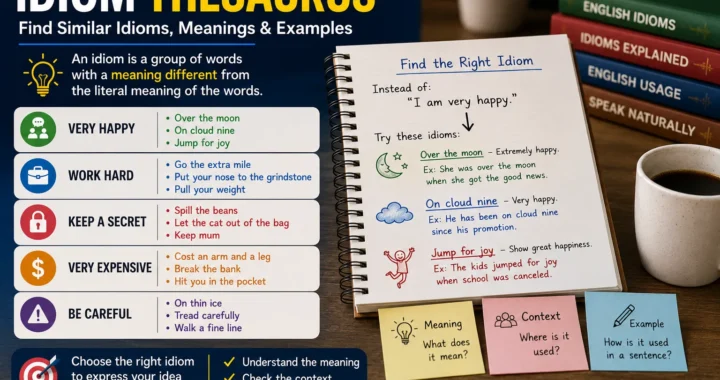
Read More: Idiom Thesaurus: Find Similar Idioms, Meanings & Examples

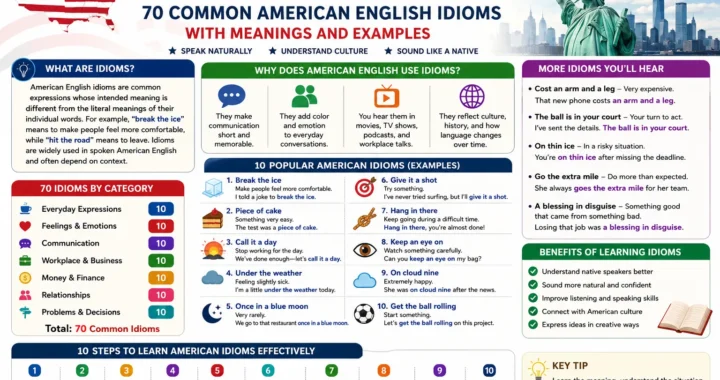
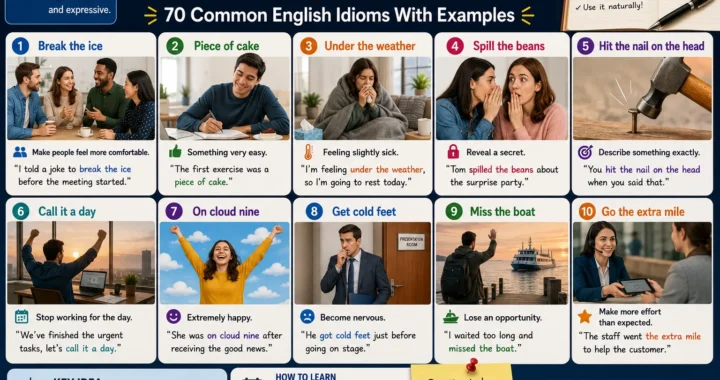
[…] Read More: Learn English Idioms with Simple Pictures & Visuals […]