
Idioms USA: 70 Common American English Idioms With Meanings and Examples
American English is full of expressions that can sound confusing when you hear them for the first time. Someone in the United States might say, “Give me a hand,” “That costs an arm and a leg,” or “We need to get the ball rolling.” These phrases are easy for fluent speakers to understand, but their literal words do not always explain what they mean.
That is why learning idioms USA can be useful for students, travelers, teachers, writers, and anyone who wants to understand American English more naturally.
An idiom is a group of words that has a meaning different from the individual words. The U.S. Department of State’s American English program has a dedicated reference guide to American English idioms and explains that idioms are closely connected to culture, everyday situations, and changes in language.
American English also includes many expressions that are shared with British, Canadian, Australian, and other varieties of English. So an idiom should not automatically be labeled as exclusive to the United States simply because Americans use it often.
The most useful approach is to learn common expressions in context. A meaning, a natural sentence, and an understanding of the situation will help you more than memorizing a long list of unusual phrases.
What Are Idioms in American English?
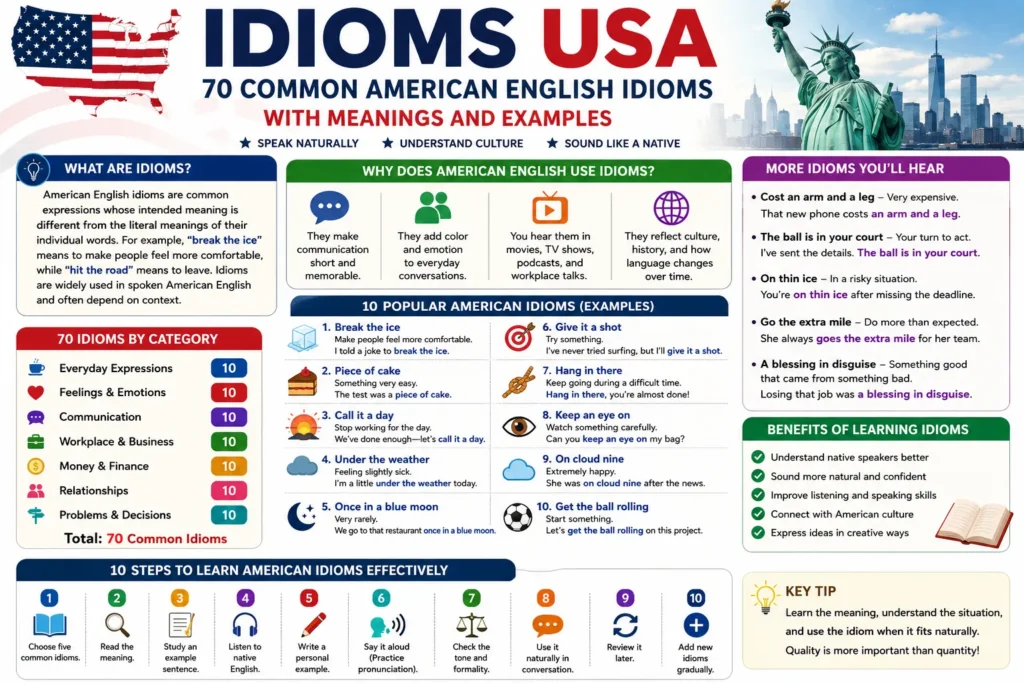
American English idioms are common expressions whose intended meaning is different from the literal meanings of their individual words. For example, “break the ice” means to make people feel more comfortable, while “hit the road” means to leave. Idioms are widely used in spoken American English and often depend on context.
The phrase “break the ice” provides a simple example.
If you interpret the words literally, you might imagine someone breaking frozen water.
In American English, the expression means:
Break the ice = make people feel more relaxed in a new social situation.
Example:
“I told a funny story to break the ice before the meeting.”
The phrase itself is not complicated. The challenge is understanding its figurative meaning.
The U.S. Department of State notes that American English contains many idioms, particularly in spoken language, and that these expressions can reflect culture and changing language use.
Why American English Uses So Many Idioms
Idioms make it possible to communicate familiar ideas in short, memorable ways.
Compare these two sentences:
“Let’s begin the meeting.”
and:
“Let’s get the ball rolling.”
Both can communicate the idea of starting something, but the second is more conversational.
Another example is:
“He became angry.”
Compared with:
“He lost his cool.”
The second version gives the sentence a more informal, conversational tone.
American English learners hear idioms in ordinary conversations, television programs, movies, podcasts, workplace discussions, and other forms of spoken language. The U.S. Department of State provides American English learning materials specifically focused on idioms and colloquial expressions for learners.
However, using idioms does not automatically make English better. The expression needs to fit the situation.
A casual phrase can sound perfectly natural when talking with friends but feel out of place in a formal report.
70 Common Idioms Used in the USA
The following expressions are useful examples of American English idioms. Some are also common in other varieties of English, so they should be understood as expressions commonly used in the United States rather than expressions that belong only to the United States.
Everyday American English Idioms
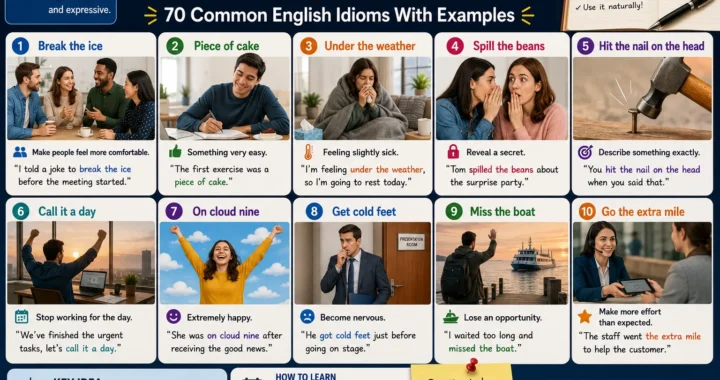
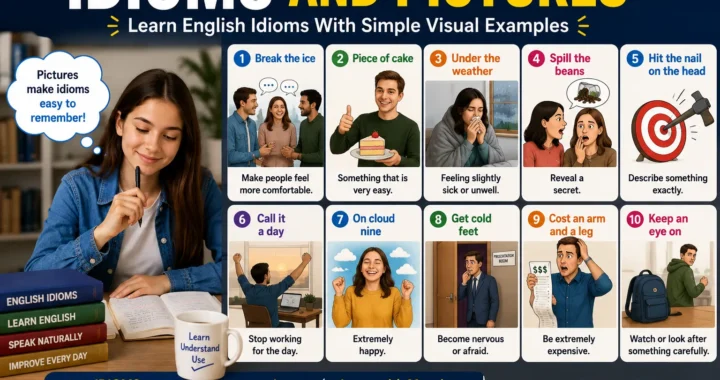
1. Break the ice
Meaning: Make people feel more comfortable.
Example:
“I asked everyone a simple question to break the ice.”
2. Piece of cake
Meaning: Something very easy.
Example:
“The first part of the test was a piece of cake.”
3. Call it a day
Meaning: Stop working for the day.
Example:
“We have finished the important work, so let’s call it a day.”
4. Under the weather
Meaning: Feeling slightly sick.
Example:
“I am feeling under the weather today.”
5. Once in a blue moon
Meaning: Very rarely.
Example:
“I eat at that restaurant once in a blue moon.”
6. Better late than never
Meaning: Doing something late is better than not doing it.
Example:
“He finally started exercising. Better late than never.”
7. So far, so good
Meaning: Things are going well until now.
Example:
“How is your new job?”
“So far, so good.”
8. Give it a shot
Meaning: Try something.
Example:
“I have never tried skiing, but I will give it a shot.”
9. Hang in there
Meaning: Keep going during a difficult time.
Example:
“Hang in there. You are almost finished.”
10. Keep an eye on
Meaning: Watch something carefully.
Example:
“Can you keep an eye on my bag?”
American Idioms About Feelings
11. On cloud nine
Meaning: Extremely happy.
Example:
“She was on cloud nine after getting the job.”
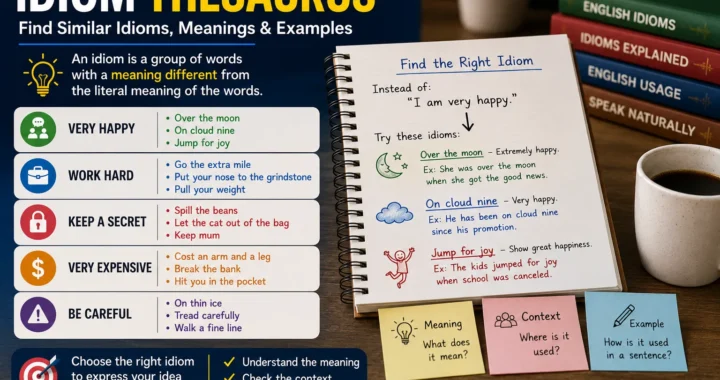
12. Over the moon
Meaning: Very happy or excited.
Example:
“His parents were over the moon about the news.”
13. Get cold feet
Meaning: Become nervous before an important event.
Example:
“He got cold feet before the wedding.”
14. Lose your cool
Meaning: Become angry.
Example:
“She lost her cool during the argument.”
15. Keep your chin up
Meaning: Stay positive during a difficult situation.
Example:
“Keep your chin up. Things will improve.”
16. Blow off steam
Meaning: Release stress, anger, or strong emotion.
Example:
“I go for a run to blow off steam after work.”
17. Green with envy
Meaning: Very jealous.
Example:
“She was green with envy when she saw her friend’s new car.”
18. Have a soft spot for
Meaning: Have a special liking for someone or something.
Example:
“I have a soft spot for old American movies.”
19. Jump for joy
Meaning: Show great happiness.
Example:
“The children jumped for joy when school ended.”
20. Have mixed feelings
Meaning: Feel both positive and negative emotions about something.
Example:
“I have mixed feelings about moving to another state.”
American Idioms About Communication
21. Beat around the bush
Meaning: Avoid saying something directly.
Example:
“Stop beating around the bush and tell me the truth.”
22. Speak your mind
Meaning: Say honestly what you think.
Example:
“She is comfortable speaking her mind.”
23. Read between the lines
Meaning: Understand an unstated meaning.
Example:
“If you read between the lines, the email sounds like a rejection.”
24. Get straight to the point
Meaning: Talk directly about the main subject.
Example:
“Let’s get straight to the point.”
25. Let the cat out of the bag
Meaning: Reveal a secret.
Example:
“Tom let the cat out of the bag about the surprise.”
26. Put words in someone’s mouth
Meaning: Claim that someone said something they did not say.
Example:
“Don’t put words in my mouth.”
27. Hear it through the grapevine
Meaning: Hear information through informal communication.
Example:
“I heard through the grapevine that the company is hiring.”
28. Put in a good word
Meaning: Say something positive about someone to help them.
Example:
“Could you put in a good word for me with your boss?”
29. Keep someone in the loop
Meaning: Keep someone informed.
Example:
“Please keep me in the loop about the project.”
30. Give someone the cold shoulder
Meaning: Ignore someone or treat them in an unfriendly way.
Example:
“She gave him the cold shoulder after their argument.”
American Workplace and Business Idioms
American workplaces use many idiomatic expressions, although the level of formality varies from one workplace to another.
31. Get the ball rolling
Meaning: Start something.
Example:
“Let’s get the ball rolling with the first question.”
32. Go the extra mile
Meaning: Make more effort than expected.
Example:
“Our customer service team went the extra mile to solve the problem.”
33. Learn the ropes
Meaning: Learn how a job or activity works.
Example:
“It took me a month to learn the ropes.”
34. Pull your weight
Meaning: Do your fair share of the work.
Example:
“Everyone needs to pull their weight.”
35. Keep your eye on the ball
Meaning: Stay focused on the main goal.
Example:
“We have many distractions, so keep your eye on the ball.”
36. Get off the ground
Meaning: Begin successfully.
Example:
“The new business finally got off the ground.”
37. Back to square one
Meaning: Return to the beginning after failure.
Example:
“The first plan failed, so we are back to square one.”
38. Put your best foot forward
Meaning: Make a good first impression.
Example:
“Put your best foot forward during the interview.”
39. Go back to the drawing board
Meaning: Start planning again after an idea fails.
Example:
“The first design did not work, so the engineers went back to the drawing board.”
40. Hit the nail on the head
Meaning: Describe or identify something exactly.
Example:
“You hit the nail on the head when you said communication was the main problem.”
American Idioms About Money
41. Make ends meet
Meaning: Have enough money to pay for basic needs.
Example:
“They are working extra hours to make ends meet.”
42. Cost an arm and a leg
Meaning: Be extremely expensive.
Example:
“That new car costs an arm and a leg.”
43. Tighten your belt
Meaning: Spend less money.
Example:
“We need to tighten our belts this month.”
44. Break even
Meaning: Reach the point where income equals costs.
Example:
“The store expects to break even by December.”
45. A ballpark figure
Meaning: A rough estimate.
Example:
“Can you give me a ballpark figure for the repairs?”
46. Cut corners
Meaning: Save time or money by skipping proper steps.
Example:
“The contractor cut corners, and the work had to be redone.”
47. In the black
Meaning: Making a profit or having positive finances.
Example:
“The company is finally in the black.”
48. In the red
Meaning: Losing money or owing money.
Example:
“The business has been in the red for several months.”
49. The bottom line
Meaning: The most important fact or result.
Example:
“The bottom line is that we need to reduce costs.”
50. In the same boat
Meaning: Be in the same difficult situation.
Example:
“We are all in the same boat, so let’s help each other.”
American Idioms About Relationships
51. Get along
Meaning: Have a friendly relationship.
Example:
“My brother and I get along very well.”
52. See eye to eye
Meaning: Agree with someone.
Example:
“We do not always see eye to eye.”
53. Have someone’s back
Meaning: Support someone.
Example:
“Don’t worry. I have your back.”
54. Give someone a hand
Meaning: Help someone.
Example:
“Can you give me a hand with these boxes?”
55. Be on good terms
Meaning: Have a friendly relationship.
Example:
“I am still on good terms with my former coworkers.”
56. Rub someone the wrong way
Meaning: Annoy someone.
Example:
“His attitude rubbed me the wrong way.”
57. Know someone inside out
Meaning: Know someone very well.
Example:
“She has worked with him for years and knows him inside out.”
58. Break someone’s heart
Meaning: Cause someone deep emotional pain.
Example:
“It broke her heart when her friend moved away.”
59. Go your separate ways
Meaning: Stop doing something together.
Example:
“After college, they went their separate ways.”
60. A people person
Meaning: Someone who enjoys interacting with people.
Example:
“She is a people person, so customer service suits her.”
American Idioms About Problems and Decisions
61. A tough nut to crack
Meaning: A difficult problem or difficult person.
Example:
“This technical problem is a tough nut to crack.”
62. Take the bull by the horns
Meaning: Deal with a difficult situation directly.
Example:
“She decided to take the bull by the horns and speak to the manager.”
63. In hot water
Meaning: Be in trouble.
Example:
“He is in hot water after missing an important deadline.”
64. On thin ice
Meaning: Be in a risky situation.
Example:
“You are on thin ice after breaking the rules again.”
65. Play it safe
Meaning: Avoid unnecessary risk.
Example:
“We decided to play it safe and leave early.”
66. Take a chance
Meaning: Accept some risk.
Example:
“I decided to take a chance and apply for the position.”
67. A blessing in disguise
Meaning: Something that seems bad but produces a good result later.
Example:
“Losing that job was a blessing in disguise.”
68. When push comes to shove
Meaning: When a situation becomes serious and action is required.
Example:
“When push comes to shove, he always accepts responsibility.”
69. The ball is in your court
Meaning: It is your responsibility to make the next move.
Example:
“I have sent you the proposal. The ball is in your court.”
70. Up in the air
Meaning: Still uncertain or undecided.
Example:
“Our vacation plans are still up in the air.”
Common American Idioms and Their Meanings
A useful way to study American English is to group expressions by the idea they communicate.
| Idiom | Simple meaning | Example |
|---|---|---|
| Break the ice | Help people feel comfortable | “I told a joke to break the ice.” |
| Piece of cake | Very easy | “The task was a piece of cake.” |
| Spill the beans | Reveal a secret | “He spilled the beans.” |
| Get the ball rolling | Start something | “Let’s get the ball rolling.” |
| Keep an eye on | Watch carefully | “Keep an eye on the kids.” |
| Go the extra mile | Make extra effort | “She went the extra mile.” |
| Make ends meet | Have enough money | “They work hard to make ends meet.” |
| Lose your cool | Become angry | “He lost his cool.” |
| On thin ice | Be in a risky situation | “You’re on thin ice.” |
| Up in the air | Be uncertain | “The plans are still up in the air.” |
| See eye to eye | Agree | “We see eye to eye.” |
| Miss the boat | Miss an opportunity | “I missed the boat.” |
Are These Idioms Used Only in the USA?
No. This is one of the most important points for anyone searching for idioms USA.
American English has its own vocabulary, expressions, cultural references, and usage patterns, but many idioms are shared across varieties of English.
For example, break the ice, once in a blue moon, cost an arm and a leg, and the ball is in your court are understood far beyond the United States.
The U.S. Department of State’s American English materials also explain that some idioms are used and understood in different parts of the English-speaking world, while others may be more limited by region or group.
So it is better to think in terms of common American usage rather than assuming that every expression in a list of American idioms is uniquely American.
This distinction becomes particularly important for learners who want to communicate internationally.
Expert Insights: How to Learn American Idioms Naturally
A common mistake is to treat an idiom as a vocabulary word with one exact translation.
That approach is often too simple.
When learning an American idiom, pay attention to four things:
Meaning: What does the expression communicate?
Context: Where would someone naturally say it?
Tone: Is it casual, neutral, humorous, or more formal?
Frequency: Is it an expression you are likely to hear regularly?
The U.S. Department of State’s American English program specifically recommends beginning idiom study with comprehension, including definitions and situations, before moving toward active speaking practice.
That approach makes practical sense.
Suppose you learn “cut corners.”
The meaning is:
Do something by skipping necessary steps, usually to save time or money.
Now consider the sentence:
“The company cut corners during construction.”
The context tells you that the company did not simply work quickly. It skipped proper steps, and the decision created a problem.
That is much more useful than memorizing only:
cut corners = do something cheaply
You should also listen for idioms in natural American speech. Voice of America provides English in a Minute, a resource specifically designed to explain American English colloquialisms and idioms through short listening examples.
This is useful because spoken English can sound different from a written vocabulary list.
A phrase you recognize on a page may be difficult to catch when someone says it quickly in a conversation. Listening helps bridge that gap.
Common Mistakes When Learning USA Idioms
1. Assuming Every American Idiom Is Unique to the United States
Some expressions commonly used in American English are also common elsewhere.
Why this is a mistake: English varieties overlap.
Better approach: Learn whether an expression is common in American English and check regional differences when they matter.
2. Translating Idioms Word by Word
A learner may try to translate “spill the beans” literally.
Why this is a mistake: The intended meaning comes from the whole expression.
Better approach: Learn the figurative meaning as one complete unit.
3. Using Idioms in Every Sentence
Fluent speakers do not need an idiom in every sentence.
Why this is a mistake: Excessive idiom use can sound forced.
Better approach: Use idioms when they fit the situation naturally.
4. Ignoring Formality
Expressions such as piece of cake and give it a shot are generally conversational.
Why this is a mistake: Casual expressions may not fit formal academic or professional writing.
Better approach: Match your language to your audience.
5. Learning the Meaning Without the Situation
Knowing that “on thin ice” means being in danger is useful, but it does not tell you how people naturally use it.
Better approach: Learn every new idiom with an example sentence and situation.
A Practical Way to Learn American English Idioms
- Choose five common idioms. Start with expressions you are likely to hear.
- Read the meaning. Make sure you understand the figurative idea.
- Study an example sentence. Notice how the expression works grammatically.
- Listen to native American English. Use podcasts, interviews, television, or resources such as Voice of America’s English in a Minute.
- Write a personal example. Connect the idiom with work, school, family, travel, or another familiar situation.
- Say the expression aloud. Practice its pronunciation and rhythm.
- Check the tone. Decide whether it is suitable for casual or formal communication.
- Use it naturally. Wait for a situation where the phrase genuinely fits.
- Review it later. Try to remember the meaning without looking at the definition.
- Add new idioms gradually. Build useful vocabulary instead of trying to memorize hundreds of expressions at once.
The U.S. Department of State’s American English resources take a similar learning approach by focusing on definitions, situations, comprehension, and eventually speaking practice.
Where to Check American English Idioms
A reliable dictionary is helpful when you are unsure about an idiom’s meaning, grammar, or usage.
The Cambridge Essential American English Dictionary is designed specifically for learners of American English and includes words, phrases, collocations, easy definitions, pronunciation information, and example sentences.
The U.S. Department of State’s American English program also provides an American English idiom reference and other learning resources.
The Merriam-Webster Learner’s Dictionary is another established resource recommended through the American English program for English teachers and learners.
These resources are especially useful when an expression looks familiar but you are unsure whether you are using it correctly.
When Should You Use American Idioms?
The best time to use an idiom is when it fits the situation and sounds natural.
Casual conversation
Idioms are often comfortable in everyday speech.
“The movie was a piece of cake.”
“Let’s call it a day.”
“Give it a shot.”
Workplace conversation
Some idioms are common at work:
“Let’s get the ball rolling.”
“Please keep me in the loop.”
“We’re all on the same page.”
Still, workplace culture varies. A very formal workplace may favor simpler language.
Academic writing
Use more care.
A sentence such as:
“The problem is a tough nut to crack.”
may sound conversational.
A formal alternative might be:
“The problem is difficult to solve.”
Both communicate the basic idea, but the second is more direct.
Good language choices depend on purpose, not just vocabulary size.
Frequently Asked Questions About Idioms USA
Q: What are idioms used in the USA?
A: American English uses many common idioms, including “break the ice,” “piece of cake,” “get the ball rolling,” “keep someone in the loop,” “make ends meet,” and “the ball is in your court.” Many are also used in other English-speaking countries, so they should not always be treated as uniquely American expressions.
Q: Are American idioms different from British idioms?
A: There is some overlap, but there are also differences in vocabulary, frequency, and preferred expressions. Some idioms are familiar across both varieties, while others may sound more natural in one country. Learners should focus on context and actual usage rather than assuming every expression belongs exclusively to one variety.
Q: What is the easiest American idiom for beginners?
A: “Piece of cake” is a simple one to learn because it means something is very easy. For example, “The homework was a piece of cake.” Other useful beginner expressions include “break the ice,” “call it a day,” and “give it a shot.”
Q: Do Americans use idioms in everyday conversation?
A: Yes. Idiomatic expressions are a normal part of spoken American English. The U.S. Department of State’s American English program describes idioms as especially common in spoken language and provides resources specifically designed to help learners understand them.
Q: Should English learners use American idioms?
A: Yes, especially common expressions that match their level and communication needs. Learners should first understand the meaning and situation, then practice using the idiom naturally. The goal is not to use as many expressions as possible, but to recognize and use familiar ones correctly.
Q: Are American idioms appropriate for formal writing?
A: Some may be, but many are more natural in conversation or informal writing. Academic, legal, and technical writing often benefits from clear and direct language. Before using an idiom, consider the reader, purpose, and level of formality.
Q: How can I learn American idioms faster?
A: Learn small groups of common idioms through definitions, example sentences, listening practice, and real situations. The U.S. Department of State recommends beginning with understanding meanings and situations before moving toward speaking activities. Regular exposure is more useful than trying to memorize a very large list at once.
Q: Where can I check the meaning of an American idiom?
A: Use established learner resources such as the Cambridge Essential American English Dictionary, Merriam-Webster’s Learner’s Dictionary, and the U.S. Department of State’s American English idiom resources. These sources can help with meanings, examples, pronunciation, and usage.
Final Thoughts
Learning idioms USA is really about understanding how American English is used in everyday situations.
Expressions such as break the ice, piece of cake, get the ball rolling, make ends meet, and the ball is in your court may seem strange when you first hear them. Once you understand the meaning and see the expression in a natural sentence, they become much easier to recognize.
Remember that American idioms are not always exclusive to the United States. English is shared across many countries, and expressions travel between regions. The U.S. Department of State specifically notes that some idioms are understood across different English-speaking communities, while others are more limited by region or group.
The most useful strategy is simple: learn a small number of common idioms, study their meanings and examples, listen to real American English, and use the expressions only when they fit naturally.
You do not need to sound overly informal or fill every sentence with colorful phrases. Strong English comes from choosing the right words for the right situation.
Learn the idiom, understand the situation, and let natural usage do the rest.