

Idiom Examples That Will Make Your English Sound More Natural
Introduction
Have you ever heard someone say “it’s raining cats and dogs” and wondered what animals have to do with the weather? That confusion is exactly what happens when you run into an idiom for the first time. Idiom examples are everywhere in everyday conversation, movies, books, and workplace chats, yet they rarely mean what the individual words suggest.
Learning idioms matters because they carry the flavor of a language. Native speakers use them without thinking, and if you don’t recognize them, you can miss the point of an entire conversation. A student might understand every single word in a sentence and still feel lost because the meaning lives in the phrase as a whole, not in the parts.
This is a common problem for language learners, new employees trying to follow office banter, and even native speakers who want to communicate with more color and confidence. The good news is that idioms follow patterns, and once you learn a good number of them, you start recognizing new ones faster.
Below you’ll find clear definitions, real examples grouped by theme, common mistakes people make, and a simple framework for learning idioms without feeling overwhelmed. Whether you’re preparing for an exam, polishing your business English, or just curious about why people talk about “kicking the bucket,” you’ll find practical answers here.
What Is an Idiom? (Quick Definition)
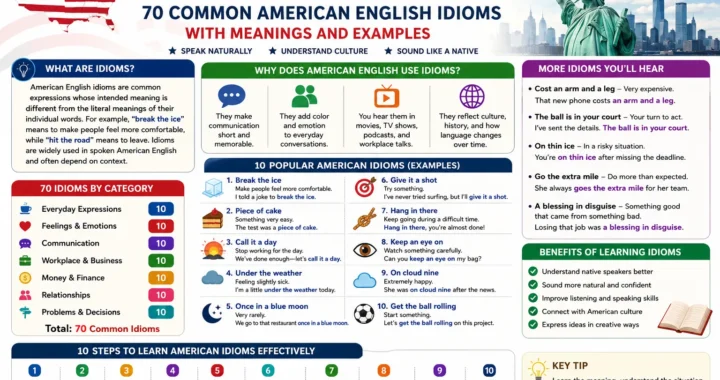
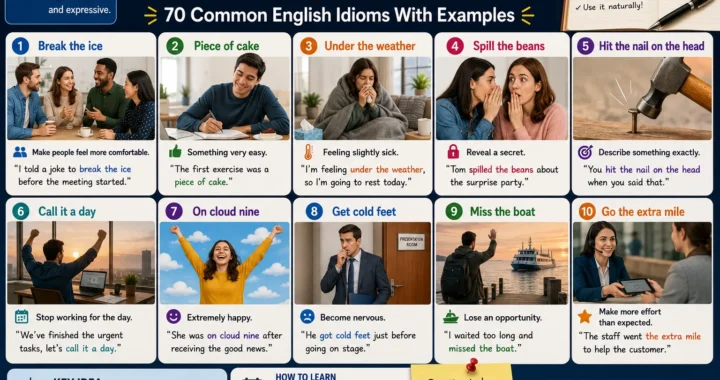
An idiom is a phrase or expression whose meaning cannot be understood by looking at the individual words. Idioms are fixed expressions that a language community accepts through common use. For example, “break the ice” doesn’t involve any actual ice. It means to ease tension in a social situation, usually by starting a friendly conversation.

Why Idioms Matter in Everyday English
Idioms give language personality. A sentence like “I’m feeling under the weather” sounds warmer and more natural than “I feel slightly unwell.” Native speakers reach for idioms because they are quick, familiar, and often more expressive than plain descriptions.
Idioms also carry cultural history. Many phrases came from sailing, farming, card games, or old customs that most people no longer practice, yet the expressions survived. “Show your true colors” comes from ships that once used flags to hide their nationality until the right moment. The action disappeared, but the phrase stayed.
For learners, idioms are also a sign of fluency. Textbooks teach grammar rules, but real conversations are full of shortcuts that only make sense once you’ve heard them before. Recognizing idioms helps you follow jokes, read between the lines, and sound less like a textbook and more like a person.
Idiom Examples Grouped by Everyday Situations
Learning idioms in isolated lists rarely sticks. Grouping them by situation makes them easier to remember and easier to use correctly.
Idioms About Feelings and Emotions
- Over the moon – extremely happy. “She was over the moon when she got the job offer.”
- Down in the dumps – feeling sad. “He’s been down in the dumps since his team lost.”
- Butterflies in my stomach – nervous excitement. “I always get butterflies in my stomach before a job interview.”
- On cloud nine – very happy about something specific. “They’ve been on cloud nine since the wedding.”
Idioms About Work and Effort
- Burn the midnight oil – work late into the night. “She burned the midnight oil to finish the report.”
- Bite the bullet – force yourself to do something difficult. “We just have to bite the bullet and start the project.”
- Learn the ropes – learn how to do a new job. “It took him a week to learn the ropes at his new office.”
- Cut corners – do something poorly to save time or money. “The contractor cut corners, and the roof started leaking within a year.”
Idioms About Money
- Break the bank – spend more money than you can afford. “A nice dinner out won’t break the bank.”
- Cost an arm and a leg – be very expensive. “That laptop cost an arm and a leg.”
- Tighten your belt – spend less money than before. “After losing his job, he had to tighten his belt.”
Idioms About Communication
- Beat around the bush – avoid saying something directly. “Stop beating around the bush and tell me what happened.”
- Spill the beans – reveal a secret. “Someone spilled the beans about the surprise party.”
- Hit the nail on the head – say something exactly right. “Her explanation hit the nail on the head.”
How Idioms Differ From Similar Expressions
People often confuse idioms with proverbs, slang, and metaphors. Understanding the difference helps you use each one correctly.
| Expression Type | What It Is | Example |
|---|---|---|
| Idiom | A fixed phrase with a non-literal meaning | “Spill the beans” (reveal a secret) |
| Proverb | A short saying that gives advice or a general truth | “Actions speak louder than words.” |
| Slang | Informal words used by a specific group, often changing quickly | “That’s lit” |
| Metaphor | A direct comparison between two unrelated things | “Time is money.” |
Idioms tend to be more fixed in wording than metaphors, which can be created freely. You can invent a new metaphor on the spot, but you can’t casually rearrange the words of an idiom and expect people to still understand it.
Expert Insights: How Fluent Speakers Actually Learn Idioms
People who become comfortable with idioms rarely memorize long lists in one sitting. Instead, they notice a phrase in context, guess its meaning from the situation, and confirm it later. This method works because idioms are tied to context. Hearing “break the ice” during an awkward introduction teaches you more than reading the definition on its own.
Frequency also matters more than variety at the beginning. A learner who deeply understands twenty common idioms will communicate better than one who has briefly seen two hundred. Common idioms show up again and again in daily speech, TV shows, and workplace emails, so mastering a smaller core set first gives you the most practical value.
Another pattern among fluent speakers is that they pay attention to the situations where idioms are appropriate. Idioms are usually casual. Using “kick the bucket” instead of “pass away” in a formal condolence message would sound out of place, even though both refer to death. Reading the tone of a conversation is just as important as knowing the meaning of the phrase.
[Internal Link: Related Article]
Common Mistakes People Make With Idioms
Mistake 1: Translating idioms word for word from another language. Every language has its own idioms, and they rarely match up directly. “It’s raining cats and dogs” makes no sense translated literally into most other languages. The fix is to learn the English idiom as a whole unit rather than trying to build it from translated parts.
Mistake 2: Changing the wording of a fixed idiom. Saying “hit the nail on its head” instead of “hit the nail on the head” sounds off to a native speaker, even if the meaning is technically clear. Idioms are fixed phrases, so small changes can make you sound unnatural or even confuse the listener.
Mistake 3: Using idioms in the wrong tone or setting. Idioms are usually informal. Using several idioms in a formal business report or academic essay can feel out of place. Save idioms for conversation, casual writing, and informal presentations.
Mistake 4: Assuming every idiom is understood the same way everywhere. Some idioms are common in American English but rare in British English, and the other way around. “Table a discussion” means to postpone it in American English but to start discussing it in British English. Always consider your audience.
Mistake 5: Overusing idioms in a single conversation. Packing too many idioms into one sentence or paragraph can sound forced rather than natural. Fluent speakers sprinkle idioms in, they don’t stack them on top of each other.
A Simple Framework for Learning Idioms Step by Step
- Start with a small, common list. Choose 15 to 20 idioms that appear often in daily conversation, workplace settings, or the media you consume most.
- Learn each idiom with an example sentence, not just a definition. Context helps the meaning stick far better than a dictionary-style explanation alone.
- Notice idioms when you hear or read them. Keep a simple notebook or phone note where you jot down new idioms you come across during the week.
- Practice using one or two new idioms in real conversation. Speaking them out loud, even in a low-stakes setting, builds confidence faster than silent memorization.
- Review idioms regularly using spaced repetition. Revisit your list every few days so the phrases move from short-term memory into long-term memory.
- Pay attention to tone and setting. Notice when native speakers use an idiom, and when they switch to plain language instead.
- Expand gradually. Once your core list feels comfortable, add new idioms grouped by theme, such as idioms about time, health, or relationships.
Idioms That Confuse Learners the Most
Some idioms cause more confusion than others because their imagery is unusual or their meaning shifted over time.
- Once in a blue moon – something that happens very rarely, not related to the moon’s actual color.
- The whole nine yards – doing everything possible or going all the way, with an origin that is still debated.
- Let the cat out of the bag – to reveal a secret, similar in meaning to “spill the beans.”
- Bark up the wrong tree – to pursue a mistaken course of action or blame the wrong person.
Understanding these takes repeated exposure, so don’t worry if a few idioms don’t make sense right away. Even native speakers sometimes use idioms without knowing their exact origin.
Frequently Asked Questions
Q: What is the easiest way to remember idioms? A: Learn idioms with a full example sentence instead of just the definition. Context gives your brain a memorable anchor. Grouping idioms by theme, such as emotions or money, also makes them easier to recall than a random alphabetical list.
Q: Are idioms the same in British and American English? A: Not always. Some idioms, like “break the ice,” are shared, while others differ or carry different meanings. For example, “table a motion” means to postpone it in American English but to begin discussing it in British English.
Q: How many idioms should a beginner learn first? A: Start with 15 to 20 of the most common idioms used in daily conversation. Mastering a small, frequently used set gives you more practical value than trying to memorize hundreds of rare expressions right away.
Q: Can idioms be used in formal writing? A: Generally, idioms are better suited for casual conversation and informal writing. Formal reports, academic papers, and official documents usually call for plain, direct language instead.
Q: Where do idioms come from? A: Many idioms originated from historical practices such as sailing, farming, or old games, and the phrases stuck around even after the original activity faded from daily life. Others grew out of literature, religious texts, or popular culture.
Q: Is it rude to use idioms with non-native speakers? A: It isn’t rude, but it can cause confusion if the listener isn’t familiar with the phrase. It helps to explain the meaning briefly the first time you use an idiom with someone who may not know it.
Q: What’s the difference between an idiom and a phrasal verb? A: A phrasal verb combines a verb with a preposition or adverb to create a new meaning, such as “give up” meaning to quit. An idiom can include phrasal verbs but usually refers to a longer, fixed expression with a non-literal meaning.
Q: Do idioms change over time? A: Yes. Some idioms fall out of use as the culture around them changes, while new ones emerge from technology, movies, and social media. Language is always shifting, and idioms shift along with it.
Bringing Idioms Into Your Everyday English
Idioms are not just decoration. They are a working part of how people actually speak, joke, complain, and connect with each other. Once a handful of idiom examples start feeling familiar, you’ll notice them everywhere: in conversations with coworkers, in the shows you watch, and in casual messages from friends.
The goal isn’t to memorize every idiom in the English language. It’s to build a comfortable, working set that lets you understand what people mean and, when it fits naturally, use a few yourself. Start small, pay attention to context, and let your list grow at a pace that feels manageable.
The next time someone tells you they’re “burning the midnight oil” or that a plan will “cost an arm and a leg,” you won’t just understand the words. You’ll understand exactly what they mean, and that’s the real mark of fluency.
Read More: What Is an Idiom? Meaning, Examples & Uses