


Idiom Meaning Explained: How to Understand Phrases That Don’t Make Literal Sense
Introduction
You hear someone say “let’s not beat around the bush” and you understand every word, yet the sentence still feels strange if you picture an actual bush being hit. That gap between the words and the real meaning is exactly what confuses so many people when they first try to figure out an idiom meaning.
This confusion is common among language learners, students preparing for reading tests, and even native speakers who grew up hearing a phrase without ever stopping to ask what it actually stands for. Idioms are used constantly in daily speech, on TV, in books, and at work, so misunderstanding one can mean missing the point of an entire sentence.
The problem gets worse because idioms almost never explain themselves. There’s no built-in clue in “kick the bucket” that tells you it means to die. You either learn the meaning from someone, from context, or from a resource like this one.
Below you’ll find a clear explanation of what an idiom meaning actually is, how to figure one out on your own, real examples broken down piece by piece, and answers to the questions people search for most when they run into a confusing phrase. By the end, you’ll have a reliable method for decoding almost any idiom you come across.
What Does “Idiom Meaning” Actually Refer To? (Quick Definition)
An idiom meaning is the actual message a fixed expression communicates, which is often completely different from what the individual words suggest. For example, the idiom meaning of “spill the beans” is to reveal a secret, even though the sentence has nothing to do with beans or spilling anything.
Why Idiom Meanings Are Different From Literal Word Meanings
Idioms work because a group of speakers agreed, over time, to use certain words as a stand-in for a completely different idea. The literal words become almost irrelevant, and the phrase as a whole carries the real message.
Take “it’s raining cats and dogs.” No animals are falling from the sky. The idiom meaning is simply that it’s raining very heavily. If you tried to translate this phrase word for word into another language, most people would have no idea what you meant.
This is what makes idioms tricky for anyone learning English as a second language, and even for native speakers encountering an older or regional phrase for the first time. The individual words act more like a costume than an explanation.

How to Figure Out an Idiom Meaning From Context
You won’t always have a dictionary nearby when you hear a new idiom, so learning to guess the meaning from context is a valuable skill.
Step 1: Look at the Situation
If someone says “I think we should call it a day” at the end of a long meeting, the situation itself gives you a strong hint. The idiom meaning here is to stop working for the time being, which fits naturally with the context of a tiring meeting.
Step 2: Notice the Tone
Idioms often carry emotional weight. “She hit the roof when she saw the mess” clearly signals anger, even before you know the exact idiom meaning of “hit the roof,” which is to become extremely angry.
Step 3: Ask or Look It Up
If context doesn’t give you enough information, it’s completely fine to ask directly or search for the phrase. Guessing wrong and repeating an idiom incorrectly can cause more confusion than simply asking what it means.
[Internal Link: Related Article]
Common Idioms and Their Real Meanings
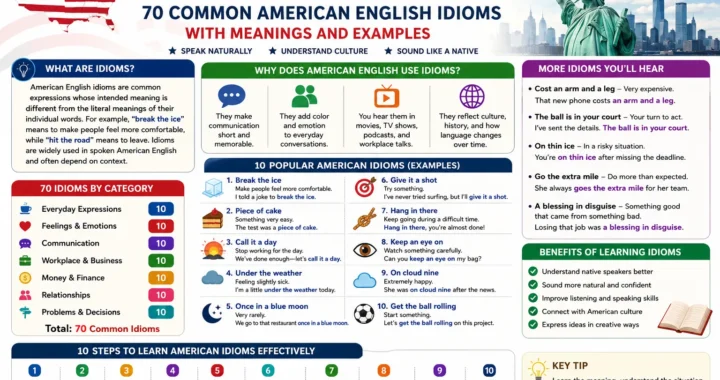
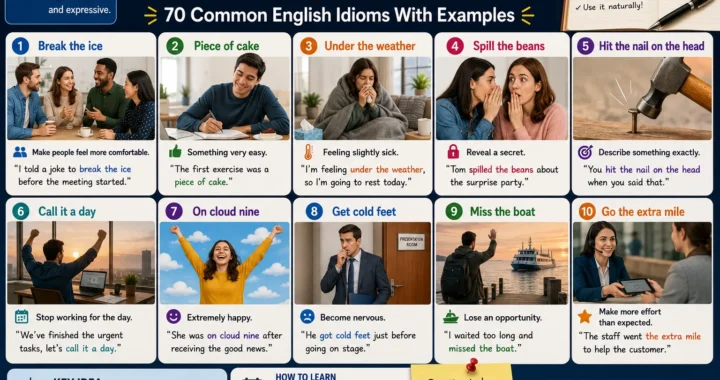
Seeing idioms side by side with their real meanings helps the pattern stick faster than reading definitions alone.
| Idiom | Idiom Meaning |
|---|---|
| Break the ice | Ease tension in a social situation |
| Under the weather | Feeling slightly unwell |
| Bite the bullet | Force yourself to do something difficult |
| Once in a blue moon | Something that happens very rarely |
| Piece of cake | Something very easy to do |
| Hit the nail on the head | Say something exactly right |
Notice that none of these meanings can be guessed just by translating the individual words. That’s the entire point of an idiom. The meaning lives in the phrase as a whole, agreed upon by common use over time.
Expert Insights: Why Idiom Meanings Are So Hard to Guess Correctly
Idioms often come from specific historical activities, and once that activity fades from daily life, the literal meaning fades with it. “Show your true colors” comes from old naval flag signals, but almost nobody thinks about ships when they use the phrase today. The idiom meaning survived long after the original context disappeared.
This explains why idioms feel arbitrary to new learners. You’re not missing a logical connection, because in most cases, the direct logical connection genuinely isn’t there anymore. It has been replaced by decades or centuries of common usage.
A more reliable approach than trying to reason out an idiom’s logic is to treat each idiom as a small vocabulary item on its own, similar to memorizing a new word. Once you accept that idioms are learned as whole units rather than decoded piece by piece, the process becomes much less frustrating.
Common Mistakes People Make When Learning Idiom Meanings
Mistake 1: Trying to translate an idiom word for word. This almost never works because idiom meanings rarely match a literal translation in another language. Learn the idiom as a complete phrase with its full meaning attached, rather than building it up word by word.
Mistake 2: Assuming every native speaker can explain the origin. Many native speakers use idioms correctly without knowing where they came from. This is completely normal, so don’t worry if you can’t trace the history of every phrase you learn.
Mistake 3: Changing the wording of the idiom. Saying “hit the nail in the head” instead of “hit the nail on the head” sounds unnatural, even if the meaning still comes across. Idioms are fixed expressions, so the exact wording usually needs to stay the same.
Mistake 4: Ignoring regional differences. Some idioms carry different meanings depending on the region. “Table a proposal” means to postpone it in American English but to begin discussing it in British English. Always consider your audience when using or interpreting an idiom.
Mistake 5: Overthinking the literal words instead of the overall message. Getting stuck on the individual words of an idiom, instead of focusing on the whole expression, usually leads to more confusion, not less. Step back and consider the full phrase and its context together.
A Practical Framework for Decoding Any Idiom
- Read or listen to the full sentence, not just the idiom. The surrounding words usually give strong clues about the intended idiom meaning.
- Consider the emotional tone of the situation. Anger, happiness, frustration, and excitement often point you toward the right category of meaning.
- Check if the idiom appears elsewhere in a similar context. Many idioms repeat across shows, articles, and conversations, so recognizing a pattern helps confirm your guess.
- Look the phrase up if you’re still unsure. A quick search or a reliable dictionary entry will confirm the idiom meaning and give you an example sentence.
- Write the idiom down with its meaning and an example. Keeping a simple running list makes review much easier later.
- Practice using the idiom yourself. Saying it out loud or writing it in a sentence helps the meaning stick far better than passive reading alone.
- Revisit your list regularly. Idioms fade from memory quickly if they’re only seen once, so regular review matters more than the length of your list.
Frequently Asked Questions
Q: What is the simplest way to explain what an idiom meaning is? A: An idiom meaning is the real message behind a fixed phrase, which is usually very different from what the individual words say on their own. For example, “break a leg” actually means good luck, not an instruction to injure yourself.
Q: Why can’t I just guess an idiom’s meaning from its words? A: Idioms often come from historical events, old customs, or activities that no longer exist in daily life, so the literal words no longer connect logically to the meaning. The meaning is agreed upon through common usage rather than through logic.
Q: Do idioms have the same meaning in every English-speaking country? A: Not always. Some idioms are shared everywhere, while others differ in meaning between regions, such as American and British English. It helps to confirm the meaning if you’re speaking with someone from a different English-speaking region.
Q: Is it okay to use an idiom if I’m not completely sure of its meaning? A: It’s better to confirm the meaning first, since using an idiom incorrectly can confuse your listener or change your intended message. A quick check before using a new idiom saves you from an awkward misunderstanding later.
Q: How can I remember idiom meanings more easily? A: Learn each idiom with a full example sentence instead of just its definition, since context creates a stronger memory anchor. Grouping idioms by theme, such as emotions or money, also makes them easier to recall.
Q: Are idioms considered formal or informal language? A: Most idioms are informal and work best in casual conversation, friendly writing, or informal presentations. Formal documents and academic writing usually call for more direct, literal language instead.
Q: Can the meaning of an idiom change over time? A: Yes, idiom meanings can shift slightly as culture and language change, and some idioms fall out of use entirely while new ones appear. Language is constantly evolving, and idioms evolve right along with it.
Understanding Idiom Meaning Is a Skill You Can Build
Every idiom you learn adds another small piece to how confidently you understand real, everyday English. The words themselves may not make literal sense, but the meaning behind them becomes clear once you know the phrase, and that recognition gets faster with practice.
Instead of trying to reason out the logic behind every expression, focus on learning each idiom meaning as a complete unit, supported by an example and a bit of context. Over time, these phrases stop feeling like puzzles and start feeling like natural parts of your vocabulary.
The next time you hear someone say they’re going to “bite the bullet” or that a task is a “piece of cake,” you won’t just recognize the words. You’ll understand exactly what they mean, and that understanding is what real fluency looks like.
Read More: Idiom Examples: Meanings & Everyday Uses


[…] Read More: Idiom Meaning Explained with Easy Examples […]