

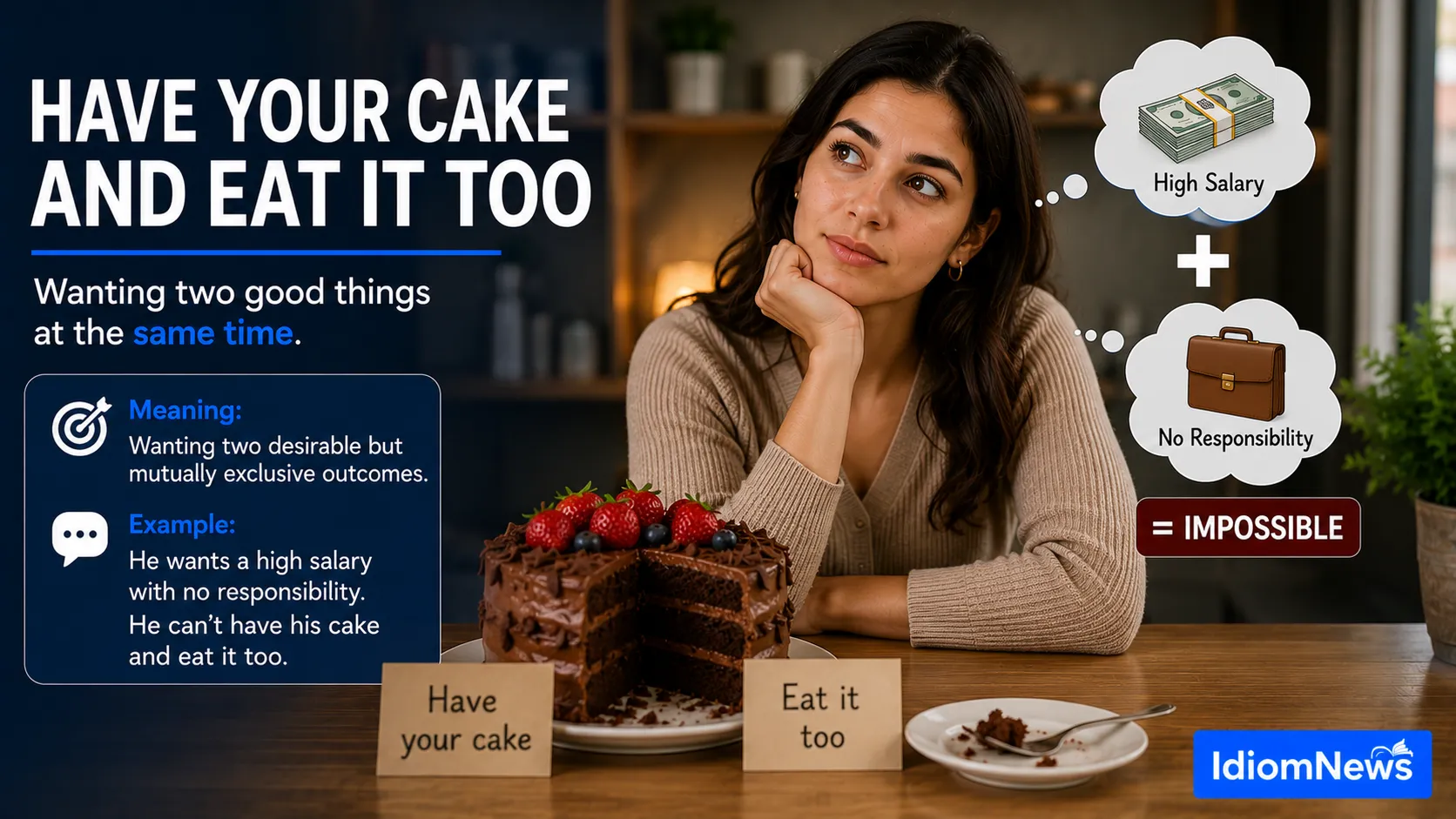
Someone wants a promotion with more pay but refuses to take on any extra responsibility. A friend says, “You can’t have your cake and eat it too.” That’s usually the moment people either nod in recognition or pause, confused about why cake is involved at all.
The have your cake and eat it too idiom is one of the more logically confusing expressions in English, mostly because the wording seems backward at first glance. Wouldn’t having cake and eating it be the whole point of owning cake in the first place?
That confusion is exactly why this idiom trips up so many people, including native English speakers who use it without ever stopping to examine its logic.
Understanding this phrase clearly, including where it came from and why the wording works the way it does, makes it far easier to use correctly and recognize instantly in conversation, writing, or media.
By the end of this piece, you’ll know exactly what this idiom means, why the phrasing seems contradictory, and how to use it naturally in your own conversations.
What Does “Have Your Cake and Eat It Too” Mean?
“Have your cake and eat it too” means wanting two desirable but mutually exclusive outcomes at the same time. It describes a situation where someone wants all the benefits of two choices without giving up anything or making a necessary trade-off. For example, wanting a high-paying job with zero responsibility fits this idiom perfectly.
Why the Wording Seems Backward
Many people find this idiom confusing because the order of the words doesn’t match the logical order of events.
Think about it step by step: you have to possess cake before you can eat it. So “have your cake and eat it too” seems to suggest something obvious, not something impossible.
The confusion clears up once you flip the logic. The idiom really means keeping your cake (not eating it) while also eating it, which is physically impossible. Once cake is eaten, it’s gone.
Some linguists and writers have pointed out that an older, clearer version of the phrase was “eat your cake and have it too,” which makes the impossibility more obvious. Over time, common usage flipped the word order, even though the meaning stayed the same.
How This Idiom Is Used in Real Sentences
Seeing the idiom in context makes its meaning much easier to grasp than any definition alone.
- “She wants to work from home full-time but also expects the same career growth as people in the office. She can’t have her cake and eat it too.”
- “He wants to save money every month but also travel constantly. At some point, he’ll realize he can’t have his cake and eat it too.”
- “You can’t complain about being tired all the time while also refusing to change your sleep schedule. That’s trying to have your cake and eat it too.”
Notice how each example involves someone wanting two conflicting outcomes without accepting any trade-off between them.
Similar Idioms That Express the Same Idea
A few other idioms carry a similar meaning, which can help reinforce understanding through comparison.
- “You can’t have it both ways” – A more direct, less imagery-based way of expressing the same conflict.
- “There’s no free lunch” – Suggests that everything comes with a cost, even if it isn’t obvious upfront.
- “Pick your poison” – Implies you have to choose between two less-than-perfect options, rather than avoiding the choice entirely.
While these idioms aren’t identical, they all touch on the same underlying idea: getting everything you want, with no trade-offs, usually isn’t realistic.
Expert Insights: Why This Idiom Endures Despite Its Confusing Structure
Idioms with unclear or seemingly backward logic often survive for generations because the underlying concept, wanting everything without sacrifice, remains a common and relatable human experience.
Even though the phrase’s word order confuses many speakers, repeated exposure through conversation and media has kept it firmly in everyday use. People learn the meaning through context long before they ever question the logic behind the wording.
This idiom is a useful example for language learners because it shows that idiomatic meaning doesn’t always need to make immediate literal sense. Sometimes the meaning is understood collectively through consistent use, regardless of whether the phrasing holds up under close examination.
For this reason, this idiom is often used in classrooms and language guides specifically to illustrate how idioms can persist even when their logic seems questionable at first glance.
Common Mistakes People Make With This Idiom
Mistake 1: Assuming the idiom is about greed
While it touches on wanting more than is realistic, the idiom isn’t necessarily about greed. It’s about the logical impossibility of keeping something whole while also consuming it.
Mistake 2: Using it for situations involving simple choices
This idiom applies specifically to situations involving mutually exclusive outcomes, not everyday decisions with no real conflict.
Mistake 3: Confusing it with wanting too much in general
The idiom isn’t a general statement about ambition. It specifically points out a contradiction between two things someone wants simultaneously.
Mistake 4: Getting stuck on the confusing word order
Some people avoid using the idiom because the phrasing feels backward. Understanding the historical “eat your cake and have it too” version can make the logic click more easily.
Practical Steps to Use This Idiom Correctly
- Identify a genuine contradiction in the situation before using the idiom, since it only fits when two desired outcomes truly conflict.
- Use it to point out unrealistic expectations, especially when someone wants full benefits without any trade-off.
- Pair it with a specific example to make the meaning clearer, especially with someone unfamiliar with the idiom.
- Avoid using it for simple either-or decisions that don’t involve conflicting desires.
- Practice recognizing the idiom in real conversations or writing, since seeing it used naturally reinforces understanding far better than memorizing the definition alone.
Frequently Asked Questions
Q: What does “have your cake and eat it too” mean?
A: It means wanting two desirable outcomes that can’t realistically coexist without a trade-off. It usually describes someone hoping to enjoy all the benefits of two choices without giving anything up.
Q: Why does the phrase seem backward?
A: Logically, you must have cake before eating it, so the phrase seems obvious rather than impossible. The original, clearer version was “eat your cake and have it too,” which better reflects the intended meaning.
Q: Is this idiom used only in negative situations?
A: It’s typically used to point out unrealistic expectations, often in a mildly critical or observational tone. It’s rarely used in a purely positive or celebratory context.
Q: Can this idiom apply to relationships?
A: Yes. It’s often used when someone wants the freedom of being single while also enjoying the benefits of a committed relationship, without compromising on either side.
Q: Is there a shorter way to express the same idea?
A: “You can’t have it both ways” expresses a very similar meaning with more direct, less figurative language, making it a useful alternative in casual conversation.
Q: Did this idiom originate recently?
A: No, it has been in use for centuries, with earlier versions dating back several hundred years in English, though the exact wording has shifted slightly over time.
Q: Is this idiom common in everyday conversation?
A: Yes, it’s widely recognized and used across most English-speaking regions, making it one of the more universally understood idioms related to trade-offs and unrealistic expectations.
Bringing It All Together
The have your cake and eat it too idiom captures a simple, relatable truth: you usually can’t get everything you want without giving something up. Once you understand the logic behind the confusing wording, the meaning becomes clear and easy to apply.
This idiom works best when pointing out a genuine contradiction, someone wanting two conflicting outcomes without accepting any trade-off between them. Recognizing that distinction helps you use it accurately rather than applying it to every situation involving choice.
Read More: English Idioms: How They Differ Across Regions and Why They Trip Up Learners

[…] Read More: “Have Your Cake and Eat It Too” Idiom: What It Really Means […]