

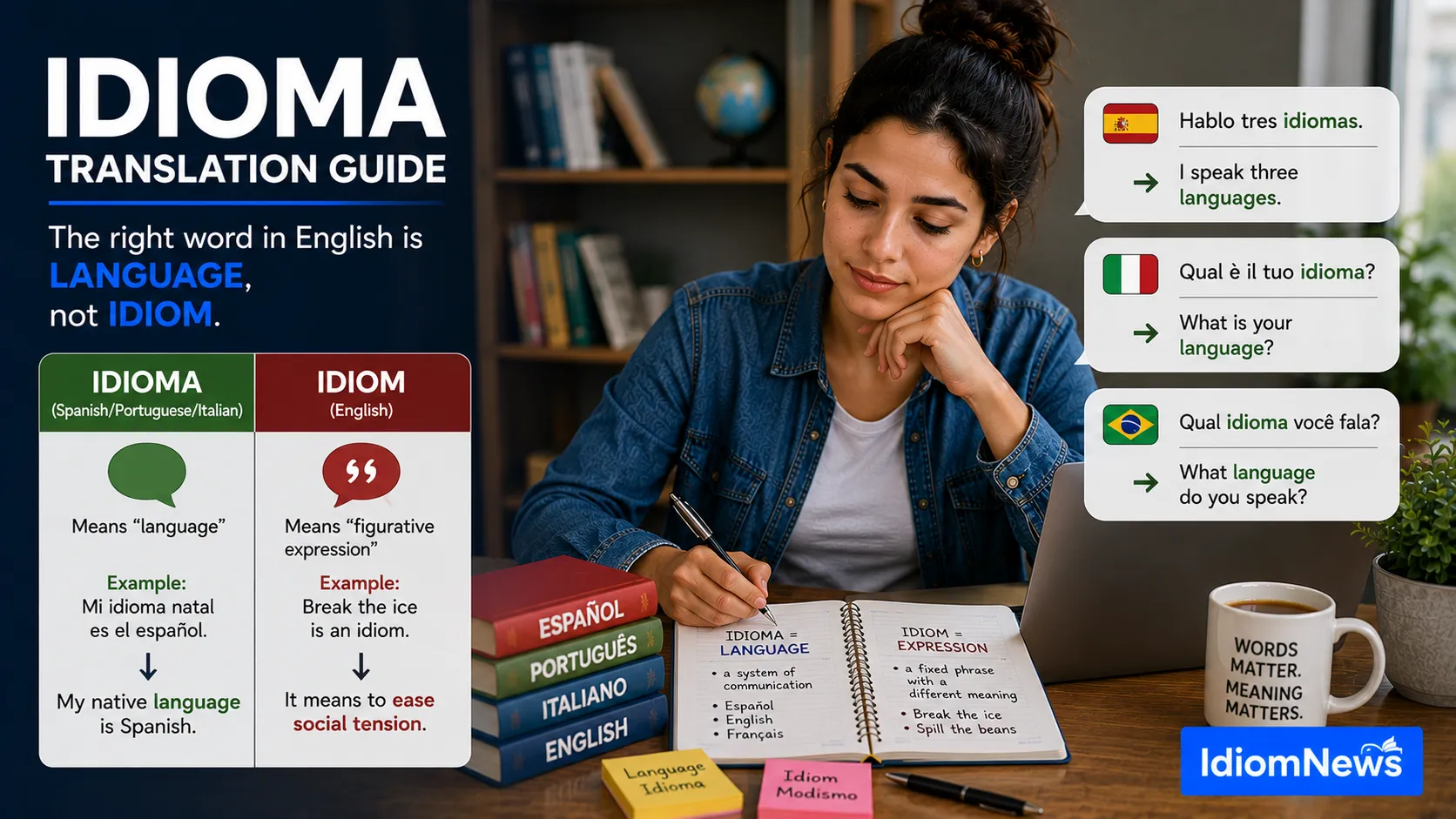
A student writing an English essay types “my native idioma is Spanish,” expecting the sentence to make sense. It doesn’t, at least not in English. That one small word choice reveals a translation mistake that happens constantly among Spanish, Portuguese, and Italian speakers writing or speaking in English.
The word idioma doesn’t carry over directly into English the way many learners assume. Understanding exactly how to translate it, and why a direct swap often creates confusion, saves learners from a mistake that quietly undermines otherwise fluent writing and speech.
This matters most for bilingual students, translators, and anyone moving between English and a Romance language like Spanish, Portuguese, or Italian on a regular basis.
Getting this translation right isn’t complicated once you understand the underlying pattern. It just requires knowing which English word actually replaces idioma in different situations.
By the end of this piece, you’ll know exactly how to translate idioma into English correctly, in formal writing, casual speech, and academic contexts.
What Does “Idioma” Translate to in English?
“Idioma” translates to “language” in English, not “idiom.” It’s used in Spanish, Portuguese, and Italian to refer to a specific language, such as Spanish, English, or French. The English word “idiom,” despite looking similar, refers to a figurative expression instead, making direct translation a common source of confusion.
Why Direct Translation Fails Here
Translating word for word feels like the safest approach, especially for beginners. With idioma, that instinct backfires completely.
The words share a Latin root, which explains why they look so similar. But English shifted the meaning toward figurative expressions over time, while Spanish, Portuguese, and Italian kept the meaning closer to “language.”
This is a classic example of what linguists call false friends: words that look nearly identical across languages but carry different meanings. Direct translation assumes shared meaning, which simply isn’t true here.
Recognizing this pattern early prevents a mistake that can otherwise slip into essays, presentations, and everyday conversation without the speaker even noticing.
How to Translate “Idioma” Correctly in Different Contexts
The correct English translation shifts slightly depending on how the word is used in the original sentence.
- Referring to a specific language – “Idioma” becomes “language.” Example: “Mi idioma natal es el español” translates to “My native language is Spanish.”
- Referring to multiple languages – “Idiomas” becomes “languages.” Example: “Hablo tres idiomas” translates to “I speak three languages.”
- Referring to a way of speaking or dialect – In some contexts, particularly Italian, “idioma” can translate to “dialect” or “linguistic variety” instead of “language” directly.
Paying attention to context helps confirm which specific English word fits best in each situation.
What “Idiom” Means in English (And Why It’s Different)
Once you understand that idioma means language, the English word “idiom” becomes much easier to define correctly on its own terms.
In English, an idiom is a fixed phrase whose meaning can’t be understood by looking at the individual words. Examples include “break the ice” or “spill the beans,” neither of which relates to languages at all.
If you’re trying to translate the English concept of “idiom” back into Spanish, Portuguese, or Italian, the correct word is usually “modismo” or “expresión idiomática” in Spanish, not “idioma.”
Keeping these two translation directions separate, idioma to English, and idiom to Spanish, Portuguese, or Italian, prevents confusion in both directions.
Expert Insights: Why False Friends Cause Persistent Translation Errors
False friends like idioma and idiom are particularly tricky because they don’t just confuse comprehension, they actively encourage incorrect translation. A learner who correctly recognizes most vocabulary can still produce an inaccurate sentence simply by trusting a familiar-looking word.
This happens because translation relies heavily on pattern recognition, and false friends specifically break that pattern. The visual and phonetic similarity creates false confidence, which is often stronger than genuine uncertainty about an unfamiliar word.
Professional translators are trained to specifically watch for false friends during translation work, since these errors tend to slip past standard proofreading if the translator isn’t actively checking for this exact issue.
For everyday learners, simply knowing that idioma and idiom are false friends, rather than direct equivalents, prevents the vast majority of translation mistakes involving this particular word pair.
Common Mistakes People Make Translating Idioma
Mistake 1: Translating idioma directly as “idiom”
This is the most frequent error. Idioma means language, so translating it as “idiom” changes the meaning of the sentence entirely.
Mistake 2: Assuming idiomas always means “idioms” in English
The plural form idiomas still means “languages,” not multiple figurative expressions. Context rarely supports the “idioms” translation.
Mistake 3: Ignoring regional or dialectal context
In some Italian contexts, idioma can mean a specific dialect rather than a national language. Skipping this nuance can lead to slightly inaccurate translations.
Mistake 4: Assuming all false friends work the same way
Not every look-alike word pair translates the same way idioma and idiom do. Each false friend needs to be checked individually rather than assumed based on pattern alone.
Practical Steps to Translate Idioma Accurately
- Default to “language” first, since this is the correct translation in the vast majority of cases.
- Check the surrounding sentence to confirm whether a specific language, multiple languages, or a dialect is being referenced.
- Avoid assuming “idiom” is ever the correct translation, since this almost always signals a false-friend mistake.
- Learn the correct English-to-target-language translation separately, using “modismo” or similar terms for actual idioms.
- Double-check translations in formal writing, since this error can slip past casual proofreading.
- Review other common false friends between English and Romance languages to build broader translation accuracy.
Idioma Translation Quick Reference
| Original Word | Correct English Translation | Common Mistake |
|---|---|---|
| Idioma | Language | Translating as “idiom” |
| Idiomas | Languages | Translating as “idioms” |
| Modismo | Idiom | Confusing with “idioma” |
This table offers a fast way to double-check translation choices whenever these similar-looking words come up.
Frequently Asked Questions
Q: What is the correct English translation of “idioma”?
A: “Idioma” translates to “language” in English. It refers to a specific language, such as Spanish or French, and should not be translated as “idiom,” which means something entirely different in English.
Q: Why do people mistakenly translate idioma as idiom?
A: The words share a similar spelling and the same Latin root, which creates a false sense of shared meaning. This pattern is known as a false friend, common between English and Romance languages.
Q: How do I say “idiom” correctly in Spanish?
A: The correct Spanish term is usually “modismo” or “expresión idiomática,” not “idioma.” Using “idioma” instead would incorrectly suggest you mean “language” rather than a figurative expression.
Q: Does idioma always mean a full language?
A: Mostly, yes, though in some Italian contexts it can refer to a specific dialect or regional linguistic variety instead of a standard national language. Context usually clarifies the intended meaning.
Q: Is this translation mistake common in professional settings?
A: Yes, especially in casual writing or spoken English among bilingual speakers. Professional translators are specifically trained to catch false friends like this during formal translation work.
Q: Are there other similar translation mistakes to watch for?
A: Yes. Words like “embarazada” in Spanish, meaning pregnant rather than embarrassed, follow the same false-friend pattern and cause similar translation errors.
Q: Does this mistake affect spoken English as much as written English?
A: Yes, though it’s often more noticeable in writing, where the incorrect word choice stands out clearly. In casual speech, context sometimes helps listeners understand the intended meaning despite the error.
Bringing It All Together
Translating idioma correctly comes down to remembering one key fact: it means language, not idiom, despite how similar the words look on the page. This single distinction resolves the vast majority of confusion surrounding this word pair.
False friends like this one are a normal, predictable part of moving between English and Romance languages. Recognizing the pattern turns a recurring mistake into an easy, automatic correction.
Next time you’re translating idioma into English, default to “language” first, then adjust based on context if a dialect or regional variety is specifically implied.
Getting this translation right, consistently and confidently, is a small but meaningful step toward stronger, more accurate bilingual communication.
Read More: “Have Your Cake and Eat It Too” Idiom: What It Really Means



[…] Read More: “Idioma” in English: How to Translate This Word Correctly in Every Context […]