


Trying to learn idioms one at a time from scattered sources gets old fast. A single, organized reference solves that problem, especially when you’re trying to build vocabulary quickly instead of hunting through dozens of articles for a handful of phrases each time.
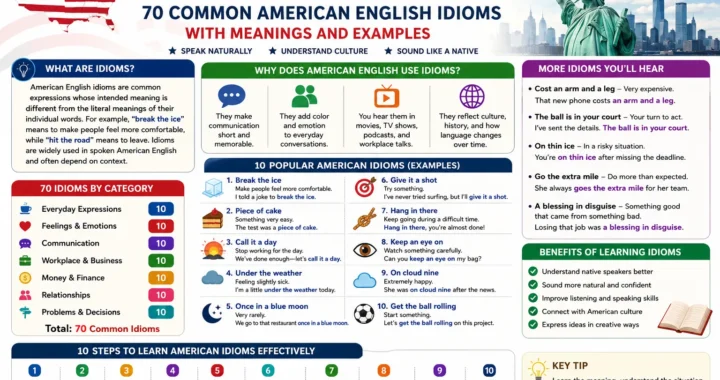
This collection of 100 idioms and their meanings covers the expressions people actually use in daily conversation, work, and casual writing. Instead of random, disconnected phrases, everything here is grouped by theme, so related idioms are easier to compare and remember together.
Whether you’re learning English, teaching it, or simply curious about where certain expressions come from, having a large, well-organized list saves time and builds vocabulary faster than piecing information together gradually.
Each idiom below includes a clear, simple meaning, so you can scan the list, find what you need, and move on without digging through long explanations.
By the end of this piece, you’ll have a ready reference of 100 common idioms you can use immediately in conversation, writing, or teaching.

What Makes a Good Idiom Reference List?
A useful idiom list pairs each expression with a clear, direct meaning and groups related phrases by theme. This structure helps readers find relevant idioms quickly and remember them more easily than scattered, unorganized lists. The best reference lists prioritize commonly used idioms over rare or highly regional ones.
Idioms About Everyday Life (1–15)
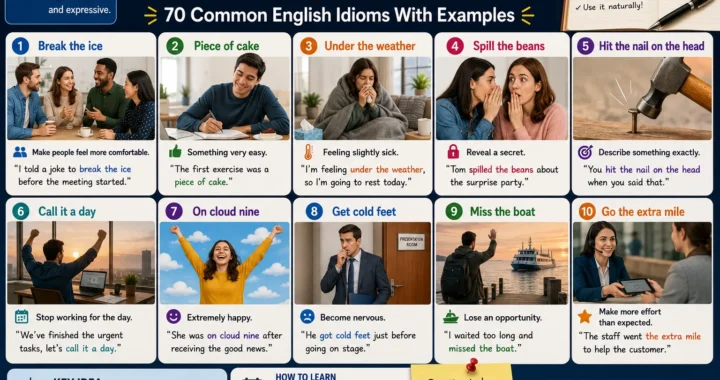
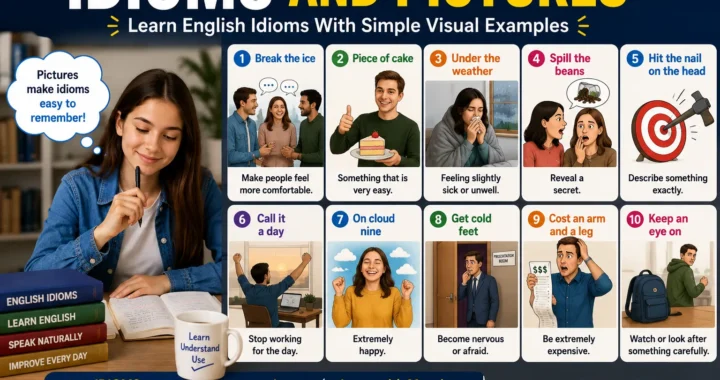
- Piece of cake – Something very easy.
- Break the ice – To ease tension in a social situation.
- Under the weather – Feeling sick.
- Hit the sack – To go to sleep.
- Spill the beans – To reveal a secret.
- Call it a night – To stop an activity and go to bed.
- Cut corners – To do something poorly to save time or money.
- Miss the boat – To miss an opportunity.
- On the ball – Alert and performing well.
- Jump the gun – To act too soon.
- Give someone the cold shoulder – To ignore someone deliberately.
- Cut to the chase – To get to the point quickly.
- Let sleeping dogs lie – To avoid bringing up a sensitive topic.
- Keep your eyes peeled – To watch carefully.
- A blessing in disguise – Something that seems bad at first but turns out well.
Idioms About Emotions and Feelings (16–30)
- Over the moon – Extremely happy.
- Down in the dumps – Feeling sad or low.
- On cloud nine – Feeling very happy or excited.
- Butterflies in my stomach – Feeling nervous.
- Cold feet – Feeling nervous before doing something important.
- Cry over spilled milk – To be upset about something that can’t be changed.
- Bite your tongue – To stop yourself from saying something.
- Wear your heart on your sleeve – To show your emotions openly.
- Fed up – Frustrated or annoyed after repeated issues.
- Blow off steam – To release built-up stress or anger.
- Green with envy – Very jealous.
- In hot water – In trouble.
- Keep a stiff upper lip – To stay calm and composed during difficulty.
- Bent out of shape – Upset or annoyed.
- On edge – Nervous or anxious.
Idioms About Time and Frequency (31–42)
- Once in a blue moon – Something that happens very rarely.
- In the nick of time – Just before it’s too late.
- Around the clock – Continuously, all day and night.
- Beat the clock – To finish before a deadline.
- Time flies – Time passes quickly.
- From day one – From the very beginning.
- In a jiffy – Very quickly.
- Ahead of the curve – More advanced than usual for the current time.
- Down to the wire – Until the very last moment.
- Better late than never – Doing something late is better than not doing it at all.
- Around the corner – About to happen soon.
- Take your time – Do something without rushing.
Idioms About Money and Value (43–55)
- Cost an arm and a leg – Very expensive.
- Break the bank – To spend more than you can afford.
- Cheap as chips – Very inexpensive.
- Money doesn’t grow on trees – Money is limited and must be earned.
- Tighten your belt – To spend less and save carefully.
- Bring home the bacon – To earn money to support your family.
- Nest egg – Savings set aside for the future.
- In the red – Losing money or in debt.
- In the black – Making a profit.
- Penny-pincher – Someone who’s very careful with money.
- Cash cow – A reliable source of income.
- Foot the bill – To pay for something.
- Worth its weight in gold – Extremely valuable.
Idioms Used in Work and Professional Settings (56–68)
- Touch base – To make brief contact or follow up.
- On the same page – In agreement or understanding something the same way.
- Think outside the box – To think creatively.
- Back to the drawing board – Starting over after a plan fails.
- Learn the ropes – To learn how to do a new job or task.
- Get the ball rolling – To start something.
- Wear many hats – To have multiple responsibilities or roles.
- Go the extra mile – To make extra effort beyond what’s expected.
- Climb the corporate ladder – To advance in a career.
- Call it quits – To stop doing something, often a job or task.
- Put all your eggs in one basket – To risk everything on a single plan.
- Keep your nose to the grindstone – To work hard and stay focused.
- Read between the lines – To understand a hidden or implied meaning.
Animal Idioms (69–80)
- Let the cat out of the bag – To accidentally reveal a secret.
- Kill two birds with one stone – To accomplish two things with one action.
- Hold your horses – Wait, slow down.
- A little bird told me – A playful way of citing an unnamed source.
- Barking up the wrong tree – Pursuing a mistaken approach.
- Straight from the horse’s mouth – Information from a reliable, firsthand source.
- When pigs fly – Something that will never happen.
- The elephant in the room – An obvious problem no one wants to discuss.
- Wolf in sheep’s clothing – Someone who seems harmless but isn’t.
- Smell a rat – To suspect something is wrong.
- Cat got your tongue – Asking why someone is unusually quiet.
- Like a fish out of water – Feeling out of place or uncomfortable.
Idioms About Effort and Difficulty (81–90)
- Bite the bullet – To face something difficult after avoiding it.
- Burn the midnight oil – To work late into the night.
- An uphill battle – A difficult struggle or challenge.
- Push the envelope – To go beyond normal limits.
- Sink or swim – Succeed or fail based on your own effort.
- By the skin of your teeth – Barely managing to succeed.
- Roll up your sleeves – To prepare to work hard.
- Take the bull by the horns – To face a difficult situation directly.
- Go against the grain – To act differently from what’s expected.
- Face the music – To accept the consequences of your actions.
Idioms About Communication (91–100)
- Beat around the bush – Avoiding the main topic.
- Speak of the devil – Said when someone appears right after being mentioned.
- Put your foot in your mouth – To say something embarrassing or awkward.
- Hit the nail on the head – To describe something exactly right.
- Give someone the benefit of the doubt – To trust someone despite uncertainty.
- Get to the point – To state the main idea directly.
- Sugarcoat something – To make bad news sound better than it is.
- Drop a hint – To suggest something indirectly.
- Food for thought – Something worth thinking about carefully.
- Long story short – Summarizing something briefly.
Expert Insights: How to Actually Use a List Like This
A list of 100 idioms is useful as a reference, but it isn’t meant to be memorized all at once. Trying to absorb every phrase in a single sitting usually leads to shallow recognition rather than confident, natural use.
The idioms that stick long-term are the ones practiced actively, through writing your own example sentences, noticing them in real conversations, or reviewing small groups repeatedly over time.
Grouping idioms by theme, as this list does, helps with initial memorization, since related concepts reinforce each other. Someone learning money idioms together, for example, tends to retain them better than learning the same phrases scattered randomly.
Treat this list as a resource to return to gradually, focusing on five to ten idioms per week rather than attempting to master the full collection immediately.
Common Mistakes People Make With Large Idiom Lists
Mistake 1: Trying to memorize everything at once
This leads to shallow, quickly forgotten knowledge. Focus on smaller groups for stronger retention.
Mistake 2: Skipping practice sentences
Reading a meaning without using the idiom in a sentence makes it harder to remember and apply correctly later.
Mistake 3: Treating every idiom as equally common
Some idioms on this list are used far more often than others. Prioritize the ones most relevant to your daily conversations first.
Mistake 4: Never reviewing the list again
Idioms fade from memory without repetition. Revisiting sections of this list periodically helps move phrases into confident, active use.
Practical Steps to Learn From This List
- Pick one category that feels most useful to your daily life or work.
- Focus on five to ten idioms per week, rather than the full list at once.
- Write an example sentence for each idiom you’re learning.
- Practice idioms out loud, since spoken repetition builds confidence faster than silent reading.
- Notice these idioms in real conversations, shows, or reading, and pause to confirm the meaning.
- Review completed categories monthly to reinforce long-term retention.
Frequently Asked Questions
Q: Is it realistic to learn 100 idioms at once?
A: Not effectively. Trying to memorize all 100 idioms in a short period usually leads to shallow retention. Focusing on five to ten idioms per week, grouped by theme, produces much stronger, longer-lasting results.
Q: Which idioms from this list are most commonly used?
A: Everyday idioms like “piece of cake,” “break the ice,” and “spill the beans” tend to appear most frequently in casual conversation, making them a strong starting point before moving to more specific categories.
Q: Are all 100 idioms appropriate for formal writing?
A: No. Most idioms on this list work best in casual conversation rather than formal or academic writing. A smaller number, like “on the same page” or “get the ball rolling,” fit reasonably well in professional communication.
Q: How should I organize my own idiom practice using this list?
A: Group idioms by theme, such as work, emotions, or money, and focus on one category at a time. This mirrors how the list itself is structured and tends to improve memorization.
Q: Can this list help with teaching English to others?
A: Yes. The categorized structure makes it useful for lesson planning, allowing teachers to introduce idioms thematically rather than randomly, which generally improves student retention.
Q: Do all these idioms work across different English-speaking countries?
A: Most are widely understood, though a few, like “cheap as chips,” are more common in British English than American English. Context and regional exposure will clarify any unfamiliar phrases.
Q: What’s the best way to remember idioms from a long list like this?
A: Active practice works best. Writing your own sentences, reviewing small groups regularly, and noticing idioms in real conversations all help move phrases from passive recognition into confident, natural use.
Bringing It All Together
A list of 100 idioms and their meanings gives you a solid, organized foundation to build real vocabulary from, without the frustration of hunting for phrases one at a time. Grouped by theme, these expressions become far easier to learn and remember than scattered, random lists.
Real progress comes from steady, active practice, not from memorizing everything at once. Pick a category, focus on a handful of idioms, and return to this list regularly as your vocabulary grows.
The next time an idiom from this list shows up in conversation, a show, or something you’re reading, you’ll recognize it immediately, and that recognition is exactly how lasting fluency gets built, one phrase at a time.
Read More: Spanish Idioms: Popular Expressions Explained With English Meanings

[…] Read More: 100 Idioms and Their Meanings: A Complete Reference List […]