

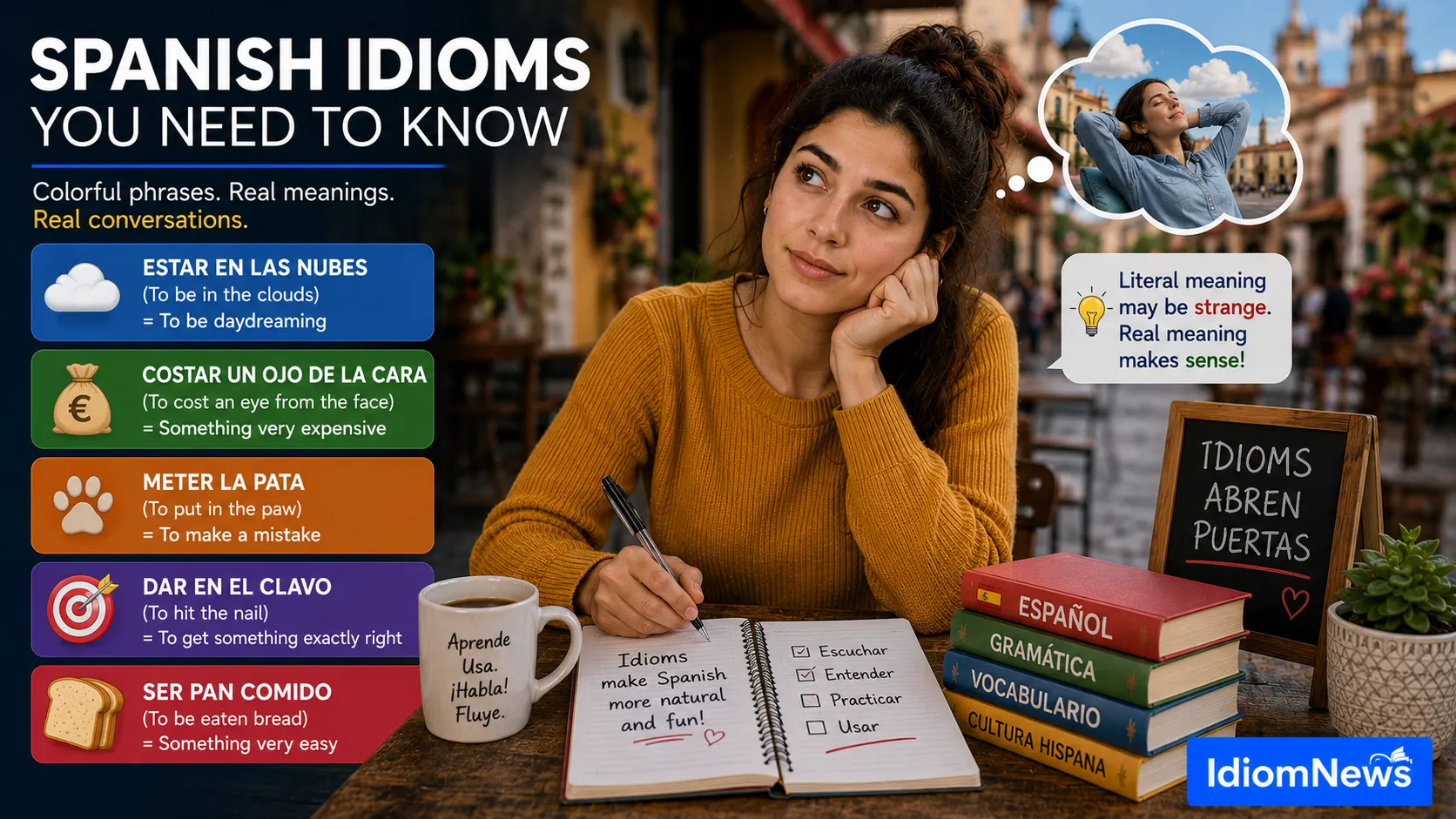
Someone learning Spanish hears “está en las nubes” and pictures actual clouds, confused about why that would make sense in conversation. Then they learn it simply means someone is daydreaming, not literally floating in the sky. That gap between the literal words and the real meaning is exactly what makes Spanish idioms both challenging and fascinating.
Spanish, like English, is packed with expressions that can’t be understood by translating word for word. These idioms show up constantly in everyday conversation, television, music, and casual writing across Spanish-speaking countries.
For English speakers learning Spanish, understanding these idioms isn’t optional. Without them, conversations, shows, and books can feel confusing, even when every individual word is technically understood.
This becomes especially important given how many Spanish-speaking countries and regional variations exist, each contributing its own flavor to the language’s idiomatic expressions.
By the end of this piece, you’ll recognize popular Spanish idioms, understand what they actually mean, and know how to use them naturally in real conversations.
What Are Spanish Idioms?
Spanish idioms are fixed expressions used throughout Spanish-speaking countries whose meaning cannot be understood by translating the individual words literally. Like English idioms, they carry a figurative meaning that native speakers learn through common usage. For example, “estar en las nubes” literally translates to “to be in the clouds,” but actually means to be daydreaming or distracted.
Everyday Spanish Idioms You’ll Hear Constantly
Some Spanish idioms appear so frequently that they’ve become part of ordinary daily conversation.
- “Ser pan comido” – Literally “to be eaten bread,” meaning something is very easy, similar to “a piece of cake” in English.
- “Costar un ojo de la cara” – Literally “to cost an eye from the face,” meaning something is very expensive.
- “Meter la pata” – Literally “to put in the paw/leg,” meaning to make a mistake or say something wrong.
- “Estar como una cabra” – Literally “to be like a goat,” meaning someone is acting crazy or silly.
These idioms show up so often in casual conversation that they’re usually among the first ones learners encounter.
Spanish Idioms About Emotions and Reactions
Emotional idioms let Spanish speakers express feelings with more color than plain adjectives allow.
- “Estar en las nubes” – To be daydreaming or distracted.
- “Quedarse de piedra” – Literally “to remain like stone,” meaning to be shocked or stunned.
- “No tener pelos en la lengua” – Literally “to have no hairs on the tongue,” meaning to speak very bluntly or honestly.
- “Ponerse las pilas” – Literally “to put in the batteries,” meaning to get energized or start working harder.
These idioms are especially common in personal conversations, where expressive language feels more natural than plain statements.
Spanish Idioms About Daily Life and Effort
These idioms describe ordinary situations, effort, and everyday decisions.
- “Dar en el clavo” – Literally “to hit the nail,” meaning to get something exactly right.
- “Hablar por los codos” – Literally “to talk through your elbows,” meaning to talk excessively.
- “Tirar la casa por la ventana” – Literally “to throw the house out the window,” meaning to spend extravagantly, usually for a celebration.
- “Importar un pepino” – Literally “to matter like a cucumber,” meaning not to care about something at all.
These phrases reveal how everyday activities and objects, from cucumbers to elbows, get transformed into vivid figurative language.
How Spanish Idioms Vary Across Regions
Spanish is spoken across many countries, and idioms often shift depending on the region, just as they do in English.
Mexican Spanish, Argentine Spanish, and Spain’s Castilian Spanish each have their own regional expressions that don’t always translate cleanly to other Spanish-speaking countries.
For example, “está chido” (meaning “that’s cool”) is common in Mexican Spanish, while “está copado” carries a similar meaning in Argentina. Both work locally, but might sound unfamiliar outside their region.
This regional variation means that learning idioms tied to a specific country or dialect can be more useful than trying to memorize a single universal list, especially if you’re focused on one particular Spanish-speaking region.
Expert Insights: Why Learning Idioms Speeds Up Spanish Fluency
Idiom fluency tends to separate intermediate Spanish learners from truly conversational speakers. Grammar and vocabulary provide the foundation, but idioms reveal whether someone understands how Spanish is actually spoken in real, everyday situations.
Many Spanish idioms rely on vivid, often food or body-related imagery, which tends to make them memorable once explained, even though they can seem confusing on first encounter.
Learners who prioritize idioms tied to common daily situations, work, emotions, and everyday effort, tend to build practical conversational skills faster than those who focus only on formal vocabulary and grammar rules.
This is part of why many Spanish language courses now include idiom-focused lessons earlier in the curriculum, rather than saving them exclusively for advanced levels.
Common Mistakes People Make With Spanish Idioms
Mistake 1: Translating idioms word for word
This almost always leads to confusion, since Spanish idioms rarely make literal sense. Learn each idiom as a complete phrase, not as individual translated words.
Mistake 2: Assuming idioms work the same across all Spanish-speaking countries
Regional differences matter. An idiom common in Mexico might sound unfamiliar or different in Spain or Argentina.
Mistake 3: Overusing idioms in formal writing
Casual idioms like “meter la pata” sound too informal for professional or academic Spanish writing. Match the idiom’s tone to the context.
Mistake 4: Confusing similar-sounding idioms
Phrases with similar structure but different meanings, such as idioms involving body parts, can easily get mixed up without careful attention to context.
Practical Steps to Learn Spanish Idioms Effectively
- Start with a short list of common idioms tied to everyday situations, emotions, and daily life.
- Learn the literal translation first, then the actual meaning, since seeing both helps the logic click.
- Practice using one idiom per day in a sentence you create yourself.
- Watch Spanish-language shows or listen to podcasts, paying attention to idioms used in context.
- Focus on idioms relevant to your target region, if you’re learning Spanish for a specific country.
- Review idioms regularly, since repeated exposure helps them move from recognition into natural, confident use.
Popular Spanish Idioms at a Glance
| Spanish Idiom | Literal Translation | Actual Meaning |
|---|---|---|
| Ser pan comido | To be eaten bread | Something very easy |
| Costar un ojo de la cara | To cost an eye from the face | Something very expensive |
| Estar en las nubes | To be in the clouds | To be daydreaming |
| Meter la pata | To put in the paw | To make a mistake |
| Dar en el clavo | To hit the nail | To get something exactly right |
This table offers a quick reference for readers who want to compare the literal and actual meanings side by side.
Frequently Asked Questions
Q: What are some common Spanish idioms for beginners?
A: Simple, widely used idioms include “ser pan comido” (something very easy) and “costar un ojo de la cara” (something very expensive). These phrases appear frequently in everyday conversation and are a good starting point for learners.
Q: Are Spanish idioms the same in every Spanish-speaking country?
A: Not always. While some idioms are widely understood everywhere, many vary by region, with Mexican, Argentine, and Spanish (Castilian) Spanish each having their own local expressions.
Q: Why do Spanish idioms often reference body parts?
A: Body-part idioms are common across many languages, including Spanish, likely because the human body offers vivid, easily visualized imagery for describing emotions, mistakes, and everyday actions.
Q: Can I use Spanish idioms in formal writing?
A: Most Spanish idioms are considered too casual for formal or academic writing. They work best in everyday conversation, casual writing, or informal communication.
Q: How can I remember Spanish idioms more easily?
A: Learning both the literal translation and the actual meaning together often helps the logic behind an idiom make more sense, especially for particularly strange or vivid expressions.
Q: Do Spanish idioms translate directly into English?
A: Rarely. Most Spanish idioms use imagery specific to Spanish-speaking culture, so direct translation usually results in phrasing that doesn’t make sense in English.
Q: What’s the best way to start learning Spanish idioms?
A: Focus on idioms tied to everyday situations, emotions, and common activities first. These appear most frequently in real conversations and offer the most practical value early in your learning process.
Bringing It All Together
Spanish idioms give the language its personality, humor, and cultural depth, turning ordinary statements into vivid, memorable expressions. Learning them takes conversational Spanish far beyond textbook vocabulary and grammar rules.
Understanding both the literal translation and the real meaning behind each idiom makes them far easier to remember, especially for phrases that seem strange or illogical at first glance.
Focus on a handful of idioms tied to daily life, emotions, and common situations, and practice using them in real conversations, shows, or writing whenever possible.
The next time someone tells you they’re “en las nubes,” you won’t picture actual clouds. You’ll understand exactly what they mean, and you’ll be one step closer to sounding naturally fluent yourself.
Read More: Funny Idioms That Will Make You Laugh (And What They Actually Mean)



[…] Read More: Spanish Idioms: Popular Expressions Explained With English Meanings […]