

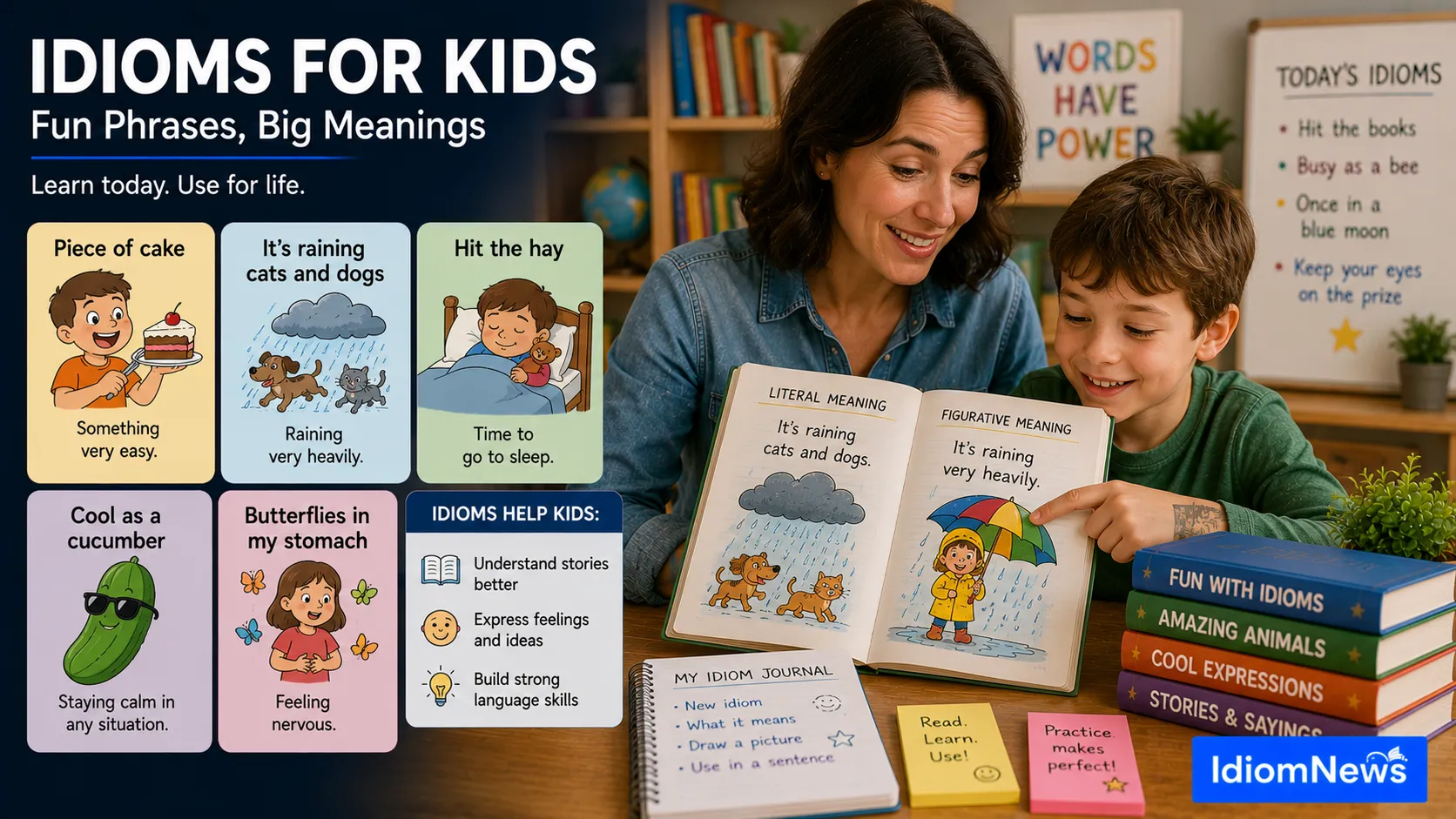
A child hears an adult say “it’s raining cats and dogs” and looks up at the sky, half expecting to see something strange falling from the clouds. That confused, curious reaction is exactly why children’s idioms need a different approach than idioms taught to teens or adults.
Kids encounter idioms constantly, in books, cartoons, family conversations, and classroom lessons, often long before anyone explains what these strange phrases actually mean. Without guidance, idioms can feel like nonsense rather than the playful, expressive language they’re meant to be.
For parents and teachers, understanding which idioms work well for children, and how to explain them in age-appropriate ways, makes a real difference in helping kids develop stronger language and reading comprehension skills.
This becomes especially important since idioms show up frequently in children’s literature and everyday speech, meaning kids who don’t understand them may struggle to fully follow stories, jokes, or conversations around them.
By the end of this piece, you’ll have a solid collection of kid-friendly idioms, practical teaching strategies, and a clear understanding of why idioms matter for children’s language development.
What Are Children’s Idioms?
Children’s idioms are simple, commonly used expressions selected specifically for their clear imagery and everyday relevance to a child’s world. These idioms typically avoid violent, adult, or overly abstract themes, focusing instead on situations kids naturally encounter, like sleep, food, animals, and school. Teaching idioms to children usually pairs each phrase with a visual example to reinforce understanding.
Why Idioms Can Be Confusing for Kids
Children naturally interpret language literally before developing the ability to understand figurative meaning, which typically strengthens gradually through early elementary school years.
This means a young child hearing “it’s raining cats and dogs” might genuinely try to picture animals falling from the sky, rather than immediately understanding the phrase means heavy rain.
This isn’t a sign of confusion or difficulty. It reflects a normal stage of language development, where figurative thinking builds gradually as children gain more exposure to context and explanation.
Understanding this helps parents and teachers approach idioms patiently, pairing each phrase with clear explanation rather than assuming children will pick up the meaning automatically.
Simple Idioms That Work Well for Children
Certain idioms are especially well-suited for children, thanks to their vivid, easy-to-picture imagery and everyday relevance.
- “Piece of cake” – Something very easy to do.
- “It’s raining cats and dogs” – It’s raining very heavily.
- “Hit the hay” – Time to go to sleep.
- “Cool as a cucumber” – Staying calm, even in a stressful situation.
- “Butterflies in my stomach” – Feeling nervous.
These idioms work well with children specifically because they connect to familiar experiences, like sleep, weather, and everyday emotions.
Idioms About School and Everyday Kid Life
Some idioms connect directly to situations children experience regularly, making them especially relatable and easy to teach.
- “Hit the books” – To study hard.
- “Teacher’s pet” – A student who’s especially favored by the teacher.
- “Once in a blue moon” – Something that happens very rarely.
- “Keep your eyes on the prize” – Stay focused on your goal.
These idioms tend to resonate strongly with school-age children, since they connect directly to classroom and daily life experiences.
Animal Idioms Kids Especially Enjoy
Animal-based idioms tend to be particularly popular with children, since animals naturally capture kids’ attention and imagination.
- “Let the cat out of the bag” – To accidentally reveal a secret.
- “Busy as a bee” – Very busy or hardworking.
- “Straight from the horse’s mouth” – Information from a reliable source.
- “When pigs fly” – Something that will never happen.
These idioms often become favorites among children specifically because of their vivid, silly imagery, which makes them memorable and fun to picture and discuss.
Expert Insights: Why Idioms Support Reading Comprehension in Kids
Idioms appear frequently throughout children’s literature, meaning kids who don’t understand figurative language can genuinely struggle to fully grasp stories, even when they understand every individual word on the page.
Teaching idioms directly, rather than assuming children will absorb them naturally through exposure alone, tends to build stronger reading comprehension skills, particularly for children who might not encounter as much figurative language in daily conversation at home.
Pairing idioms with visual illustrations works especially well for children, since young learners generally respond strongly to visual reinforcement when learning abstract or figurative concepts.
This is part of why many elementary reading curriculums specifically include lessons on common idioms, treating figurative language comprehension as an important building block alongside vocabulary and grammar instruction.
Common Mistakes Adults Make Teaching Idioms to Kids
Mistake 1: Assuming kids will understand idioms without explanation
Children often interpret language literally at first. Explaining the figurative meaning directly, rather than assuming automatic understanding, supports stronger comprehension.
Mistake 2: Choosing idioms with confusing or outdated imagery
Some idioms reference unfamiliar historical objects or activities, making them harder for kids to connect with. Choosing idioms tied to familiar, everyday experiences works better.
Mistake 3: Skipping visual reinforcement
Idioms taught only through verbal explanation are often harder for children to remember. Pairing idioms with simple illustrations significantly improves retention.
Mistake 4: Introducing too many idioms at once
Overwhelming children with a long list of idioms at one time makes retention difficult. Focusing on a small, manageable group works far better for young learners.
Practical Steps to Teach Idioms to Children
- Start with idioms tied to familiar experiences, like sleep, school, weather, and animals.
- Pair each idiom with a simple illustration, showing both the literal and figurative meaning side by side.
- Introduce a small group at a time, focusing on three to five idioms per lesson or reading session.
- Use idioms in real conversation, giving children natural opportunities to hear and practice them.
- Encourage kids to draw their own illustrations, reinforcing understanding through creative, hands-on practice.
- Read books that naturally include idioms, discussing unfamiliar phrases together as they come up.
Kid-Friendly Idioms by Category
| Category | Example Idiom | Meaning |
|---|---|---|
| Sleep | Hit the hay | Time to go to sleep |
| School | Hit the books | Study hard |
| Weather | Raining cats and dogs | Raining very heavily |
| Animals | Busy as a bee | Very busy or hardworking |
| Emotions | Butterflies in my stomach | Feeling nervous |
This table offers a quick, organized reference for parents and teachers introducing idioms to children by everyday theme.
Frequently Asked Questions
Q: At what age do children start understanding idioms?
A: Most children begin developing an understanding of figurative language, including idioms, gradually during early elementary school, though full comprehension often continues improving throughout childhood with continued exposure and explanation.
Q: Why do kids sometimes take idioms literally?
A: Young children naturally interpret language literally before figurative thinking fully develops. This is a normal part of language development, not a sign of confusion or difficulty understanding language generally.
Q: What are some easy idioms to teach young children?
A: Simple, vivid idioms like “piece of cake,” “hit the hay,” and “raining cats and dogs” work well for young children, since they connect to familiar, everyday experiences and easy-to-picture imagery.
Q: How can I help my child understand idioms better?
A: Pairing idioms with simple illustrations and explaining both the literal and figurative meaning together tends to help children understand and remember idioms far more effectively than verbal explanation alone.
Q: Why do idioms matter for children’s reading comprehension?
A: Idioms appear frequently in children’s books, so kids who don’t understand figurative language can struggle to fully follow stories, even when they know every individual word used in the text.
Q: Are animal idioms especially good for teaching kids?
A: Yes, animal-based idioms tend to be particularly popular with children, since animals naturally capture their attention and imagination, making these idioms especially memorable and enjoyable to learn.
Q: How many idioms should I introduce to a child at once?
A: Introducing three to five idioms per lesson or reading session tends to work best, allowing children to fully absorb and remember each phrase before moving on to new ones.
Bringing It All Together
Children’s idioms open up a playful, imaginative side of language that goes far beyond simple vocabulary and grammar. Choosing idioms tied to familiar experiences, sleep, school, animals, and everyday emotions, makes figurative language feel approachable rather than confusing.
Supporting kids through this learning process, with clear explanations and visual reinforcement, builds stronger reading comprehension and a genuine appreciation for how playful and expressive language can be.
Start small, choose a handful of idioms that connect to your child’s daily life, and look for natural opportunities to explain and reinforce them through books, conversation, and creative activities.
The next time your child hears an idiom and pauses, confused, you’ll have exactly what you need to turn that moment into a fun, memorable language lesson.
Read More: American Idioms: Common Expressions Rooted in U.S. Culture and History


[…] Read More: Children’s Idioms: Fun, Easy Expressions Kids Can Actually Understand […]