

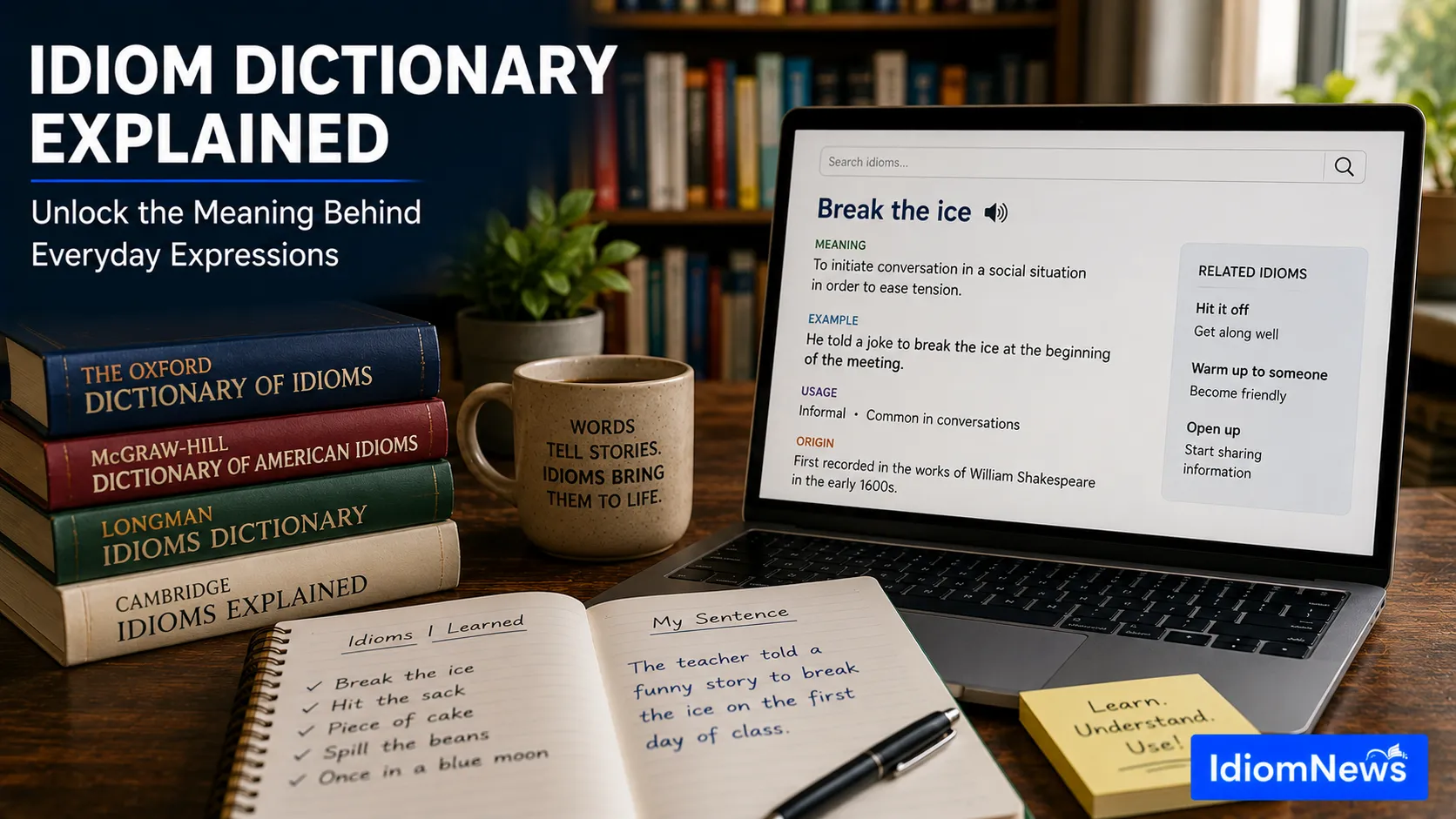
Someone hears an unfamiliar idiom mid-conversation and has no idea where to turn for a quick, reliable answer. Typing the phrase into a general search engine sometimes works, but often returns confusing forum posts or unrelated results instead of a clear definition.
An idiom dictionary solves this exact problem. It’s built specifically to explain figurative phrases that regular dictionaries often handle poorly or skip entirely, since idioms don’t follow the same definition format as standard vocabulary words.
This matters for language learners, writers, students, and anyone who regularly runs into unfamiliar expressions in books, conversations, or media and wants a fast, dependable way to look them up.
Understanding what an idiom dictionary actually offers, and how to use one effectively, makes idiom lookup far less frustrating than relying on general search results or guessing from context alone.
By the end of this piece, you’ll know exactly what an idiom dictionary is, how it differs from a regular dictionary, and how to use one to build stronger, more confident English skills.
What Is an Idiom Dictionary?
An idiom dictionary is a reference resource specifically focused on explaining the figurative meanings of idiomatic expressions, rather than literal vocabulary definitions. Unlike a standard dictionary, which defines individual words, an idiom dictionary treats each idiom as a complete phrase, often including its meaning, example sentences, and sometimes its origin. This structure makes it far more useful for understanding figurative language.
How an Idiom Dictionary Differs From a Regular Dictionary
A standard dictionary defines words individually, which works poorly for idioms, since idiomatic meaning comes from the entire phrase, not the separate words within it.
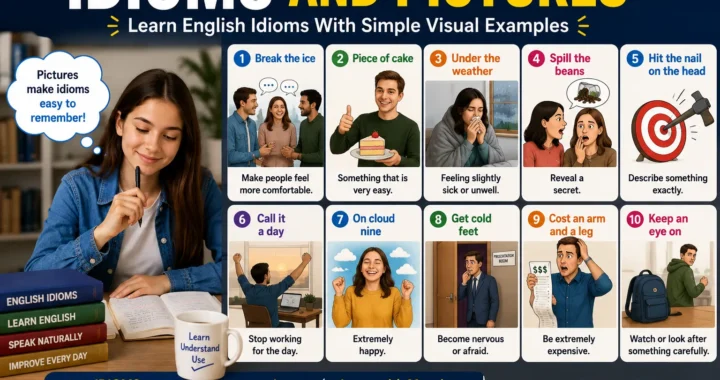
Looking up “spill” and “beans” separately in a regular dictionary tells you nothing about the idiom “spill the beans,” which means to reveal a secret. The individual definitions simply don’t connect to the figurative meaning.
An idiom dictionary solves this by treating the whole phrase as a single entry, providing the actual figurative meaning directly, often alongside example sentences showing how the phrase is used in real conversation.
This distinction is exactly why general dictionaries, while useful for vocabulary, aren’t well suited for looking up figurative expressions.
What a Good Idiom Dictionary Entry Includes
Not every idiom dictionary entry is equally useful. The most helpful entries typically include several key components.
- A clear, direct definition – Explaining the figurative meaning in simple terms.
- An example sentence – Showing the idiom used naturally in context.
- Usage notes – Indicating whether the idiom is formal, casual, or regional.
- Origin information (when available) – Explaining where the phrase historically came from, when documented.
Entries missing example sentences or usage context tend to be less helpful, since they leave the reader to guess how and when the idiom should actually be used.
How to Use an Idiom Dictionary Effectively
Simply looking up a definition isn’t always enough to fully understand or correctly use an idiom afterward.
- Read the example sentence carefully, since it shows how the idiom fits naturally into real speech or writing.
- Check the usage notes, confirming whether the idiom fits formal or casual contexts before using it yourself.
- Look up idioms you actually encounter, rather than randomly browsing entries, since idioms tied to real context are easier to remember.
- Write your own example sentence after looking up an idiom, reinforcing the definition through active practice.
Treating an idiom dictionary as a starting point for practice, rather than a final destination, builds stronger retention than simply reading a definition and moving on.
Types of Idiom Dictionaries Available
Idiom dictionaries come in a few different formats, each suited to slightly different needs.
- Print idiom dictionaries – Physical books offering curated, editorially reviewed idiom collections, often organized alphabetically or by theme.
- Online idiom dictionaries – Websites offering searchable databases, often updated more frequently than print editions and easier to browse quickly.
- App-based idiom dictionaries – Mobile apps designed for quick lookup on the go, sometimes including audio pronunciation or interactive quizzes.
- Language-learning platform glossaries – Idiom sections built into broader language-learning apps or courses, often paired with lessons and practice exercises.
Choosing the right format often depends on how and when you’re most likely to actually use it, whether that’s quick mobile lookups during conversation or deeper study sessions with a physical book.
Expert Insights: Why Context Matters More Than the Definition Alone
A definition alone rarely tells the full story of how an idiom is actually used. Two idioms with similar dictionary definitions can carry very different tones, one casual and playful, another more formal or even slightly outdated.
This is why strong idiom dictionary entries include example sentences and usage notes, not just a bare definition. Context reveals nuances that a short definition alone often misses entirely.
Learners who treat idiom dictionary lookups as a quick reference, rather than a deep learning tool, often struggle to actually use idioms confidently in their own speech and writing. The definition explains what a phrase means; example sentences show how it actually gets used.
Combining dictionary lookups with real exposure, through reading, conversation, or media, tends to build far stronger, more natural idiom usage than relying on lookup alone.
Common Mistakes People Make Using Idiom Dictionaries
Mistake 1: Reading only the definition and skipping the example sentence
The definition alone often isn’t enough to understand how an idiom fits naturally into conversation. Example sentences fill in that missing context.
Mistake 2: Ignoring usage notes about formality or region
Some idioms only work in casual settings, while others carry regional differences. Skipping usage notes can lead to using an idiom incorrectly or in the wrong context.
Mistake 3: Trusting every online source equally
Not all idiom dictionaries are equally accurate or well-researched. Prioritizing well-established, reputable sources helps avoid incorrect or oversimplified definitions.
Mistake 4: Looking up idioms without ever using them
Passive lookup alone rarely builds lasting fluency. Writing your own example sentences after looking up an idiom significantly improves retention.
Practical Steps to Get the Most From an Idiom Dictionary
- Choose a reputable idiom dictionary, whether print, online, or app-based, prioritizing sources with example sentences and usage notes.
- Look up idioms as you encounter them in real reading or conversation, rather than browsing randomly.
- Read the full entry, including examples and usage notes, not just the definition.
- Write your own sentence using the idiom immediately after looking it up.
- Revisit idioms you’ve looked up before, reinforcing memory through spaced repetition.
- Cross-check uncertain or unusual idioms across multiple sources, especially for regional or historical claims.
What to Look for in a Reliable Idiom Dictionary
| Feature | Why It Matters |
|---|---|
| Clear, direct definitions | Makes the figurative meaning immediately understandable |
| Example sentences | Shows how the idiom fits naturally into real speech |
| Usage notes | Clarifies formality, tone, and regional differences |
| Searchability | Allows quick lookup when encountering unfamiliar phrases |
This table highlights the core features worth prioritizing when choosing between different idiom dictionary options.
Frequently Asked Questions
Q: What is the purpose of an idiom dictionary?
A: An idiom dictionary explains the figurative meaning of fixed expressions, treating each idiom as a complete phrase rather than defining individual words. This makes it far more useful than a standard dictionary for understanding idiomatic language.
Q: How is an idiom dictionary different from a regular dictionary?
A: A regular dictionary defines individual words literally, while an idiom dictionary explains the figurative meaning of an entire fixed phrase, since idioms can’t be understood by combining individual word definitions.
Q: Are online idiom dictionaries reliable?
A: Many are, particularly those maintained by established language education or publishing organizations. It’s worth cross-checking unusual or historically claimed idioms across multiple reputable sources for accuracy.
Q: Should I memorize idioms directly from a dictionary?
A: Reading definitions alone rarely builds lasting fluency. Writing your own example sentences and encountering idioms in real context tends to produce much stronger retention than memorization alone.
Q: Do idiom dictionaries include idiom origins?
A: Many do, though origin information varies in reliability. Well-documented idioms, particularly those from literature or historical events, tend to have more accurate origin details than idioms with uncertain or debated backstories.
Q: Can I use an idiom dictionary to check formal versus casual tone?
A: Yes, quality idiom dictionaries typically include usage notes indicating whether a phrase fits formal or casual contexts, helping you avoid using an idiom inappropriately in the wrong setting.
Q: Is a print or online idiom dictionary better for learning?
A: Both have advantages. Print dictionaries often offer curated, editorially reviewed entries, while online and app-based dictionaries provide faster searchability, making them more convenient for quick lookups during real conversations.
Bringing It All Together
An idiom dictionary fills a gap that regular dictionaries simply can’t cover, explaining figurative phrases as complete units of meaning rather than isolated, literal words. Choosing a reliable source with clear definitions, example sentences, and usage notes makes lookup far more useful than a bare definition alone.
Real fluency comes from combining dictionary lookups with active practice, writing your own sentences, and noticing idioms in real conversation, reading, or media whenever they appear.
The next time an unfamiliar idiom catches you off guard, a good idiom dictionary can turn that moment of confusion into a clear, memorable addition to your vocabulary, one phrase at a time.
Read More: What Happened to Idiom Brewing Co.? The Story of Frederick’s Beloved Brewery

[…] Read More: Idiom Dictionary: How to Find and Understand Any Idiom’s Meaning […]