

Someone editing an essay wants to avoid repeating the word “idiom” five times in one paragraph, but isn’t sure what else to call it. That small writing problem points to a bigger, genuinely useful question: what other words actually mean the same thing as “idiom,” and are they truly interchangeable?
Finding the right idiom synonym isn’t just about avoiding repetition. Several related terms carry subtle differences in meaning, formality, or scope, and using them incorrectly can shift what a sentence actually communicates.
This matters for writers, students, editors, and English learners who want to vary their vocabulary without accidentally introducing a word that doesn’t quite mean the same thing as “idiom.”
Understanding these distinctions turns a simple word-swap into a more precise choice, helping you pick the term that best fits your specific context.
By the end of this piece, you’ll know the closest synonyms for “idiom,” how they differ from one another, and when each one is the better choice.
What’s a Good Synonym for “Idiom”?
The closest synonyms for “idiom” include “expression,” “phrase,” “figure of speech,” and “saying,” though each carries slightly different shades of meaning. “Expression” and “figure of speech” work as close, nearly interchangeable substitutes in most contexts. “Phrase” and “saying” are broader terms that don’t always specifically imply figurative meaning the way “idiom” does.
The Closest Synonyms for Idiom
A few terms function as true, near-exact synonyms for “idiom” in most everyday contexts.
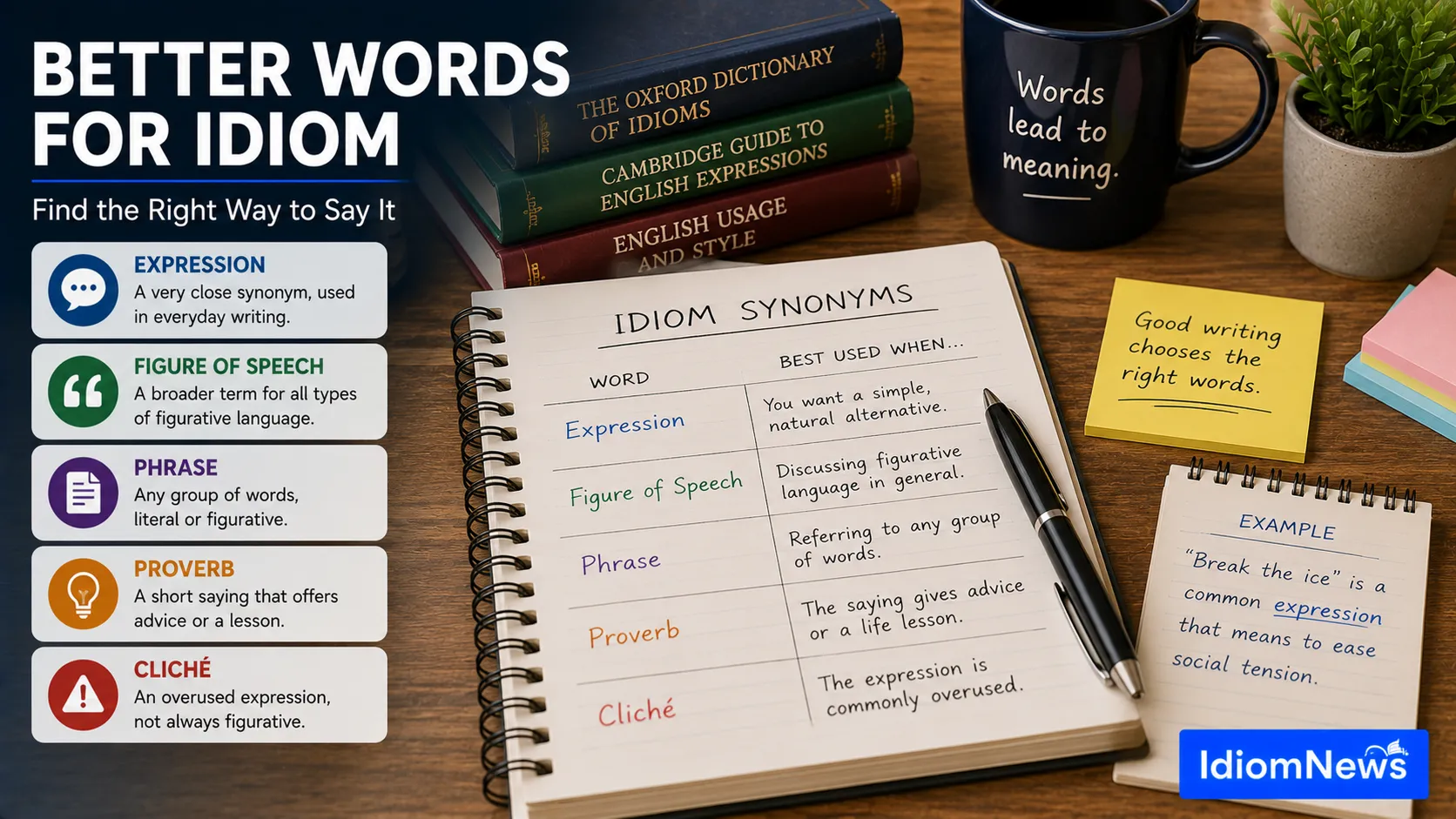
- “Expression” – A very close synonym, often used interchangeably with “idiom” in casual and formal writing alike. “That’s a common expression” works nearly identically to “that’s a common idiom.”
- “Figure of speech” – A slightly more formal, broader term that includes idioms but also covers other figurative language types, like metaphors and similes.
- “Idiomatic expression” – A more formal, explicit way of saying “idiom,” often used in academic or linguistic writing.
These three terms come closest to matching “idiom” in both meaning and usage, making them the safest substitutes in most writing contexts.
Related Terms That Aren’t Quite Synonyms
Several other words are commonly mistaken for idiom synonyms, but they carry meaningful differences worth understanding.
- “Phrase” – A much broader term referring to any group of words functioning as a unit, whether literal or figurative. Not every phrase is an idiom, so this word isn’t a precise synonym.
- “Saying” – Often overlaps with idiom, but leans more toward short, memorable statements, sometimes offering advice, closer to a proverb than a true idiom.
- “Proverb” – Specifically refers to a phrase offering advice or a life lesson, unlike idioms, which simply describe a situation or feeling without necessarily teaching anything.
- “Cliché” – Refers to an overused expression, which may or may not be idiomatic. A cliché can be a literal phrase used too often, not necessarily a figurative one.
Using these terms interchangeably with “idiom” can introduce subtle inaccuracies, even though they’re closely related in casual conversation.
When to Use “Expression” Instead of “Idiom”
“Expression” works as a nearly seamless substitute for “idiom” in most everyday writing and conversation, particularly when you want to avoid repeating the same word multiple times in one piece.
- “Break the ice” is a common expression meaning to ease social tension.
- “Break the ice” is a common idiom meaning to ease social tension.
Both sentences communicate essentially the same idea, making “expression” a safe, natural substitute in the vast majority of contexts.
When “Figure of Speech” Is the Better Choice
“Figure of speech” works well when you want a slightly more formal or academic tone, or when discussing figurative language more broadly, beyond idioms specifically.
This term technically covers a wider category, including metaphors, similes, hyperbole, and idioms together. Using “figure of speech” when specifically discussing idioms is accurate, but slightly less precise than using “idiom” or “expression” directly.
It works especially well in academic writing, linguistics discussions, or any context where you’re grouping idioms together with other types of figurative language.
Expert Insights: Why Precision Matters When Choosing a Synonym
Choosing between “idiom,” “expression,” and “figure of speech” might seem like a minor stylistic decision, but precision matters more in formal or academic writing than in casual conversation.
In linguistics and language teaching specifically, these terms carry more defined, technical distinctions than they do in everyday speech. A linguist discussing “figures of speech” broadly is intentionally including metaphors and similes alongside idioms, not simply using a fancier word for the same concept.
For general writing, “expression” remains the safest, most natural substitute for “idiom,” since it carries nearly identical meaning without introducing unwanted technical baggage or shifting the scope of what you’re describing.
Understanding this distinction helps writers choose synonyms deliberately, rather than assuming all these related terms are perfectly interchangeable in every context.
Common Mistakes People Make Choosing Idiom Synonyms
Mistake 1: Using “phrase” as if it means the same thing as “idiom”
“Phrase” is much broader and includes literal word groupings, not just figurative ones. Not every phrase qualifies as an idiom.
Mistake 2: Confusing “proverb” with “idiom”
Proverbs specifically offer advice or a life lesson, while idioms simply describe a situation or feeling. The two terms aren’t interchangeable despite both being figurative.
Mistake 3: Treating “cliché” as a synonym for “idiom”
A cliché refers to an overused expression, which may or may not be idiomatic. Some clichés are literal phrases used too often, not figurative idioms.
Mistake 4: Overusing “figure of speech” when a simpler word would work
While technically accurate, “figure of speech” can sound unnecessarily formal in casual writing, where “expression” or “idiom” itself would flow more naturally.
Practical Steps to Choose the Right Idiom Synonym
- Default to “expression” when you simply want to avoid repeating “idiom” without changing the meaning.
- Use “figure of speech” when discussing figurative language more broadly, beyond idioms specifically.
- Avoid “phrase” as a direct substitute, since it doesn’t necessarily imply figurative meaning.
- Reserve “proverb” for phrases that specifically offer advice or a lesson, not general figurative expressions.
- Check context before using “cliché,” since it implies overuse rather than simply describing figurative meaning.
- Read your sentence back with the substitute word in place, confirming the meaning still matches what you intended.
Idiom Synonyms at a Glance
| Word | How Close a Synonym | Key Difference |
|---|---|---|
| Expression | Very close | Nearly interchangeable in most contexts |
| Figure of speech | Close, broader | Includes metaphors, similes, and other figurative language |
| Phrase | Not precise | Includes literal word groupings, not just figurative ones |
| Proverb | Not precise | Specifically offers advice or a lesson |
| Cliché | Not precise | Implies overuse, not necessarily figurative meaning |
This table offers a quick way to compare how closely each related term actually matches the meaning of “idiom.”
Frequently Asked Questions
Q: What is the best synonym for “idiom”?
A: “Expression” is generally the closest and most natural synonym for “idiom,” working interchangeably in most everyday and formal writing contexts without changing the intended meaning.
Q: Is “phrase” a synonym for “idiom”?
A: Not precisely. “Phrase” is a much broader term that includes both literal and figurative word groupings, while “idiom” specifically refers to expressions with non-literal, figurative meaning.
Q: Can I use “figure of speech” instead of “idiom”?
A: Yes, though “figure of speech” is a broader category that includes idioms alongside metaphors, similes, and other figurative language. It’s accurate but slightly less specific than “idiom” itself.
Q: Is “proverb” the same as “idiom”?
A: No. Proverbs specifically offer advice or a life lesson, like “the early bird catches the worm,” while idioms simply describe a situation or feeling without necessarily teaching anything.
Q: Are “cliché” and “idiom” interchangeable?
A: Not exactly. A cliché refers to an overused expression, which may or may not be figurative. Some clichés are literal phrases used too often, not idioms specifically.
Q: Why does choosing the right idiom synonym matter?
A: Precision matters especially in formal or academic writing, where terms like “figure of speech” and “proverb” carry more defined, technical distinctions than they might in casual conversation.
Q: What word should I use to avoid repeating “idiom” in an essay?
A: “Expression” works as the safest, most natural substitute in most writing contexts, since it closely matches the meaning of “idiom” without introducing unwanted technical distinctions.
Bringing It All Together
Finding the right synonym for “idiom” comes down to understanding subtle but meaningful differences between related terms. “Expression” offers the closest, most natural substitute, while “figure of speech,” “proverb,” and “cliché” each carry distinct shades of meaning worth understanding before swapping them in.
Choosing precisely, rather than treating these words as fully interchangeable, strengthens both casual writing and more formal or academic work where accuracy matters most.
The next time you’re looking to vary your vocabulary around the word “idiom,” reach for “expression” first, and consider the more specific alternatives only when their particular meaning actually fits what you’re trying to say.
Read More: Idiom Dictionary: How to Find and Understand Any Idiom’s Meaning


[…] Read More: Idiom Synonym: Words That Mean the Same Thing as “Idiom” […]