


What Are Idioms and Examples? A Quick Reference for Students and Teachers
A student gets a homework assignment asking them to “define idioms and give five examples,” and stares at a blank page, unsure how to explain something they use every day without ever consciously thinking about it. That’s a common moment, and it’s exactly the gap this piece is built to close.
Understanding what idioms are matters, but knowing how to clearly define the concept and immediately back it up with solid, well-chosen examples is a specific skill, one that homework assignments, classroom presentations, and quizzes often require directly.
This resource works as a quick, complete reference: a clear definition first, followed immediately by organized, ready-to-use examples across common categories, so you’re not left scrambling to find both pieces separately.
Whether you’re a student completing an assignment, a teacher building a lesson, or simply someone who wants a clean, all-in-one explanation, this piece gives you exactly what’s needed without extra digging.
By the end of this piece, you’ll have a clear definition of idioms plus a solid, categorized bank of examples ready to reference, cite, or study from directly.
What Are Idioms?
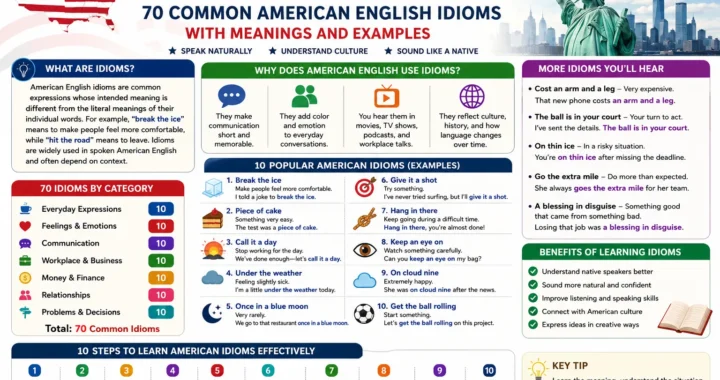
Idioms are fixed phrases whose meaning cannot be understood by looking at the individual words alone. The meaning of the whole phrase is learned through common usage, not logic. For example, “break the ice” doesn’t involve any actual ice. It means to ease tension in an awkward or new social situation, a meaning entirely separate from the literal words used.

Idiom Examples: Everyday Situations
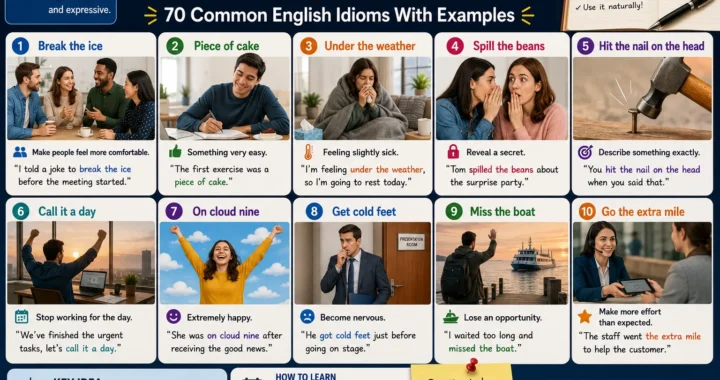
- Piece of cake – Something very easy to do. “The test was a piece of cake.”
- Break the ice – To ease social tension. “He told a joke to break the ice.”
- Under the weather – Feeling sick. “I’m staying home; I’m under the weather.”
- Hit the sack – To go to sleep. “It’s late, I should hit the sack.”
- Spill the beans – To reveal a secret. “She spilled the beans about the surprise.”
These five idioms are commonly used in beginner-level lessons and homework assignments, since they’re widely recognized and easy to explain with a clear example sentence.
Idiom Examples: Emotions and Feelings
- Over the moon – Extremely happy. “She was over the moon about her acceptance letter.”
- Down in the dumps – Feeling sad or low. “He’s been down in the dumps all week.”
- On cloud nine – Feeling very happy or excited. “They’ve been on cloud nine since the wedding.”
- Cold feet – Feeling nervous before something important. “He got cold feet before the interview.”
- Butterflies in my stomach – Feeling nervous. “I get butterflies before every presentation.”
These emotional idioms are especially useful examples for assignments focused on how figurative language expresses feelings more vividly than plain adjectives.
Idiom Examples: Time and Frequency
- Once in a blue moon – Something that happens very rarely. “We only meet up once in a blue moon.”
- In the nick of time – Just before it’s too late. “He arrived in the nick of time.”
- Around the clock – Continuously, all day and night. “The staff worked around the clock.”
- Better late than never – Doing something late is better than not at all. “She finally called back. Better late than never.”
These idioms work well for assignments specifically covering how figurative language describes timing or frequency.
Idiom Examples: Money and Value
- Cost an arm and a leg – Very expensive. “That laptop cost an arm and a leg.”
- Break the bank – To spend more than you can afford. “The trip didn’t break the bank.”
- Money doesn’t grow on trees – Money is limited and must be earned. “My parents always said money doesn’t grow on trees.”
Idiom Examples: Animals
- Let the cat out of the bag – To accidentally reveal a secret. “He let the cat out of the bag about the party.”
- Kill two birds with one stone – To accomplish two things with one action. “Running errands on my way home kills two birds with one stone.”
- Hold your horses – Wait, slow down. “Hold your horses, we’re not ready yet.”
- When pigs fly – Something that will never happen. “He’ll clean his room when pigs fly.”
Animal idioms work especially well as examples for younger students or beginner lessons, since the imagery is vivid and memorable.
Idiom Examples: Work and School
- Hit the books – To study hard. “I need to hit the books before the exam.”
- Touch base – To make brief contact or follow up. “Let’s touch base tomorrow.”
- Learn the ropes – To learn how to do a new task or job. “It took her a week to learn the ropes at her new job.”
Expert Insights: What Makes a Strong Example When Explaining Idioms
A strong idiom example does more than just show the phrase in isolation. It includes a full sentence demonstrating natural context, since context reveals how the idiom actually functions grammatically and tonally in real communication.
When completing assignments or lessons involving idioms, examples that pair the idiom with a relatable, everyday situation, rather than an abstract or unusual one, tend to be easier for both the student explaining it and the audience receiving the explanation to understand and remember.
Teachers often note that students demonstrate stronger comprehension when they can explain not just what an idiom means, but why the literal words don’t match that meaning, showing genuine understanding of figurative language rather than simple memorization.
This is why the strongest homework answers typically include both a clear definition and a well-chosen, natural example sentence together, rather than relying on either piece alone.
Common Mistakes Students Make With Idiom Examples
Mistake 1: Giving an example without a full sentence
Simply listing “piece of cake” without showing it in a sentence makes the example less clear and less demonstrative of actual understanding.
Mistake 2: Choosing an idiom without knowing its exact meaning
Selecting an idiom because it sounds interesting, without confirming its precise meaning, often leads to using it incorrectly in the example sentence.
Mistake 3: Using overly obscure or rare idioms
Choosing an idiom that’s genuinely difficult to explain or rarely used can make the answer harder to understand than choosing a clear, common example.
Mistake 4: Forgetting to explain why it’s figurative
A strong answer explains that the idiom’s meaning differs from its literal words, not just what the phrase means on its own.
Practical Steps to Answer “What Are Idioms” Assignments Well
- Start with a clear, one-sentence definition, explaining that an idiom’s meaning can’t be understood from its individual words.
- Choose common, easy-to-explain examples, rather than obscure or rarely used idioms.
- Write a full sentence for each example, showing the idiom used naturally in context.
- Briefly explain why the idiom is figurative, noting the gap between the literal words and the actual meaning.
- Organize examples by category if your assignment allows it, since this shows stronger organizational understanding.
- Double-check each idiom’s meaning before including it, to avoid using any phrase incorrectly.
Idiom Examples by Category
| Category | Idiom Example | Meaning |
|---|---|---|
| Everyday | Piece of cake | Very easy |
| Emotion | Over the moon | Extremely happy |
| Time | Once in a blue moon | Very rarely |
| Money | Cost an arm and a leg | Very expensive |
| Animal | Hold your horses | Wait, slow down |
| Work/School | Hit the books | Study hard |
This table offers a quick, organized reference covering one strong example from each major category.
Frequently Asked Questions
Q: What are idioms, simply explained?
A: Idioms are fixed phrases whose meaning can’t be figured out by looking at the individual words. Their meaning is learned through common usage, not logic. “Break the ice,” for example, means easing social tension, not anything literally related to ice.
Q: Can you give five simple examples of idioms?
A: Yes: “piece of cake” (very easy), “break the ice” (ease tension), “spill the beans” (reveal a secret), “hit the sack” (go to sleep), and “once in a blue moon” (very rarely).
Q: What’s a good idiom example for a homework assignment?
A: Choose a common, easy-to-understand idiom like “piece of cake,” paired with a full sentence: “The test was a piece of cake.” This shows both the phrase and its natural use in context.
Q: Why do idioms need example sentences, not just definitions?
A: An example sentence shows how the idiom functions naturally in context, revealing grammar, tone, and typical usage that a bare definition alone doesn’t demonstrate.
Q: Are there different categories of idiom examples?
A: Yes. Common categories include emotions, time, money, animals, and work or school-related idioms, each offering examples suited to different types of assignments or lessons.
Q: What idioms work best for younger students?
A: Vivid, easy-to-picture idioms, particularly animal-based ones like “hold your horses” or “let the cat out of the bag,” tend to work especially well for younger learners due to their memorable imagery.
Q: How do I explain why an idiom is figurative rather than literal?
A: Point out that the individual words don’t logically connect to the phrase’s actual meaning. For example, “spill the beans” has nothing to do with actual beans; it simply means revealing a secret.
Bringing It All Together
Understanding what idioms are becomes far clearer once paired with solid, well-chosen examples across different everyday categories. A clear definition explains the concept, while strong examples, shown in full sentences, demonstrate exactly how idioms function in real communication.
Whether you’re completing an assignment, preparing a lesson, or just building your own vocabulary, having both pieces together, definition and examples, gives you a complete, ready-to-use reference.
The next time you need to explain what an idiom is, you’ll have exactly what’s needed: a clear definition and a solid bank of examples, organized and ready to go.


[…] Read More: What Are Idioms? Definition and Examples Explained […]