

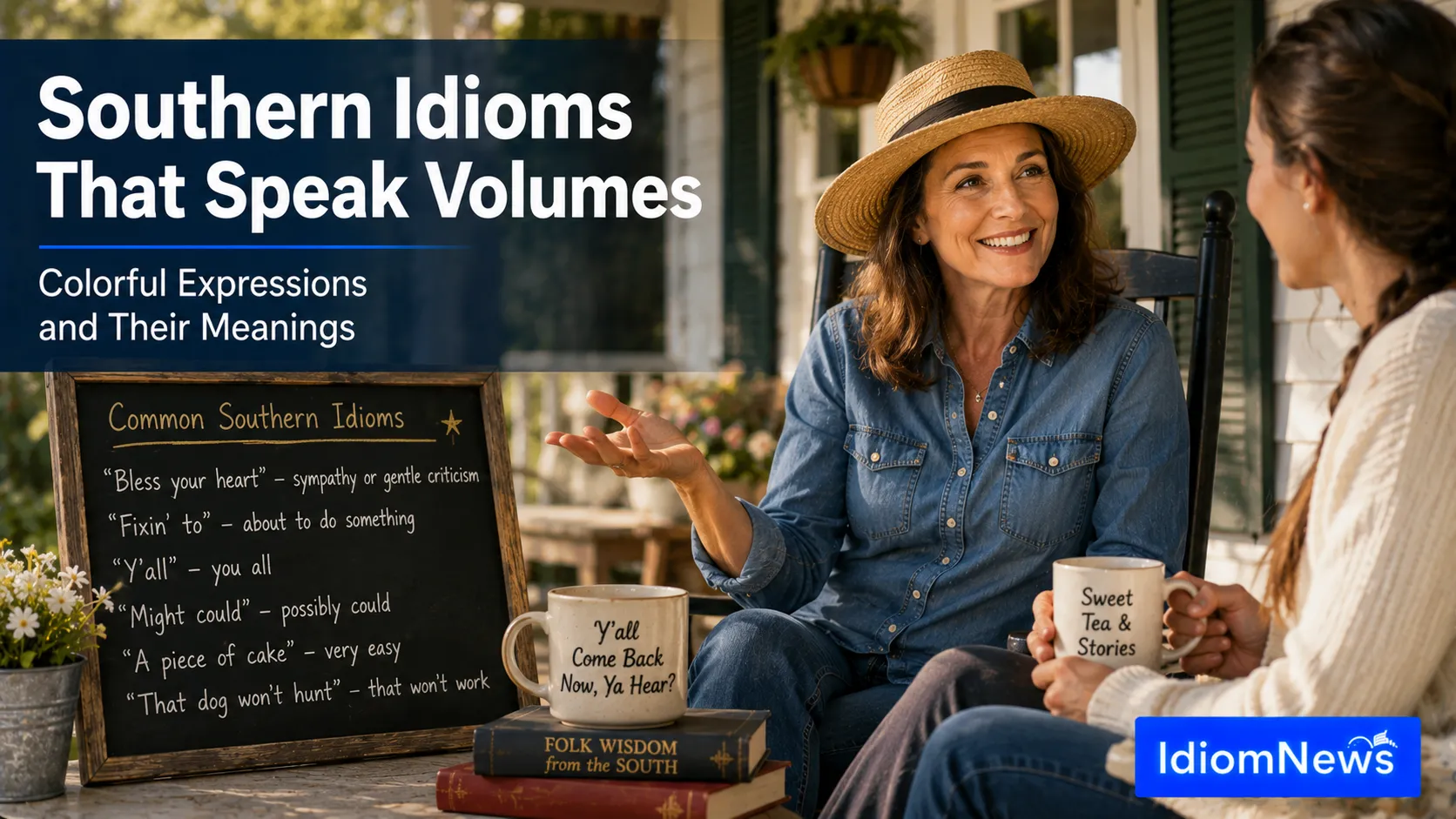
Southern Idioms: Colorful Expressions From the American South
Someone visiting the American South for the first time hears a local say “bless your heart” and walks away completely unsure whether they were just complimented, comforted, or quietly insulted. That confusion is a rite of passage for anyone encountering southern idioms for the first time.
Southern idioms carry a distinct flavor shaped by the region’s history, storytelling traditions, and social customs. Many phrases pack layered meaning, humor, warmth, or gentle criticism, into just a few folksy words that outsiders often need explained.
This matters for anyone relocating to the South, dating or working with Southerners, or simply enjoying Southern literature, film, and television where these expressions appear constantly and rarely get translated for outside audiences.
Understanding these idioms, including their sometimes tricky double meanings, helps outsiders avoid misreading conversations and gives a genuine appreciation for a distinctly regional style of American English.
By the end of this piece, you’ll recognize common Southern idioms, understand their real meanings, and know how to interpret some of the region’s trickier double-meaning phrases.
What Are Southern Idioms?
Southern idioms are figurative expressions commonly used across the American South, often reflecting the region’s storytelling traditions, rural history, and social customs around politeness and indirectness. Many carry double meanings, allowing speakers to express criticism or blunt opinions in a softer, more socially acceptable way. Understanding these idioms often requires reading between the lines, not just translating the words directly.
Everyday Southern Idioms You’ll Hear Often
Certain phrases appear constantly across casual Southern conversation, regardless of the specific state or community.
- “Fixin’ to” – About to do something. “I’m fixin’ to head to the store.”
- “Y’all” – A common Southern contraction for “you all,” used to address a group.
- “Might could” – Possibly could, expressing a soft, uncertain possibility. “I might could stop by later.”
- “Over yonder” – Referring to a place some distance away, often with a vague gesture toward the general direction.
- “Ain’t that something” – An expression of surprise or amazement about a situation.
These everyday phrases reflect the region’s distinctly relaxed, conversational speech patterns, differing noticeably from more formal American English.
The Famous Double Meaning of “Bless Your Heart”
Few Southern idioms cause as much confusion as “bless your heart,” precisely because its meaning shifts significantly depending on tone and context.
- Genuine sympathy: “She just lost her job. Bless her heart.” Here, the phrase expresses real, warm concern.
- Gentle criticism disguised as kindness: “He tried so hard, bless his heart.” In this context, the phrase softens a polite way of pointing out that someone’s effort wasn’t very successful.
- Mild condescension: “Bless her heart, she really thought that outfit looked good.” Here, the phrase carries a subtle, gently mocking undertone.
Context and tone matter enormously with this particular idiom, since the exact same words can express either genuine warmth or polite disapproval depending on how they’re delivered.
Southern Idioms About Effort and Determination
Many Southern idioms describe hard work, persistence, and determination, often tied to the region’s agricultural history.
- “Working like a dog” – Working extremely hard.
- “Slower than molasses in January” – Moving very slowly, referencing how thick molasses becomes in cold weather.
- “Bout to fall out” – Extremely tired, close to collapsing from exhaustion.
- “Root hog or die” – Meaning you have to work hard for what you need, since no one will provide it for you.
These idioms often connect directly to the region’s farming and rural history, reflecting a cultural emphasis on hard work and self-reliance.
Southern Idioms Used to Describe People and Behavior
Southern speech includes many colorful ways of describing personality traits and behavior, often through vivid, memorable comparisons.
- “Doesn’t have the sense God gave a goose” – Describing someone as not very smart.
- “All hat, no cattle” – Describing someone who talks big but doesn’t back it up with real substance or action.
- “Madder than a wet hen” – Extremely angry.
- “Happy as a pig in mud” – Very content or satisfied.
- “Cute as a button” – Describing someone or something as adorable.
These idioms lean heavily on vivid, often animal-related imagery, making them memorable and distinctly regional in flavor.
Southern Idioms About Food and Hospitality
Given the South’s strong cultural emphasis on hospitality and food, several idioms connect directly to these themes.
- “Y’all come back now, ya hear?” – A warm, friendly farewell inviting future visits.
- “That dog won’t hunt” – Describing an idea, excuse, or plan that simply won’t work.
- “Hungry as a bear” – Very hungry.
- “Not enough room to swing a cat” – Describing a very small, cramped space.
Expert Insights: Why Southern Idioms Rely So Heavily on Indirectness
Southern communication culture has historically placed strong emphasis on politeness and social harmony, which helps explain why so many Southern idioms serve as softer, more indirect ways of expressing criticism, disagreement, or bad news.
“Bless your heart” exemplifies this pattern perfectly, allowing a speaker to communicate genuine sympathy or gentle criticism without directly stating an unflattering opinion outright.
This indirectness isn’t unique to the American South; many cultures develop similar linguistic patterns where softening language serves social harmony. But the specific idioms and phrasing used to accomplish this reflect the South’s particular history, storytelling traditions, and regional identity.
Understanding this underlying cultural pattern, not just individual idiom definitions, helps outsiders interpret Southern speech more accurately, particularly phrases that carry double or hidden meanings depending on context and tone.
Common Mistakes People Make With Southern Idioms
Mistake 1: Taking “bless your heart” only at face value
This phrase can express genuine sympathy or gentle criticism depending on tone and context. Assuming it’s always purely kind can lead to misunderstanding subtle social cues.
Mistake 2: Assuming all Southern idioms are used only in casual, rural settings
Many Southern idioms appear across all social and educational levels throughout the region, not exclusively in rural or informal contexts.
Mistake 3: Overgeneralizing “the South” as linguistically uniform
Southern idioms and speech patterns vary somewhat between states and even specific communities, meaning not every phrase is universally used across the entire region.
Mistake 4: Using Southern idioms without understanding appropriate context
Some idioms, particularly ones involving subtle criticism, require careful reading of tone and situation to use or interpret correctly.
Practical Steps to Understand and Use Southern Idioms
- Pay close attention to tone, especially with idioms like “bless your heart” that carry multiple possible meanings.
- Learn the cultural context behind common phrases, since many connect to the region’s agricultural or storytelling history.
- Listen for regional variation, since specific idioms may differ somewhat between Southern states or communities.
- Practice using idioms in appropriate, casual conversational settings, since most fit informal rather than formal contexts.
- Ask for clarification when uncertain, particularly with idioms carrying potential double meanings.
Frequently Asked Questions
Q: What does “bless your heart” really mean?
A: It depends entirely on tone and context. It can express genuine sympathy, gentle criticism disguised as kindness, or mild condescension, making it one of the trickiest Southern idioms to interpret correctly.
Q: Are Southern idioms used the same way across every Southern state?
A: Not exactly. While many idioms are widely shared throughout the region, some variation exists between specific states and communities, reflecting local history and speech patterns.
Q: Why do Southern idioms often rely on indirect language?
A: Southern communication culture historically emphasizes politeness and social harmony, which explains why many idioms soften criticism or disagreement rather than stating opinions bluntly.
Q: What does “fixin’ to” mean?
A: It means “about to” or “getting ready to” do something. For example, “I’m fixin’ to leave” simply means the person is about to leave shortly.
Q: Can Southern idioms be used in professional settings?
A: Most Southern idioms fit casual, conversational contexts rather than formal professional writing, though some, depending on region and workplace culture, may appear naturally in spoken conversation.
Q: Why do so many Southern idioms reference animals?
A: Animal imagery offers vivid, easily visualized comparisons, and the South’s historical agricultural background likely contributed to how frequently these references appear in regional idioms.
Q: Is “y’all” considered an idiom?
A: Not exactly an idiom in the figurative sense, but it’s a distinctly Southern contraction (“you all”) that’s become one of the region’s most recognizable linguistic markers.
Bringing It All Together
Southern idioms offer a genuinely rich, distinctive slice of American English, shaped by the region’s storytelling traditions, agricultural history, and strong cultural emphasis on politeness and hospitality. Understanding them means paying attention not just to definitions, but to tone and context as well.
Phrases like “bless your heart” reveal just how much meaning can hide behind a few simple, folksy words, depending entirely on how and when they’re spoken.
The next time you hear a Southern idiom that leaves you unsure exactly what was meant, pause and consider the tone. That small habit will help you catch the subtle, often clever meaning hiding just beneath the surface.

[…] Read More: Southern Idioms: Meanings, Examples & Origins […]