

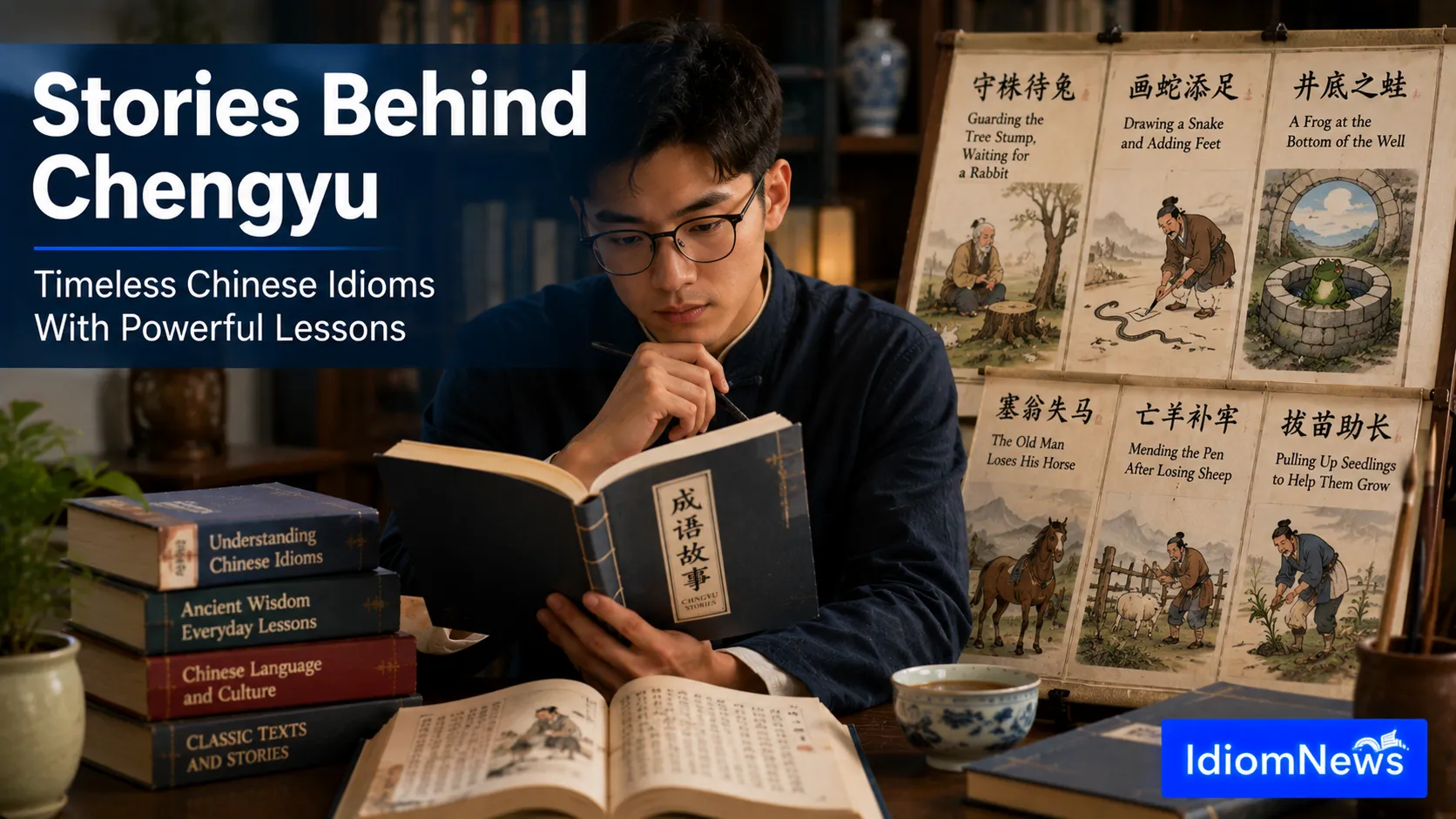
Chengyu Idioms: The Full Stories Behind 8 Famous Chinese Sayings
A student memorizes that 画蛇添足 (huà shé tiān zú) means “to ruin something by overdoing it,” passes the vocabulary quiz, and promptly forgets the phrase within a month. Meanwhile, a classmate who actually knows the story, a man who added feet to a snake he’d drawn and lost a wine-drinking contest because of it, remembers the idiom years later without any extra effort.
Chengyu idioms work differently from ordinary vocabulary precisely because most of them are compressed stories, not just clever phrasing. Knowing the full narrative behind each one isn’t a bonus. It’s often the actual mechanism that makes the phrase memorable and meaningful in the first place.
This matters for Chinese language learners who’ve hit a wall with bare definitions, teachers looking for genuinely engaging classroom material, and anyone curious about the historical and literary roots behind China’s most enduring four-character sayings.
Rather than listing dozens of chengyu with one-line definitions, this piece walks through several well-known chengyu in real narrative detail, the kind of depth that actually makes these idioms stick.
By the end of this piece, you’ll know the full stories behind several famous chengyu idioms, understand why the story matters as much as the phrase, and have a genuinely memorable foundation for further study.
What Makes Chengyu Different From a One-Line Definition
Chengyu idioms are four-character Chinese expressions whose full meaning typically depends on an accompanying historical or literary story, not just the literal translation of the individual characters. Reading only a short definition, without the narrative behind it, tends to produce weak, quickly forgotten understanding, since the connection between the characters and their figurative meaning is often not logically obvious without the story providing context.
守株待兔 (shǒu zhū dài tù): Guarding a Tree Stump, Waiting for a Rabbit
This chengyu tells the story of a farmer working his field who witnessed a rabbit accidentally run into a tree stump at full speed, breaking its neck and dying instantly. The farmer, delighted with this unexpected free meal, abandoned his farming entirely and sat by the stump day after day, waiting for another rabbit to repeat the same accident.
No second rabbit ever came, and the farmer’s fields fell into neglect while he wasted his time waiting for luck to strike twice in the same way.
Today, 守株待兔 describes someone who relies on a lucky, one-time outcome instead of consistent effort, waiting passively for good fortune rather than working toward a goal. The story’s imagery, a person literally sitting and waiting by a stump, makes the idiom’s criticism of laziness and misplaced hope immediately clear once you know the narrative.
画蛇添足 (huà shé tiān zú): Drawing a Snake and Adding Feet
Several men were sharing a jug of wine and decided to hold a contest: whoever could draw a snake fastest would win the entire jug. One man finished his drawing well before the others and, feeling overly confident with his extra time, decided to add feet to his snake to show off his skill further.
While he was adding those unnecessary feet, another competitor finished a simple, accurate snake drawing and claimed the wine, pointing out that snakes don’t have feet, so the first man’s drawing was no longer correct.
This chengyu now describes ruining something good by adding unnecessary, excessive detail, essentially overdoing a task that was already complete and correct.
塞翁失马 (sài wēng shī mǎ): The Old Man at the Frontier Loses His Horse
An elderly man living near the northern frontier owned a horse that one day ran away into neighboring territory. His neighbors offered sympathy over the loss, but the old man simply replied that this misfortune might actually turn out to be a blessing.
Sure enough, his horse eventually returned, bringing along a fine wild horse from the neighboring territory. This time, neighbors congratulated him on his good luck, but again he remained cautious, suggesting this fortune might bring trouble later.
His son, excited by the new horse, tried riding it, fell, and broke his leg. Once more, the old man refrained from despair, and when war broke out shortly after, his son’s broken leg kept him from being drafted into a conflict that claimed the lives of many other young men in the area.
This chengyu now describes how a setback might actually lead to unexpected good fortune, and vice versa, encouraging a patient, non-reactive perspective toward both good and bad turns of fortune.
井底之蛙 (jǐng dǐ zhī wā): The Frog at the Bottom of a Well
A frog living its entire life at the bottom of a well believed the small circle of sky visible above represented the entire world. Content and confident in this limited understanding, the frog considered its well a perfectly complete universe.
One day, a turtle from the sea happened to pass by and described the vastness of the ocean, an environment far larger and more varied than anything the frog had ever imagined from within its narrow well.
The frog, having never experienced anything beyond its small, enclosed space, struggled to even comprehend the turtle’s description, since its entire frame of reference was limited to the well it had never left.
This chengyu describes someone with an extremely narrow, limited perspective, mistaking their small personal experience for a complete understanding of the wider world.
亡羊补牢 (wáng yáng bǔ láo): Mending the Pen After Losing Sheep
A shepherd discovered one morning that several of his sheep had escaped overnight through a hole in his pen’s fence. A neighbor suggested he repair the fence immediately, but the shepherd initially dismissed the advice, reasoning that the sheep were already gone and the damage was done.
After losing more sheep through the same unrepaired hole in the following days, the shepherd finally relented and fixed the fence. From that point forward, he lost no additional sheep, and he later reflected that fixing the problem, even after some loss had already occurred, was far better than never fixing it at all.
This chengyu teaches that it’s never too late to correct a mistake or address a problem, even after some damage has already been done, since preventing further loss still holds real value.
拔苗助长 (bá miáo zhù zhǎng): Pulling Up Seedlings to Help Them Grow
A farmer, anxious about how slowly his crops seemed to be growing compared to his expectations, decided to physically pull each seedling slightly upward, believing this would help them grow taller faster.
Satisfied with his work, he returned home and proudly told his family he had helped his crops grow significantly that day. When his son went to check the field the next morning, he discovered that every single seedling had died, since pulling them upward had damaged their roots rather than accelerating their natural growth.
This chengyu warns against forcing unnatural haste onto a process that requires patience, describing situations where impatient interference actually damages rather than helps progress.
Expert Insights: Why Story-Based Learning Outperforms Isolated Memorization
Cognitive research on memory consistently shows that information embedded within a narrative structure tends to be retained significantly longer than isolated facts or definitions learned without context. Chengyu, by their very design, take advantage of this principle naturally, since each idiom essentially compresses a complete story into just four characters.
This explains why native Chinese speakers, who typically learn chengyu through storytelling and repeated exposure throughout their schooling, rarely forget these idioms despite their compact, sometimes cryptic structure. The story provides the scaffolding that makes the connection between characters and meaning feel logical rather than arbitrary.
For adult learners without this extended childhood exposure, deliberately seeking out the full story behind each chengyu, rather than settling for a bare translation, replicates some of that same narrative-based retention advantage within a much shorter timeframe.
This is precisely why chengyu resources that include only literal translations and one-line definitions tend to produce far weaker long-term retention than resources that include the full accompanying story.
Common Mistakes People Make Learning Chengyu Through Stories
Mistake 1: Skipping the story and memorizing only the translation
This significantly weakens retention, since the connection between the characters and the figurative meaning is often not obvious without the narrative providing context.
Mistake 2: Assuming every chengyu has an equally well-documented story
Some chengyu have clear, well-established historical origins, while others have more uncertain or debated backstories, worth acknowledging rather than treating every explanation as definitively confirmed.
Mistake 3: Reading the story once and never revisiting it
Even story-based learning benefits from periodic review, since chengyu still require repeated exposure over time to move into confident, long-term use.
Mistake 4: Focusing only on famous chengyu with dramatic stories
While engaging, prioritizing only dramatic or well-known stories can mean missing simpler, high-frequency chengyu that appear more often in everyday and formal Chinese.
Practical Steps to Learn Chengyu Through Their Stories
- Read the full story behind each new chengyu, not just a one-line translation or definition.
- Practice retelling the story briefly in your own words, reinforcing the narrative alongside the four characters.
- Write the characters by hand while reviewing the story, connecting the visual structure to the narrative meaning.
- Create your own modern example sentence, applying the chengyu’s lesson to a situation from your own life.
- Revisit each story periodically, since spaced review strengthens long-term retention even for story-based learning.
- Balance famous, dramatic chengyu with simpler, high-frequency ones, ensuring practical everyday usefulness alongside memorable storytelling.
Featured Chengyu at a Glance
| Chengyu | Literal Meaning | Lesson |
|---|---|---|
| 守株待兔 | Guarding a stump, waiting for a rabbit | Don’t rely on luck instead of effort |
| 画蛇添足 | Drawing a snake, adding feet | Don’t ruin something by overdoing it |
| 塞翁失马 | The old man loses his horse | Misfortune may bring unexpected benefit |
| 井底之蛙 | A frog at the bottom of a well | Don’t mistake limited experience for complete understanding |
| 亡羊补牢 | Mending the pen after losing sheep | It’s never too late to fix a problem |
| 拔苗助长 | Pulling up seedlings to help them grow | Forcing haste can damage natural progress |
This table offers a quick reference summarizing the core lesson behind each chengyu covered in this piece.
Frequently Asked Questions
Q: Why do chengyu idioms require knowing a story, unlike many English idioms?
A: Chengyu are compact, four-character expressions that often directly reference a specific historical or literary narrative. Without that story, the connection between the characters and the figurative meaning frequently isn’t logically obvious.
Q: What does 塞翁失马 mean?
A: It means that an apparent misfortune might eventually lead to unexpected good fortune, based on a story about an old man whose lost horse eventually brought both fortune and, indirectly, protection from war.
Q: Are all chengyu stories historically verified?
A: Not always with complete certainty. Some chengyu have well-documented historical or literary origins, while others carry more traditional, less rigorously verified backstories passed down through generations.
Q: Why does learning the story behind a chengyu improve memory?
A: Narrative context provides logical scaffolding that connects the four characters to their figurative meaning, which research on memory shows significantly improves retention compared to isolated definitions alone.
Q: What does 井底之蛙 mean, and where does it come from?
A: It means having an extremely narrow, limited perspective. It comes from a story about a frog living at the bottom of a well who believed its small view of the sky represented the entire world.
Q: How many chengyu should I learn with full stories versus simple definitions?
A: There’s no strict rule, but prioritizing well-documented, high-frequency chengyu with clear stories for deep learning, while using simpler definitions for less common ones, tends to balance depth and efficiency well.
Q: Can chengyu stories help with more than just vocabulary?
A: Yes. Many chengyu stories also offer insight into Chinese history, philosophy, and cultural values, providing broader cultural literacy alongside straightforward language learning.
Bringing It All Together
Chengyu idioms reveal their full depth only when you know the stories behind them. A phrase like 守株待兔 or 塞翁失马 isn’t just clever four-character phrasing. Each one carries an entire narrative, compressed and preserved across generations, that gives the idiom real, lasting meaning.
Learning chengyu through their stories, rather than bare translations alone, builds understanding that’s far more likely to stick, precisely because the narrative gives the characters somewhere to attach in memory.
The next time you come across an unfamiliar chengyu, look for its story before settling for a one-line definition. That extra step often makes the difference between a quickly forgotten phrase and a genuinely memorable piece of language and history.
Read More: What Is an Idiom? Definitions From Major Dictionaries




[…] Read More: Chengyu Idioms: 8 Famous Chinese Stories Explained […]