

Chinese Idioms in Chinese: Understanding the Terms, Characters, and Categories
A learner asks a Chinese teacher how to say “idiom” in Chinese, expecting one simple word back, and instead gets a short explanation involving three or four different terms, each describing a slightly different type of fixed expression. That moment of “wait, there’s more than one word for this?” is a genuinely useful starting point for understanding how Chinese idioms actually work in their original language.
Chinese idioms in Chinese aren’t a single, uniform category the way “idiom” often functions in English. Instead, Chinese linguistics recognizes several distinct types of fixed expressions, each with its own name, structure, and typical use, chengyu being just the most well-known among them.
This matters for serious Chinese learners who want to move beyond a surface-level understanding, teachers building accurate curriculum material, and anyone curious about how Chinese itself categorizes its own idiomatic language.
Understanding these distinct categories, along with the practical basics of reading and writing them in Chinese characters, gives you a genuinely more accurate picture than treating all Chinese idioms as one single, interchangeable group.
By the end of this piece, you’ll know the different terms Chinese uses for its own idioms, how they differ from each other, and the basics of working with these expressions in Chinese script.
What Does “Idiom” Actually Mean in Chinese?
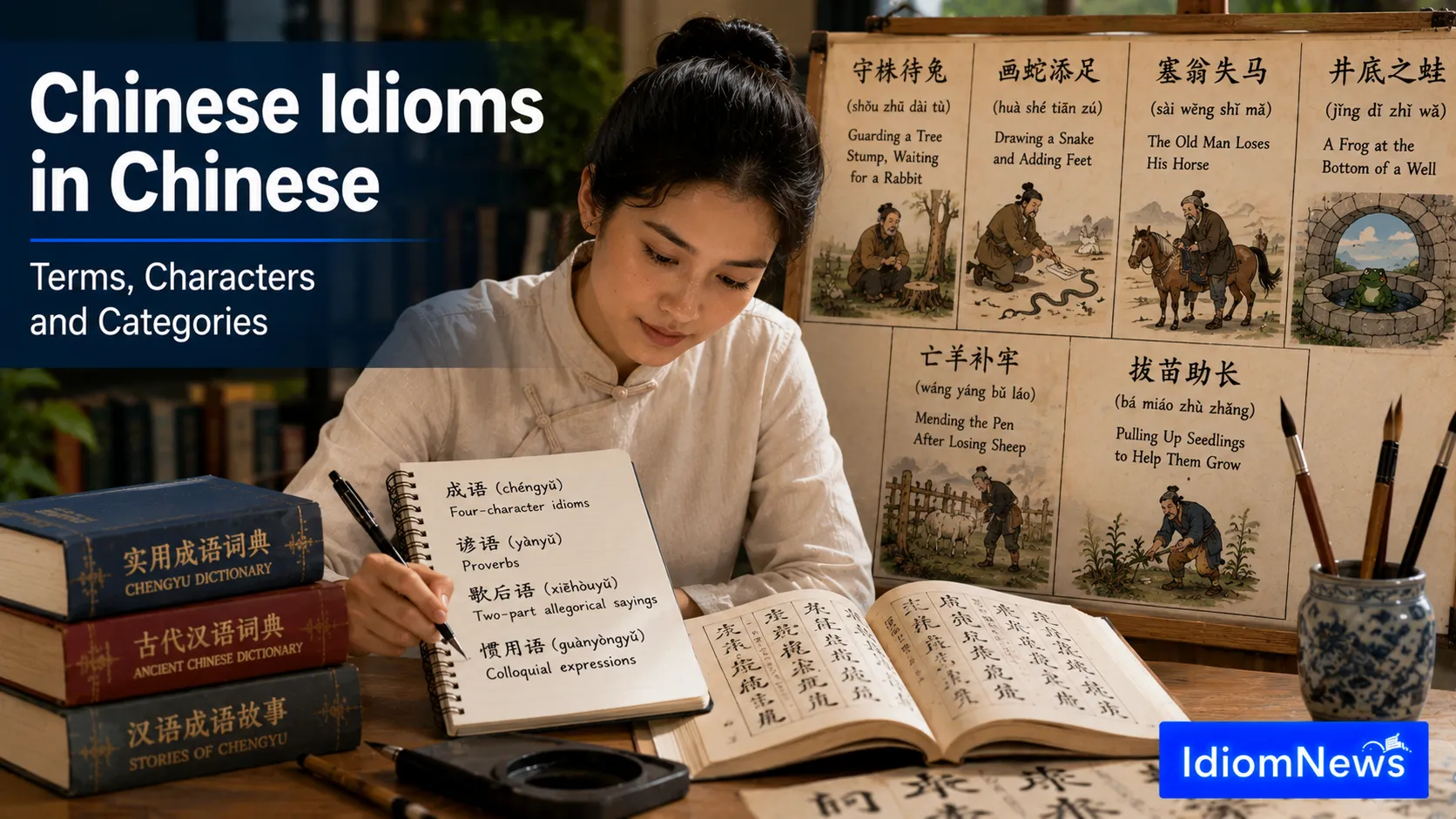
In Chinese, the closest and most common term for “idiom” is 成语 (chéngyǔ), specifically referring to traditional four-character fixed expressions, though Chinese also recognizes several related but distinct categories of idiomatic language, including 谚语 (proverbs), 歇后语 (two-part allegorical sayings), and 惯用语 (colloquial fixed expressions). Each term describes a structurally and functionally different type of fixed phrase, rather than being interchangeable synonyms.
成语 (Chéngyǔ): The Classic Four-Character Idiom
成语 (chéngyǔ) represents the category most people think of first when discussing Chinese idioms, characterized by its strict four-character structure and frequent ties to classical literature, history, or philosophy.
Examples like 守株待兔 (guarding a stump, waiting for a rabbit) and 画蛇添足 (drawing a snake and adding feet) fall specifically into this category, each carrying a compressed story or lesson within exactly four characters.
Chengyu tend to appear more frequently in formal and written Chinese, including news broadcasts, essays, and literature, compared to some of the other idiom categories discussed below.
谚语 (Yànyǔ): Folk Proverbs and Sayings
谚语 (yànyǔ) refers to folk proverbs, typically offering practical wisdom or life advice, similar to English proverbs like “the early bird catches the worm.”
Unlike chengyu, 谚语 don’t follow a strict four-character structure and often originate from common folk wisdom rather than classical literature or documented historical events.
For example, 早起的鸟儿有虫吃 (zǎoqǐ de niǎor yǒu chóng chī), meaning “the early bird gets the worm,” functions as a 谚语 rather than a chengyu, since it doesn’t follow the compact four-character format and offers direct, practical advice rather than a historically compressed lesson.
歇后语 (Xiēhòuyǔ): Two-Part Allegorical Sayings
歇后语 (xiēhòuyǔ) represents one of the more distinctly structured categories, consisting of two parts: a descriptive, often humorous first half, followed by an explanatory second half that reveals the actual intended meaning.
This structure allows speakers to state only the first half in casual conversation, letting the listener mentally complete the second half, similar to how English speakers might say “when in Rome…” without finishing the full phrase.
A well-known example is 泥菩萨过江,自身难保 (ní púsà guò jiāng, zìshēn nán bǎo), literally “a clay Buddha crossing a river can’t even protect itself,” meaning someone in trouble themselves can’t reasonably help others. Often, only the first half would be spoken in casual conversation, with listeners expected to understand the implied second half.
This playful, riddle-like structure makes 歇后语 distinctly different from the more formal, compressed nature of chengyu.
惯用语 (Guànyòngyǔ): Everyday Colloquial Idioms
惯用语 (guànyòngyǔ) describes colloquial, everyday fixed expressions that don’t necessarily follow the four-character structure of chengyu and typically carry a more casual, conversational tone.
These expressions function somewhat similarly to English idioms like “spill the beans” or “hit the sack,” casual figurative phrases used in everyday speech rather than formal or literary writing.
For example, 走后门 (zǒu hòumén), literally “go through the back door,” means using personal connections to gain an unfair advantage, a casual expression far more common in everyday conversation than in formal writing.
Reading and Writing Chinese Idioms: Simplified vs Traditional Characters
Understanding Chinese idioms in their original script requires knowing that Chinese uses two different character systems: simplified characters, standard in mainland China, and traditional characters, still used in Taiwan, Hong Kong, and some overseas Chinese communities.
Many common chengyu look nearly identical across both systems, since simplification primarily affected certain frequently used characters, but some idioms do show visible differences depending on which system you’re reading.
For example, the chengyu 龍飛鳳舞 (traditional) becomes 龙飞凤舞 (simplified), both meaning “flying dragon, dancing phoenix,” a phrase describing vigorous, flowing calligraphy or handwriting. Learners focused specifically on mainland Chinese media and communication typically prioritize simplified characters, while those studying Taiwanese or Hong Kong Chinese specifically need traditional character familiarity.
Expert Insights: Why This Terminology Distinction Matters for Serious Learners
Understanding the difference between 成语, 谚语, 歇后语, and 惯用语 matters most for learners moving beyond basic conversational Chinese toward more advanced reading comprehension, particularly for formal writing, literature, or academic Chinese study.
This is because these categories often appear differently across contexts. Formal writing and news media lean heavily on chengyu, while everyday conversation more frequently includes 惯用语 and occasionally the playful, riddle-like structure of 歇后语.
Recognizing which category a specific idiom belongs to also helps learners correctly predict its typical register, formal versus casual, and appropriate context, preventing awkward mismatches like using a very formal chengyu in an overly casual conversation, or vice versa.
For learners specifically preparing for HSK exams or academic Chinese study, prioritizing chengyu specifically tends to offer the strongest testing returns, since these appear most consistently in formal reading passages and writing assessments at intermediate and advanced levels.
Common Mistakes People Make With Chinese Idiom Terminology
Mistake 1: Treating “chengyu” as a synonym for all Chinese idioms
Chengyu specifically refers to four-character expressions. Other categories, like 谚语 and 惯用语, are equally valid types of Chinese idioms but follow different structures and functions.
Mistake 2: Assuming all Chinese idioms follow the four-character structure
Only chengyu specifically follow this format. Proverbs, colloquial expressions, and allegorical sayings often have different lengths and structures entirely.
Mistake 3: Ignoring the difference between simplified and traditional characters
Some idioms look visibly different depending on which character system you’re reading, which matters significantly depending on your specific regional focus.
Mistake 4: Using overly formal chengyu in casual conversation
Since chengyu often carry a more literary, formal tone, using them excessively in casual speech can sound unnaturally stiff, similar to using overly formal vocabulary in casual English conversation.
Practical Steps to Study Chinese Idioms Across Different Categories
- Learn to distinguish chengyu, 谚语, 歇后语, and 惯用语 by structure and typical context before diving deeply into memorization.
- Prioritize chengyu first if preparing for HSK exams, since this category appears most consistently in formal testing contexts.
- Choose your character system based on your specific goals, focusing on simplified characters for mainland Chinese contexts or traditional characters for Taiwan and Hong Kong.
- Practice writing idioms by hand, reinforcing both character recognition and stroke order alongside meaning.
- Match idiom category to context, using more casual 惯用语 in everyday conversation and chengyu in more formal writing or speech.
- Explore 歇后语 specifically for cultural and conversational insight, since their playful, riddle-like structure offers genuine cultural interest beyond straightforward vocabulary building.
Chinese Idiom Categories Compared
| Term | Structure | Typical Tone | Example Context |
|---|---|---|---|
| 成语 (Chéngyǔ) | Four characters | Formal, literary | News, essays, literature |
| 谚语 (Yànyǔ) | Variable length | Practical, folk wisdom | Everyday advice and sayings |
| 歇后语 (Xiēhòuyǔ) | Two-part, riddle-like | Playful, conversational | Casual conversation |
| 惯用语 (Guànyòngyǔ) | Variable length | Casual, colloquial | Everyday speech |
This table offers a quick comparison of the four major categories, showing how each differs by structure, tone, and typical context of use.
Frequently Asked Questions
Q: What is the Chinese word for “idiom”?
A: The closest and most common term is 成语 (chéngyǔ), specifically referring to traditional four-character fixed expressions. However, Chinese also recognizes related categories like 谚语, 歇后语, and 惯用语 for other types of fixed, idiomatic phrases.
Q: Are all Chinese idioms four characters long?
A: No, only chengyu specifically follow this strict four-character format. Other categories, like proverbs (谚语) and colloquial expressions (惯用语), often have different, more variable lengths and structures.
Q: What is 歇后语, and how is it different from chengyu?
A: 歇后语 is a two-part allegorical saying with a descriptive first half and an explanatory second half, often used playfully in casual conversation, unlike the more formal, compact four-character structure of chengyu.
Q: Should I learn simplified or traditional Chinese characters for idioms?
A: This depends on your specific goals. Simplified characters are standard in mainland China, while traditional characters remain in use in Taiwan, Hong Kong, and some overseas Chinese communities.
Q: Which type of Chinese idiom is most important for HSK exam preparation?
A: Chengyu specifically appears most consistently in formal HSK reading passages and writing assessments, particularly at intermediate and advanced levels, making it the priority category for exam-focused study.
Q: Is 惯用语 the same as chengyu?
A: No. 惯用语 refers to casual, everyday colloquial expressions that don’t follow the four-character structure of chengyu and typically carry a more conversational, informal tone.
Q: Why does Chinese have so many different terms for idiomatic expressions?
A: These distinct categories reflect genuinely different structures, origins, and typical contexts of use, ranging from formal literary chengyu to casual colloquial expressions, rather than being simple synonyms for the same concept.
Bringing It All Together
Chinese idioms in Chinese represent a genuinely richer, more categorized system than the single English term “idiom” might suggest. From formal four-character chengyu to playful two-part 歇后语 and casual 惯用语, each category serves a distinct structural and contextual purpose within the language.
Understanding these categories, along with the basics of simplified versus traditional characters, gives learners a far more accurate and useful foundation than treating all Chinese idioms as one uniform group.
The next time you encounter an unfamiliar Chinese fixed expression, consider which category it likely belongs to. That small habit of categorization will deepen your understanding far beyond simple memorization alone.
Read More: Chengyu Idioms: 8 Famous Chinese Stories Explained



[…] Read More: Chinese Idioms in Chinese: Terms, Characters & Categories […]