

Examples of Idiom by Grammatical Function: How They Work in a Sentence
Someone learns that “under the weather” means feeling sick, then accidentally writes “she has under the weather” instead of “she is under the weather.” The idiom’s meaning was understood perfectly. What went wrong was grammar, specifically, not recognizing that this particular idiom functions like an adjective, not a verb phrase.
Examples of idiom are usually organized by theme, emotions, money, time, but rarely by grammatical function, even though understanding whether an idiom acts like a verb, adjective, or noun in a sentence directly affects how to use it correctly.
This gap matters for learners who’ve memorized idiom meanings but still struggle to slot them correctly into original sentences, since knowing what a phrase means doesn’t automatically reveal how it behaves grammatically.
Organizing examples this way, by how each idiom functions structurally rather than by topic, fills a genuinely useful gap that most idiom resources skip entirely.
By the end of this piece, you’ll have examples of idiom organized by grammatical role, along with a clearer sense of how to slot each type correctly into your own writing.
Why Grammatical Function Matters for Using Idioms Correctly
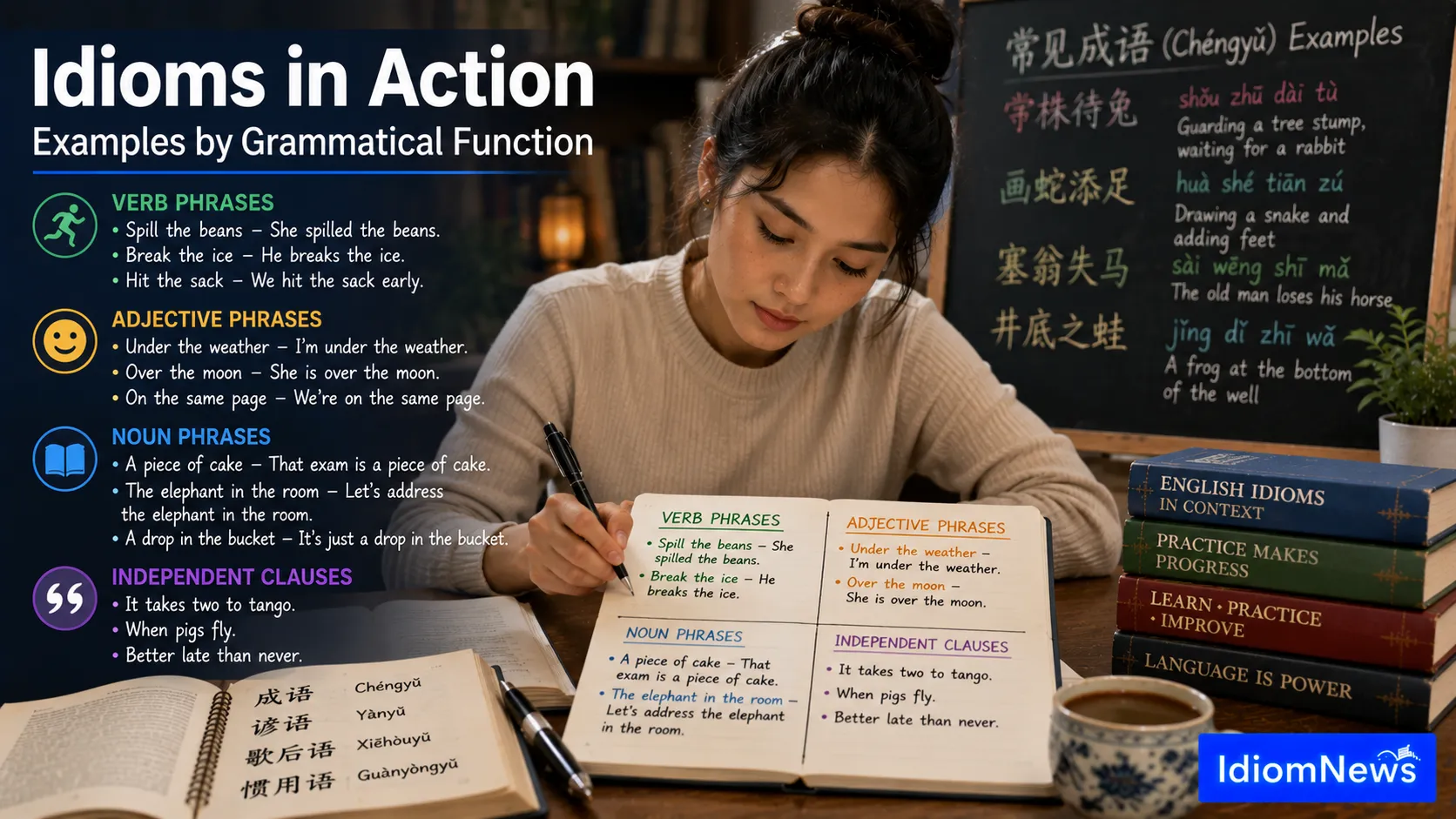
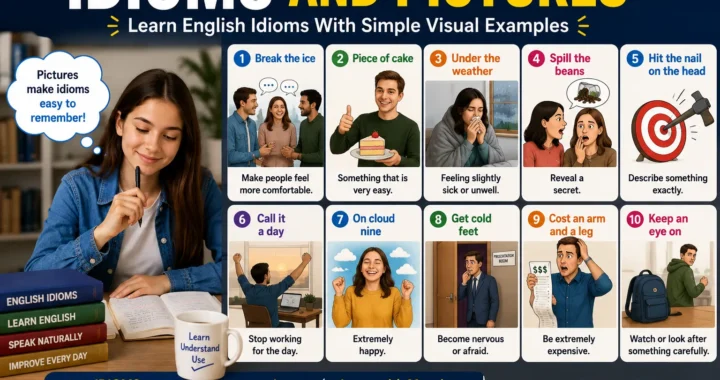
Idioms function differently within a sentence depending on their grammatical role, acting as verb phrases, adjective phrases, or noun phrases, even though this structural behavior often gets overlooked in favor of simply memorizing meaning. Knowing whether an idiom functions like a verb (“spill the beans”), an adjective (“under the weather”), or a noun (“a piece of cake”) directly determines how it should be positioned and conjugated within your own sentences.
Examples of Idiom That Function as Verb Phrases
These idioms act like verbs, meaning they typically follow a subject and conjugate based on tense, just like any regular verb phrase would.
- Spill the beans – “She spilled the beans about the surprise party.” (past tense, following subject “she”)
- Break the ice – “He breaks the ice with a joke at every meeting.” (present tense, third person singular)
- Hit the sack – “We’re going to hit the sack early tonight.” (future/near-future construction)
- Bite the bullet – “They finally bit the bullet and signed the contract.” (past tense)
- Touch base – “Let’s touch base tomorrow morning.” (base/imperative form)
Notice how each of these idioms adjusts naturally for tense and subject, following the same conjugation patterns as any ordinary verb phrase in English.
Examples of Idiom That Function as Adjective Phrases
These idioms describe a state or quality, typically following a linking verb like “is,” “was,” or “feel,” similar to how a regular adjective would.
- Under the weather – “I’m feeling under the weather today.” (describes a state, following “feeling”)
- Over the moon – “She was over the moon about the news.” (describes a state, following “was”)
- On cloud nine – “They’ve been on cloud nine since the engagement.” (describes an ongoing state)
- Down in the dumps – “He’s been down in the dumps lately.” (describes an emotional state)
- On the same page – “We’re finally on the same page about the plan.” (describes a shared understanding)
These adjective-like idioms typically remain fixed regardless of tense, since the linking verb before them carries the grammatical adjustment instead.
Examples of Idiom That Function as Noun Phrases
These idioms act like nouns, often following articles like “a” or “the,” and can typically be the subject or object within a sentence.
- A piece of cake – “That exam was a piece of cake.” (functions as a predicate noun)
- A drop in the bucket – “That donation is just a drop in the bucket.” (functions as a predicate noun)
- The elephant in the room – “Nobody wanted to address the elephant in the room.” (functions as a direct object)
- A blessing in disguise – “Losing that job turned out to be a blessing in disguise.” (functions as a predicate noun)
- The last straw – “Missing the flight was the last straw.” (functions as a predicate noun)
These noun-like idioms typically pair with linking verbs like “is” or “was” and behave grammatically like any other noun phrase acting as a subject complement or object.
Examples of Idiom That Function as Full Independent Clauses
Some idioms function as complete, standalone statements rather than fitting neatly into a single grammatical role within a larger sentence.
- “It takes two to tango” – Used as a standalone statement, typically responding to a claim of one-sided blame.
- “When pigs fly” – Often used alone as a sarcastic reply, implying something will never happen.
- “Better late than never” – Frequently stands alone as a complete thought following a delayed action.
- “The early bird catches the worm” – Functions as a standalone proverb-like statement, encouraging early action.
These idioms behave more like complete sentences themselves, rather than needing to be integrated grammatically into a larger sentence structure, making them somewhat distinct from the verb, adjective, and noun categories above.
Comparing Idiom Types Side by Side
Seeing these categories directly compared helps clarify how differently each type behaves grammatically within a sentence.
| Idiom | Grammatical Function | Example Sentence |
|---|---|---|
| Spill the beans | Verb phrase | “She spilled the beans.” |
| Under the weather | Adjective phrase | “I’m under the weather.” |
| A piece of cake | Noun phrase | “It was a piece of cake.” |
| It takes two to tango | Independent clause | “It takes two to tango.” |
This comparison table highlights exactly why treating all idioms the same grammatically leads to common structural mistakes.
Expert Insights: Why Idiom Instruction Often Skips Grammatical Function
Most idiom resources organize examples by theme or topic, emotions, money, work, since this format feels more intuitive and engaging for casual browsing or vocabulary building. Grammatical function, by contrast, requires a more structural, analytical approach that many general resources skip entirely.
This gap creates a real practical problem: a learner can know exactly what “under the weather” means while still writing an ungrammatical sentence, simply because they didn’t recognize the idiom needed a linking verb rather than direct conjugation like a verb phrase idiom would require.
Understanding grammatical function becomes especially important for intermediate and advanced learners specifically working on writing accuracy, since meaning alone doesn’t guarantee correct sentence construction, particularly for idioms whose behavior isn’t immediately obvious from their wording.
This structural approach complements, rather than replaces, thematic idiom study, offering a genuinely useful additional lens for learners who’ve already built solid vocabulary but want to strengthen grammatical accuracy specifically.
Common Mistakes People Make With Idiom Grammar
Mistake 1: Treating adjective-phrase idioms like verb phrases
Writing “she under the weathers” instead of “she is under the weather” mistakenly applies verb conjugation logic to a phrase that actually needs a linking verb.
Mistake 2: Forgetting articles before noun-phrase idioms
Dropping “a” or “the” before idioms like “piece of cake” or “elephant in the room” makes the sentence sound grammatically incomplete.
Mistake 3: Trying to conjugate independent-clause idioms
Phrases like “it takes two to tango” function as complete statements and typically don’t need additional grammatical modification to fit into a larger sentence.
Mistake 4: Assuming all idioms follow identical grammatical rules
Since idioms span multiple grammatical categories, verb phrases, adjective phrases, noun phrases, and independent clauses, applying one uniform grammatical approach to all of them leads to inconsistent, sometimes incorrect sentences.
Practical Steps to Practice Idioms by Grammatical Function
- Identify the idiom’s grammatical category before attempting to use it in your own sentence, checking whether it functions as a verb, adjective, or noun phrase.
- Practice verb-phrase idioms across different tenses, applying standard conjugation rules just as you would with any regular verb.
- Pair adjective-phrase idioms with an appropriate linking verb, like “is,” “was,” or “feel,” rather than conjugating them directly.
- Include the correct article before noun-phrase idioms, ensuring the sentence reads grammatically complete.
- Use independent-clause idioms as standalone statements, rather than trying to integrate them awkwardly into a larger sentence structure.
- Review your own example sentences, checking that each idiom’s grammatical role matches how you’ve actually used it.
Frequently Asked Questions
Q: Why does an idiom’s grammatical function matter if I already know its meaning?
A: Knowing an idiom’s meaning doesn’t guarantee correct sentence construction. Understanding whether it functions as a verb, adjective, or noun phrase determines exactly how to position and conjugate it correctly within your own writing.
Q: How can I tell if an idiom functions as a verb phrase?
A: Verb-phrase idioms typically follow a subject directly and conjugate for tense, similar to regular verbs. Examples include “spill the beans” and “break the ice,” which change form based on tense and subject.
Q: What’s an example of an idiom that functions as an adjective?
A: “Under the weather” functions as an adjective phrase, typically following a linking verb like “is” or “feel,” as in “I’m feeling under the weather,” rather than being conjugated directly like a verb.
Q: Do noun-phrase idioms need an article before them?
A: Usually, yes. Idioms like “a piece of cake” or “the elephant in the room” typically require an article, “a” or “the,” to read as grammatically complete within a sentence.
Q: Can idioms function as complete sentences on their own?
A: Yes, some idioms, like “it takes two to tango” or “when pigs fly,” function as standalone independent clauses, often used as direct responses rather than integrated into a larger sentence structure.
Q: Is it common for idiom lessons to cover grammatical function specifically?
A: Not typically. Most idiom resources organize examples by theme rather than grammatical role, making structural, function-based organization like this a less commonly covered but genuinely useful additional approach.
Q: What’s the best way to practice using idioms grammatically correctly?
A: Identifying each idiom’s grammatical category first, then practicing example sentences specifically within that category, tends to build stronger grammatical accuracy than studying idioms by theme alone.
Bringing It All Together
Examples of idiom organized by grammatical function reveal a structural layer that meaning-focused study often misses entirely. Recognizing whether an idiom behaves like a verb, adjective, noun, or complete independent clause directly affects how to correctly slot it into your own sentences.
This approach works best alongside, not instead of, thematic idiom study, giving you both the meaning and the grammatical mechanics needed to use each phrase confidently and correctly.
The next time you learn a new idiom, take a moment to identify its grammatical function first. That extra step often prevents the kind of small, avoidable errors that meaning alone simply can’t catch.
Read More: Devil’s Advocate Idiom Meaning, Origin & Examples

[…] Read More: Examples of Idiom by Grammatical Function Explained […]