

How to Define Idioms for Any Audience, From Kids to Academics
A parent explaining idioms to a curious seven-year-old needs completely different language than a linguistics professor writing a textbook definition, yet both are technically answering the exact same question: what is an idiom?
Learning to define idioms well isn’t just about memorizing one fixed explanation. It’s about adjusting your explanation to fit who’s actually asking, a skill that matters for teachers, parents, writers, and anyone who regularly needs to explain this concept to different kinds of people.
This matters because a definition that works perfectly for a college student studying linguistics might completely lose a young child, while an overly simplified explanation might feel condescending or imprecise for an advanced learner or academic audience.
Understanding how to define idioms clearly across different levels of complexity gives you genuine flexibility, whether you’re teaching a classroom, writing content, or just explaining the concept to a curious friend.
By the end of this piece, you’ll have several ready-to-use ways to define idioms, calibrated for different audiences, along with guidance on choosing the right one for your specific situation.
What Is the Simplest Way to Define Idioms?
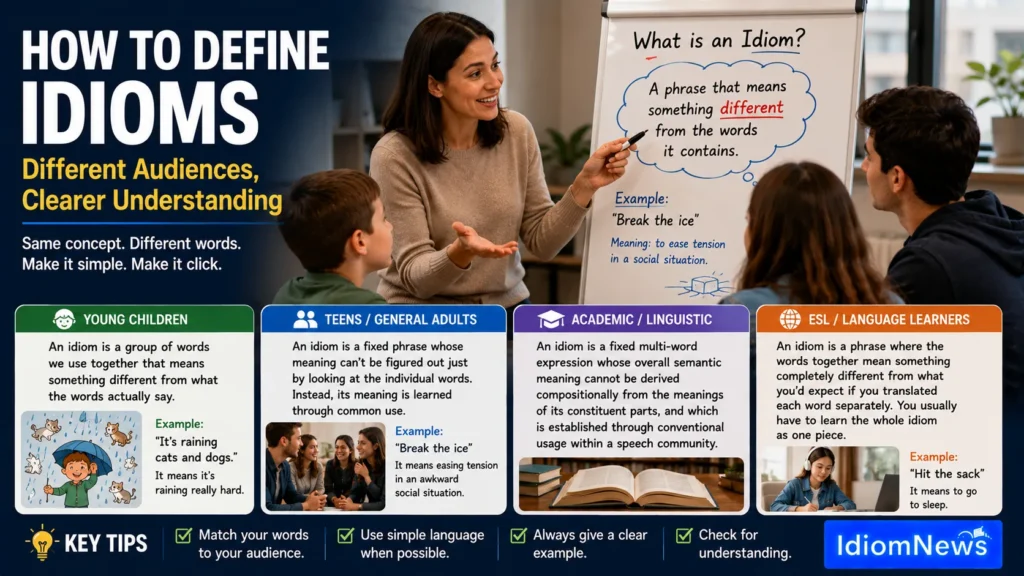
At the most basic level, idioms are groups of words that mean something different from what the individual words say. This simple definition works well for young children or absolute beginners, focusing purely on the core concept, that the meaning isn’t obvious from the words alone, without introducing additional linguistic terminology or complexity.
Defining Idioms for Young Children
When explaining idioms to children, concrete, visual language works far better than abstract terminology.
A strong child-friendly definition might sound like: “An idiom is a group of words we use together that means something different from what the words actually say. Like when someone says ‘it’s raining cats and dogs,’ they don’t mean actual cats and dogs are falling from the sky. They just mean it’s raining really, really hard.”
This approach works well specifically because it immediately follows the abstract definition with a concrete, visual example, letting the illustration do most of the actual teaching work rather than relying on the definition alone.
Avoiding terms like “figurative” or “literal” at this level, and instead simply contrasting “what the words say” with “what it actually means,” keeps the explanation accessible without sacrificing accuracy.
Defining Idioms for Teenagers and General Adult Audiences
For older students or general adult audiences without a background in linguistics, you can introduce slightly more precise vocabulary while still keeping the explanation conversational.
A solid definition at this level might read: “An idiom is a fixed phrase whose meaning can’t be figured out just by looking at the individual words. Instead, its meaning is something people learn through common use. For example, ‘break the ice’ doesn’t involve any actual ice. It means easing tension in an awkward social situation.”
This version introduces the term “figurative” indirectly (through the phrase “meaning can’t be figured out from individual words”) without requiring the audience to already know specialized vocabulary.
Defining Idioms for Academic or Linguistic Contexts
For academic writing, linguistics coursework, or professional lexicography, a more precise, technical definition becomes appropriate.
A stronger academic definition might state: “An idiom is a fixed multi-word expression whose overall semantic meaning cannot be derived compositionally from the meanings of its constituent parts, and which is established through conventional usage within a speech community.”
This version introduces specific linguistic terminology, “semantic meaning,” “compositionally,” “constituent parts,” appropriate for readers already familiar with basic linguistic concepts and expecting technical precision.
Defining Idioms for ESL and Language Learners
Language learners benefit from a definition that specifically addresses the challenge idioms present for non-native speakers, since this audience’s core confusion often differs from that of native speakers or children.
A useful ESL-focused definition might read: “An idiom is a phrase where the words together mean something completely different from what you’d expect if you translated each word separately. This is why idioms are often hard to guess, even if you know every individual word in the phrase. You usually just have to learn the whole idiom as one piece.”
This version directly addresses the specific confusion ESL learners commonly experience, namely, correctly translating individual words but still failing to understand the overall meaning, making the explanation immediately relevant to their actual learning challenge.
Comparing These Definitions Side by Side
Seeing these audience-specific definitions together highlights exactly how the core concept stays consistent while the language and complexity shift.
| Audience | Key Focus | Example Definition Style |
|---|---|---|
| Young children | Concrete, visual | “Means something different from what the words say” |
| Teens/general adults | Clear, conversational | “Fixed phrase, meaning learned through common use” |
| Academic/linguistic | Precise, technical | “Meaning cannot be derived compositionally” |
| ESL learners | Addresses translation confusion | “Can’t guess it even knowing every individual word” |
This comparison shows that while the underlying concept never actually changes, the language used to explain it should shift significantly based on who’s receiving the explanation.
Expert Insights: Why One-Size-Fits-All Definitions Often Fail
A definition perfectly calibrated for one audience often fails for another, not because the underlying concept changes, but because comprehension depends heavily on matching vocabulary complexity and explanatory approach to the listener’s existing knowledge and needs.
Educators specifically trained in differentiated instruction recognize this principle broadly: effective teaching requires adjusting explanation style to the audience, not just simplifying or complicating a single fixed definition uniformly across every situation.
This matters particularly for idioms specifically, since the concept itself, meaning that differs from literal words, can be explained through multiple valid entry points: visual imagery for children, translation confusion for ESL learners, or technical linguistic terminology for academic audiences.
Recognizing which entry point best suits your specific audience, rather than defaulting to one fixed explanation for every situation, significantly improves how effectively the definition actually lands and gets understood.
Common Mistakes People Make Defining Idioms
Mistake 1: Using the same definition regardless of audience
A definition that works well academically often loses younger or general audiences, while an overly simplified explanation can feel imprecise or condescending for advanced audiences.
Mistake 2: Skipping a concrete example after an abstract definition
Even a well-worded definition benefits significantly from an immediate, concrete example, particularly for younger or beginner audiences.
Mistake 3: Using unnecessary linguistic jargon for general audiences
Terms like “compositional meaning” or “semantic derivation” add unnecessary complexity for audiences who simply need a clear, functional understanding of the concept.
Mistake 4: Oversimplifying for academic or advanced audiences
Using only a child-friendly definition in academic writing can come across as imprecise or insufficiently rigorous for that specific context.
Practical Steps to Define Idioms for Your Specific Audience
- Identify your audience’s existing knowledge level before choosing a specific definition approach.
- Start with the simplest accurate version that fits your audience, adding complexity only if genuinely necessary.
- Pair any definition with a concrete example, regardless of audience, since examples reinforce abstract explanations significantly.
- Avoid unnecessary jargon unless your specific audience already expects and understands that level of technical language.
- Test your definition on someone from your target audience, checking whether it genuinely lands clearly before using it more broadly.
Frequently Asked Questions
Q: What is the simplest way to define idioms?
A: At the most basic level, idioms are groups of words that mean something different from what the individual words literally say. This simple definition works especially well for young children or absolute beginners.
Q: How should I define idioms for an academic paper?
A: Academic contexts typically call for more precise, technical language, describing idioms as fixed multi-word expressions whose overall meaning cannot be derived compositionally from their individual parts.
Q: Why does the definition of idioms need to change for different audiences?
A: Effective communication requires matching vocabulary complexity and explanatory approach to the listener’s existing knowledge, even though the underlying concept of an idiom remains exactly the same across all these different explanations.
Q: What’s a good way to define idioms for ESL learners specifically?
A: A useful ESL-focused definition emphasizes that idioms can’t be understood even when every individual word is correctly translated, directly addressing the specific confusion these learners commonly experience.
Q: Should I always include an example when defining an idiom?
A: Yes, generally. Pairing an abstract definition with a concrete example significantly strengthens understanding, particularly for younger or beginner audiences, though it remains helpful across nearly every audience level.
Q: Is it condescending to use a simple definition for advanced audiences?
A: It can be, depending on context. Academic or advanced audiences generally expect more precise, technical language, so an overly simplified definition might feel imprecise or insufficiently rigorous for that specific setting.
Q: How can I test whether my idiom definition works for my audience?
A: Try the definition on someone genuinely representative of your target audience before using it more broadly, checking whether it lands clearly and accurately without requiring significant additional explanation.
Bringing It All Together
Learning to define idioms well means recognizing that one fixed explanation rarely serves every audience equally well. The core concept, meaning that differs from literal words, stays consistent, but the language, complexity, and examples you choose should shift based on who’s actually listening.
Whether you’re explaining idioms to a curious child, an ESL learner, or an academic audience, matching your explanation to their specific needs makes the difference between a definition that genuinely lands and one that simply gets repeated without real understanding.
The next time you need to define idioms for someone, pause and consider your specific audience first. That small adjustment often makes all the difference in whether your explanation actually clicks.
Read More: Cock and Bull Story Idiom Meaning Explained


[…] Read More: How to Define Idioms for Every Audience […]