


Someone learns the definition of “hit the ground running” perfectly, then freezes when asked to actually use it in a sentence of their own. That gap between knowing what an idiom means and confidently placing it into a real sentence is one of the most common sticking points in learning idiomatic English.
Seeing an idiom in a sentence, ideally several sentences, makes the difference between passively recognizing a phrase and actually being able to use it naturally in your own speech or writing.
This matters for students completing homework assignments, English learners building conversational confidence, and writers looking for clear, correctly used examples before incorporating an idiom into their own work.
Rather than offering definitions alone, seeing each idiom used multiple times, in slightly different contexts, builds a much stronger, more flexible understanding of how these phrases actually function in real communication.
By the end of this piece, you’ll have dozens of example sentences across common idioms, organized by theme, ready to reference or model your own writing after.
Why Example Sentences Matter More Than Definitions Alone
Seeing an idiom in a sentence shows its natural grammatical structure, appropriate tone, and typical context, information a bare definition often leaves out entirely. A definition explains what a phrase means, while an example sentence demonstrates exactly how it fits naturally into real communication, including verb conjugation, sentence position, and everyday phrasing.

Everyday Idioms Used in Sentences
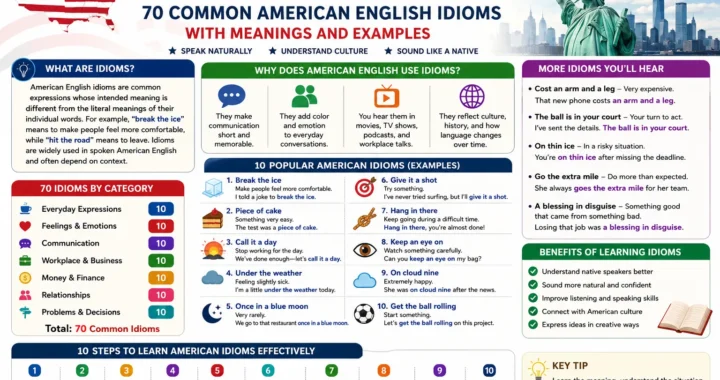
- Piece of cake: “Don’t worry about the exam. It’ll be a piece of cake for you.”
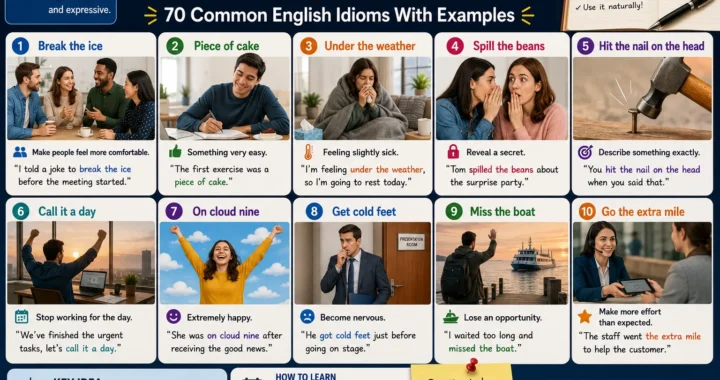
- Break the ice: “He told a joke to break the ice before the meeting started.”
- Under the weather: “I’m staying home today. I’m feeling a bit under the weather.”
- Hit the sack: “It’s already midnight. I should probably hit the sack.”
- Spill the beans: “She accidentally spilled the beans about the surprise party.”
- Call it a night: “We’re both exhausted, so let’s just call it a night.”
These everyday idioms appear so frequently in casual conversation that seeing them in context helps reinforce natural, confident usage quickly.
Idioms About Emotions Used in Sentences
- Over the moon: “She was over the moon when she got the acceptance letter.”
- Down in the dumps: “He’s been down in the dumps since he lost his job.”
- On cloud nine: “They’ve been on cloud nine ever since the engagement.”
- Cold feet: “He got cold feet right before the wedding ceremony.”
- Butterflies in my stomach: “I always get butterflies in my stomach before a big presentation.”
Emotional idioms are especially common in personal storytelling, making these example sentences useful for both writing and everyday conversation.
Idioms About Time Used in Sentences
- Once in a blue moon: “We only see each other once in a blue moon these days.”
- In the nick of time: “He arrived at the airport in the nick of time, right before boarding closed.”
- Around the clock: “The hospital staff worked around the clock during the emergency.”
- Beat the clock: “The team managed to beat the clock and finish the project early.”
- Down to the wire: “The negotiations went right down to the wire before a deal was reached.”
Time-related idioms show up frequently in both casual and professional writing, particularly when describing deadlines or how often something happens.
Idioms About Money Used in Sentences
- Cost an arm and a leg: “That new laptop cost an arm and a leg.”
- Break the bank: “You don’t need to break the bank to throw a nice party.”
- Tighten your belt: “We had to tighten our belt after the unexpected repair costs.”
- Bring home the bacon: “Both parents work hard to bring home the bacon for their family.”
- In the red: “The company has been in the red for the past two quarters.”
These idioms often appear in discussions about budgeting, spending, and financial decisions, both in personal conversation and business writing.
Idioms About Work Used in Sentences
- Touch base: “Let’s touch base again tomorrow morning after the meeting.”
- On the same page: “Before we move forward, I want to make sure we’re on the same page.”
- Think outside the box: “The manager encouraged the team to think outside the box for new solutions.”
- Back to the drawing board: “The client rejected the design, so it’s back to the drawing board.”
- Learn the ropes: “It took a few weeks for the new employee to learn the ropes.”
Workplace idioms tend to feel more neutral and professional, making them especially useful for emails, meetings, and business communication.
Idioms About Effort and Difficulty Used in Sentences
- Bite the bullet: “I finally bit the bullet and scheduled the dentist appointment.”
- Burn the midnight oil: “She’s been burning the midnight oil to finish her thesis on time.”
- An uphill battle: “Convincing him to change his mind was an uphill battle.”
- Roll up your sleeves: “It’s time to roll up our sleeves and get this project finished.”
- Face the music: “He finally had to face the music and admit his mistake.”
These idioms describe challenges and hard work, often appearing in conversations about tasks, responsibilities, and personal accountability.
Expert Insights: Why Multiple Example Sentences Build Stronger Fluency
Seeing an idiom used just once often isn’t enough to build confident, flexible usage. Multiple example sentences, across slightly different contexts, help learners recognize how a single idiom can adapt to various situations while keeping its core meaning intact.
This variation also reveals which parts of an idiom stay fixed and which parts, typically the verb tense or subject, shift naturally depending on the sentence. Comparing several examples side by side makes these patterns much easier to notice than studying just one isolated sentence.
Writers and educators often recommend reviewing three to five example sentences per idiom before attempting to write an original sentence independently, since this repetition builds a stronger intuitive sense of natural phrasing than a single example alone.
This approach mirrors how vocabulary acquisition works more broadly: repeated, varied exposure produces significantly stronger retention than a single, isolated encounter with any new phrase.
Common Mistakes People Make Writing Idioms Into Sentences
Mistake 1: Changing fixed words within the idiom
Altering core words, like saying “spill the peas” instead of “spill the beans,” makes the sentence sound incorrect, even if the surrounding grammar is otherwise fine.
Mistake 2: Forgetting to adjust the verb for tense and subject
The idiom’s core wording stays fixed, but the verb still needs to match tense and subject, just like any other sentence in English.
Mistake 3: Using an idiom in the wrong tone or context
Casual idioms can sound out of place in formal writing, while more neutral idioms fit better across both casual and professional contexts.
Mistake 4: Writing a sentence that doesn’t match the idiom’s actual meaning
Sometimes learners construct a grammatically correct sentence that doesn’t actually reflect the idiom’s true figurative meaning, leading to confusing or incorrect usage.
Practical Steps to Practice Writing Idioms in Sentences
- Read several example sentences for each idiom before attempting to write your own.
- Identify the fixed and flexible parts of the idiom, noting which words can change with tense or subject.
- Write three original sentences using the same idiom, adjusting tense and subject each time.
- Check your sentence against the idiom’s actual meaning, confirming it correctly reflects the intended figurative sense.
- Practice matching tone to context, choosing casual idioms for informal writing and more neutral ones for professional communication.
- Review and revise regularly, since repeated practice builds far stronger, more natural sentence construction over time.
Frequently Asked Questions
Q: Why is it helpful to see an idiom in a sentence rather than just its definition?
A: A sentence shows the idiom’s natural grammatical structure, appropriate tone, and typical context, information a bare definition alone doesn’t provide. This makes it much easier to use the idiom correctly and confidently yourself.
Q: How many example sentences should I review before writing my own?
A: Reviewing three to five example sentences per idiom tends to build stronger, more flexible understanding than studying just one isolated example, since variation helps reveal natural usage patterns.
Q: Can I change words within an idiom to fit my sentence better?
A: Generally, no. Core words within most idioms stay fixed, and changing them, even slightly, usually makes the sentence sound incorrect or confusing, even if your intended meaning stays clear.
Q: Do I need to adjust idioms for verb tense?
A: Yes. While the core wording of an idiom stays fixed, the verb inside it typically still needs to match tense and subject, following standard English grammar rules just like any other sentence.
Q: Are all idioms appropriate for both casual and formal writing?
A: No. Some idioms, like “touch base,” fit fairly neutral, professional contexts, while others, like “spill the beans,” sound too casual for formal writing and work better in everyday conversation.
Q: What’s the best way to practice writing idioms into my own sentences?
A: Writing three original sentences per idiom, adjusting tense and subject each time, and checking each sentence against the idiom’s actual meaning builds stronger, more confident usage than passive reading alone.
Q: Why do some idiom sentences sound more natural than others?
A: Natural-sounding sentences typically match the idiom’s usual tone, context, and grammatical structure. Comparing multiple well-written examples helps you internalize these natural patterns more effectively than a single example alone.
Bringing It All Together
Seeing an idiom in a sentence, especially multiple sentences across different contexts, builds far stronger, more confident usage than memorizing a definition alone. Each example reveals natural grammar, appropriate tone, and typical context that a bare definition simply can’t capture.
Practicing with real example sentences, then writing your own variations, moves you from passively recognizing idioms to actually using them naturally in your own speech and writing.
The next time you’re learning a new idiom, look for several example sentences first. That small extra step often makes the difference between forgetting a phrase and genuinely making it part of your natural vocabulary.
Read More: How to Learn Chengyu Idioms: A Study Guide for Chinese Language Learners


[…] Read More: Idiom in a Sentence: Example Sentences for 40+ Common Idioms […]