

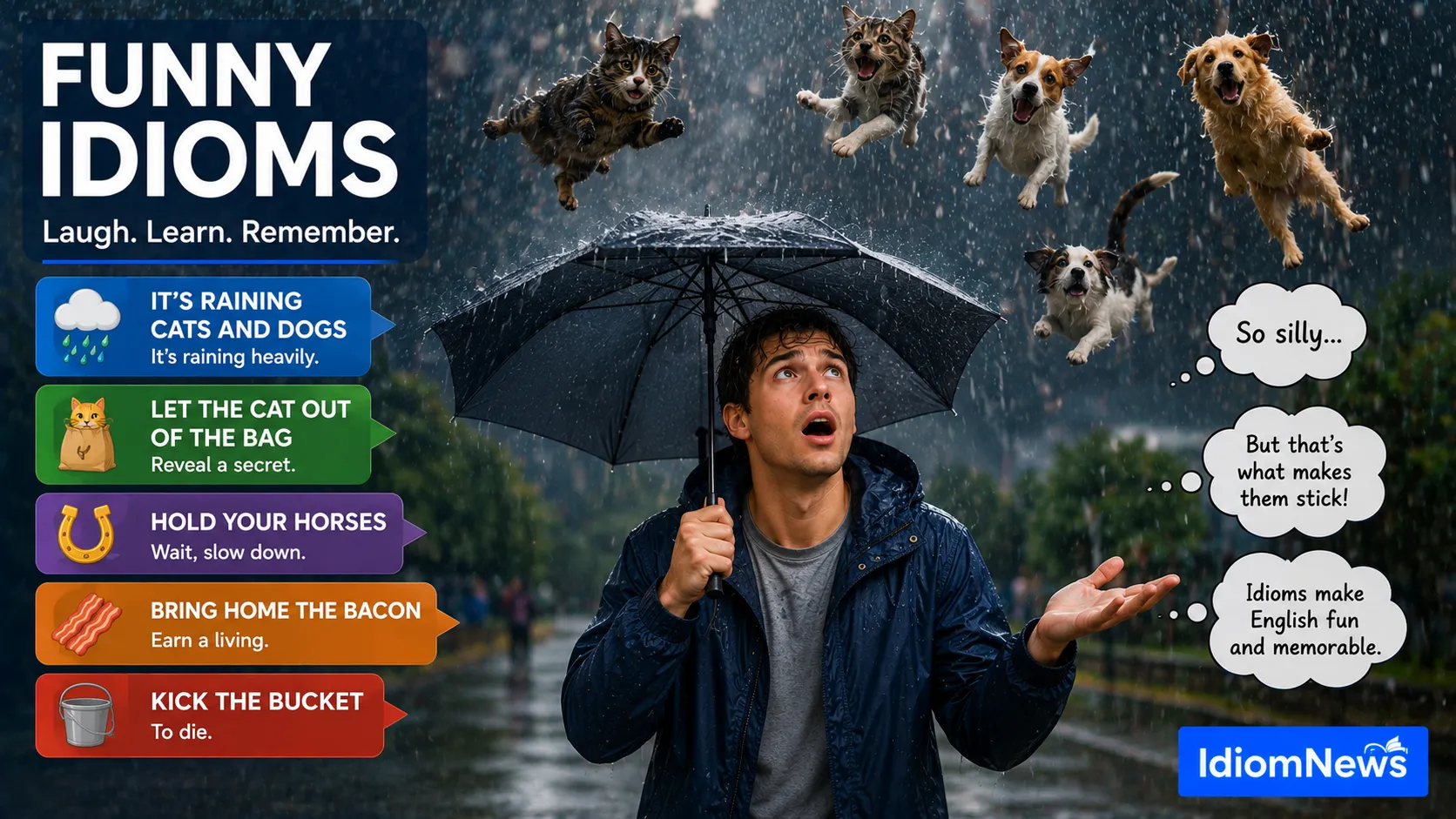
Someone says it’s “raining cats and dogs” outside, and for a split second, you might picture actual animals falling from the sky before your brain catches up and realizes it just means heavy rain. That brief moment of absurd imagery is exactly why funny idioms are so entertaining.
English is full of these ridiculous phrases, expressions so strange and vivid that they practically beg to be pictured literally, even though everyone knows better. That gap between the literal image and the intended meaning is where the humor lives.
For learners and native speakers alike, funny idioms offer something rare: language that’s memorable specifically because it’s absurd. Nobody forgets an idiom about a horse’s mouth or a dead cat once they’ve heard it explained.
Beyond the entertainment value, these phrases also make excellent teaching tools. Their sheer strangeness helps the meaning stick far better than a plain, forgettable phrase ever could.
By the end of this piece, you’ll have a solid collection of funny idioms, a clear understanding of what they actually mean, and a much better appreciation for just how weird English can be.
What Makes an Idiom “Funny”?
Funny idioms are expressions with especially vivid, absurd, or unexpected literal imagery, even though their actual meaning is completely ordinary. The humor comes from the contrast between the strange picture the words create and the simple, everyday idea being expressed. For example, “let the cat out of the bag” simply means revealing a secret, despite the odd image it creates.
Animal-Based Idioms That Sound Absurd
Animals show up constantly in funny idioms, often in situations that make no logical sense once you picture them literally.
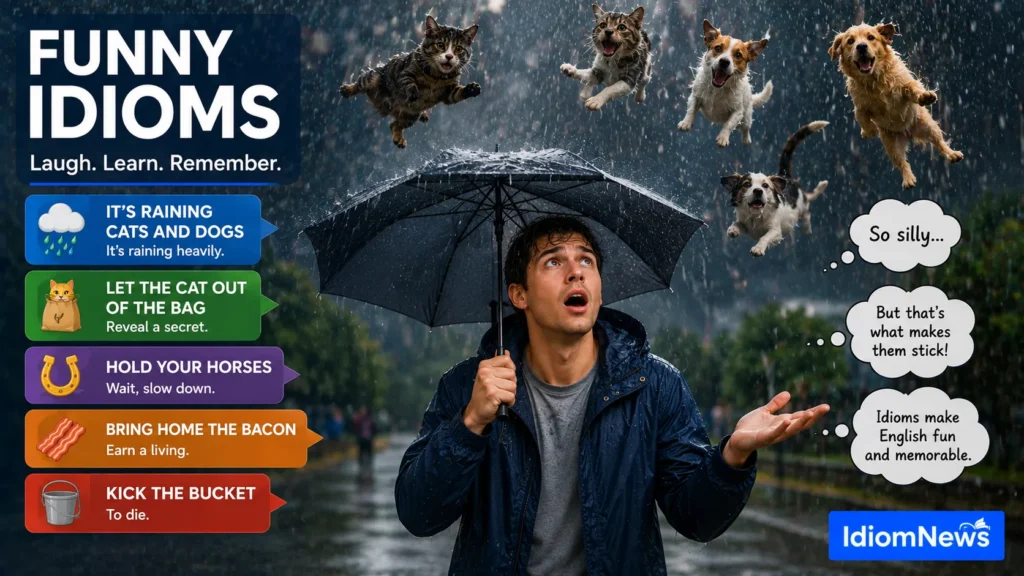
- “It’s raining cats and dogs” – It’s raining very heavily.
- “Let the cat out of the bag” – To accidentally reveal a secret.
- “Hold your horses” – Wait, slow down, don’t rush.
- “Kill two birds with one stone” – To accomplish two things with a single action.
- “A little bird told me” – A playful way of saying you heard something from an unnamed source.
Picturing these phrases literally is part of what makes them so memorable, and honestly, a little ridiculous.
Food-Based Idioms With Strange Imagery
Food idioms often combine everyday meals with completely unexpected situations, creating some genuinely funny mental pictures.
- “That’s how the cookie crumbles” – That’s just how things turned out; accept it.
- “Bring home the bacon” – To earn money to support your family.
- “Full of beans” – Very energetic or lively.
- “Not my cup of tea” – Something you don’t personally enjoy.
These idioms turn ordinary meals into strange, memorable metaphors that stick in your mind far longer than a plain explanation would.
Body-Part Idioms That Sound Bizarre Out of Context
Idioms involving body parts often create the strangest literal images once you actually stop and picture them.
- “Cost an arm and a leg” – Something extremely expensive.
- “Pull someone’s leg” – To joke with or tease someone.
- “By the skin of your teeth” – Barely managing to succeed or escape something.
- “Keep your chin up” – Stay positive during a difficult time.
Teeth don’t have skin, yet this idiom has survived for generations specifically because the strange imagery makes it memorable.
Idioms That Sound Like Complete Nonsense at First
Some idioms are so oddly specific that they sound almost invented, even though they’re genuinely common in everyday English.
- “The whole nine yards” – Everything possible; going all out.
- “Barking up the wrong tree” – Pursuing a mistaken or incorrect approach.
- “Beating around the bush” – Avoiding the main topic instead of addressing it directly.
- “Straight from the horse’s mouth” – Information from a reliable, firsthand source.
These idioms tend to spark the most confusion for learners, simply because there’s no obvious logical connection between the words and the meaning.
Expert Insights: Why Funny Idioms Tend to Survive Longer
Idioms with vivid, unusual imagery often last longer in everyday language than plain, forgettable phrases. The absurdity itself acts as a memory aid, making these expressions easier to recall and repeat over time.
This pattern shows up across many languages, not just English. Humans generally remember unusual or surprising information better than ordinary, expected information, and funny idioms take full advantage of that tendency.
For language learners, this means funny idioms are often worth prioritizing early. Their memorable, sometimes ridiculous imagery makes them easier to retain than idioms with plainer, less distinctive phrasing.
This is also part of why funny idioms show up so often in comedy, children’s media, and casual conversation. Their built-in humor makes them naturally entertaining to use, which keeps them circulating generation after generation.
Common Mistakes People Make With Funny Idioms
Mistake 1: Taking the imagery too literally
New learners sometimes get stuck picturing the literal scene instead of moving to the intended meaning. Treat the phrase as a whole unit, not a literal description.
Mistake 2: Using funny idioms in overly formal settings
Phrases like “raining cats and dogs” work fine casually but can sound out of place in formal writing or professional communication.
Mistake 3: Assuming funny idioms translate well into other languages
Most funny idioms are specific to English and rarely make sense translated literally into another language.
Mistake 4: Overusing them in a single conversation
Even entertaining idioms can feel forced if used too frequently. A little humor goes a long way in natural conversation.
Practical Steps to Learn and Use Funny Idioms
- Start with the most vivid, memorable idioms, since their imagery makes them naturally easier to recall.
- Picture the literal meaning intentionally, then compare it to the actual meaning to reinforce the humor and the lesson together.
- Practice using one funny idiom per day in a casual sentence you create yourself.
- Notice funny idioms in comedy shows, cartoons, or casual conversations, since they appear frequently in lighthearted contexts.
- Avoid using them in formal writing, saving them instead for casual conversation or creative writing.
- Share favorite idioms with others, since explaining the humor to someone else reinforces your own understanding.
Frequently Asked Questions
Q: What are some examples of funny idioms in English?
A: Popular examples include “it’s raining cats and dogs,” “let the cat out of the bag,” and “kick the bucket.” These phrases create vivid, unusual mental images despite describing fairly ordinary situations.
Q: Why do funny idioms use such strange imagery?
A: The unusual imagery makes these phrases more memorable than plain language would be. Humans tend to remember surprising or absurd information better than expected, ordinary phrasing.
Q: Are funny idioms appropriate for formal writing?
A: Generally, no. Most funny idioms sound too casual for formal or academic writing. They work best in everyday conversation, creative writing, or informal communication.
Q: Do funny idioms exist in languages other than English?
A: Yes, most languages have their own versions of vivid, humorous expressions. However, these idioms rarely translate directly, since the imagery is often specific to that language’s culture and history.
Q: Why are animal idioms so common among funny idioms?
A: Animals offer vivid, easily visualized imagery that works well for figurative language. Many funny idioms use animals specifically because they create memorable, sometimes absurd mental pictures.
Q: Can funny idioms help with language learning?
A: Yes. Their vivid, unusual imagery often makes them easier to remember than plainer idioms, which is why many language learners find funny idioms especially useful early in their studies.
Q: What’s the funniest idiom in English?
A: This varies by personal opinion, but idioms like “the whole nine yards” and “barking up the wrong tree” are frequently mentioned for their oddly specific, hard-to-explain imagery.
Bringing It All Together
Funny idioms turn ordinary ideas into vivid, memorable expressions that stick with you long after you first hear them. Their strange, sometimes absurd imagery isn’t a flaw. It’s exactly what makes them so effective and entertaining.
Learning these phrases offers a lighthearted way into idiomatic English, since their humor naturally makes the meaning easier to remember than plainer expressions.
Next time you’re building your idiom vocabulary, don’t skip the funny ones. Their built-in silliness might just make them the easiest phrases you’ll ever learn.
The next time it starts “raining cats and dogs,” you’ll picture the absurd literal image for a split second, laugh a little internally, and know exactly what’s really being said.
Read More: “Idioma” in English: How to Translate This Word Correctly in Every Context




[…] Read More: Funny Idioms That Will Make You Laugh (And What They Actually Mean) […]