

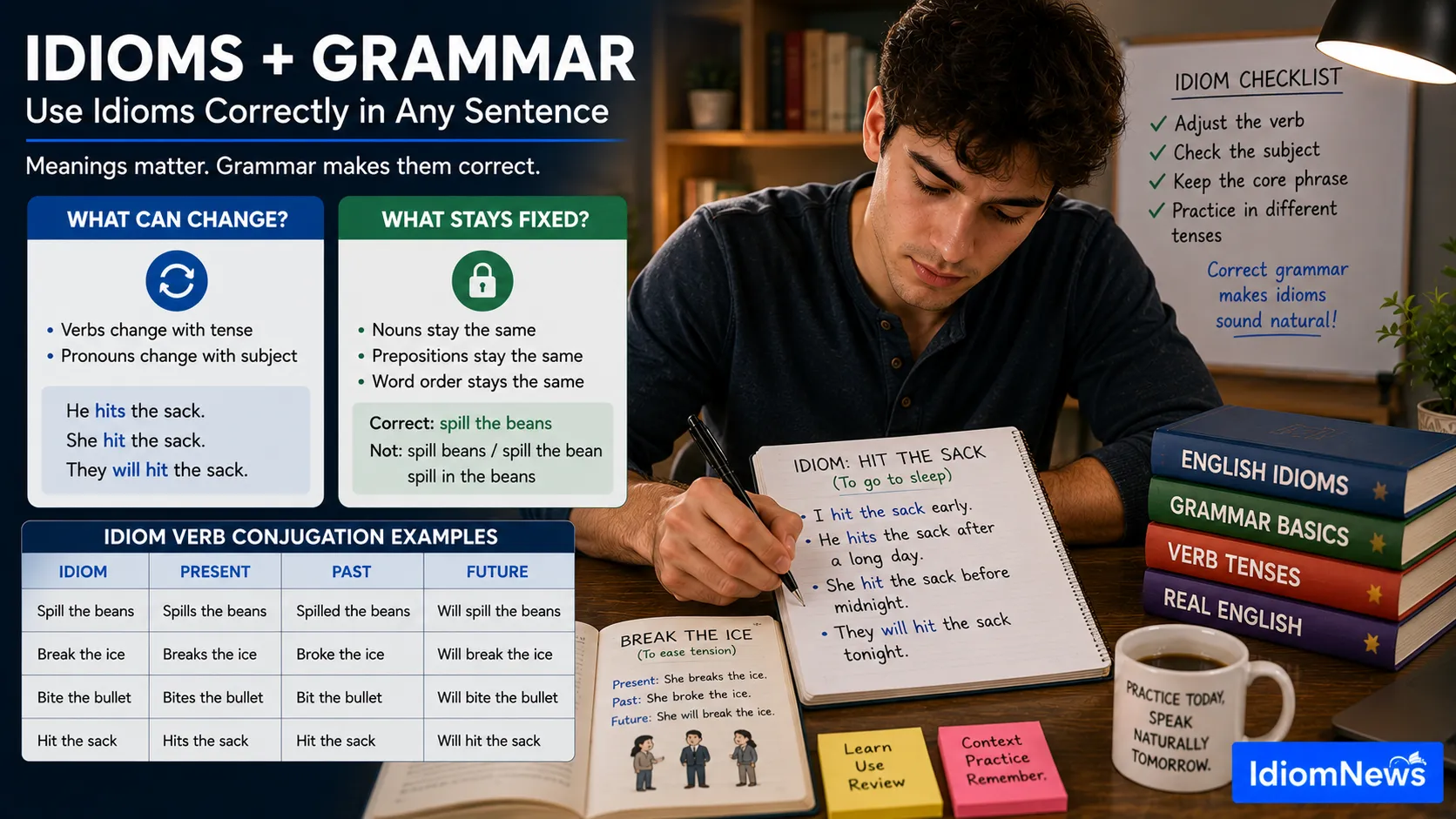
Someone learns the idiom “hit the sack” perfectly, then writes “yesterday I hitted the sack early,” unsure why the sentence suddenly feels wrong. The idiom itself wasn’t the problem. The verb conjugation was.
This is one of the most overlooked challenges in learning idioms. Knowing what a phrase means is only half the job. Knowing how to correctly adjust it for tense, subject, and sentence structure is the part that actually makes it usable in real writing and conversation.
Many idiom resources explain meaning clearly but skip this practical piece entirely, leaving learners able to recognize idioms in reading but unable to confidently use them correctly themselves.
Understanding exactly how idioms shift within a sentence, what parts can change and what parts must stay fixed, removes a major source of confusion for anyone trying to move from recognizing idioms to actually using them.
By the end of this piece, you’ll know exactly how to adjust idioms for tense, subject, and sentence position, so you can use them naturally and correctly in your own writing and speech.
How Do Idioms Work Grammatically in a Sentence?
Idioms function as fixed phrases, but the verb inside them usually still changes based on tense, subject, and sentence structure, just like any regular verb. The core wording of the idiom stays the same, while grammatical elements like verb conjugation adjust normally. For example, “hit the sack” becomes “hit the sack” (present), “hits the sack” (third person singular), or “hit the sack” (past tense, since “hit” doesn’t change form).

Which Parts of an Idiom Can Change
Most idioms have one flexible part, usually the verb, and one or more fixed parts that never change regardless of grammar.
- Verb changes with tense and subject: “She hits the sack early.” / “They hit the sack early.” / “He hit the sack early last night.”
- Pronouns sometimes adjust: “I bit my tongue” versus “She bit her tongue,” where the possessive pronoun shifts to match the subject.
- The core idiom phrase stays fixed: “Hit the sack” never becomes “hit the bag” or “strike the sack,” even though those words seem similar.
Recognizing which parts are flexible and which parts are locked in place prevents common grammar mistakes when adjusting idioms for different sentences.
Adjusting Idioms for Verb Tense
Verb tense is usually the trickiest part of using idioms correctly, since irregular verbs inside idioms follow the same irregular patterns they would outside of idiomatic phrases.
- “Spill the beans” – Present: “He spills the beans.” Past: “He spilled the beans.” Future: “He will spill the beans.”
- “Break the ice” – Present: “She breaks the ice.” Past: “She broke the ice.” Future: “She will break the ice.”
- “Bite the bullet” – Present: “They bite the bullet.” Past: “They bit the bullet.” Future: “They will bite the bullet.”
Since these verbs (spill, break, bite) are common outside of idioms too, their conjugation patterns inside idioms follow exactly the same rules learners already know from regular verb study.
Adjusting Idioms for Subject and Number
Idioms also need to match their subject in number, just like any other verb phrase in English.
- Singular subject: “He breaks the ice at every party.”
- Plural subject: “They break the ice at every party.”
- Third person singular: “She spills the beans every time.”
This follows standard subject-verb agreement rules, meaning learners who already understand basic English grammar can apply the same logic directly to idioms without learning new rules specifically for idiomatic phrases.
What Stays Fixed No Matter the Sentence
While verbs and pronouns often shift, several parts of most idioms remain completely unchanged, regardless of tense, subject, or sentence structure.
- Nouns inside idioms usually stay fixed: “Spill the beans” never becomes “spill the bean” or “spill beans” without the article.
- Prepositions stay fixed: “Under the weather” never shifts to “below the weather” or “in the weather.”
- Word order generally stays fixed: Idioms rarely allow reordering, unlike regular sentences where word order sometimes has more flexibility.
Attempting to modify these fixed elements, even slightly, often makes the idiom sound incorrect or confusing to native speakers, even if the intended meaning stays technically clear.
Expert Insights: Why Verb Conjugation Trips Up Idiom Learners
Idiom instruction often focuses heavily on meaning while spending far less time on the grammatical mechanics of actually using idioms correctly in a sentence. This creates a gap between recognizing idioms while reading and confidently using them in original writing or speech.
This gap becomes especially noticeable with irregular verbs, since learners sometimes assume idioms follow entirely separate grammar rules, when in reality the same irregular conjugation patterns from regular English grammar apply directly inside idiomatic phrases.
Practicing idioms across multiple tenses and subjects, not just memorizing the base form, tends to build far stronger, more flexible usage skills than learning idioms only in their most common, default form.
This approach mirrors how verb conjugation is taught more broadly in English grammar instruction, applying the same systematic practice to idiomatic verbs rather than treating them as a separate, disconnected category.
Common Mistakes People Make Using Idioms in Sentences
Mistake 1: Treating the entire idiom as unchangeable
Some learners avoid adjusting idioms at all, using only the base form regardless of tense. This creates grammatically incorrect sentences, even though the idiom itself is used correctly.
Mistake 2: Changing fixed nouns or prepositions
Altering fixed parts of an idiom, like changing “under the weather” to “in the weather,” makes the phrase sound incorrect, even if the intended meaning stays clear.
Mistake 3: Forgetting irregular verb conjugation
Verbs like “bite,” “break,” and “hit” follow irregular patterns outside of idioms too. Forgetting this leads to mistakes like “bited the bullet” instead of “bit the bullet.”
Mistake 4: Overcorrecting subject-verb agreement
Some learners apply agreement rules inconsistently, using “he spill the beans” instead of “he spills the beans,” despite understanding basic subject-verb agreement in regular sentences.
Practical Steps to Use Idioms Correctly in Sentences
- Identify the verb inside the idiom first, since this is usually the only part that needs grammatical adjustment.
- Check whether the verb is regular or irregular, applying the same conjugation rules used elsewhere in English grammar.
- Practice writing the same idiom across multiple tenses, rather than only learning its most common form.
- Leave fixed nouns, prepositions, and word order unchanged, since these rarely shift regardless of grammar.
- Read real sentences using the idiom in different tenses to reinforce correct usage patterns.
- Write your own practice sentences, adjusting the same idiom for different subjects and tenses deliberately.
Idiom Verb Conjugation Examples
| Idiom | Present | Past | Future |
|---|---|---|---|
| Spill the beans | Spills the beans | Spilled the beans | Will spill the beans |
| Break the ice | Breaks the ice | Broke the ice | Will break the ice |
| Bite the bullet | Bites the bullet | Bit the bullet | Will bite the bullet |
| Hit the sack | Hits the sack | Hit the sack | Will hit the sack |
This table offers a quick reference for practicing verb conjugation within common idioms across different tenses.
Frequently Asked Questions
Q: Can the verb inside an idiom change based on tense?
A: Yes. The verb inside most idioms changes normally based on tense and subject, following the same conjugation rules as regular English verbs. Only the core wording of the idiom itself stays fixed.
Q: Can I change the nouns inside an idiom?
A: Generally, no. Nouns inside idioms, like “beans” in “spill the beans,” typically stay fixed. Changing them, even slightly, usually makes the idiom sound incorrect or confusing.
Q: Why do some idioms use irregular verb forms?
A: Many idioms include irregular verbs, like “bite” or “break,” that follow the same irregular conjugation patterns used elsewhere in English grammar, not special rules unique to idioms.
Q: Is word order flexible within idioms?
A: No, word order within idioms is typically fixed. Unlike regular sentences, which sometimes allow flexible word order, idioms generally require the exact same sequence every time they’re used.
Q: Do idioms need to match subject-verb agreement rules?
A: Yes. Idioms follow standard subject-verb agreement, meaning singular and plural subjects require different verb forms, just like any other sentence in English.
Q: How can I practice using idioms in different tenses?
A: Writing the same idiom in past, present, and future tense, using different subjects each time, builds strong, flexible usage skills far better than only memorizing the idiom’s most common form.
Q: Why is grammar important when using idioms, since they’re figurative anyway?
A: While the meaning of an idiom is figurative, the sentence structure around it still follows standard English grammar rules. Ignoring grammar makes even a correctly understood idiom sound unnatural or incorrect.
Bringing It All Together
Using idioms correctly in sentences requires more than just knowing their meaning. Understanding which parts of an idiom can change with tense and subject, and which parts must stay completely fixed, makes the difference between recognizing an idiom and actually using it fluently.
Most of this comes down to applying grammar rules you likely already know, verb conjugation and subject agreement, directly to the flexible parts of idiomatic phrases.
Practice adjusting a handful of common idioms across different tenses and subjects, paying close attention to which words shift and which stay locked in place. That focused practice builds real, usable confidence.
The next time you use an idiom in your own writing or conversation, pause and check the verb. Getting that one detail right is often all it takes to sound completely natural.
Read More: Chinese Idioms: Meanings, Origins, and Why They Matter in the Language


[…] Read More: Use of Idioms in Sentences: A Practical Guide to Getting It Right […]