

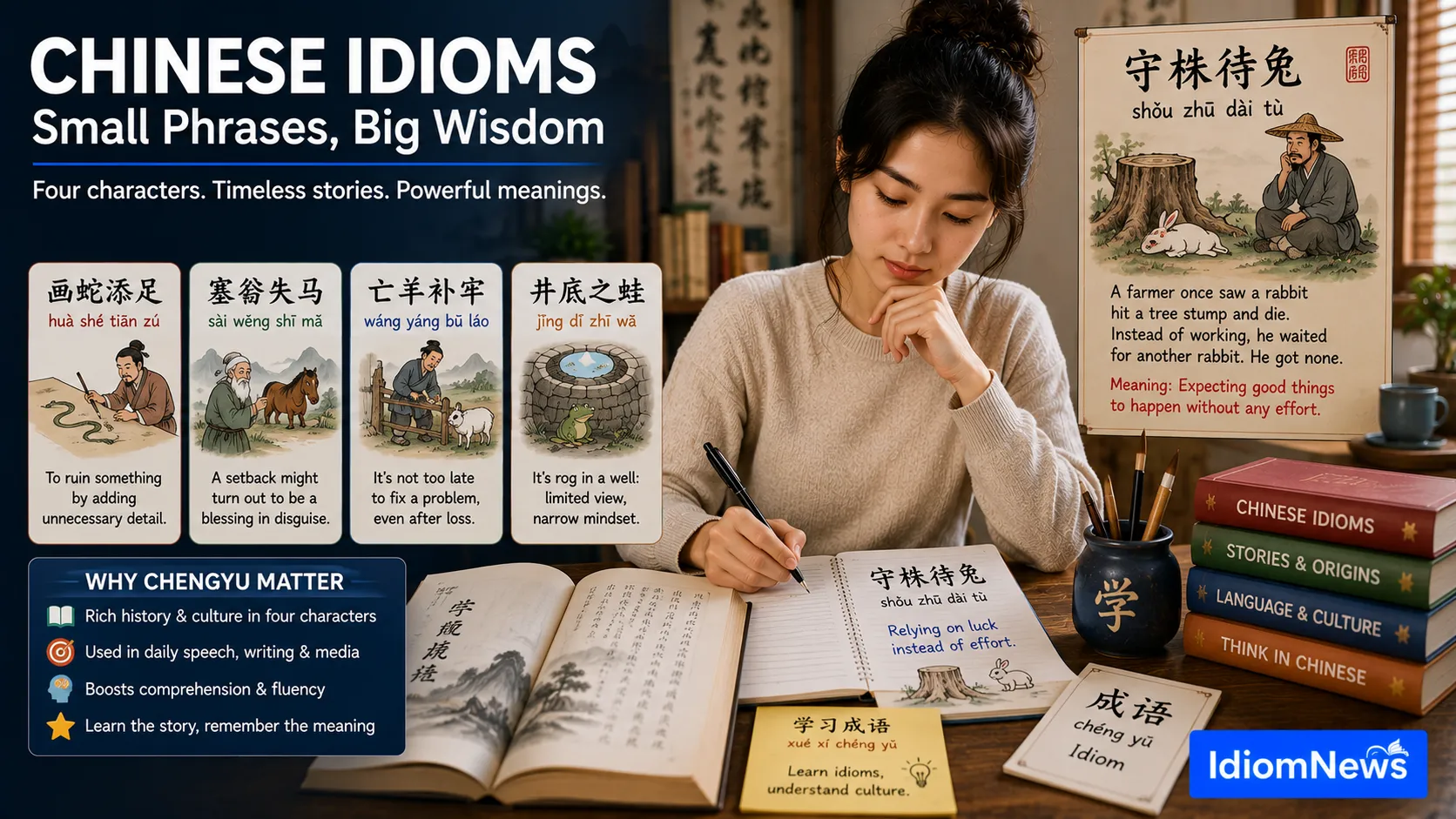
Someone learning Mandarin hears “守株待兔” (shǒu zhū dài tù) and, after translating it word for word, ends up picturing someone guarding a tree stump while waiting for a rabbit. That literal image seems bizarre until you realize it’s describing something very familiar: waiting passively for good luck instead of putting in real effort.
Chinese idioms, often called chengyu (成语), work differently from many idioms in other languages. Most consist of exactly four characters, drawing on centuries of history, literature, and philosophy to compress a complete story or lesson into a compact phrase.
This matters enormously for anyone learning Mandarin, since chengyu appear constantly in formal writing, conversation, and even casual speech. Skipping them means missing a significant part of how fluent Chinese speakers actually communicate.
Understanding how these idioms work, where they come from, and how to use them appropriately opens up a much deeper connection to Chinese language and culture than vocabulary study alone.
By the end of this piece, you’ll understand what makes Chinese idioms unique, recognize several common examples, and know how to start using them appropriately in your own learning.
What Are Chinese Idioms?
Chinese idioms, known as chengyu, are typically four-character expressions whose meaning cannot be understood by translating the individual characters literally. Many originate from historical stories, classical literature, or philosophical texts, condensing an entire narrative or lesson into a short, fixed phrase. Understanding a chengyu often requires knowing its original story, not just its individual characters.

Why Chinese Idioms Are Often Tied to Stories
Unlike many English idioms, which can lose their original context over time, Chinese chengyu frequently retain a clear connection to a specific historical story or fable.
This means understanding a chengyu often involves learning a short narrative, not just memorizing a definition. The story explains why the specific characters and imagery were chosen in the first place.
For example, the idiom 守株待兔 (shǒu zhū dài tù), meaning “guarding a tree stump, waiting for a rabbit,” comes from a story about a farmer who saw a rabbit accidentally run into a tree stump and die. Instead of continuing to farm, he waited by the stump hoping for another rabbit, wasting his time on unearned luck.
This idiom now describes someone relying on luck instead of effort, a meaning that only makes full sense once you know the underlying story.
Common Chinese Idioms and Their Meanings
Several chengyu appear frequently enough in everyday Chinese that they’re considered essential for learners at almost any level.
- 画蛇添足 (huà shé tiān zú) – Literally “drawing a snake and adding feet,” meaning to ruin something by adding unnecessary detail.
- 塞翁失马 (sài wēng shī mǎ) – Referring to a story about a farmer whose lost horse eventually led to unexpected good fortune, meaning a setback might actually turn out to be a blessing in disguise.
- 亡羊补牢 (wáng yáng bǔ láo) – Literally “mending the pen after the sheep are lost,” meaning it’s not too late to fix a problem, even after some damage has already occurred.
- 井底之蛙 (jǐng dǐ zhī wā) – Literally “a frog at the bottom of a well,” describing someone with a narrow, limited perspective on the world.
Each of these idioms compresses an entire lesson or story into just four characters, which is part of what makes chengyu so distinct from idioms in many other languages.
How Chinese Idioms Differ From English Idioms
Several structural and cultural differences separate chengyu from typical English idioms.
Most chengyu follow a strict four-character format, while English idioms vary widely in length and structure. This compact format makes chengyu feel more like proverbs or compressed stories than casual figurative phrases.
Chengyu also tend to carry stronger ties to classical literature, historical events, and philosophy, particularly Confucian and Daoist texts, compared to many English idioms, which more often stem from everyday trades, sailing, or informal daily life.
Finally, chengyu are used more heavily in formal and written Chinese than many English idioms are in formal English writing, making them especially important for anyone studying academic or professional Mandarin.
Expert Insights: Why Chengyu Are Considered Essential for Fluency
Chengyu function as more than decorative language in Chinese. They’re frequently used in essays, news broadcasts, speeches, and formal writing, meaning learners who skip them can struggle significantly with advanced reading and listening comprehension.
Because so many chengyu reference specific historical stories, learning them also builds cultural literacy alongside language skills, offering insight into Chinese history, philosophy, and storytelling traditions that vocabulary study alone doesn’t provide.
Native Chinese speakers often use chengyu unconsciously, similar to how English speakers use common idioms without thinking twice. This makes recognizing and eventually using chengyu a meaningful marker of advancing fluency, rather than just an optional vocabulary category.
For learners, prioritizing well-known chengyu with strong cultural relevance tends to offer more practical value than attempting to memorize the full body of chengyu, which numbers in the thousands.
Common Mistakes People Make With Chinese Idioms
Mistake 1: Translating chengyu character by character
This almost always leads to confusion, since the individual characters rarely convey the idiom’s actual meaning without the underlying story or context.
Mistake 2: Ignoring the historical story behind an idiom
Many chengyu only make full sense once you understand their originating story. Skipping this context makes the idiom harder to remember and use correctly.
Mistake 3: Using chengyu in overly casual contexts
Some chengyu carry a formal, literary tone that feels out of place in very casual conversation, similar to using overly formal vocabulary in casual English speech.
Mistake 4: Assuming all four-character phrases are chengyu
Not every four-character phrase in Chinese is a true chengyu with historical or idiomatic significance. Some are simply descriptive phrases without deeper figurative meaning.
Practical Steps to Learn Chinese Idioms Effectively
- Start with widely used chengyu that appear frequently in textbooks, news, and everyday conversation.
- Learn the story behind each idiom, since this context makes the meaning far easier to remember.
- Practice writing the characters by hand, which helps reinforce both the visual structure and meaning together.
- Notice chengyu in Chinese media, such as news broadcasts, dramas, or written articles, to see them used in real context.
- Avoid memorizing chengyu without context, since isolated definitions are much harder to retain than idioms paired with their originating stories.
- Review regularly, since chengyu benefit strongly from repeated exposure across different contexts.
Frequently Asked Questions
Q: What is a chengyu in Chinese?
A: A chengyu is a traditional four-character Chinese idiom, often derived from historical stories, classical literature, or philosophy. Its meaning usually cannot be understood by translating the individual characters literally.
Q: Why are most Chinese idioms exactly four characters long?
A: This compact structure developed through classical Chinese literary tradition, where concise, rhythmic phrasing was valued. Over time, the four-character format became the standard structure for most chengyu.
Q: Do I need to know the history behind every Chinese idiom?
A: Not strictly, but understanding the originating story makes chengyu significantly easier to remember and use correctly, since the historical context explains why specific characters and imagery were chosen.
Q: Are Chinese idioms used in casual conversation or mainly formal writing?
A: Chengyu appear in both, though they’re especially common in formal writing, news, and literature. Certain widely known chengyu are also used casually in everyday spoken conversation.
Q: How many Chinese idioms exist?
A: There are thousands of documented chengyu, though a relatively small core group of a few hundred appears frequently enough in everyday and formal Chinese to be considered essential for learners.
Q: Can I use Chinese idioms if I’m just starting to learn Mandarin?
A: Yes, though it’s usually more practical to focus on basic vocabulary and grammar first, then gradually introduce common chengyu as your reading and listening comprehension develops.
Q: Are Chinese idioms similar to proverbs in English?
A: In some ways, yes. Many chengyu carry a lesson or moral similar to English proverbs, though chengyu are more tightly tied to specific historical stories than most English idiomatic expressions.
Bringing It All Together
Chinese idioms, or chengyu, offer far more than compact figurative phrases. Each one often carries an entire historical story or philosophical lesson, compressed into just four characters, making them a genuinely rich part of learning the language.
Understanding chengyu deepens not just vocabulary, but cultural literacy, offering insight into Chinese history and storytelling traditions that vocabulary study alone simply can’t provide.
Start with a handful of well-known chengyu, learn their stories, and look for them in real Chinese media as your comprehension grows. That approach builds both language skill and cultural understanding together.
The next time you encounter an unfamiliar four-character phrase in Chinese, pause and ask about its story. That question alone often unlocks both the meaning and a small piece of history behind it.
Read more: Is “Screaming Bloody Murder” an Idiom? Here’s the Clear Answer




[…] Read More: Chinese Idioms: Meanings, Origins, and Why They Matter in the Language […]