


English Idioms and Phrases: A Practical Guide to Speaking More Naturally
Introduction
A coworker says a project is “on the back burner” and you’re left wondering if this has something to do with cooking. It doesn’t. English idioms and phrases like this one show up constantly in daily conversation, and they rarely mean what the individual words suggest.
For anyone trying to sound more natural in English, whether you’re a student, a professional, or someone preparing for daily conversations abroad, idioms and phrases can feel like an entirely separate language layered on top of the one you already learned. Textbooks teach grammar and vocabulary, but they rarely explain why someone would say they’re “burning the midnight oil” instead of simply saying they’re working late.
The truth is, native speakers use these expressions without even thinking about them. They’re baked into everyday speech, work emails, casual texts, and even news headlines. Skipping over them means missing a huge part of how people actually communicate.
This becomes even more noticeable in real conversations, where idioms often carry emotional weight or humor that a literal sentence wouldn’t capture. Someone who says “I’m all ears” sounds more engaged than someone who simply says “I’m listening.”
Building familiarity with common English idioms and phrases doesn’t require memorizing thousands of expressions. It requires understanding a manageable set of high-frequency phrases, learning how they’re used, and practicing them in context until they start to feel like second nature.
What Are English Idioms and Phrases?
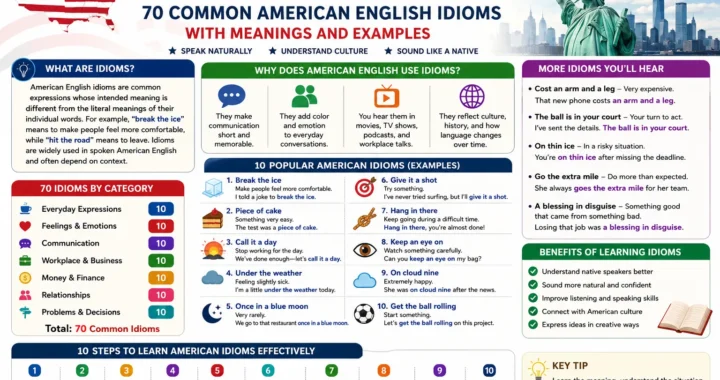
English idioms and phrases are common expressions whose meanings differ from the literal definitions of the words used. They develop through repeated use in everyday speech and often reflect cultural history, humor, or shared experience. Understanding them helps learners follow conversations, media, and writing more naturally, since these expressions appear constantly in spoken and informal English.

The Difference Between Idioms and Everyday Phrases
Not every common expression is technically an idiom, and understanding the distinction can clear up a lot of confusion.
A phrase is simply a group of words that work together, such as “a piece of cake” used literally to describe dessert. An idiom, on the other hand, uses that same phrase in a non-literal way, where “a piece of cake” means something is very easy.
Some expressions sit in a gray area. Collocations, like “make a decision” or “take a break,” aren’t idioms because their meaning is fairly literal, but they still need to be learned as fixed word pairings rather than built from scratch.
Knowing this difference matters because it changes how you study. Idioms need to be memorized as complete units with non-literal meanings, while collocations mostly need to be learned as natural word combinations.
Image Suggestion: A split-screen photo showing a literal slice of cake on one side and two people casually chatting on the other, representing literal versus idiomatic meaning.
Everyday Idioms and Phrases Grouped by Situation
Learning idioms works best when they’re tied to real situations rather than memorized as a random list.
At Work
- “Think outside the box” means to come up with creative solutions.
- “Get the ball rolling” means to start a project or task.
- “On the same page” means everyone agrees or understands something the same way.
In Social Conversations
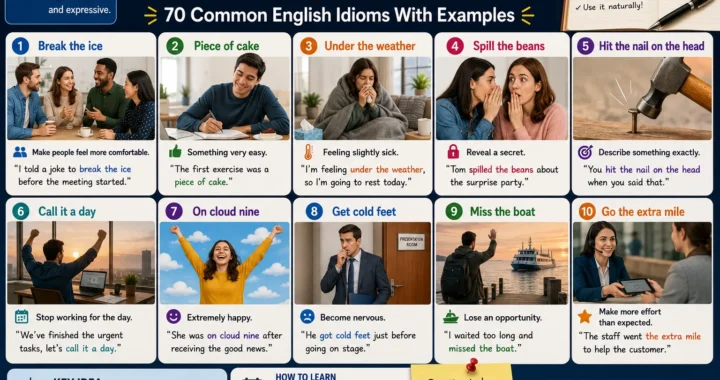
- “Break the ice” means easing tension at the start of a conversation.
- “Small talk” refers to light, casual conversation about unimportant topics.
- “Catch up” means to talk about what’s happened since you last spoke.
Describing Difficulty
- “A tough nut to crack” describes a difficult problem or person.
- “Between a rock and a hard place” means facing two difficult choices.
- “An uphill battle” describes something that requires a lot of effort.
Describing Ease
- “A walk in the park” means something is very easy.
- “Smooth sailing” means things are going without problems.
- “Piece of cake” means something is simple to do.
Grouping expressions this way makes them easier to recall, since your brain connects the phrase to a situation instead of trying to remember it in isolation.
How Idioms and Phrases Differ Across English-Speaking Countries
English idioms aren’t identical everywhere they’re spoken, and this catches many learners off guard.
British English, American English, and Australian English share a large number of expressions, but each also has phrases that are far more common in one region than another. For example, British speakers might say something is “not my cup of tea,” a phrase Americans understand but use less often in daily speech.
Some idioms carry different meanings depending on where you are. “Tabling a discussion” means postponing it in American English, but in British English, it can mean bringing it up for discussion right away.
This regional variation is worth paying attention to, especially for anyone learning English for travel, work, or media consumption tied to a specific country. Watching shows, reading articles, or speaking with people from the region you’re most interested in can help you pick up the phrases that matter most for your situation.
[Internal Link: Related Article]
Image Suggestion: A world map with pins on the United Kingdom, United States, and Australia, representing regional differences in English expressions.
Expert Insights: Why Context Matters More Than Definitions
Memorizing a dictionary definition of an idiom is rarely enough to use it correctly. The real skill lies in understanding the context where a phrase naturally fits.
Take the phrase “bite off more than you can chew.” Knowing it means taking on too much responsibility is useful, but recognizing when someone would actually say it, usually when discussing overcommitment at work or in personal projects, is what makes the phrase usable in real conversation.
This is why passive learning, just reading a list of idioms, tends to produce weak results. Active exposure, through conversations, shows, podcasts, or reading articles where idioms appear naturally, teaches the timing and tone that definitions alone can’t capture.
A useful habit is to notice not just what an idiom means, but who says it, when they say it, and what emotion or situation prompted it. This builds a much deeper, more usable understanding than definition-based memorization alone.
Common Mistakes When Learning English Idioms and Phrases
Mistake 1: Memorizing Long Lists Without Context
Many learners try to memorize hundreds of idioms from a list, which often leads to forgetting most of them quickly.
A better approach is learning a smaller number of high-frequency idioms deeply, through real examples and repeated exposure, rather than trying to cover everything at once.
Mistake 2: Mixing Up Similar-Sounding Idioms
Idioms that sound alike, such as “once in a blue moon” and “out of the blue,” get confused often, since both involve the word “blue” but mean completely different things.
The fix is to pay close attention to the full phrase and its meaning, rather than relying on a single word to trigger recognition.
Mistake 3: Translating Idioms Word-for-Word
Trying to translate an idiom directly from another language, or into one, usually results in a phrase that doesn’t make sense to a native speaker.
Idioms should be treated as complete units of meaning. Learn the English idiom on its own terms, rather than mapping it to an idiom from another language.
Mistake 4: Using Idioms Too Formally or Too Often
Idioms are naturally casual, so overusing them in formal writing, or stacking too many into a single sentence, can sound unnatural.
A more effective habit is using idioms the way native speakers do, sparingly and only when they genuinely fit the conversation.
Image Suggestion: A person reviewing flashcards with idioms written on them, sitting at a desk with a notebook open beside a laptop.
Practical Steps to Master English Idioms and Phrases
- Choose a focused starting list. Begin with twenty to thirty idioms that show up frequently in everyday conversation, rather than an overwhelming master list.
- Learn each idiom through a real example. Read or listen to a sentence where the idiom is used naturally, rather than only reading its definition.
- Group idioms by situation. Sort them into categories like work, emotions, or difficulty, so your brain has a mental shortcut for recalling them.
- Practice speaking them out loud. Saying an idiom in a full sentence helps it move from passive recognition to active use.
- Notice idioms in media you already enjoy. Shows, podcasts, and books naturally repeat common idioms, which reinforces memory without extra study time.
- Keep a running list. Write down new idioms you encounter, along with the sentence they appeared in, to build a personal reference over time.
- Test yourself in conversation. Try using a newly learned idiom in a real conversation or piece of writing within a few days of learning it.
- Revisit older idioms regularly. Idioms fade from memory if they aren’t used, so briefly reviewing your list every few weeks keeps them accessible.
Frequently Asked Questions
Q: What’s the difference between an idiom and a phrase? A: A phrase is simply a group of words used together, and its meaning can be literal. An idiom is a specific type of phrase where the meaning is non-literal, meaning it can’t be understood just by looking at the individual words.
Q: How many English idioms should a learner know? A: There’s no fixed number, but knowing around 100 to 150 high-frequency idioms covers most everyday conversations. Quality of understanding matters more than the total count memorized.
Q: Are idioms used in professional or business English? A: Some idioms appear in business English, especially in meetings and casual workplace conversations, such as “get the ball rolling” or “on the same page.” However, idioms are generally avoided in formal written business communication like contracts or official reports.
Q: Do idioms change over time? A: Yes, idioms can fall out of common use or shift slightly in meaning as language and culture evolve. Some idioms remain stable for generations, particularly ones tied to well-known historical or literary origins.
Q: What’s the fastest way to learn idioms naturally? A: Exposure through real conversations, shows, and reading tends to work faster than memorizing lists, since context helps the meaning and usage stick together. Practicing idioms in your own sentences also speeds up retention.
Q: Why do some idioms not make sense even after translation? A: Idioms are built from cultural context and shared history, not just literal word meanings, so a direct translation often loses the original sense. Learning the idiom as a whole English expression works better than translating it piece by piece.
Q: Can using idioms improve fluency? A: Yes, using idioms naturally and at appropriate moments is often seen as a sign of stronger fluency, since it shows comfort with the language beyond basic grammar and vocabulary. Overusing them, however, can have the opposite effect.
Q: Is it better to learn idioms alone or in context? A: Learning idioms in context, through real sentences and situations, is far more effective than memorizing isolated definitions. Context provides the timing, tone, and setting needed to use an idiom correctly.
Final Thoughts
English idioms and phrases aren’t just extra vocabulary to memorize for a test. They’re part of how people naturally express humor, frustration, encouragement, and everything in between. Skipping them means missing a genuine layer of how conversations actually happen.
The good news is that mastering them doesn’t require perfection or a massive list of expressions. It requires steady, consistent exposure, paying attention to how native speakers use them, and practicing a manageable set of phrases until they start showing up naturally in your own speech.
Start small, notice idioms in the conversations and media around you, and give yourself permission to make mistakes along the way. Before long, phrases like “get the ball rolling” or “on the same page” will feel less like foreign expressions and more like natural parts of how you speak.
Read More: What Are Idioms? Meaning, Examples & Uses


[…] Read More: English Idioms and Phrases: Meaning & Examples […]