


What Are Idioms? A Simple Guide to Understanding and Using Them Correctly
Introduction
You hear someone say they’re “under the weather” and you instantly know they mean they feel sick, not that a cloud is sitting on top of them. That’s the strange magic of idioms. They’re phrases that mean something completely different from what the individual words suggest, and once you know them, they slip into everyday speech without a second thought.
For anyone learning English, idioms can feel like a secret code. A person might understand every single word in a sentence like “she let the cat out of the bag” and still have no idea what actually happened. Nobody opened a bag. No cat was involved. The phrase simply means someone revealed a secret.
This confusion is completely normal, and it happens to language learners and even native speakers who run into an unfamiliar phrase. Idioms are shaped by history, culture, and habit, so their meanings often can’t be guessed just by breaking down the words.
Understanding idioms matters because they show up everywhere: in conversations, movies, books, workplace emails, and casual texts between friends. Missing their meaning can lead to genuine confusion, while knowing them helps you sound more natural and connect with people more easily.
This article breaks down what idioms are, why they exist, how to use them correctly, and how to avoid the common mistakes that trip people up.
What Is an Idiom?
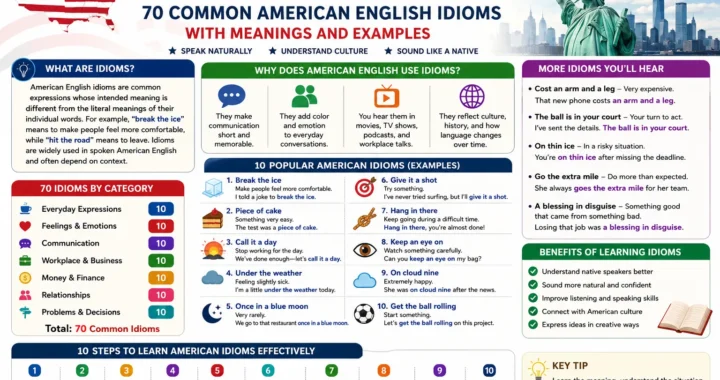
An idiom is a group of words with a meaning that is different from the literal meaning of the individual words. These phrases are fixed expressions, meaning you generally can’t swap out the words and expect the same meaning. For example, “kick the bucket” means to die, not to literally kick a bucket. Idioms develop over time through common usage and often reflect a culture’s history or daily life.

Why English Is Full of Idioms
Every language develops idioms because people naturally look for colorful, memorable ways to describe everyday feelings and situations. Saying “I’m exhausted” gets the point across, but saying “I’m running on empty” paints a picture that sticks in someone’s mind.
Many English idioms come from old trades, farming life, sailing, and even sports. “Bite the bullet,” for instance, is believed to come from a time when soldiers literally bit down on a bullet during surgery to cope with pain before anesthesia existed. Over the years, the phrase stuck around, but its meaning shifted to describe facing something difficult with courage.
Idioms also spread through storytelling, literature, and pop culture. Shakespeare alone is credited with introducing dozens of phrases still used today, including “break the ice” and “wild goose chase.”
Because idioms are shaped by shared experiences, different English-speaking countries sometimes use different idioms for the same idea. British English and American English, for example, don’t always match up perfectly, which adds another layer for learners to navigate.
Image Suggestion: A close-up photo of an open dictionary page with the word “idiom” highlighted, sitting beside a notebook and pen.
Common Types of Idioms and How They Work
Not all idioms function the same way. Grouping them into categories can make them easier to learn and remember.
Idioms About Emotions
These describe how someone feels without stating it directly.
- “Over the moon” means extremely happy.
- “Down in the dumps” means feeling sad.
- “Butterflies in my stomach” means feeling nervous.
Idioms About Time
These help describe timing or urgency in a more expressive way.
- “In the nick of time” means just barely in time.
- “Once in a blue moon” means something that rarely happens.
- “Beat the clock” means finishing something before a deadline.
Idioms About Money
Money-related idioms are extremely common in daily conversation.
- “Break the bank” means spending more than you can afford.
- “Cost an arm and a leg” means something is very expensive.
- “Tighten your belt” means to spend less money.
Idioms About Relationships and Communication
These often describe how people interact with one another.
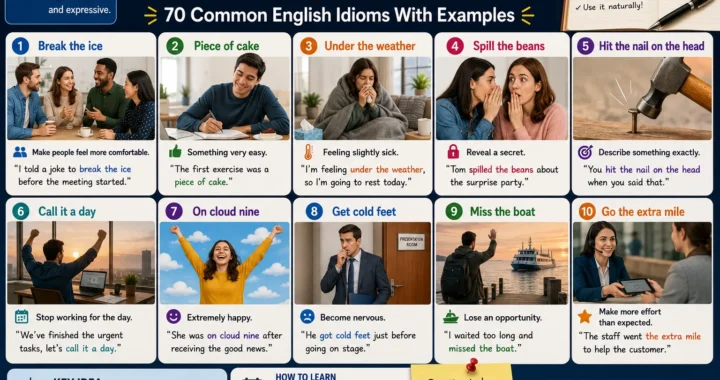
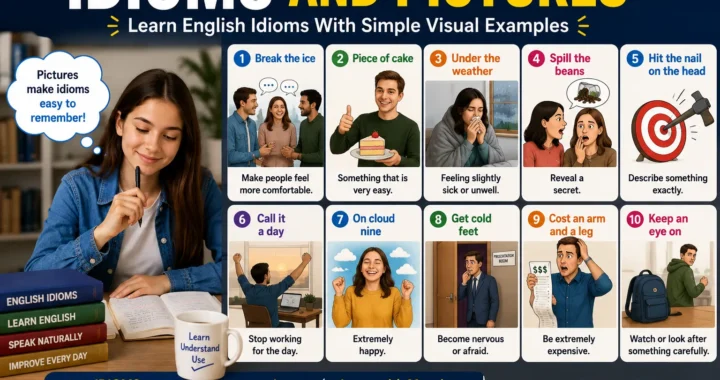
- “Break the ice” means starting a conversation to ease tension.
- “Give someone the cold shoulder” means ignoring someone on purpose.
- “Read between the lines” means understanding something that isn’t stated directly.
Learning idioms by category, rather than trying to memorize a random list, makes it much easier to recall them naturally in conversation.
Image Suggestion: A simple flat-lay graphic showing four labeled categories, emotions, time, money, and relationships, each with a small icon.
How to Use Idioms Correctly in Conversation
Knowing what an idiom means is only half the job. Using it correctly, at the right moment, is where many learners stumble.
Idioms usually fit into casual or semi-formal conversation. They work well in conversations with friends, in blog posts, or in relaxed workplace chats. They tend to feel out of place in formal writing, legal documents, or academic papers.
Timing also matters. An idiom should match the emotional tone of the situation. Saying “it’s raining cats and dogs” during a light conversation about weather works fine, but dropping a cheerful idiom into a serious conversation can feel awkward or even disrespectful.
Another key point is that idioms are fixed phrases. Changing the wording, even slightly, can confuse the listener or make the sentence sound wrong. “Kick the bucket” cannot become “kick the pail” and still be understood as slang for dying, even though a bucket and a pail are the same thing.
[Internal Link: Related Article]
Image Suggestion: Two people sitting at a coffee shop table, laughing mid-conversation, representing natural idiom use in casual speech.
Expert Insights: Why Idioms Are So Hard to Translate
One of the most interesting things about idioms is how poorly they translate between languages. A phrase that makes perfect sense in English might sound completely nonsensical when translated word-for-word into another language, and the reverse is true as well.
This happens because idioms aren’t really about the individual words. They’re about shared cultural understanding. When a group of people repeatedly uses a phrase in the same context, the phrase eventually takes on a meaning of its own, separate from its literal parts. That shared history doesn’t automatically transfer to another language or culture.
This is why translation apps and beginner language learners often struggle with idiomatic phrases. A direct translation might be grammatically correct while still missing the actual meaning entirely. For learners, the more reliable approach is to learn idioms as whole units, rather than trying to translate them piece by piece from another language.
This also explains why idioms are considered a marker of fluency. Someone who uses idioms naturally, and at the right moments, typically demonstrates a much deeper comfort with a language than someone who only understands its literal vocabulary and grammar rules.
Common Mistakes People Make With Idioms
Mistake 1: Taking Idioms Literally
Many learners try to picture the literal scene an idiom describes, which usually leads to confusion. Someone who hears “spill the beans” might picture an actual mess.
The correct approach is to learn the idiom’s actual meaning first, then treat the literal words as background information rather than a visual guide.
Mistake 2: Changing the Wording
Idioms are fixed expressions. Swapping “hit the nail on the head” for “hit the nail on its head” or “strike the nail on the head” can make the phrase sound off, even if the meaning seems similar.
The fix is simple: memorize idioms exactly as they’re commonly used, rather than trying to reword them for personal style.
Mistake 3: Using Idioms in the Wrong Context
Idioms are casual by nature, so using them in formal writing, such as a legal contract or academic essay, can come across as unprofessional.
Save idioms for conversations, informal writing, blogs, and casual emails where a relaxed tone fits naturally.
Mistake 4: Overusing Idioms
Stringing together too many idioms in a single conversation or piece of writing can sound unnatural, almost like a checklist rather than genuine speech.
A better approach is to use idioms sparingly, the same way a native speaker would, sprinkled in naturally rather than forced into every sentence.
Mistake 5: Assuming All English Idioms Are Universal
Not every idiom is understood everywhere. Some are regional, and others are more common in British English than American English, or vice versa.
It helps to pay attention to where an idiom is commonly used and adjust based on the audience.
Image Suggestion: A whiteboard with a crossed-out literal drawing of “spilled beans” next to a checkmark and the correct meaning written beside it.
Practical Steps to Learn and Use Idioms Confidently
- Start with high-frequency idioms. Focus first on the phrases people actually use in daily conversation, such as “break the ice” or “under the weather,” rather than obscure ones.
- Learn the meaning before the literal words. Understand what the idiom communicates in real life before analyzing its individual parts.
- Group idioms by theme. Organizing idioms into categories like emotions, money, or time makes them easier to remember and recall.
- See them in real sentences. Reading or listening to idioms used in context, through shows, books, or conversations, helps the meaning stick far better than a plain definition.
- Practice using one idiom a day. Try working a single new idiom into a sentence or conversation to build comfort gradually.
- Pay attention to tone and setting. Notice when native speakers use idioms and when they switch to more formal language.
- Avoid direct translation. If a phrase doesn’t make sense translated literally, treat it as its own unit of meaning rather than trying to force it into another language’s logic.
- Review regularly. Revisit idioms you’ve learned every few weeks so they don’t fade from memory.
Idioms vs. Other Figures of Speech
| Type | Definition | Example |
|---|---|---|
| Idiom | Fixed phrase with a non-literal meaning | “Break the ice” |
| Metaphor | A direct comparison without using “like” or “as” | “Time is money” |
| Simile | A comparison using “like” or “as” | “As busy as a bee” |
| Proverb | A short saying that offers advice or wisdom | “The early bird catches the worm” |
Understanding the difference helps clear up confusion, since idioms are often mistaken for proverbs or metaphors, even though each one works a little differently.
Frequently Asked Questions
Q: What is the difference between an idiom and a proverb? A: An idiom is a fixed phrase with a meaning different from its literal words, while a proverb is a short saying that offers advice or a general truth. “Break the ice” is an idiom, while “Actions speak louder than words” is a proverb offering life advice.
Q: How many idioms are there in English? A: There is no exact number, since idioms are constantly created, forgotten, or replaced by newer expressions. Most language experts agree there are several thousand idioms used regularly across English-speaking countries.
Q: Are idioms used in formal writing? A: Idioms are generally avoided in formal writing, such as academic papers, legal documents, and official reports. They fit better in casual conversation, informal writing, and creative or conversational content.
Q: Why are idioms hard for language learners? A: Idioms are hard because their meaning can’t be understood by translating individual words. Learners need to memorize the phrase as a whole unit and understand the context in which it’s used.
Q: Do all English speakers use the same idioms? A: No, idiom use varies by region and country. British English, American English, and Australian English each have idioms that are more common in their own regions and less familiar elsewhere.
Q: Can idioms change meaning over time? A: Yes, some idioms shift meaning or fall out of use as culture and language evolve. Others stay remarkably consistent for centuries, especially those tied to well-known historical or literary origins.
Q: What’s the best way to memorize idioms? A: The most effective method is learning idioms in context, through real conversations, shows, or reading, rather than memorizing isolated definitions. Grouping idioms by theme also helps with recall.
Q: Is it okay to create new idioms? A: New idioms do emerge naturally over time, often through pop culture, social media, or generational slang. However, they only become recognized idioms once a large group of people consistently understands and uses them the same way.
Final Thoughts
Idioms aren’t just quirky phrases to memorize for a test. They’re a living part of how people actually talk, joke, comfort each other, and share ideas. Learning them opens a door to understanding conversations on a deeper level, catching humor, and expressing yourself in a way that feels natural rather than robotic.
The key is patience. Nobody learns idioms overnight, and even native speakers occasionally mix one up or forget where a phrase came from. What matters is building familiarity bit by bit, paying attention to how idioms are used in real conversations, and trying them out without worrying about getting it perfect right away.
The next time you hear a phrase that makes no literal sense, like someone saying they’re “on cloud nine,” you’ll know exactly what they mean, and maybe you’ll even find yourself using it too.
Read More: English Language Idioms: Meaning & Examples

[…] Read More: What Are Idioms? Meaning, Examples & Uses […]
[…] problem gets worse because idioms almost never explain themselves. There’s no built-in clue in “kick the bucket” […]