

Best Idioms in English: The Most Versatile and Memorable Expressions
Not every idiom earns its place in everyday language equally. Some feel tired or overused the moment they’re spoken, while others land with genuine impact every single time, capturing a feeling or situation so precisely that no plain sentence could do it justice.
The best idioms share a few consistent qualities: vivid imagery, broad versatility across different contexts, and a kind of staying power that keeps them useful decades after they first became common. These aren’t necessarily the most frequently used idioms, but the ones that consistently earn their place in a sentence.
This matters for writers looking to add genuine color to their work, public speakers wanting memorable phrasing, and anyone building a stronger, more expressive vocabulary rather than just a longer one.
Rather than another exhaustive list, this piece makes actual selections, explaining specifically what earns each idiom a spot among the best, and why some commonly cited idioms don’t quite make the cut.
By the end of this piece, you’ll have a curated collection of genuinely strong idioms, along with a clear sense of what separates a merely common idiom from a truly excellent one.
What Makes an Idiom One of the “Best”?
The best idioms combine vivid, easily visualized imagery with broad versatility, meaning they work naturally across many different situations rather than fitting only one narrow context. Unlike idioms chosen simply for frequency of use, “best” idioms earn their place through genuine expressive power, clarity, and staying relevant across generations rather than fading into cliché or narrow, dated usage.
Best Idioms for Describing Difficulty
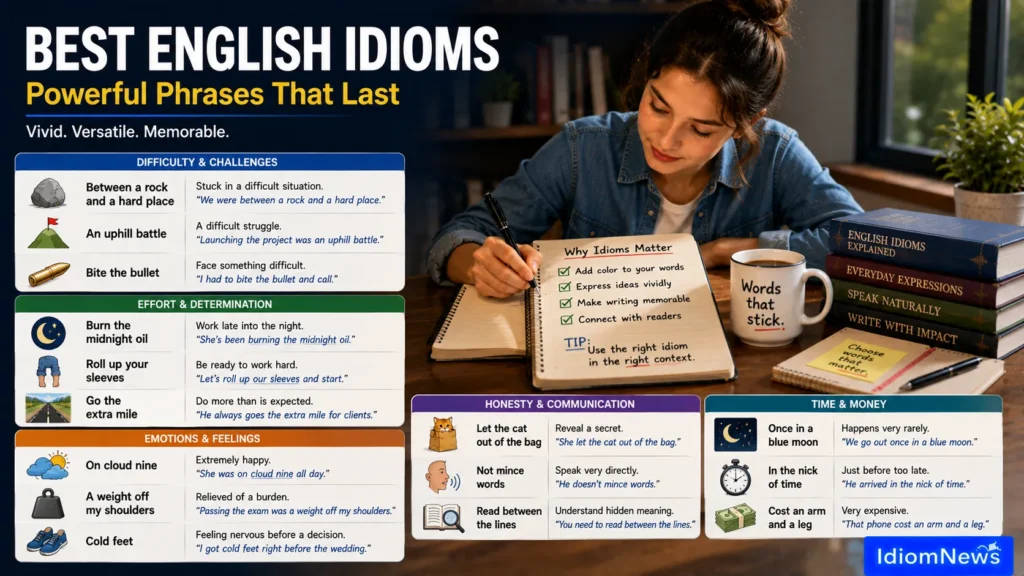
- “Between a rock and a hard place” – Earns its spot through vivid physical imagery that instantly communicates being trapped between two equally difficult options, with no comfortable third choice.
- “An uphill battle” – Works across nearly any context involving sustained effort against resistance, from personal struggles to business challenges to political campaigns.
- “Bite the bullet” – Captures a very specific, relatable moment: finally facing something you’ve been avoiding, with historical weight that adds genuine gravity to the phrase.
These three earn their place specifically because they apply naturally across personal, professional, and even historical or political contexts without feeling forced.
Best Idioms for Describing Effort and Determination
- “Burn the midnight oil” – A genuinely evocative image, actual candlelight sustaining late-night work, that still feels natural even in a world of electric lighting and screens.
- “Roll up your sleeves” – Physically intuitive and immediately understood, this idiom works equally well for manual labor and abstract, mental effort.
- “Go the extra mile” – Versatile enough to describe customer service, personal relationships, academic effort, or professional dedication, without ever feeling forced into an inappropriate context.
These idioms consistently show up in writing about effort and dedication precisely because they’re flexible enough to fit almost any situation involving hard work.
Best Idioms for Describing Emotional States
- “On cloud nine” – Genuinely distinct from more common alternatives like “very happy,” carrying a specific sense of elevated, almost weightless joy.
- “A weight off my shoulders” – Physically intuitive and universally relatable, this idiom captures relief in a way that feels immediately understood, regardless of the specific situation causing it.
- “Cold feet” – Earns its spot through specificity: it describes a very particular kind of pre-commitment nervousness that plain language struggles to capture as precisely.
These idioms outperform simpler alternatives (“very happy,” “relieved,” “nervous”) by adding texture and specificity that plain adjectives simply can’t match.
Best Idioms for Describing Honesty and Communication
- “Not mince words” – A precise, elegant way of describing directness, with a slightly old-fashioned charm that still reads as sophisticated rather than dated.
- “Read between the lines” – Genuinely versatile, applying equally well to interpreting text, conversation, or even nonverbal social cues.
- “Come to light” – Works particularly well in formal or journalistic writing, describing information becoming known without sounding overly dramatic or casual.
These idioms consistently appear in strong writing specifically because they add precision, not just color, to descriptions of how people communicate or reveal information.
Idioms That Are Common But Don’t Quite Make the “Best” List
Not every frequently used idiom earns a spot among the genuinely best, and understanding why some fall short is instructive.
- “At the end of the day” – Extremely common, but has become something of a filler phrase, often used without adding real meaning or specificity to a sentence.
- “Think outside the box” – So overused in business contexts specifically that it’s become something of a cliché, ironically undermining the creative spirit it’s meant to describe.
- “It is what it is” – Functional but vague, offering little specific imagery or precision compared to more vivid alternatives.
These idioms remain common precisely because they’re easy and low-effort to reach for, but their overuse has worn down much of their original expressive power.
Expert Insights: Why Some Idioms Age Better Than Others
Idioms tend to age well when their imagery remains intuitively understandable even as the literal context that inspired them fades from common experience. “Burn the midnight oil,” for example, still works despite most people no longer working by literal candlelight, because the underlying image of sustained, late-night effort remains universally clear.
By contrast, idioms tied too closely to a specific, narrow professional jargon or a passing cultural trend often lose their expressive power quickly, becoming clichés precisely because they were adopted too widely, too fast, within one specific context, like corporate or business writing.
Writers and editors sometimes describe the best idioms as those maintaining a balance between familiarity and freshness: recognizable enough to be immediately understood, yet not so overused that they’ve become background noise a reader skims past without registering.
This is part of why genuinely skilled writers tend to favor a smaller set of well-chosen, versatile idioms over a larger collection of trendy or narrowly applicable ones, prioritizing lasting expressive quality over sheer frequency of use.
Common Mistakes People Make Choosing “Best” Idioms
Mistake 1: Confusing “most common” with “best”
Frequency of use doesn’t necessarily indicate quality or lasting expressive power. Some extremely common idioms have become tired clichés precisely because of overuse.
Mistake 2: Choosing idioms tied to narrow, dated contexts
Idioms rooted too specifically in outdated technology or narrow professional jargon tend to age poorly compared to idioms with broader, more timeless imagery.
Mistake 3: Overusing even genuinely strong idioms
Even the best idioms lose impact if used too frequently within a single piece of writing or conversation, since repetition undermines their intended emphasis.
Mistake 4: Ignoring context when selecting a “best” idiom
An idiom that works beautifully in casual writing might feel out of place in formal or academic contexts, regardless of its overall quality or versatility.
Practical Steps to Choose Genuinely Strong Idioms for Your Writing
- Prioritize versatility over familiarity, choosing idioms that work naturally across multiple contexts rather than one narrow situation.
- Favor vivid, intuitive imagery, since idioms with clear, easily visualized meaning tend to age and read better than abstract ones.
- Avoid idioms that have become clichés in your specific field, particularly overused business or corporate phrases.
- Use strong idioms sparingly, reserving them for moments where they genuinely add precision or color, rather than scattering them throughout your writing.
- Match the idiom to your writing’s tone, ensuring even a genuinely excellent idiom fits the formality level of your specific piece.
Best Idioms by Category
| Category | Best Idiom | Why It Earns Its Spot |
|---|---|---|
| Difficulty | Between a rock and a hard place | Vivid, universally relatable imagery |
| Effort | Burn the midnight oil | Timeless imagery despite changing technology |
| Emotion | A weight off my shoulders | Physically intuitive, broadly applicable |
| Communication | Read between the lines | Genuinely versatile across contexts |
This table summarizes the strongest example from each category covered throughout this piece.
Frequently Asked Questions
Q: What makes an idiom one of the “best” rather than just common?
A: The best idioms combine vivid, easily visualized imagery with genuine versatility across different contexts, maintaining their expressive power over time rather than becoming worn down through overuse.
Q: Is “think outside the box” one of the best idioms?
A: Not by this standard. While extremely common, particularly in business contexts, it has become something of a cliché through overuse, ironically undermining the creative spirit it’s meant to convey.
Q: Why do some idioms age better than others?
A: Idioms age well when their core imagery remains intuitively clear, even as the specific literal context fades from common experience. Idioms tied too narrowly to specific trends or jargon tend to lose relevance faster.
Q: Can even a genuinely strong idiom be overused?
A: Yes. Using even the best idioms too frequently within a single piece of writing or conversation undermines their impact, since repetition weakens the emphasis they’re meant to provide.
Q: What’s an example of a versatile idiom that works across many contexts?
A: “An uphill battle” works well across personal, professional, and even political contexts, describing sustained effort against resistance without feeling forced into any single narrow situation.
Q: Should I avoid all common idioms in favor of “best” ones?
A: Not necessarily. Common idioms still serve genuine communication purposes. The distinction matters most when you specifically want writing or speech to feel more vivid, precise, or memorable.
Q: How can I tell if an idiom has become a cliché in my field?
A: If the phrase appears constantly in your specific industry’s writing or conversation without adding real specificity or meaning, it’s likely become a cliché, regardless of how strong the idiom might be in other contexts.
Bringing It All Together
The best idioms earn their place through genuine expressive power, not just frequency of use. Vivid imagery, broad versatility, and lasting relevance separate a truly excellent idiom from one that’s simply common, or worse, worn into cliché through overuse.
Choosing carefully, favoring idioms that add real precision and color rather than reaching for the first familiar phrase that comes to mind, strengthens both your writing and your everyday communication.
The next time you’re tempted to use a tired, overused idiom, pause and consider whether a more vivid, versatile alternative might actually serve your point better. That small habit of selectivity is often what separates genuinely strong writing from merely adequate writing.
Read More: What Is an Example Idiom? Meaning, Origin & Usage

[…] Read More: Best Idioms in English: Top Expressions with Meanings […]