

What Is an Example Idiom? One Phrase Explained From Every Angle
Someone asks, “can you just give me an example idiom so I actually understand what this is?” Not five examples. Not a list. Just one, explained clearly enough that the whole concept finally clicks.
That’s a genuinely reasonable request, and it deserves a genuinely focused answer. Rather than listing dozens of idioms and hoping one sticks, walking through a single example idiom in real depth, its literal meaning, actual meaning, origin, and use in a sentence, often teaches the concept more effectively than a long list ever could.
This matters for anyone encountering the term “idiom” for the first time, students needing a clear model answer for an assignment, or teachers looking for one strong, complete example to build an entire lesson around.
Rather than overwhelming you with options, this piece picks one example idiom, “break the ice,” and uses it to illustrate exactly what makes something an idiom, from every angle.
By the end of this piece, you’ll fully understand what an example idiom looks like, using one clear, thoroughly explained case, and you’ll be able to apply that same understanding to any new idiom you encounter afterward.
What Is an Example Idiom?
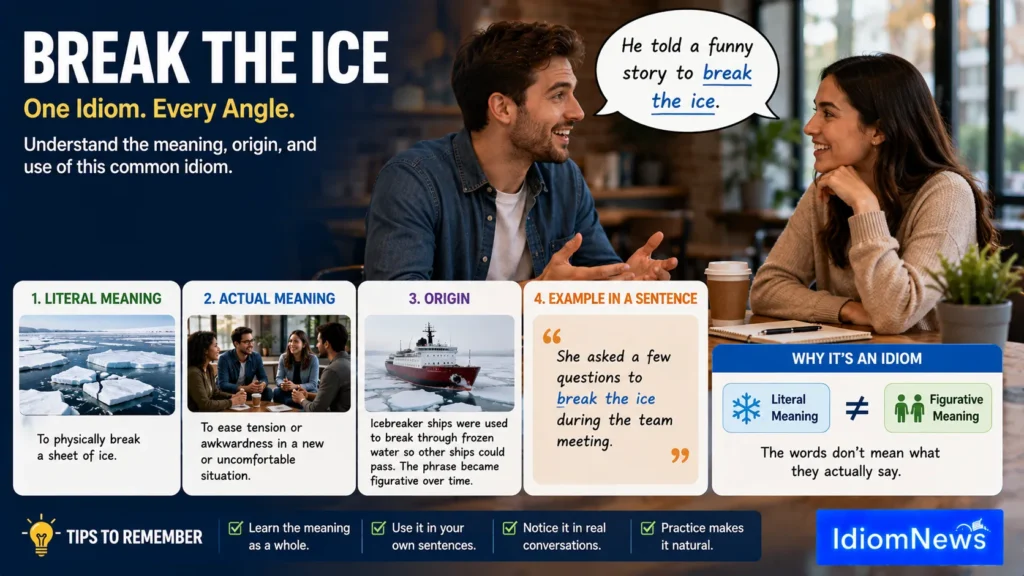
An example idiom is a specific phrase used to illustrate what an idiom is: a fixed expression whose meaning cannot be understood by looking at its individual words. “Break the ice” serves as a clear example idiom, since the phrase has nothing literally to do with breaking actual ice. Instead, it means easing tension or awkwardness in a new or uncomfortable social situation.
The Literal Meaning of This Example Idiom
Taken word for word, “break the ice” describes physically cracking or breaking apart a sheet of ice, the kind you might find on a frozen pond or windshield.
If you didn’t already know this phrase was idiomatic, you might reasonably picture someone with a hammer or tool, literally breaking ice into pieces. Nothing about the individual words “break,” “the,” and “ice” hints at anything related to social situations or conversation.
This gap, between what the words literally describe and what the phrase actually means, is exactly what defines an idiom. The literal meaning and the figurative meaning have essentially nothing to do with each other.
The Actual Meaning of This Example Idiom
In real usage, “break the ice” means to ease tension, awkwardness, or unfamiliarity, typically at the start of a social situation where people don’t yet feel comfortable with each other.
Someone might “break the ice” at a party by asking a friendly question, telling a lighthearted joke, or simply starting a casual conversation with a stranger. The phrase captures that specific moment of moving from initial awkwardness into more relaxed, comfortable interaction.
Notice how this actual meaning requires no reference to literal ice whatsoever. It’s a completely separate, figurative concept that happens to be expressed using ice-related words.
Where This Example Idiom Comes From
“Break the ice” traces back to a genuinely literal historical origin, one tied to actual ships and actual ice.
Before modern icebreaking ships existed, frozen waterways could completely block trade and travel between regions during winter months. Specially designed vessels were eventually built specifically to break through this ice, physically opening a path for other ships to follow and allowing trade and communication to resume.
Over time, this literal image, breaking through a physical barrier to allow movement and connection, gradually shifted into a figurative sense: breaking through the initial social barrier or awkwardness that blocks comfortable conversation between people who don’t yet know each other well.
This origin story helps explain why the idiom makes a strange kind of sense once you understand the connection, even though the words alone don’t reveal that link on their own.
This Example Idiom Used in a Full Sentence
Seeing the idiom in a complete sentence shows exactly how it functions naturally in real communication.
- “He told a funny story to break the ice before the meeting started.”
- “The awkward silence finally broke when someone made a joke, breaking the ice.”
- “She’s great at breaking the ice with new coworkers.”
In each sentence, the idiom describes a social action, easing tension or awkwardness, with absolutely no connection to literal ice or breaking anything physical.
What Makes “Break the Ice” a Strong Teaching Example
This particular idiom works especially well as a single, explanatory example for a few specific reasons.
- Clear literal versus figurative contrast: The gap between the literal words and the actual meaning is obvious and easy to visualize.
- Genuinely traceable origin: Unlike many idioms with uncertain backstories, this one connects logically to a real historical practice.
- Common, everyday usage: It appears frequently enough in real conversation that recognizing it elsewhere becomes immediately useful.
- Simple grammatical structure: It functions clearly as a verb phrase, making it easy to demonstrate correct conjugation and sentence placement.
These features make “break the ice” a genuinely strong choice when only one complete, well-explained example idiom is needed to illustrate the entire concept.
Expert Insights: Why One Well-Explained Example Often Teaches Better Than Many
When someone is encountering the concept of idioms for the very first time, presenting a long list can actually work against understanding. Too many examples at once can overwhelm rather than clarify, since the learner hasn’t yet built a mental framework for what to notice or compare.
A single, thoroughly explained example, covering literal meaning, actual meaning, origin, and usage, gives the learner a complete mental model they can then apply independently to new idioms they encounter later.
Educators sometimes call this an anchor example: one especially clear case that becomes a reference point learners can mentally return to whenever they need to check whether an unfamiliar phrase qualifies as an idiom.
This approach works particularly well for absolute beginners or for anyone specifically asking “what is an example idiom,” since the question itself signals they want depth on one case, not breadth across many.
Common Mistakes People Make When Learning From a Single Example
Mistake 1: Assuming every idiom has an equally clear, traceable origin
“Break the ice” has a well-documented historical connection, but many idioms don’t. Don’t assume every phrase will explain itself this neatly.
Mistake 2: Focusing only on the meaning, skipping the literal-versus-figurative contrast
Understanding why an idiom is figurative, not just what it means, builds a much stronger foundation for recognizing other idioms later.
Mistake 3: Not practicing the example in an original sentence
Reading example sentences is useful, but writing your own reinforces the understanding far more effectively.
Mistake 4: Stopping after just one example without applying the pattern elsewhere
A single anchor example works best as a starting point, not an ending point. Use it to test and understand new idioms as you encounter them.
Practical Steps to Learn From a Single Example Idiom
- Identify the literal meaning first, picturing exactly what the individual words describe.
- Identify the actual, figurative meaning, noting how it differs completely from the literal interpretation.
- Research the idiom’s origin if available, since understanding the historical connection often makes the logic click.
- Write your own example sentence, using the idiom naturally in a new context.
- Apply this same four-step process to a new, unfamiliar idiom, testing whether your understanding transfers successfully.
Frequently Asked Questions
Q: What is a good example idiom to explain what an idiom is?
A: “Break the ice” works well as an example idiom, since it has a clear, traceable literal meaning (physically breaking ice), a distinct figurative meaning (easing social tension), and a well-documented historical origin connecting the two.
Q: Why does “break the ice” count as an idiom?
A: Because its actual meaning, easing tension in a social situation, cannot be understood by looking at the individual words “break,” “the,” and “ice” alone. That gap between literal words and figurative meaning defines an idiom.
Q: Where does the idiom “break the ice” come from?
A: It traces back to icebreaker ships, historically used to physically break through frozen waterways so other ships could pass. This literal image of breaking through a barrier gradually became figurative, describing breaking through social awkwardness instead.
Q: How do I use “break the ice” in a sentence?
A: You might say, “He told a joke to break the ice before the meeting started,” using the idiom to describe easing tension or awkwardness at the beginning of a social situation.
Q: Is one example idiom enough to understand the whole concept?
A: For many learners, yes, a single, thoroughly explained example provides a strong mental model. From there, applying that same understanding to new, unfamiliar idioms becomes much easier.
Q: What makes a good “single example” idiom for teaching purposes?
A: A strong example idiom has a clear literal-versus-figurative contrast, a traceable origin, common everyday usage, and simple grammatical structure, all of which “break the ice” demonstrates clearly.
Q: Can I apply this same explanation method to other idioms?
A: Yes. Once you understand how to break down an idiom’s literal meaning, figurative meaning, origin, and usage using this one example, you can apply that same process to any new idiom you encounter.
Bringing It All Together
Understanding what an example idiom looks like doesn’t require a long list. One well-chosen phrase, thoroughly explained from every angle, “break the ice” in this case, can teach the entire concept clearly and completely.
The literal meaning, the actual figurative meaning, the historical origin, and a natural example sentence together build a genuine, transferable understanding, one you can apply to any new idiom you come across afterward.
The next time you encounter an unfamiliar phrase and wonder whether it’s an idiom, run it through the same four questions this example walked through. That single habit will serve you far better than memorizing any list ever could.
Read More: Some Examples of Idioms with Meanings & Sentences

[…] Read More: What Is an Example Idiom? Meaning, Origin & Usage […]