

Hilarious Idioms That Sound Absolutely Ridiculous Taken Literally
Imagine someone walking into a meeting and announcing they’re going to “kick the bucket” later today. Picture it literally: a person marching over to an actual bucket and delivering a solid kick. Now realize that phrase actually means they’re planning to die. That gap between the mental image and the real meaning is exactly why so many idioms are genuinely, unexpectedly hilarious once you actually stop and picture them.
Hilarious idioms earn their humor specifically from this kind of mental whiplash: a completely absurd literal scene crashing into a totally mundane, serious, or unrelated actual meaning. The bigger that gap, the funnier the idiom tends to be.
This matters for anyone who enjoys language for its own sake, teachers looking for genuinely entertaining classroom material, or writers wanting to inject real humor into content about English idioms.
Rather than just listing idioms, this piece specifically picks out the ones that become funniest when you actually stop and picture the literal scene playing out, explaining exactly what makes each one land as comedy.
By the end of this piece, you’ll have a collection of genuinely hilarious idioms, along with a clear sense of exactly why picturing them literally makes them so much funnier.
What Makes an Idiom “Hilarious” Rather Than Just Figurative?
Hilarious idioms specifically create a large, absurd gap between their literal, word-for-word meaning and their actual, unrelated figurative meaning. The comedy comes from imagining the literal scene playing out in real life, an image so ridiculous or mismatched with reality that it becomes genuinely funny, even though the actual meaning is often completely serious or mundane.
Idioms That Become Ridiculous When You Picture Them Literally
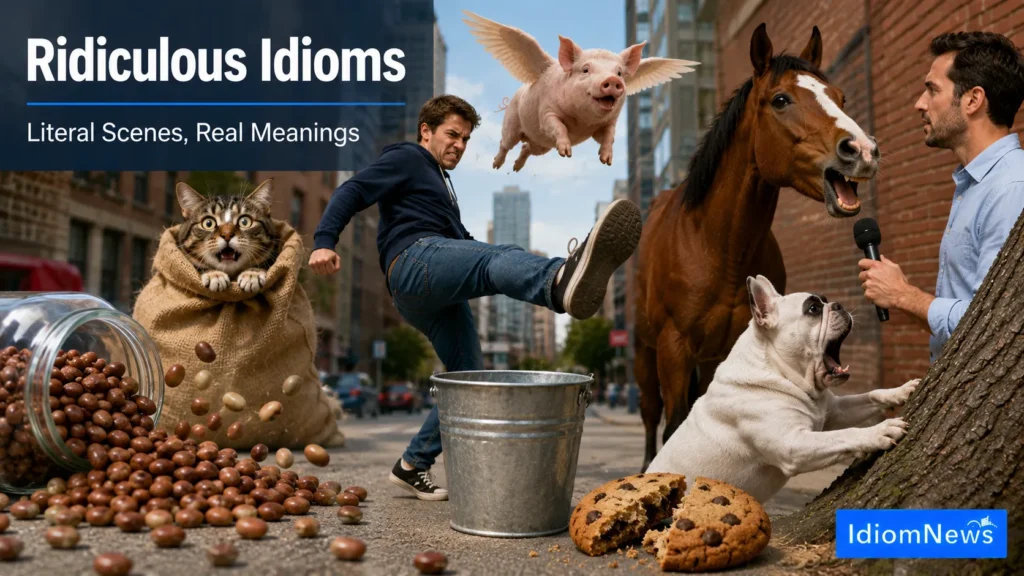
- “Kick the bucket” – Picture someone literally kicking an actual bucket, then realize this means they’ve died. The mismatch between a mundane physical action and something so serious is genuinely absurd.
- “Spill the beans” – Imagine someone dramatically knocking over an entire jar of beans across a table, when really they’ve just revealed a secret about a surprise party.
- “Let the cat out of the bag” – Picture a literal cat somehow stuffed into a bag, then released, all to represent someone accidentally mentioning a surprise gift.
- “Bite the bullet” – Imagine someone literally biting down on an actual bullet, teeth and all, simply to represent finally scheduling a dentist appointment they’ve been avoiding.
Each of these becomes funnier the more specifically and vividly you picture the literal scene, especially when the actual meaning is something completely ordinary.
Idioms Involving Genuinely Absurd Animal Scenarios
- “It’s raining cats and dogs” – Actual cats and dogs, falling from the sky, landing on umbrellas and sidewalks, all to describe moderately heavy rainfall.
- “When pigs fly” – A full squadron of airborne pigs soaring through the sky, representing something that will simply never happen.
- “Straight from the horse’s mouth” – A horse, somehow capable of speech, calmly relaying reliable information directly to a listener.
- “There’s more than one way to skin a cat” – A genuinely unsettling image once you actually picture it, used casually to mean there are multiple approaches to solving a problem.
These idioms lean particularly hard into absurd animal scenarios, making them some of the most reliably funny once you actually stop to visualize them.
Idioms That Sound Even Funnier Out of Context
- “The whole nine yards” – Picture someone measuring exactly nine yards of fabric, string, or football field, when the phrase actually just means doing something completely and thoroughly.
- “Barking up the wrong tree” – A dog, standing confidently beneath a tree, barking with total conviction at absolutely nothing, representing someone pursuing an entirely mistaken approach.
- “Cat got your tongue?” – The genuinely bizarre implication that a cat has physically stolen someone’s tongue, simply because they’ve gone quiet.
- “Not enough room to swing a cat” – An oddly specific and slightly alarming unit of spatial measurement, used casually to describe a cramped apartment.
These idioms are especially funny because they’re phrases most native speakers use constantly without ever consciously registering how strange they actually sound.
Idioms Involving Food That Get Weirder the More You Picture Them
- “That’s how the cookie crumbles” – A cookie, crumbling in slow motion, apparently representing an entire philosophy of accepting life’s disappointments.
- “Full of beans” – Someone described as being physically packed, internally, with beans, simply to convey that they’re energetic.
- “Bring home the bacon” – A literal strip of bacon being carried home, representing an entire paycheck and someone’s financial responsibility to their family.
Expert Insights: Why Absurdity Makes Idioms More Memorable, Not Just Funnier
The same feature that makes these idioms hilarious, the wide gap between literal and figurative meaning, also happens to make them significantly easier to remember than plainer, more literal expressions.
Cognitive research on humor and memory consistently shows that unexpected, absurd, or incongruous imagery tends to stick in memory far better than mundane or expected information. Idioms with the biggest literal-versus-figurative gap essentially get a free memory boost from their own inherent comedy.
This is part of why hilarious idioms tend to be among the first ones language learners actually retain long-term, even before they’ve mastered more useful but less visually striking expressions. The humor isn’t just entertainment; it’s functioning as a genuine memory aid.
Teachers and content creators specifically leverage this pattern, prioritizing visually absurd idioms early in instruction precisely because the built-in comedy accelerates both engagement and long-term retention compared to plainer, more forgettable phrases.
Common Mistakes People Make With Hilarious Idioms
Mistake 1: Assuming the humor means these idioms are only for casual use
While genuinely funny, many of these idioms, like “kick the bucket” or “bite the bullet,” are still widely used and understood across both casual and semi-formal contexts.
Mistake 2: Overusing them in a single conversation for comedic effect
Packing too many absurd idioms into one exchange, even intentionally for humor, can start to feel forced rather than naturally funny.
Mistake 3: Assuming every idiom becomes funny when pictured literally
Not every idiom has strong enough visual imagery to produce genuine comedic absurdity. This effect works best specifically with idioms involving vivid, concrete literal scenes.
Mistake 4: Forgetting the actual figurative meaning while focusing on the humor
It’s easy to get caught up in the comedy of the literal image and accidentally lose track of what the idiom genuinely means in real conversation.
Practical Steps to Use Hilarious Idioms in Teaching or Writing
- Choose idioms with strong, specific visual imagery, since these produce the biggest, funniest literal-versus-figurative gap.
- Explicitly walk through the literal picture first, before revealing the actual meaning, to maximize the comedic contrast.
- Use illustrations or descriptions to enhance the absurdity, since visualizing the scene amplifies the humor significantly.
- Balance humor with genuine explanation, ensuring the actual figurative meaning is clearly understood, not just the joke.
- Introduce these idioms early in language learning, since their built-in humor tends to accelerate memorable, long-term retention.
Frequently Asked Questions
Q: What makes an idiom hilarious rather than just figurative?
A: Hilarious idioms create a large, absurd gap between their literal meaning and their actual figurative meaning. Picturing the literal scene, like biting an actual bullet, produces genuine comedic contrast with the real, often mundane meaning.
Q: What’s an example of a genuinely funny idiom when taken literally?
A: “Kick the bucket” is a strong example. Picturing someone literally kicking a bucket, only to learn the phrase actually means someone has died, creates a striking, absurd comedic contrast.
Q: Why do animal idioms tend to be especially funny?
A: Animal-based idioms often involve genuinely bizarre literal scenarios, like flying pigs or talking horses, which tend to produce especially vivid and absurd mental images compared to idioms without animal imagery.
Q: Does the humor in these idioms help with learning them?
A: Yes. Research on memory and humor suggests that absurd, unexpected imagery tends to stick in memory better than plain, expected information, making genuinely funny idioms easier to remember long-term.
Q: Are hilarious idioms appropriate for formal writing?
A: Some, like “kick the bucket,” fit casual to semi-formal contexts depending on tone, while others remain distinctly casual and work best in everyday conversation rather than formal writing.
Q: Can every idiom become funny if you picture it literally?
A: Not equally. Idioms with vivid, concrete literal imagery, like specific animals or physical actions, tend to produce much stronger comedic effect than idioms with vaguer or more abstract literal meanings.
Q: How can teachers use humor to teach idioms more effectively?
A: Walking students through the literal, absurd image before revealing the actual figurative meaning maximizes both engagement and memorability, using the built-in humor as a genuine teaching tool rather than just entertainment.
Bringing It All Together
Hilarious idioms earn their humor from a genuinely simple trick: picturing the literal scene against the actual, often completely unrelated meaning. That absurd contrast, kicking buckets, flying pigs, talking horses, isn’t just entertaining. It’s often exactly what makes these phrases so memorable in the first place.
The next time you use a common idiom without thinking twice, pause and actually picture it literally. You might just discover that some of your most ordinary, everyday expressions are secretly some of the funniest phrases in the entire English language.
Read More: Heart Leaping to Your Throat Idiom: Meaning & Use

[…] Read More: Hilarious Idioms: Funny Phrases Taken Literally […]