

Idiom Children’s Definition: How to Write One Kids Actually Understand
A children’s dictionary defines “idiom” as “a group of words established by usage as having a meaning not deducible from those of the individual words,” and a nine-year-old reading it walks away more confused than when they started. That definition might be technically accurate, but it completely fails the one job a children’s definition actually has: helping a child understand.
Writing a genuinely effective idiom children’s definition requires more than just simplifying vocabulary. It means rethinking the entire explanation from a child’s actual point of view, what they already know, what confuses them, and what kind of example will make the concept click.
This matters for parents helping with homework, teachers building classroom materials, children’s book authors, and anyone creating dictionaries, glossaries, or worksheets specifically designed for young readers.
Rather than just providing one definition, this piece walks through exactly what makes a children’s definition of “idiom” actually work, along with several tested examples appropriate for different age ranges.
By the end of this piece, you’ll know how to write or evaluate a genuinely effective idiom children’s definition, appropriate for the specific age group you’re working with.
What Is a Good Children’s Definition of “Idiom”?
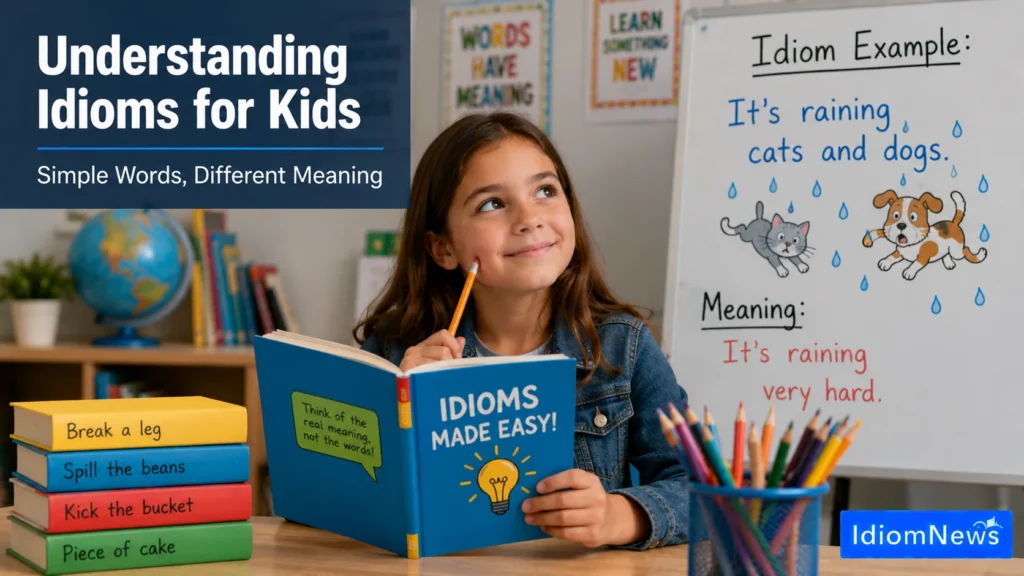
A good children’s definition explains that an idiom is a group of words that means something different from what the words say by themselves, usually paired immediately with a simple, familiar example. For example: “An idiom is a saying where the words don’t mean exactly what they say. Like when someone says ‘it’s raining cats and dogs,’ they just mean it’s raining really hard, not that animals are falling from the sky.”
Why Standard Dictionary Definitions Fail Children
Most standard dictionary definitions of “idiom” rely on vocabulary and sentence structure that assume an adult reading level, words like “deducible,” “constituent,” or “established by usage.”
Even when a child can technically sound out these words, the underlying concepts, semantic derivation, conventional linguistic usage, require abstract reasoning skills that most children haven’t fully developed yet, particularly younger elementary-aged readers.
This mismatch means a child can read every word in a standard definition without actually understanding what an idiom is, which defeats the entire purpose of a definition in the first place.
What Makes a Children’s Definition Actually Work
Effective children’s definitions share a few consistent features, regardless of the specific idiom being explained.
- Concrete language over abstract terminology: Avoiding words like “figurative” or “literal” in favor of simpler phrasing like “what the words say” versus “what it really means.”
- An immediate, familiar example: Following the definition directly with a specific idiom the child likely already knows or can easily picture.
- Short, simple sentence structure: Breaking the explanation into two or three short sentences rather than one long, complex one.
- Visual or relatable imagery: Choosing example idioms with vivid, easy-to-picture literal meanings, since this helps cement the abstract concept.
These features work together, not individually, which is why a strong children’s definition combines simple wording with a concrete example rather than relying on either alone.
Idiom Children’s Definitions by Age Range
Different age groups benefit from slightly different levels of explanation, even when using the same core approach.
Ages 5-7 (Early Readers)
“An idiom is a group of words that means something different from what it sounds like. Like ‘break a leg!’ It doesn’t mean someone should really hurt their leg. It means ‘good luck!'”
This version keeps sentences very short and relies entirely on one clear, memorable example without introducing additional vocabulary or concepts.
Ages 8-10 (Elementary Readers)
“An idiom is a phrase that people use where the words don’t mean exactly what they say. For example, ‘it’s raining cats and dogs’ doesn’t mean actual cats and dogs are falling from the sky. It just means it’s raining very hard. People learn idioms by hearing them used, not by figuring out the words on their own.”
This version introduces slightly more explanation about how idioms are learned, appropriate for a stronger reading level while still avoiding technical vocabulary.
Ages 11-13 (Middle Grade Readers)
“An idiom is a fixed expression whose meaning can’t be understood just by looking at the individual words. Instead, people learn the meaning through common use. For example, ‘spill the beans’ has nothing to do with actual beans. It means telling a secret, often by accident.”
This version can handle slightly more precise vocabulary, like “fixed expression,” while still keeping the overall explanation accessible and grounded in a clear example.
Choosing the Right Example Idiom for a Children’s Definition
Not every idiom works equally well as the example paired with a children’s definition. The strongest choices share specific qualities.
- Vivid, easily visualized literal meaning: Idioms like “it’s raining cats and dogs” or “break a leg” create clear mental pictures.
- Familiar, everyday actual meaning: Choosing an idiom whose real meaning connects to something a child already understands, like luck, rain, or secrets.
- Appropriate content for children: Avoiding idioms with references to violence, death, or adult themes, even if the idiom itself is common in general use.
- Simple grammatical structure: Idioms that function as clear, standalone phrases tend to work better than ones requiring complex sentence context to demonstrate.
Choosing well here directly affects whether the definition actually succeeds in helping a child understand the broader concept, not just memorize one specific phrase.
Expert Insights: Why Definition and Example Must Work Together for Children
For adult readers, a definition alone can sometimes stand on its own, since adults typically have the abstract reasoning skills to connect a definition to examples independently, even without one provided directly.
Children, particularly younger elementary-aged readers, generally learn abstract concepts far more effectively when a definition is immediately paired with a concrete, specific example, rather than presented as a standalone abstract statement they’re expected to apply on their own.
Educational content specialists who write children’s dictionaries and reference materials specifically prioritize this definition-plus-example structure, recognizing that separating the two significantly weakens comprehension for young readers, even when the definition itself is technically well-written.
This is part of why the most effective idiom children’s definitions never present the abstract explanation alone. The example isn’t just a nice addition. For young readers, it functions as a genuinely necessary component of the definition actually working.
Common Mistakes People Make Writing Children’s Idiom Definitions
Mistake 1: Using adult-level vocabulary within the definition itself
Words like “figurative,” “literal,” or “derived” add unnecessary complexity that undermines the goal of a children’s definition, even when the surrounding sentences are otherwise simple.
Mistake 2: Providing a definition without an immediate example
An abstract explanation alone, even a simplified one, often isn’t enough for young readers to fully grasp the concept without a concrete example attached directly.
Mistake 3: Choosing an example idiom with confusing or abstract imagery
Not every idiom translates well into a simple, visual example. Choosing one with vague or hard-to-picture literal meaning weakens the definition’s effectiveness.
Mistake 4: Using the same definition across very different age ranges
A definition appropriate for a thirteen-year-old may still be too complex for a six-year-old, even though both technically fall under “children.”
Practical Steps to Write an Effective Children’s Idiom Definition
- Identify your specific target age range, since definitions should genuinely differ between early readers and middle-grade readers.
- Avoid technical linguistic vocabulary, favoring simple, concrete language like “what the words say” versus “what it really means.”
- Choose one clear, familiar example idiom, prioritizing vivid, easy-to-picture literal imagery.
- Keep sentences short, breaking the explanation into two or three simple sentences rather than one long, complex one.
- Test the definition with an actual child in your target age range, checking whether it genuinely makes sense before finalizing it.
- Pair the definition with a visual illustration when possible, since imagery significantly strengthens comprehension for young readers.
Frequently Asked Questions
Q: What is a simple definition of idiom for kids?
A: A kid-friendly definition might read: “An idiom is a group of words that means something different from what it sounds like.” This works best when paired with a familiar example, like “break a leg” meaning “good luck.”
Q: Why can’t children just use a regular dictionary definition of “idiom”?
A: Standard dictionary definitions often use vocabulary and abstract concepts, like “deducible” or “constituent parts,” that assume an adult reading level, making them difficult for children to genuinely understand.
Q: Should a children’s definition of “idiom” always include an example?
A: Yes, generally. Young readers understand abstract concepts far more effectively when a definition is immediately paired with a concrete, specific example, rather than presented as a standalone explanation.
Q: How does a definition for a 6-year-old differ from one for a 12-year-old?
A: Definitions for younger children use shorter sentences and simpler vocabulary with one clear example, while definitions for older children can introduce slightly more precise terms, like “fixed expression,” while still avoiding overly technical language.
Q: What makes a good example idiom to pair with a children’s definition?
A: Strong examples have vivid, easily visualized literal meanings, familiar and appropriate actual meanings, and simple grammatical structure, all of which help reinforce the abstract concept being explained.
Q: Can idiom definitions include illustrations for children?
A: Yes, and this often significantly strengthens comprehension. Pairing a simple definition and example with a visual illustration helps young readers connect the abstract concept to something concrete and memorable.
Q: Why do some children’s dictionaries still use overly complex idiom definitions?
A: Sometimes children’s reference materials borrow language too closely from adult dictionaries without sufficiently adapting the vocabulary and structure for a younger reading level, undermining their intended purpose.
Bringing It All Together
Writing an effective idiom children’s definition means genuinely rethinking the explanation from a child’s point of view, not just simplifying adult vocabulary, but restructuring the entire approach around concrete language and an immediate, familiar example.
The strongest children’s definitions never stand alone as pure abstract explanation. They pair simple wording with vivid, relatable examples that do much of the actual teaching work themselves.
The next time you’re writing or choosing a definition of “idiom” for a young reader, test it against one simple standard: would a child in your target age range genuinely understand it, or would they just be sounding out words without real comprehension? That question alone will guide you toward a definition that actually works.


[…] Read More: Idiom Definition for Kids: Simple Guide With Examples […]