


Idiom Definition and Examples: Everything You Need in One Place
Someone searches “idiom definition and examples” wanting exactly that: a clear explanation of what the word means, immediately followed by real examples showing it in action. Not a linguistics lecture. Not a scattered list. Just the two pieces, together, in one place.
That’s exactly what this piece delivers. A precise, easy-to-understand definition, paired directly with categorized examples you can actually use, whether you’re completing homework, teaching a lesson, or just building your own vocabulary.
Idioms show up constantly in everyday English, conversations, media, casual writing, yet a definition alone rarely helps someone actually recognize or use them. Examples do the real teaching work, which is exactly why both pieces belong together.
By the end of this piece, you’ll have a complete, ready-to-use reference: the definition of idiom, explained clearly, plus a solid, categorized bank of examples to study, cite, or share.
Idiom Definition
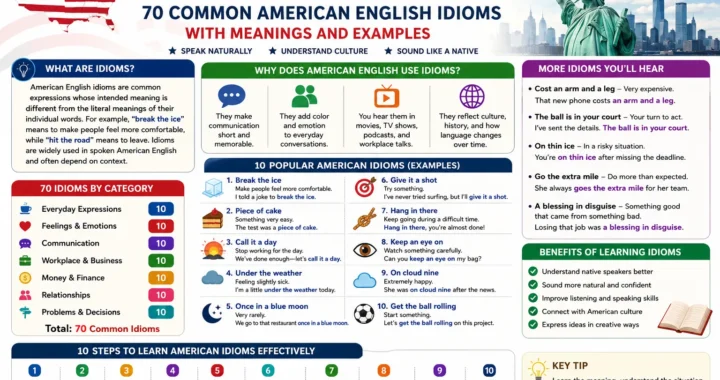
An idiom is a fixed group of words whose overall meaning cannot be understood by looking at the individual words alone. The meaning is learned through common usage within a language community, not through logic. For example, “break the ice” doesn’t involve any actual ice. It means easing tension in an awkward or new social situation, a meaning entirely separate from the literal words used.
Why This Definition Matters
The key phrase in this definition is “cannot be understood by looking at the individual words alone.” That’s what separates an idiom from an ordinary phrase.
A regular phrase like “close the door” means exactly what it says. An idiom like “spill the beans” doesn’t. Knowing what “spill” and “beans” mean individually gives you no clue that the phrase actually means “reveal a secret.”
This gap between literal words and actual meaning is the single defining feature of every idiom, and it’s the test you can apply to any unfamiliar phrase to check whether it qualifies.
Idiom Examples: Everyday Situations
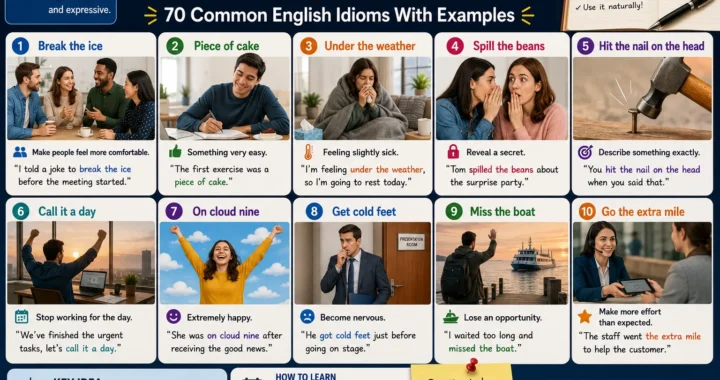
- Piece of cake – Something very easy to do. “The test was a piece of cake.”
- Break the ice – To ease social tension. “He told a joke to break the ice.”
- Under the weather – Feeling sick. “I’m staying home; I’m under the weather.”
- Hit the sack – To go to sleep. “It’s late, I should hit the sack.”
- Spill the beans – To reveal a secret. “She spilled the beans about the surprise.”
These five idioms are commonly used in beginner-level lessons and homework assignments, since they’re widely recognized and easy to explain with a clear example sentence.
Idiom Examples: Emotions and Feelings
- Over the moon – Extremely happy. “She was over the moon about her acceptance letter.”
- Down in the dumps – Feeling sad or low. “He’s been down in the dumps all week.”
- On cloud nine – Feeling very happy or excited. “They’ve been on cloud nine since the wedding.”
- Cold feet – Feeling nervous before something important. “He got cold feet before the interview.”
- Butterflies in my stomach – Feeling nervous. “I get butterflies before every presentation.”
These emotional idioms show how figurative language expresses feelings more vividly than plain adjectives alone.
Idiom Examples: Time and Money
- Once in a blue moon – Something that happens very rarely. “We only meet up once in a blue moon.”
- In the nick of time – Just before it’s too late. “He arrived in the nick of time.”
- Cost an arm and a leg – Very expensive. “That laptop cost an arm and a leg.”
- Break the bank – To spend more than you can afford. “The trip didn’t break the bank.”
These idioms work well for assignments or writing specifically covering how figurative language describes timing, frequency, or financial value.
Idiom Examples: Animals
- Let the cat out of the bag – To accidentally reveal a secret. “He let the cat out of the bag about the party.”
- Kill two birds with one stone – To accomplish two things with one action. “Running errands on my way home kills two birds with one stone.”
- Hold your horses – Wait, slow down. “Hold your horses, we’re not ready yet.”
- When pigs fly – Something that will never happen. “He’ll clean his room when pigs fly.”
Animal idioms work especially well as examples for younger students or beginner lessons, since the imagery is vivid and memorable.
Idiom Examples: Work and School
- Hit the books – To study hard. “I need to hit the books before the exam.”
- Touch base – To make brief contact or follow up. “Let’s touch base tomorrow.”
- Learn the ropes – To learn how to do a new task or job. “It took her a week to learn the ropes at her new job.”
How to Tell If a Phrase Is Actually an Idiom
A few simple checks help confirm whether an unfamiliar phrase qualifies as a true idiom.
- Test the literal meaning: If the literal interpretation doesn’t fit the context, you’re likely dealing with an idiom.
- Check if the wording is fixed: Idioms rarely change their exact structure. You wouldn’t say “spill the peas” instead of “spill the beans.”
- Consider whether cultural knowledge is required: If understanding the phrase depends on already knowing the specific expression, rather than just vocabulary, it’s probably idiomatic.
Applying these checks consistently makes it much easier to separate true idioms from the much larger pool of ordinary English phrases.
Expert Insights: Why Definition and Examples Work Better Together
A dictionary-style definition of “idiom” explains the concept abstractly, but it rarely helps someone recognize or use an idiom confidently on its own. Seeing several clear examples, each paired with a definition and full sentence, builds a much stronger, more practical understanding.
This happens because idioms are learned through pattern recognition and repeated exposure, not through memorizing a formal rule. Once someone sees enough examples, they start to intuitively recognize the difference between literal and figurative language independently.
Language teachers often introduce idioms this exact way, pairing a simple definition immediately with a handful of clear, common examples, since the examples do most of the actual conceptual work that a definition alone cannot accomplish.
This is precisely why “idiom definition and examples” is searched together so frequently: people recognize, often instinctively, that neither piece alone gives them a complete, usable understanding.
Common Mistakes People Make With Idiom Definitions and Examples
Mistake 1: Taking the idiom literally
New learners often picture the exact words, leading to confusion. Idioms should be understood as a complete unit of meaning, not broken apart word by word.
Mistake 2: Giving a definition without an example sentence
Simply listing “piece of cake” without showing it in a sentence makes the example less clear and less demonstrative of actual understanding.
Mistake 3: Using an idiom without confirming its exact meaning
Selecting an idiom because it sounds familiar, without confirming its precise meaning, risks using it incorrectly.
Mistake 4: Overusing idioms in formal writing
Casual idioms like “spill the beans” can sound out of place in formal or academic writing.
Practical Steps to Learn From an Idiom’s Definition and Examples
- Start with the definition, understanding the core concept: meaning that can’t be figured out from individual words.
- Choose common, easy-to-explain examples, rather than obscure or rarely used idioms.
- Write a full sentence for each example, showing the idiom used naturally in context.
- Briefly explain why the idiom is figurative, noting the gap between the literal words and the actual meaning.
- Practice with your own original sentences, reinforcing understanding beyond the examples provided here.
- Review regularly, since repeated exposure moves idioms from recognition into confident, natural use.
Idiom Examples by Category
| Category | Idiom Example | Meaning |
|---|---|---|
| Everyday | Piece of cake | Very easy |
| Emotion | Over the moon | Extremely happy |
| Time | Once in a blue moon | Very rarely |
| Money | Cost an arm and a leg | Very expensive |
| Animal | Hold your horses | Wait, slow down |
| Work/School | Hit the books | Study hard |
This table offers a quick, organized reference covering one strong example from each major category.
Frequently Asked Questions
Q: What is the definition of an idiom?
A: An idiom is a fixed group of words whose overall meaning can’t be understood by looking at its individual words. The meaning is learned through common usage, not logic. “Break the ice,” for example, means easing social tension, unrelated to actual ice.
Q: Can you give five simple examples of idioms?
A: Yes: “piece of cake” (very easy), “break the ice” (ease tension), “spill the beans” (reveal a secret), “hit the sack” (go to sleep), and “once in a blue moon” (very rarely).
Q: Why do idioms need examples, not just a definition?
A: An example sentence shows how the idiom functions naturally in context, revealing grammar, tone, and typical usage that a bare definition alone doesn’t demonstrate.
Q: How can I tell if a phrase is an idiom or just a regular phrase?
A: Test whether the literal meaning fits the context. If it doesn’t, but the phrase still communicates something clear to native speakers, and the wording stays fixed, it’s likely an idiom.
Q: Are idiom definitions the same across all dictionaries?
A: The core concept stays consistent, but specific wording, scope, and additional detail can vary between dictionary sources, particularly around historical or secondary definitions.
Q: What idioms work best for beginners?
A: Common, everyday idioms with vivid, easy-to-picture imagery, like “piece of cake,” “break the ice,” or “hold your horses,” work well for beginners since they’re widely recognized and simple to explain.
Q: How many idiom examples should I learn at once?
A: Starting with five to ten idioms at a time, reviewed regularly, tends to build stronger retention than trying to memorize a large list all in one sitting.
Bringing It All Together
Understanding idiom definition and examples together gives you a complete, usable picture that neither piece provides alone. The definition explains the core concept, meaning separate from individual words, while the examples show exactly how that concept plays out in real, everyday sentences.
Whether you’re completing an assignment, teaching a lesson, or just building your own vocabulary, having both pieces in one place saves you from piecing together scattered explanations.
The next time you need to explain what an idiom is, you’ll have exactly what’s needed: a clear definition and a solid bank of examples, organized and ready to go.
Read More: Idiom Definition for Kids: Simple Guide With Examples


[…] Read More: Idiom Definition and Examples: Complete Guide […]