

Someone reads “time is money” and calls it an idiom, while someone else insists it’s a metaphor. Both reactions are understandable, since the phrase sits right at the blurry edge between these two related but genuinely different types of figurative language.
The idiom vs metaphor comparison trips up more people than expected, including writers, students, and even some teachers. Both involve non-literal meaning, which makes them easy to confuse, even though they work in noticeably different ways.
This distinction matters for anyone studying literature, writing creatively, or simply trying to understand English more precisely, especially since textbooks and casual conversation often use these terms loosely, without explaining exactly where the line falls.
Understanding what separates an idiom from a metaphor clears up a common source of confusion and helps you recognize, analyze, and use figurative language with much greater precision.
By the end of this piece, you’ll know exactly what separates idioms from metaphors, how to tell them apart in real sentences, and why some phrases genuinely blur the line between the two.
What’s the Difference Between an Idiom and a Metaphor?
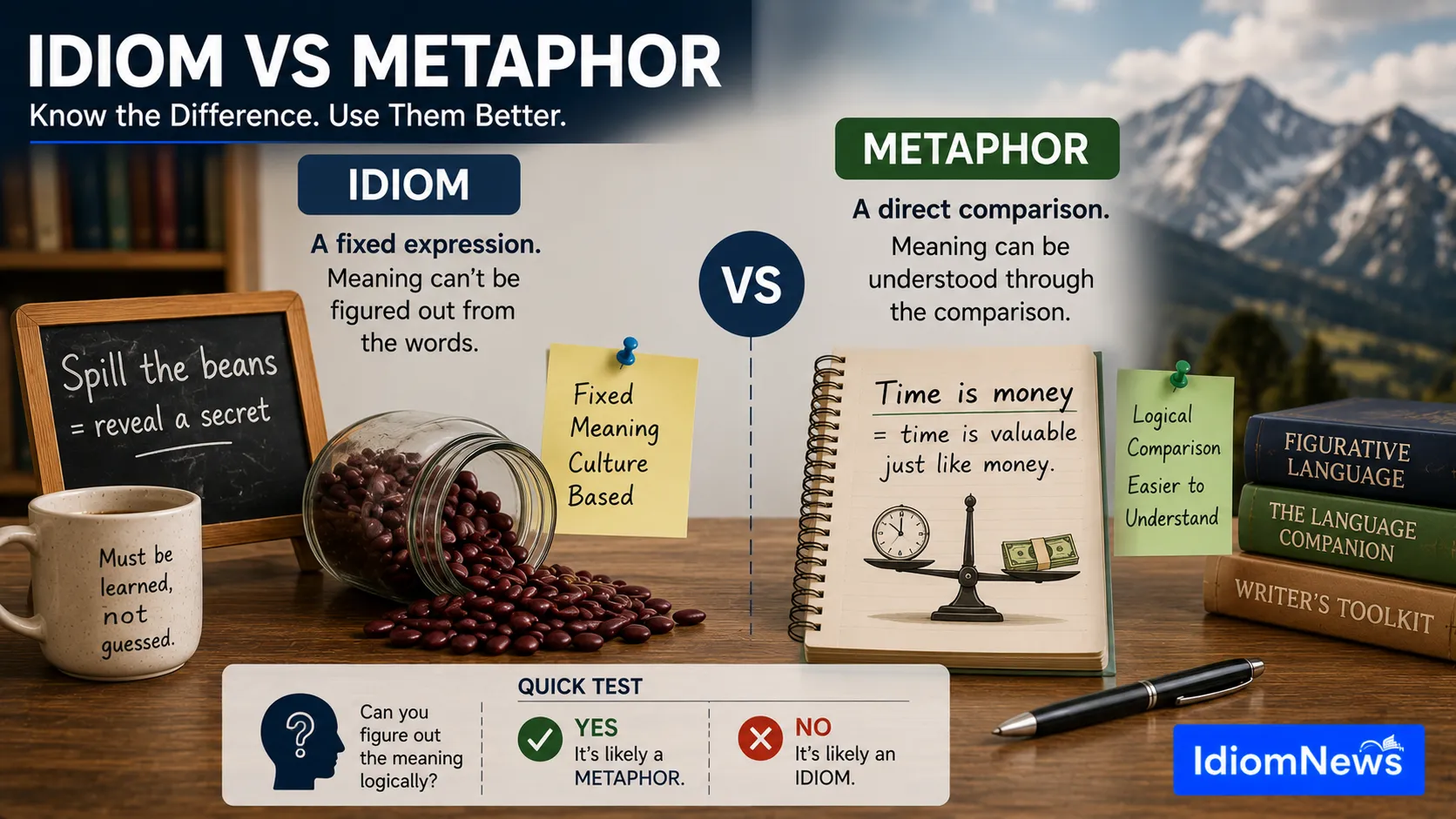
An idiom is a fixed expression whose meaning must be learned as a whole, while a metaphor directly compares two unrelated things to highlight a shared quality. Idioms rarely change wording and their meaning isn’t obvious from context alone. Metaphors, by contrast, can be newly created and understood immediately through the comparison itself, without prior cultural knowledge.
How Metaphors Actually Work
A metaphor directly states that one thing is another, drawing a comparison to highlight a shared characteristic, without using “like” or “as.”
- “Time is money” – Comparing time to money to emphasize that time is valuable and shouldn’t be wasted.
- “Her voice is music to my ears” – Comparing a pleasant voice to music to emphasize how enjoyable it is to hear.
- “He has a heart of stone” – Comparing someone’s emotional coldness to the hardness of stone.
Metaphors can be understood through logical reasoning, even if you’ve never heard that specific comparison before. The comparison itself carries the meaning.
How Idioms Actually Work
An idiom, by contrast, carries a fixed meaning that must be learned through cultural exposure, not logical reasoning based on the words themselves.
- “Spill the beans” – Meaning to reveal a secret, with no logical connection between beans and secrets that a first-time listener could reasonably guess.
- “Kick the bucket” – Meaning to die, an association that isn’t derivable from the words alone.
- “Break the ice” – Meaning to ease social tension, a meaning that requires prior knowledge of the phrase.
Unlike metaphors, idioms generally can’t be understood through pure logical reasoning. Their meaning is essentially memorized through repeated cultural exposure.
The Key Test: Can You Figure It Out Logically?
The clearest way to separate idioms from metaphors is testing whether the figurative meaning can be reasonably deduced through logic alone, without prior knowledge of the specific phrase.
Metaphor test: “Life is a rollercoaster” – Even without hearing this exact phrase before, most people can reason through the comparison: rollercoasters have ups and downs, similar to the unpredictable nature of life.
Idiom test: “Bite the bullet” – Without prior knowledge, there’s no clear logical path connecting biting a bullet to facing something difficult. The meaning must be learned, not reasoned out.
This logical-reasoning test works as a reliable, practical way to categorize unfamiliar figurative phrases correctly.
Why Some Phrases Genuinely Blur the Line
Not every figurative phrase fits neatly into one category. Some expressions started as metaphors and gradually became idiomatic through repeated, fixed use over time.
“Time is money,” for example, functions as a clear metaphor structurally, directly comparing two things. But because it’s become such a fixed, commonly repeated phrase, some linguists also classify it as idiomatic, since native speakers rarely construct the comparison fresh; they simply recall the fixed phrase.
This overlap happens because metaphors that get used repeatedly enough, without variation, can gradually take on idiom-like fixed status, even though they retain their original comparative structure.
Recognizing this overlap helps explain why some sources classify certain phrases differently, without either classification necessarily being wrong.
Expert Insights: Why This Distinction Matters Beyond Terminology
Understanding the difference between idioms and metaphors isn’t just an academic exercise. It affects how each type of figurative language should be taught, translated, and analyzed.
Metaphors, since they rely on logical comparison, often translate reasonably well across languages, even if the exact phrasing changes. A reader unfamiliar with “time is money” as an English phrase can still likely understand a similar metaphor if it exists in their own language, since the underlying comparison is logically transparent.
Idioms, by contrast, rarely translate well at all, precisely because their meaning isn’t derived through logical comparison. This is why language learners often find idioms significantly more challenging than metaphors, even though both fall under the broader category of figurative language.
This distinction also matters in literary analysis, where identifying whether an author is using a fresh, original metaphor versus a familiar, fixed idiom affects how a reader interprets the author’s creative choices.
Common Mistakes People Make With Idioms and Metaphors
Mistake 1: Assuming all figurative language is either purely idiom or purely metaphor
Some phrases genuinely blur the line, having originated as metaphors before becoming fixed, idiom-like expressions through repeated use.
Mistake 2: Assuming metaphors are always fresh and new
While metaphors can be newly created, many, like “time is money,” have become so commonly repeated that they function almost identically to idioms in everyday use.
Mistake 3: Assuming idioms always involve comparison
Unlike metaphors, idioms don’t necessarily compare two things directly. Some, like “spill the beans,” simply describe an action or situation figuratively without a clear comparative structure.
Mistake 4: Using the terms interchangeably in formal writing
While casual conversation often blends these terms loosely, academic or formal writing benefits from more precise, consistent terminology.
Practical Steps to Tell Idioms and Metaphors Apart
- Apply the logical reasoning test, checking whether the figurative meaning could be deduced without prior knowledge of the specific phrase.
- Check whether the phrase involves direct comparison, a strong sign of metaphor rather than idiom.
- Consider whether the wording is fixed or flexible, since idioms typically resist rewording, while metaphors can often be rephrased while keeping the same meaning.
- Accept that some phrases genuinely overlap, rather than forcing every expression into a single strict category.
- Practice classifying unfamiliar phrases, using both the logical test and comparison check together for stronger accuracy.
Idiom vs Metaphor at a Glance
| Feature | Idiom | Metaphor |
|---|---|---|
| Meaning derivable through logic | No | Yes |
| Requires cultural/prior knowledge | Yes | Not necessarily |
| Wording flexibility | Fixed | Often flexible |
| Translates well across languages | Rarely | Often |
| Example | “Spill the beans” | “Time is money” |
This table offers a quick way to compare the core differences between these two related types of figurative language.
Frequently Asked Questions
Q: What’s the main difference between an idiom and a metaphor?
A: An idiom’s meaning must be learned through cultural exposure, since it can’t be logically deduced from the words alone. A metaphor directly compares two things, and its meaning can often be reasoned out even without prior knowledge of that specific phrase.
Q: Can a phrase be both an idiom and a metaphor?
A: Yes, in some cases. Phrases like “time is money” started as clear metaphors but have become so fixed and commonly repeated that some linguists also classify them as idiomatic.
Q: Why do idioms translate poorly across languages while metaphors often translate better?
A: Metaphors rely on logical comparison, which often exists similarly across different languages and cultures. Idioms depend on specific, memorized cultural knowledge, which rarely matches directly between languages.
Q: How can I tell if a new phrase is a metaphor or an idiom?
A: Test whether the figurative meaning can be reasonably deduced through logic alone. If it can, it’s likely a metaphor. If the meaning requires prior knowledge of that specific phrase, it’s more likely an idiom.
Q: Are all metaphors newly created, unlike idioms?
A: Not necessarily. While metaphors can be freshly created, many commonly used ones, like “time is money,” have become fixed expressions through repeated use, similar to how idioms function.
Q: Does every idiom involve some kind of comparison?
A: No. Unlike metaphors, many idioms simply describe an action or situation figuratively, without directly comparing two separate things. “Spill the beans” doesn’t compare anything; it simply describes revealing a secret.
Q: Why does the idiom versus metaphor distinction matter for writers?
A: Understanding the difference helps writers use figurative language more precisely, particularly in literary analysis, where distinguishing between fresh metaphorical comparisons and familiar, fixed idioms affects how a reader interprets creative choices.
Bringing It All Together
Idioms and metaphors both fall under figurative language, but they work in genuinely different ways. Metaphors rely on logical comparison that can often be reasoned out, while idioms require memorized cultural knowledge that resists straightforward logic.
Understanding this distinction, including the phrases that genuinely blur the line between the two, sharpens how you read, analyze, and use figurative language across both casual and formal writing.
The next time you come across a figurative phrase, try applying the logical reasoning test. That simple check often reveals, clearly and quickly, exactly which category the phrase actually belongs to.
Read More: Idiom Synonym: Words That Mean the Same Thing as “Idiom”


[…] Read More: Idiom vs Metaphor: What Separates These Two Types of Figurative Language […]