


Someone says “let’s touch base next week,” and if you don’t already know the phrase, you might picture an actual baseball diamond instead of a quick follow-up meeting. That gap between words and meaning is exactly why idioms with explanation matter so much for anyone trying to understand English fully.
Idioms rarely make sense when you break them into individual words. That’s the whole point of them. But without a clear explanation attached, they can leave readers more confused than informed.
This creates a real problem for language learners, students, and even native speakers who encounter unfamiliar idioms in books, conversations, or workplace emails. A phrase without context or explanation often raises more questions than it answers.
Getting clear, simple explanations alongside each idiom removes that confusion immediately. Instead of guessing, readers get a direct answer paired with a real example showing exactly how the phrase is used.
By the end of this piece, you’ll have a solid collection of common idioms, each paired with a clear explanation and a practical example, so you can start using them with confidence.
What Does “Idioms With Explanation” Mean?
Idioms with explanation refers to figurative expressions presented alongside a clear, direct definition of their actual meaning. Since idioms can’t be understood literally, pairing each phrase with a simple explanation helps readers grasp the intended meaning immediately. For example, “hit the books” (idiom) means to study hard (explanation).

Idioms About Daily Life, Explained
Everyday idioms describe ordinary situations using vivid, non-literal language.
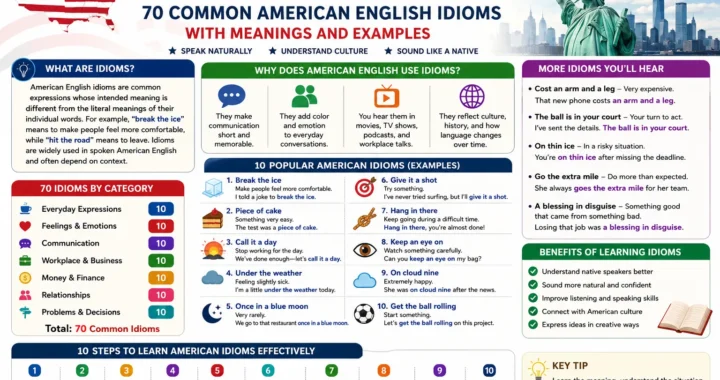
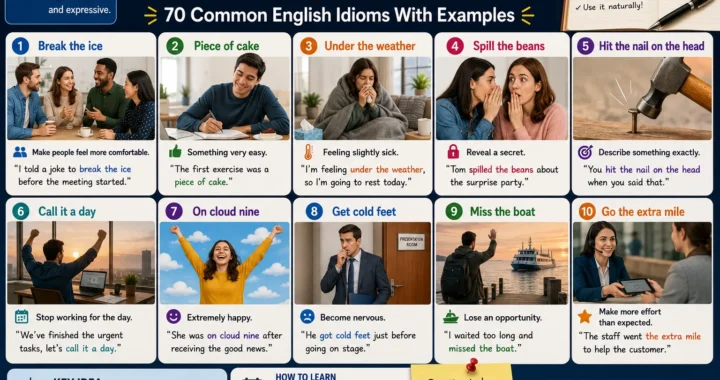
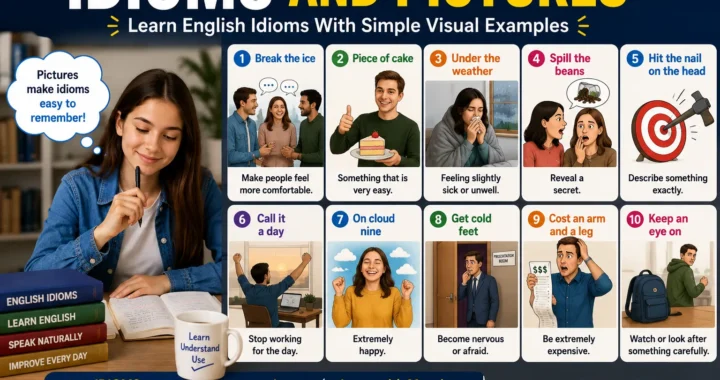
- “Piece of cake” – Explanation: something very easy to do. Example: “That test was a piece of cake.”
- “Under the weather” – Explanation: feeling sick or unwell. Example: “I’m staying home today, I’m under the weather.”
- “Hit the sack” – Explanation: to go to sleep. Example: “I’m exhausted, I’m going to hit the sack early.”
- “Once in a blue moon” – Explanation: something that happens very rarely. Example: “We only see each other once in a blue moon.”
These idioms appear constantly in casual speech, which makes them a natural starting point for building confidence.
Idioms About Emotions, Explained
Emotional idioms allow speakers to describe feelings with more color and detail than plain adjectives alone.
- “Over the moon” – Explanation: extremely happy. Example: “She was over the moon about her promotion.”
- “Down in the dumps” – Explanation: feeling sad or low. Example: “He’s been down in the dumps since the move.”
- “Butterflies in my stomach” – Explanation: feeling nervous. Example: “I get butterflies in my stomach before every interview.”
Understanding these emotional idioms makes it far easier to follow personal conversations and casual storytelling.
Idioms About Money, Explained
Money-related idioms show up frequently in both casual conversations and professional discussions.
- “Cost an arm and a leg” – Explanation: something very expensive. Example: “That car cost an arm and a leg.”
- “Break the bank” – Explanation: to spend more than you can afford. Example: “The vacation didn’t break the bank.”
- “Money doesn’t grow on trees” – Explanation: a reminder that money is limited. Example: “My parents always said money doesn’t grow on trees.”
[Internal Link: Related Article] exploring common idioms across different categories can help readers who want a broader collection organized by theme.
These idioms make conversations about spending and saving feel more natural and less repetitive.
Idioms Used in Work Settings, Explained
Certain idioms appear specifically in professional environments, meetings, and workplace emails.
- “Touch base” – Explanation: to make brief contact or follow up. Example: “Let’s touch base tomorrow morning.”
- “On the same page” – Explanation: in agreement or understanding something the same way. Example: “Before we move forward, let’s make sure we’re on the same page.”
- “Back to the drawing board” – Explanation: starting over after a plan fails. Example: “The proposal was rejected, so it’s back to the drawing board.”
These idioms tend to sound more neutral and professional compared to casual idioms like “spill the beans.”
Expert Insights: Why Explanation Matters More Than Definition Alone
A plain dictionary definition often isn’t enough to help someone actually use an idiom correctly. Explanation paired with a real example shows how the phrase fits naturally into a sentence, not just what it technically means.
This distinction matters because idioms depend heavily on context. Knowing that “break the ice” means easing social tension is useful, but seeing it used in a real sentence, like starting a conversation at a party, makes the meaning stick far more effectively.
Language learners often report that idioms feel more memorable when explanation and example appear together, rather than as separate, disconnected pieces of information.
This is part of why pairing idioms with clear explanations, instead of relying on definitions alone, tends to build faster, more practical understanding.
Common Mistakes People Make With Idiom Explanations
Mistake 1: Relying only on literal translation
Translating each word separately leads to confusion, since idioms don’t follow literal logic. The explanation should focus on the phrase’s actual meaning, not its individual words.
Mistake 2: Skipping real examples
An explanation without an example sentence often feels abstract. Pairing both together makes the idiom easier to understand and remember.
Mistake 3: Assuming one explanation fits every context
Some idioms shift slightly depending on tone or situation. Paying attention to context prevents misapplying an idiom incorrectly.
Mistake 4: Overcomplicating the explanation
A short, direct explanation usually works better than a long, technical one. Simple language helps the meaning land clearly and quickly.
Practical Steps to Learn Idioms With Explanation
- Look for idioms paired with both a definition and an example, not definitions alone.
- Write your own example sentence after learning each new idiom’s explanation.
- Group idioms by theme, such as emotions, money, or work, to make review easier.
- Practice using one idiom per day in real conversation or writing.
- Revisit unclear idioms, checking whether the explanation still makes sense in different contexts.
- Review regularly, since repeated exposure helps idioms move from memorized definitions into natural use.
Frequently Asked Questions
Q: Why do idioms need explanations instead of just definitions?
A: Idioms carry meaning that isn’t obvious from individual words, so a plain explanation paired with an example helps readers understand exactly how and when to use the phrase correctly in real conversation.
Q: What’s an example of an idiom with a clear explanation?
A: “Spill the beans” means to reveal a secret, often accidentally. For example, “He spilled the beans about the surprise party before we were ready to tell her.”
Q: How can I explain idioms to someone learning English?
A: Pair the idiom with a simple, direct explanation and a real example sentence. Avoid translating word for word, since that usually leads to confusion rather than clarity.
Q: Do all idioms need a long explanation?
A: No. Most idioms can be explained clearly in one short sentence. Overly long or technical explanations often confuse readers more than they help.
Q: Why do example sentences matter when learning idioms?
A: Examples show how an idiom fits naturally into real conversation, which helps the meaning stick far better than a definition alone. Context makes idioms easier to remember and apply correctly.
Q: Can idiom explanations vary slightly depending on context?
A: Yes, in some cases. While the core meaning usually stays consistent, tone or emphasis can shift slightly depending on the situation, so paying attention to context is helpful.
Q: What’s the fastest way to learn idioms with explanations?
A: Reviewing idioms paired with both a definition and a practical example, then practicing your own sentences, builds understanding faster than memorizing definitions alone.
Bringing It All Together
Idioms with explanation turn confusing, unfamiliar phrases into clear, usable language. Instead of guessing what a phrase might mean, you get a direct explanation paired with a real example showing exactly how it works.
This approach makes idioms far easier to remember than relying on dictionary definitions alone. Seeing a phrase used naturally, alongside its meaning, helps everything click into place much faster.
Instead of trying to memorize every idiom at once, focus on a handful at a time, paired with clear explanations and examples you can actually picture in a real conversation.
The next time an unfamiliar idiom catches you off guard, look for both the explanation and an example. That combination will make understanding, and eventually using, idioms feel almost second nature.
Read More: Common Idioms Explained: Everyday Phrases and What They Really Mean

[…] Read More: Idioms With Explanation: Popular Phrases Broken Down in Simple Terms […]
[…] hands you a random list of fifty idioms with definitions, and within minutes, half of them blur together. That’s the problem with most idiom lists. […]