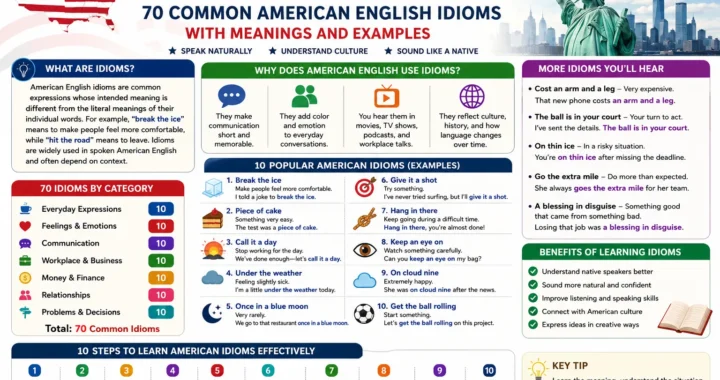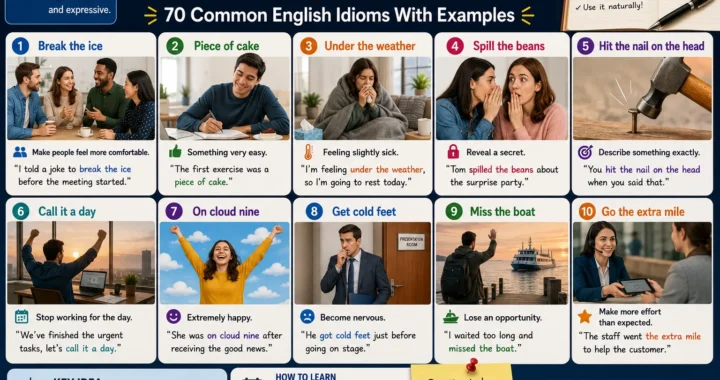


A friend tells you they’re going to “call it a night,” and somehow you instantly know they mean going to bed, not making a phone call. No one taught you the individual words. You just absorbed the phrase through years of hearing it used. That’s the strange, everyday reality of idioms.
So what are idioms, exactly? They’re expressions that carry a meaning completely separate from the literal words inside them. English is packed with these phrases, and most native speakers use dozens of them daily without a second thought.
For learners, though, idioms often feel like a wall. You can know every individual word in a sentence and still have no idea what the sentence actually means, simply because it’s idiomatic rather than literal.
This confusion is completely normal. Idioms aren’t logical puzzles you can solve with vocabulary knowledge. They’re cultural shortcuts, passed down and repeated until they became permanent fixtures of everyday speech.
By the end of this piece, you’ll understand exactly what idioms are, why they exist, how to spot them, and how to start using them with real confidence instead of hesitation.
What Are Idioms? A Direct Definition
Idioms are fixed expressions whose meaning cannot be worked out by looking at each word separately. The phrase functions as one unit of meaning, understood through common cultural usage rather than logic. For example, “call it a night” means to stop an activity and go to bed, not to literally name the evening.

The Logic Behind Illogical Phrases
Idioms feel illogical at first glance, but there’s usually a reason behind them, even if that reason has faded from common memory.
Many idioms started as literal descriptions of real activities. “Show your true colors” once referred to ships raising flags to reveal their nationality during battle.
Over generations, people kept using the phrase even after the original context disappeared. The literal meaning faded, but the figurative meaning stuck around and eventually became automatic.
This pattern repeats across most idioms. A concrete action or image becomes so familiar that it starts standing in for a broader idea, feeling, or situation.
Why Idioms Aren’t Just Random Word Combinations
It’s tempting to think idioms are simply strange, random phrases English speakers agreed to use. In reality, they follow patterns, even if those patterns aren’t obvious at first.
Most idioms relate to universal human experiences: emotions, time, money, effort, or relationships. This is part of why idioms translate roughly, even if not exactly, across many different languages and cultures.
For example, English says “once in a blue moon” for something rare. Other languages have their own version of this idea, using different imagery but expressing a similar concept.
[Internal Link: Related Article] exploring idiom origins in more depth can help readers who want to trace specific phrases back to their historical roots.
Recognizing these universal themes makes idioms feel less like memorization and more like patterns you can predict.
How to Recognize an Idiom in a Sentence
Spotting an idiom becomes easier once you know what to look for, even before checking a dictionary.
- The literal meaning doesn’t fit the context. If someone says they’re “feeling under the weather” indoors on a sunny day, something figurative is happening.
- The wording feels fixed. Idioms rarely change. You wouldn’t say “under the climate” instead of “under the weather.”
- Everyone around you seems to understand it instantly. Confusion on your end, paired with clear understanding from others, often signals an idiom.
Testing a phrase against these signs helps confirm whether you’re dealing with an idiom or simply an unfamiliar vocabulary word.
Expert Insights: Why Idioms Take Longer to Learn Than Vocabulary
Idiom fluency tends to develop more slowly than vocabulary or grammar, even among advanced English learners. This happens because idioms require repeated exposure in real context, not memorization of isolated definitions.
Learning a new vocabulary word usually transfers cleanly across situations. Learning an idiom only helps in the specific contexts where that exact phrase applies, since the wording is largely fixed and the meaning doesn’t extend logically to new combinations.
This is why immersion, through conversations, shows, podcasts, and reading, tends to build idiom fluency far more effectively than studying idiom lists alone. Context teaches idioms in a way definitions simply can’t replicate.
Many language teachers treat idiom fluency as one of the clearest signs that a learner has moved beyond textbook English into natural, everyday communication.
Common Mistakes People Make When Learning Idioms
Mistake 1: Trying to translate idioms word for word
This almost always leads to confusion, since idioms rarely match across languages. Learn idioms as whole phrases instead of piecing them together from individual translated words.
Mistake 2: Assuming idioms are optional extras
Some learners skip idioms entirely, focusing only on grammar and vocabulary. This leaves major gaps in understanding real conversations, shows, and casual writing.
Mistake 3: Memorizing idioms without context
A list of idioms without example sentences is hard to retain. Idioms stick far better when learned through real situations.
Mistake 4: Using idioms in the wrong tone
Some idioms are playful and casual, while others feel outdated or dramatic. Mismatched tone can make a sentence feel awkward, even if the idiom is used correctly.
Mistake 5: Overusing idioms unnaturally
Native speakers use idioms occasionally, not constantly. Packing too many into one sentence tends to sound forced rather than fluent.
Practical Steps to Start Understanding Idioms Today
- Pick a small starting list of five to ten common idioms rather than trying to learn dozens at once.
- Find each idiom used in a real sentence, through shows, articles, or conversations, instead of relying on a definition alone.
- Write your own example sentence for each idiom to reinforce the meaning.
- Test unfamiliar phrases against the literal-meaning check described earlier in this piece.
- Avoid direct translation from your first language when guessing meaning.
- Revisit your list weekly, adding new idioms gradually as older ones become natural.
- Practice using idioms out loud, since spoken repetition builds confidence faster than silent reading alone.
Frequently Asked Questions
Q: What are idioms in the simplest terms?
A: Idioms are fixed phrases whose meaning is different from what the individual words suggest. People understand them through common usage, not logic. For example, “call it a night” means to stop and go to sleep, not to name the evening.
Q: Why are idioms so hard to understand at first?
A: Idioms don’t follow literal logic, so knowing individual words doesn’t help predict their meaning. Understanding idioms requires cultural familiarity built through repeated exposure, not vocabulary knowledge alone.
Q: Do idioms exist in every language?
A: Yes, most languages develop their own idiomatic expressions over time. However, these idioms rarely translate directly from one language to another, since they’re shaped by each culture’s unique history and experiences.
Q: How many idioms does someone need to know to sound fluent?
A: There’s no exact number, but recognizing 100 to 150 common idioms tied to everyday topics, like emotions, time, and money, covers most situations learners encounter in daily conversation.
Q: Can idioms be used in formal writing?
A: Generally, idioms are avoided in formal or academic writing, since they can sound too casual. They fit more naturally into conversational, creative, or informal business communication.
Q: What’s the fastest way to learn idioms?
A: Regular exposure through real conversations, shows, and reading builds idiom understanding faster than memorizing lists. Seeing idioms used in context helps the meaning stick far more effectively.
Q: Do idioms ever change meaning over time?
A: It’s uncommon, but not impossible. More often, entire idioms fall out of use while new ones emerge, rather than existing idioms shifting to mean something different.
Bringing It All Together
Idioms turn plain language into something more vivid, expressive, and culturally rich. They might feel confusing at first, but once you understand that their meaning lives in the whole phrase, not the individual words, everything becomes easier to grasp.
Real understanding comes from noticing idioms in actual conversations, shows, and everyday writing, not from memorizing definitions in isolation. Context does most of the teaching here.
Start small. Pick a handful of idioms that feel useful, watch for them in real situations, and practice using them yourself. Fluency builds gradually, one phrase at a time.
The next time someone tells you they’re going to “call it a night,” you won’t just understand the phrase. You’ll be one step closer to using idioms just as naturally yourself.
Read More: Idioms With Explanation: Popular Phrases Broken Down in Simple Terms