

Someone describes a new date as showing “a lot of red flags,” and everyone listening instantly understands the warning being communicated, no actual flags involved anywhere. Understanding the red flag idiom meaning helps explain exactly why this phrase has become such a go-to way to describe warning signs in modern conversation.
This expression shows up constantly, in dating conversations, workplace discussions, and casual warnings about people, situations, or decisions. Its popularity has grown significantly in recent years, particularly in conversations about relationships and personal boundaries.
Understanding exactly what this idiom means, where it originally came from, and how to use it correctly, helps clarify a phrase that’s become deeply embedded in everyday English, especially online and in casual conversation.
This matters for anyone encountering the phrase in conversation, social media, or writing, and wanting to understand both its meaning and the nuance behind how it’s typically used.
By the end of this piece, you’ll know exactly what “red flag” means as an idiom, how to use it correctly, and how it differs from related terms people sometimes confuse it with.
What Does “Red Flag” Mean as an Idiom?
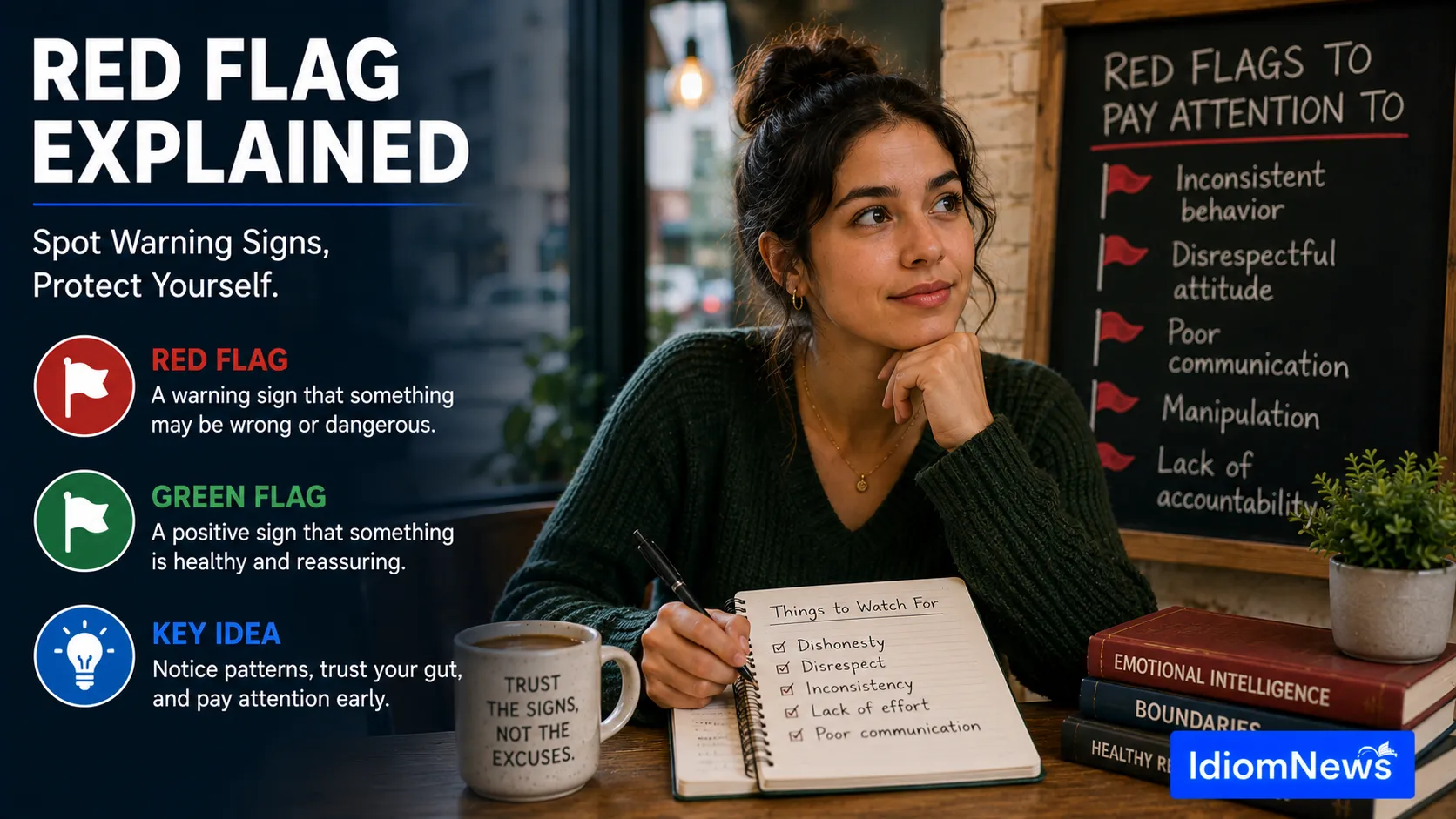
As an idiom, “red flag” refers to a warning sign or indicator that something is wrong, problematic, or potentially dangerous. It’s most commonly used to describe concerning behavior or characteristics in a person, relationship, job, or situation. For example, “he canceled plans three times in a row, which felt like a red flag” means his behavior signaled a potential problem worth paying attention to.
How “Red Flag” Is Used in Real Sentences
Seeing the idiom in context makes its meaning far clearer than a definition alone.
- “He never introduced me to any of his friends after six months of dating. That was a major red flag.”
- “The company kept avoiding questions about pay during the interview, which felt like a red flag.”
- “Ignoring your calls for days without explanation is a red flag in any relationship.”
In each example, “red flag” points to a specific behavior or pattern that suggests a deeper problem, one worth noticing and taking seriously rather than dismissing.
Where the Red Flag Idiom Comes From
The idiom’s origin connects to the literal use of red flags as warning signals across several different contexts throughout history.
Red flags have long been used internationally as a visual signal for danger or caution, appearing in maritime signaling, military contexts, and safety warnings, since red is widely recognized as a color associated with alert and danger.
This literal use of red flags as warning signals gradually extended into figurative language, where the phrase came to represent any signal, not just a literal flag, indicating a problem or risk worth paying attention to.
The exact transition from purely literal to widely used idiomatic meaning happened gradually over time, rather than through one single, documented moment.
Why “Red Flag” Has Become So Popular Recently
While the idiom itself isn’t new, its usage has increased noticeably in recent years, particularly in conversations about dating, relationships, and personal boundaries.
Social media and online dating culture have played a significant role in popularizing the term, with “red flag” becoming a common shorthand for identifying concerning behavior patterns before they escalate into bigger problems.
This surge in usage has also led to some idiom dilution, where the term sometimes gets applied to very minor personal preferences or disagreements, rather than reserved specifically for genuinely concerning behavior.
Red Flag vs Green Flag: Understanding the Related Term
As “red flag” grew more popular, a related term emerged specifically as its opposite: “green flag,” referring to a positive sign or reassuring indicator.
- Red flag – A warning sign suggesting a problem or concern.
- Green flag – A positive sign suggesting healthy, reassuring behavior or characteristics.
For example, “he remembered small details from our first conversation weeks later, which felt like a green flag” uses the positive counterpart to describe encouraging behavior, contrasting directly with the warning implied by “red flag.”
This paired terminology has become especially common in relationship and dating conversations, offering a simple, shared vocabulary for discussing both concerning and reassuring signs in another person’s behavior.
Expert Insights: Why “Red Flag” Resonates So Strongly Today
The widespread adoption of “red flag” as everyday shorthand reflects a broader cultural shift toward openly discussing relationship dynamics, personal boundaries, and warning signs in both personal and professional contexts.
Part of the phrase’s staying power comes from its simplicity. Rather than explaining a complicated pattern of concerning behavior in detail, “red flag” offers an immediately understood shorthand that most people recognize instantly, regardless of the specific situation being described.
However, as the term has spread into broader everyday use, its meaning has sometimes become diluted, with people occasionally applying it to minor personal preferences or simple incompatibilities rather than genuinely concerning behavior patterns.
This shift highlights an important nuance: while “red flag” remains a useful shorthand, its effectiveness depends on being used thoughtfully, reserved for behavior that genuinely signals risk or concern, rather than every minor disagreement or personal difference
Common Mistakes People Make Using “Red Flag”
Mistake 1: Applying the term to minor personal preferences
Using “red flag” for simple incompatibilities, like differing taste in movies, dilutes the term’s meaning, which is meant to signal genuine concern.
Mistake 2: Ignoring context and pattern
A single red flag in isolation doesn’t always indicate a serious problem. Patterns of behavior over time typically matter more than one isolated incident.
Mistake 3: Assuming red flags only apply to romantic relationships
While commonly used in dating contexts, the idiom applies broadly to friendships, workplaces, business decisions, and many other situations involving warning signs.
Mistake 4: Dismissing genuine red flags too quickly
Some people minimize legitimate warning signs, avoiding the term even when a real pattern of concerning behavior is present.
Practical Steps to Use the “Red Flag” Idiom Correctly
- Reserve it for genuinely concerning behavior, rather than minor personal preferences or simple disagreements.
- Look for patterns, not isolated incidents, since one instance doesn’t always indicate a serious ongoing problem.
- Use it across different contexts appropriately, recognizing it applies to friendships, workplaces, and business situations, not just romantic relationships.
- Pair it with “green flag” when relevant, offering balanced language for both positive and concerning signs.
- Explain the specific behavior alongside the term, since simply saying “that’s a red flag” without context can feel vague or dismissive.
Frequently Asked Questions
Q: What does “red flag” mean in a relationship?
A: In a relationship context, “red flag” refers to a behavior or characteristic that signals a potential problem or concern, such as dishonesty, inconsistency, or disrespect, worth paying close attention to.
Q: Is “red flag” only used for romantic relationships?
A: No. While commonly associated with dating, the idiom applies broadly to friendships, workplaces, business decisions, and any situation involving a warning sign worth noticing.
Q: What’s the opposite of a red flag?
A: The commonly used opposite term is “green flag,” referring to a positive, reassuring sign or behavior, rather than a warning sign of concern.
Q: Where does the red flag idiom come from?
A: The phrase traces back to the literal use of red flags as visual warning signals in contexts like maritime signaling and safety warnings, gradually extending into broader figurative use over time.
Q: How many red flags are considered too many?
A: There’s no fixed number, since context and severity matter more than counting individual instances. A pattern of concerning behavior, rather than one isolated incident, typically signals a more serious issue.
Q: Why has “red flag” become more popular recently?
A: Social media and online dating culture have significantly boosted its usage, offering simple, widely understood shorthand for identifying concerning behavior patterns in relationships and other situations.
Q: Can “red flag” apply to workplace situations?
A: Yes. The idiom works well in professional contexts too, describing concerning signs during interviews, job offers, or workplace dynamics that suggest a potential problem worth taking seriously.
Bringing It All Together
The red flag idiom meaning centers on identifying warning signs, behaviors or patterns that signal a potential problem worth paying attention to, whether in relationships, friendships, or professional situations. Its simplicity and immediate recognizability have made it a go-to phrase in modern conversation.
Using the term thoughtfully, reserved for genuine concerns rather than minor personal preferences, keeps its meaning clear and useful rather than diluted through overuse.
The next time you notice a concerning pattern in someone’s behavior, you’ll have exactly the right word for it, and you’ll understand precisely why that small phrase carries so much meaning in just two simple words.
Read More: Idioms in Spanish: How to Translate Common English Expressions Correctly

[…] Read More: Red Flag Idiom Meaning: What It Really Means and How to Use It […]
[…] Read More: Red Flag Idiom Meaning: What It Really Means and How to Use It […]