

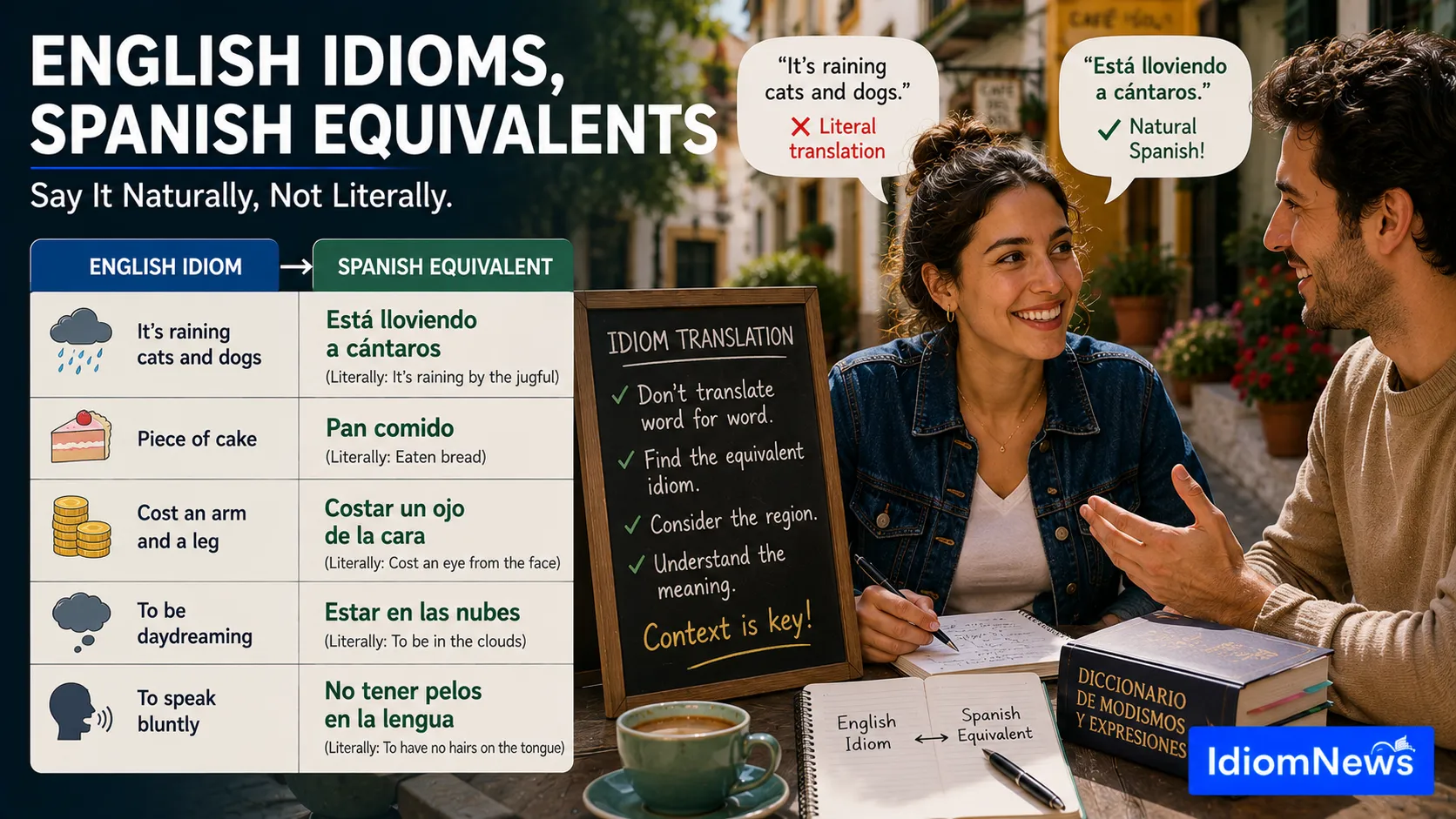
An English speaker learning Spanish wants to say “it’s raining cats and dogs” and translates it directly, word for word, into Spanish. The result makes no sense to a native speaker. Spanish has its own idiom entirely for heavy rain, and it has nothing to do with animals.
This is one of the most common frustrations for English speakers learning Spanish: knowing exactly what you want to say in English, but having no idea how to express that same idea idiomatically in Spanish, since direct translation almost never works.
This matters for students, travelers, and anyone communicating regularly with Spanish speakers, since relying on literal translation for idiomatic expressions often produces confusing or completely meaningless sentences.
Understanding how to find the correct Spanish equivalent, rather than translating English idioms directly, removes one of the most persistent obstacles standing between intermediate and truly fluent Spanish communication.
By the end of this piece, you’ll know how to correctly express common English ideas using real Spanish idioms, rather than confusing, literal translations that don’t actually work.
Why You Can’t Translate Idioms Directly Into Spanish
Idioms in Spanish rarely match English idioms word for word, since each language developed its own figurative expressions independently over time. Instead of translating literally, you need to find the equivalent Spanish idiom that expresses the same underlying idea, even if the specific words and imagery are completely different. This applies in both directions, English to Spanish and Spanish to English.
English Idioms and Their Spanish Equivalents
Rather than translating word for word, native Spanish speakers use entirely different phrases to express the same underlying ideas.
- “It’s raining cats and dogs” becomes “Está lloviendo a cántaros” (literally “it’s raining by the jugful”).
- “Piece of cake” becomes “Pan comido” (literally “eaten bread”).
- “Cost an arm and a leg” becomes “Costar un ojo de la cara” (literally “cost an eye from the face”).
- “Once in a blue moon” becomes “De vez en cuando” or, for something rarer, “De higos a brevas” (literally “from figs to figs,” referencing an uncommon fruit season).
Notice how each Spanish equivalent uses completely different imagery, even though the overall meaning matches the original English idiom closely.
Spanish Idioms and Their English Equivalents
The same challenge works in reverse. Spanish idioms translated literally into English usually sound strange, requiring you to find the matching English idiom instead.
- “Estar en las nubes” (literally “to be in the clouds”) matches the English idiom “to have your head in the clouds” or “to be daydreaming.”
- “Meter la pata” (literally “to put in the paw”) matches “to put your foot in your mouth” or “to mess up.”
- “Tirar la casa por la ventana” (literally “to throw the house out the window”) matches “to spare no expense” or “to go all out.”
- “No tener pelos en la lengua” (literally “to have no hairs on the tongue”) matches “to not mince words” or “to speak bluntly.”
Recognizing these matched pairs helps bridge the gap between literal translation and natural, idiomatically correct communication in both languages.
When There’s No Direct Equivalent
Some English idioms simply don’t have a clean, one-to-one Spanish equivalent, requiring a more descriptive translation instead.
For idioms without a clear match, the safest approach is translating the underlying meaning directly, rather than forcing an awkward literal translation or an imperfect idiom substitute.
For example, the English idiom “bite the bullet” doesn’t have an exact Spanish idiom equivalent. In this case, Spanish speakers might simply say “enfrentar la situación” (to face the situation) or “afrontar algo difícil” (to confront something difficult), conveying the same practical meaning without forcing an idiomatic match that doesn’t naturally exist.
This approach, prioritizing clear meaning over forced idiom matching, prevents confusing, unnatural-sounding Spanish sentences when a genuine equivalent simply isn’t available.
How Regional Spanish Affects Idiom Translation
Spanish spans many countries, and idiom equivalents sometimes shift depending on the specific region you’re communicating with.
Mexican Spanish, Argentine Spanish, and Spain’s Castilian Spanish occasionally use different idioms for the same underlying English concept, even when a single “standard” Spanish translation might be listed in general resources.
For example, while “pan comido” is widely understood across most Spanish-speaking regions for “piece of cake,” some regions might favor slightly different casual expressions in everyday conversation. Being aware of your target region helps you choose the idiom most likely to sound natural to your specific audience.
Expert Insights: Why Idiom Translation Requires More Than a Dictionary
Standard translation tools and dictionaries often struggle significantly with idioms, since literal, word-for-word translation completely misses the figurative meaning that makes an idiom function in the first place.
This is why professional translators specifically study idiom equivalents as a distinct skill, separate from general vocabulary translation. Finding the right idiom requires understanding both languages’ figurative systems, not just matching individual words.
For learners, building a personal reference of idiom equivalents, rather than relying solely on automatic translation tools, tends to produce far more natural, confident communication, particularly in casual conversation where idioms appear constantly.
This approach mirrors how experienced language learners generally develop idiomatic fluency: through deliberate study of equivalent expressions, not through direct, literal translation practice alone.
Common Mistakes People Make Translating Idioms Into Spanish
Mistake 1: Translating idioms word for word
This almost always produces confusing or meaningless Spanish, since idioms rarely match literally across languages.
Mistake 2: Assuming automatic translation tools handle idioms well
Many translation tools still struggle with idiomatic expressions, often producing literal translations that don’t convey the intended figurative meaning.
Mistake 3: Ignoring regional differences in idiom usage
An idiom equivalent common in Mexico might sound unfamiliar or less natural in Spain or Argentina, so considering your audience’s region matters.
Mistake 4: Forcing an idiom match when none exists
For English idioms without a clear Spanish equivalent, forcing an awkward literal translation or mismatched idiom often sounds more confusing than simply describing the underlying meaning directly.
Practical Steps to Translate Idioms Into Spanish Accurately
- Identify the underlying meaning first, rather than focusing on the literal English words.
- Search specifically for the Spanish idiom equivalent, not a direct, word-for-word translation.
- Check whether the equivalent idiom is regionally specific, adjusting based on your target audience if needed.
- Default to describing the meaning directly when no clean idiom equivalent exists.
- Practice using idiom pairs in real sentences, reinforcing both the English and Spanish versions together.
- Confirm unfamiliar idiom translations with a native speaker when accuracy matters, particularly in professional or formal contexts.
Common English-Spanish Idiom Equivalents
| English Idiom | Spanish Equivalent | Literal Spanish Meaning |
|---|---|---|
| It’s raining cats and dogs | Está lloviendo a cántaros | It’s raining by the jugful |
| Piece of cake | Pan comido | Eaten bread |
| Cost an arm and a leg | Costar un ojo de la cara | Cost an eye from the face |
| To be daydreaming | Estar en las nubes | To be in the clouds |
| To speak bluntly | No tener pelos en la lengua | To have no hairs on the tongue |
This table offers a quick reference for translating between common English and Spanish idiom pairs.
Frequently Asked Questions
Q: Can I translate English idioms directly into Spanish?
A: No, direct translation almost always produces confusing or meaningless Spanish. Instead, you need to find the equivalent Spanish idiom that expresses the same underlying meaning, even if the specific words differ completely.
Q: What’s the Spanish equivalent of “piece of cake”?
A: The Spanish equivalent is “pan comido,” which literally translates to “eaten bread.” Despite the different imagery, it conveys the same meaning of something being very easy.
Q: Do all English idioms have a Spanish equivalent?
A: No. Some English idioms don’t have a clean, one-to-one Spanish equivalent. In these cases, it’s usually better to describe the underlying meaning directly rather than forcing an awkward translation.
Q: Are Spanish idiom equivalents the same across all Spanish-speaking countries?
A: Not always. While many idioms are widely understood, some regional variation exists between Mexican, Argentine, and Castilian Spanish, so considering your specific audience helps ensure natural-sounding communication.
Q: Why do translation apps struggle with idioms?
A: Most translation tools rely heavily on literal, word-for-word translation, which misses the figurative meaning that makes idioms function. Idiom translation typically requires specialized knowledge beyond basic vocabulary matching.
Q: How can I learn Spanish idiom equivalents effectively?
A: Building a personal reference pairing English idioms with their Spanish equivalents, then practicing both in real sentences, tends to work better than relying solely on automatic translation tools or memorizing isolated definitions.
Q: What should I do if there’s no direct Spanish equivalent for an English idiom?
A: Focus on describing the underlying meaning directly, using clear, literal Spanish, rather than forcing an awkward or mismatched idiomatic translation that might confuse native speakers.
Bringing It All Together
Translating idioms in Spanish requires moving beyond literal, word-for-word translation and instead finding the equivalent expression that captures the same underlying meaning. This shift, from translating words to translating ideas, marks a genuine step toward natural, confident Spanish communication.
Building a personal collection of English-Spanish idiom pairs, while staying aware of regional differences, helps bridge the gap between textbook Spanish and the way native speakers actually talk.
The next time you’re tempted to translate an idiom word for word, pause and search for its Spanish equivalent instead. That small habit will save you from countless confusing, and occasionally funny, translation mishaps.
Read More: Idiom vs Metaphor: What Separates These Two Types of Figurative Language



[…] Read More: Idioms in Spanish: How to Translate Common English Expressions Correctly […]