

The Meaning of “Idiom”: Where the Word Itself Comes From
Ask someone to explain the meaning of idiom, and they’ll usually describe examples, phrases like “break the ice” or “spill the beans.” Fewer people stop to ask a more basic question: where did the word “idiom” itself come from, and what did it originally mean before it settled into its current, familiar sense?
That question turns out to have a genuinely interesting answer. The word “idiom” has shifted meaning over centuries, moving from a much broader concept to the more specific figurative-language sense most people know today.
This matters for anyone curious about language history, students studying etymology, or writers who want a deeper, more precise understanding of a word they use constantly without ever examining closely.
Tracing the meaning of idiom back to its roots also clarifies why the word gets used slightly differently in linguistics compared to everyday conversation, a distinction that often goes unexplained.
By the end of this piece, you’ll understand where the word “idiom” originally came from, how its meaning evolved, and how that history still shapes the way linguists use the term today.
What Does “Idiom” Actually Mean?
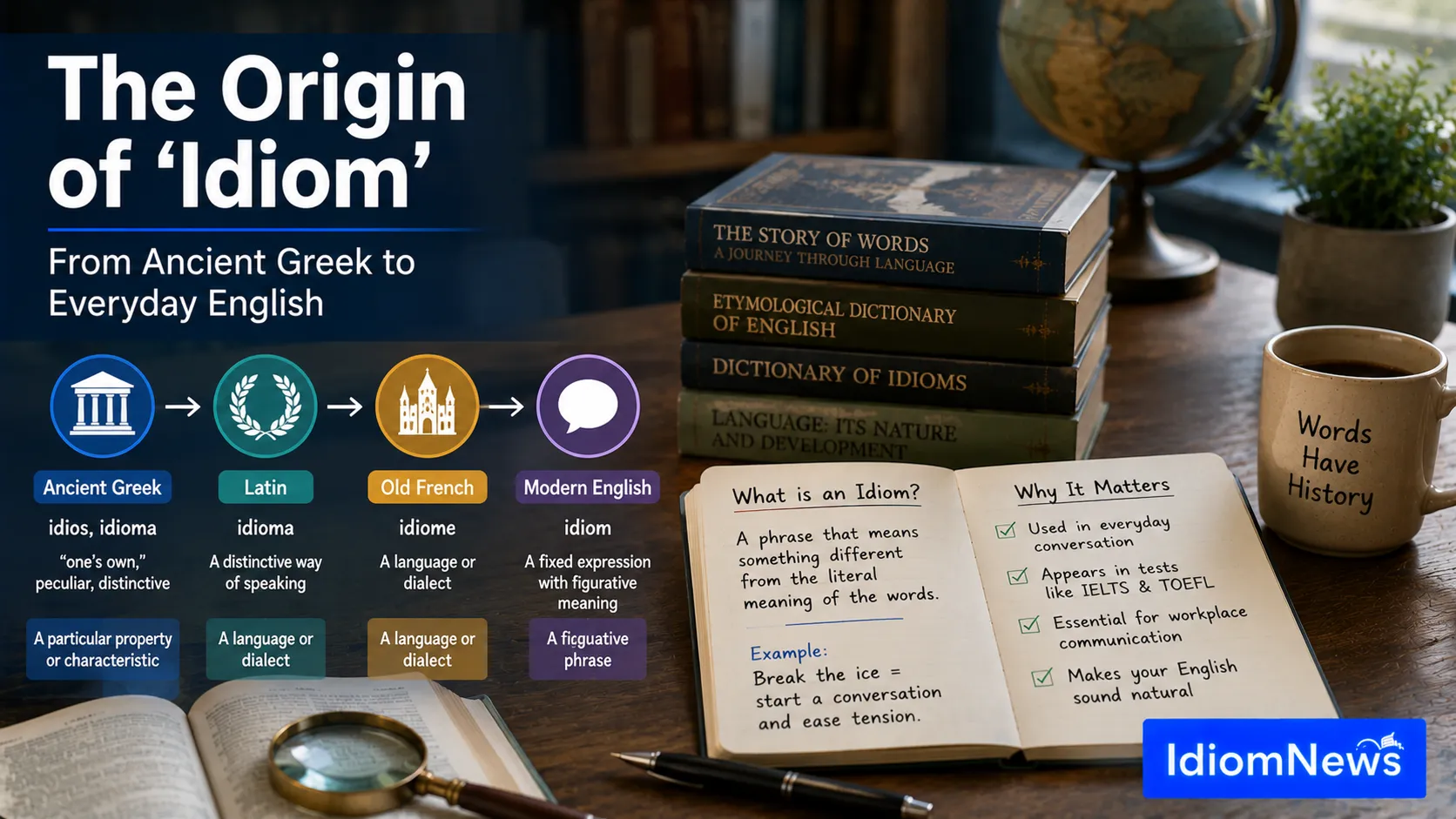
The word “idiom” originally comes from the Greek word “idioma,” meaning a particular property, peculiarity, or characteristic way of speaking. Over time, its meaning narrowed in English to specifically describe fixed expressions with figurative meaning, though its broader historical sense, referring to a language’s distinctive character as a whole, still survives in some linguistic contexts today.
Image Suggestion: A simple etymology graphic tracing the word “idiom” back through Greek, Latin, and French roots to its modern English usage.
The Word’s Origins in Ancient Greek
The word “idiom” traces back to the Greek term “idioma,” itself derived from “idios,” meaning “one’s own” or “private, personal, peculiar to oneself.”
In its original Greek sense, “idioma” referred broadly to something distinctive or characteristic, not specifically to figurative language at all. It described a particular quality or peculiarity that set something apart.
This root sense of “belonging to a specific individual or group” carried forward through Latin, where “idioma” retained a similar broad meaning before eventually making its way into French and then English.
How “Idiom” Came to Mean a Language Itself
Before settling into its current, more specific meaning, “idiom” was historically used in English to refer to an entire language or dialect, not just a figurative phrase within it.
This older sense survives today in the Spanish, Portuguese, and Italian word “idioma,” which still means “language” in those languages, a direct continuation of this earlier, broader meaning rather than the narrower figurative-phrase sense that developed specifically in English.
In English specifically, this broader sense of “idiom” as an entire language or dialect gradually became less common, giving way to the narrower meaning most speakers use today, referring to specific fixed expressions rather than a whole language system.
How “Idiom” Narrowed to Its Modern Meaning
The shift from “idiom” meaning an entire language or dialect to meaning a specific figurative expression happened gradually, reflecting a broader linguistic pattern where words shift from describing a whole category to describing one distinctive feature within it.
[Internal Link: Related Article] exploring the difference between “idioma” and “idiom” can help readers understand how this same word diverged across different languages that share the same Latin root.
This narrowing makes sense conceptually. A language’s “idiom,” in the older sense, referred to its distinctive characteristics, and fixed figurative expressions are exactly the kind of feature that makes one language distinctly different from another. Over time, this specific type of distinctive expression became what the word “idiom” primarily referred to in English.
By the time “idiom” reached its modern English usage, this narrower sense, describing a fixed phrase with non-literal meaning, had become the dominant, standard definition.
Image Suggestion: A timeline graphic showing the word “idiom” shifting meaning from “a language’s distinctive character” to “a specific figurative phrase” across different historical periods.
How Linguists Still Use the Word’s Broader Original Sense
While most everyday English speakers use “idiom” specifically to mean a figurative expression, linguists sometimes still draw on the word’s older, broader meaning in more technical contexts.
In linguistics, the term “idiolect” (an individual’s own distinctive way of speaking) shares the same Greek root, “idios,” reflecting the original sense of something personal or particular to an individual or group, rather than referring to figurative language specifically.
This connection reveals that the modern, narrow meaning of “idiom” as a fixed figurative phrase represents just one specific application of a much older, broader linguistic concept centered on distinctiveness and particularity.
Understanding this etymological background helps explain occasional confusion when the word “idiom” appears in more technical or historical linguistic writing, where its meaning may lean closer to the word’s original, broader sense.
Expert Insights: Why Word Meanings Narrow Over Time
The shift in “idiom’s” meaning, from broad linguistic distinctiveness to specific figurative expressions, reflects a well-documented pattern in language change called semantic narrowing, where a word’s meaning becomes more specific and restricted over time.
This pattern appears across many English words, not just “idiom.” Words often start with a broad, general meaning and gradually settle into a narrower, more specific sense as language usage standardizes around one particular application.
Etymologists generally attribute this kind of narrowing to practical communication needs. As English speakers needed a specific, dedicated term for figurative expressions distinct from literal language, “idiom” gradually absorbed that specific function, while its broader original sense faded from common English usage.
This history offers a useful example of how word meanings aren’t fixed or accidental, but instead reflect gradual, traceable shifts shaped by how a language’s speakers actually use and need particular terms over time.
Image Suggestion: A simple linguistic diagram showing semantic narrowing, with a wide circle labeled “distinctive characteristic” narrowing down to a smaller circle labeled “figurative expression.”
Common Misconceptions About the Meaning of Idiom
Misconception 1: “Idiom” always meant a figurative phrase
Historically, the word originally referred to a language’s distinctive character as a whole, not specifically to figurative expressions, a narrower meaning that developed later in English.
Misconception 2: The word’s meaning is unrelated across languages
Spanish, Portuguese, and Italian “idioma” (meaning “language”) actually reflects the word’s older, broader historical sense, not an unrelated coincidence.
Misconception 3: “Idiom” and “idiolect” are unrelated terms
Both words share the same Greek root, “idios,” reflecting a shared conceptual connection to personal distinctiveness, even though they’re used quite differently in modern English.
Misconception 4: Etymology doesn’t matter for understanding modern usage
Understanding a word’s history often clarifies why it’s used slightly differently across contexts, particularly in more technical linguistic writing compared to everyday conversation.
Practical Steps to Explore Word Origins Like This One
- Trace a word back through its earliest documented roots, checking Greek, Latin, or other historical language sources when available.
- Look for related words sharing the same root, since these often reveal a word’s original, broader meaning.
- Compare the word’s meaning across related languages, since divergence often highlights historical shifts in meaning.
- Consider semantic narrowing or broadening, checking whether a word’s modern meaning is narrower or wider than its historical origin.
- Cross-check etymology claims across reputable sources, since popular explanations sometimes lack strong historical documentation.
Image Suggestion: A person researching a word’s etymology using both a historical dictionary and academic linguistic resources.
The Evolution of “Idiom” at a Glance
| Stage | Meaning |
|---|---|
| Ancient Greek (“idios,” “idioma”) | Something personal, particular, or distinctive |
| Historical English/Romance languages | An entire language or dialect |
| Modern English | A fixed expression with figurative meaning |
This table traces the word’s meaning as it narrowed from a broad linguistic concept into its specific modern English sense.
Frequently Asked Questions
Q: What is the original meaning of the word “idiom”?
A: The word traces back to the Greek term “idioma,” meaning a particular property or characteristic way of speaking, derived from “idios,” meaning “one’s own” or “peculiar to oneself.”
Q: Why does “idioma” mean “language” in Spanish but “idiom” means a figurative phrase in English?
A: Both words share the same root, but English narrowed the meaning specifically toward figurative expressions over time, while Spanish, Portuguese, and Italian retained the word’s older, broader sense of “language.”
Q: Is “idiom” related to the word “idiolect”?
A: Yes. Both words share the Greek root “idios,” meaning “one’s own” or “particular.” “Idiolect” refers to an individual’s distinctive way of speaking, reflecting the same underlying concept of personal distinctiveness.
Q: When did “idiom” start meaning a figurative phrase specifically?
A: The exact transition happened gradually over time rather than at one specific documented moment, as English usage increasingly settled around this narrower, more specific sense of the word.
Q: What is semantic narrowing?
A: Semantic narrowing describes how a word’s meaning becomes more specific and restricted over time, moving from a broader original sense to a narrower, more particular modern meaning, as happened with “idiom.”
Q: Does understanding a word’s etymology change how it should be used today?
A: Not necessarily for everyday communication, but understanding etymology often clarifies why a word appears with slightly different meanings across technical, historical, or cross-language contexts.
Q: Are there other English words that narrowed in meaning like “idiom” did?
A: Yes, semantic narrowing is a well-documented pattern across many English words, where a broader original meaning gradually settles into a more specific, restricted modern usage over time.
Bringing It All Together
The meaning of idiom carries far more history than its modern definition alone suggests. Tracing the word back to its Greek roots reveals a much broader original concept, one centered on distinctiveness and personal characteristic, that gradually narrowed into the figurative-expression sense used in English today.
This history also explains a genuinely interesting cross-language connection: the word’s older, broader sense survives directly in Spanish, Portuguese, and Italian, where “idioma” still means “language” rather than a specific figurative phrase.
The next time you use the word “idiom,” you’ll be using more than just a term for figurative phrases. You’ll be carrying forward a word with roots stretching back to ancient ideas about what makes any particular way of speaking distinctly its own.



[…] Read More: Meaning of Idiom: Origin, History & Definition […]