


Someone hands you a random list of fifty idioms with definitions, and within minutes, half of them blur together. That’s the problem with most idiom lists. They throw phrases at you without structure, making it hard to actually remember anything.
A well-organized list of idioms works differently. When phrases are grouped by theme, whether that’s emotions, time, money, or work, your brain has an easier time holding onto the meaning and recalling it later in real conversation.
This matters for anyone learning English, teaching it, writing content, or simply trying to build a stronger, more natural vocabulary. Idioms show up constantly in daily speech, and having a clear reference makes them far less intimidating.
Rather than overwhelming you with hundreds of unrelated phrases, a focused, categorized list gives you something practical you can actually use, review, and apply right away.
By the end of this piece, you’ll have a clear list of idioms organized by category, along with practical guidance on how to actually remember and use them.
What Is a List of Idioms Used For?
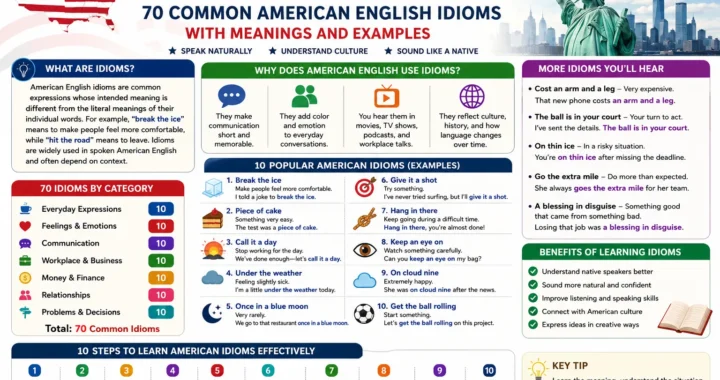
A list of idioms is a curated collection of figurative expressions, usually organized by theme or frequency of use, designed to help readers learn and reference common phrases quickly. These lists typically include the idiom, its meaning, and sometimes an example sentence. They work best when grouped logically rather than presented randomly.

Idioms About Time
Time-related idioms help describe how often or how quickly something happens.
- Once in a blue moon – Something that happens very rarely.
- In the nick of time – Just before it’s too late.
- Around the clock – Continuously, all day and night.
- Beat the clock – To finish something before a deadline.
- Time flies – Time passes quickly, especially when you’re busy or enjoying yourself.
These idioms replace plain phrases like “rarely” or “quickly” with more vivid, memorable language.
Idioms About Money
Money-related idioms appear often in both casual and professional conversations.
- Cost an arm and a leg – Extremely expensive.
- Break the bank – To spend more than you can afford.
- Cheap as chips – Very inexpensive, mostly used in British English.
- Money doesn’t grow on trees – A reminder that money is limited.
- Tighten your belt – To spend less and save money carefully.
[Internal Link: Related Article] exploring common idioms with detailed explanations can help readers who want deeper context on phrases like these.
Understanding these idioms makes conversations about spending and budgeting feel more natural and relatable.
Idioms About Emotions and Feelings
Emotional idioms give speakers a way to describe feelings with more color than plain adjectives.
- Over the moon – Extremely happy.
- Down in the dumps – Feeling sad or low.
- On cloud nine – Feeling very happy or excited.
- Butterflies in my stomach – Feeling nervous.
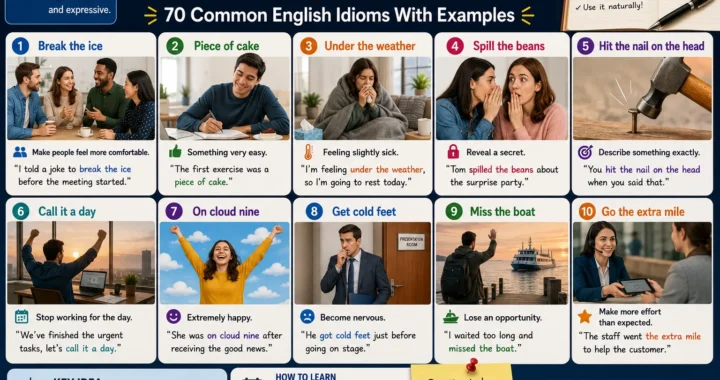
- Cold feet – Feeling nervous or hesitant right before doing something important.
These idioms are especially common in personal conversations, where expressive language feels more natural than plain statements.
Idioms About Work and Professional Life
Certain idioms are specifically common in workplace conversations and business communication.
- Touch base – To make brief contact or follow up.
- On the same page – In agreement or understanding something the same way.
- Think outside the box – To think creatively.
- Back to the drawing board – Starting over after a plan fails.
- Learn the ropes – To learn how to do a new job or task.
These idioms tend to feel more neutral and appropriate for formal or semi-formal settings compared to casual idioms.
Idioms About Everyday Situations
Some idioms don’t fit neatly into one category but appear constantly in daily conversation.
- Piece of cake – Something very easy.
- Under the weather – Feeling sick.
- Hit the sack – To go to sleep.
- Spill the beans – To reveal a secret.
- Break the ice – To ease tension in a social situation.
These general idioms are often the first ones learners encounter, since they show up so frequently in casual speech.
Expert Insights: How to Actually Use a List of Idioms Effectively
A list alone rarely builds real fluency. The idioms that stick tend to be the ones learners actively use in sentences, not just read passively.
Grouping idioms by theme, as shown above, helps with initial memorization, but true retention comes from repeated exposure in real context, through conversations, shows, or reading.
Trying to memorize an entire list at once often backfires, leading to shallow recognition rather than confident, natural use. Focusing on five to ten idioms at a time, practiced actively, tends to produce far stronger results.
This is why the most effective approach combines a structured list with consistent, real-world practice, rather than relying on the list as a standalone learning tool.
Common Mistakes People Make When Using Idiom Lists
Mistake 1: Trying to memorize too many idioms at once
This leads to shallow, easily forgotten knowledge. Focusing on a small, manageable group produces stronger, longer-lasting retention.
Mistake 2: Skipping example sentences
An idiom list with definitions alone is harder to apply. Example sentences show how each phrase fits naturally into real conversation.
Mistake 3: Treating every idiom as equally important
Some idioms are extremely common, while others are rare or regional. Prioritizing frequently used idioms offers more practical value early on.
Mistake 4: Never reviewing the list again
Idioms fade from memory without repetition. Revisiting a list periodically helps move phrases from passive recognition into active, confident use.
Practical Steps to Build Your Own Idiom List
- Start with categories relevant to your daily life, such as work, emotions, or casual conversation.
- Limit each study session to five to ten idioms, rather than trying to cover an entire list at once.
- Write an example sentence for each idiom, using situations from your own life when possible.
- Review your list weekly, adding a few new idioms as older ones become familiar.
- Practice idioms out loud, since spoken repetition builds confidence faster than silent reading.
- Track idioms you actually use in real conversations to reinforce long-term retention.
Quick Reference: Idioms by Category
| Category | Example Idiom | Meaning |
|---|---|---|
| Time | Once in a blue moon | Very rarely |
| Money | Cost an arm and a leg | Very expensive |
| Emotion | Over the moon | Extremely happy |
| Work | Touch base | Make brief contact |
| Everyday | Piece of cake | Very easy |
This table offers a fast overview for readers who want to scan idioms by theme rather than reading through the full list.
Frequently Asked Questions
Q: What’s the best way to use a list of idioms?
A: Focus on a small group at a time, ideally organized by theme, and practice using each idiom in your own sentences. Reviewing the list regularly helps idioms move from recognition into natural, confident use.
Q: How many idioms should be on a beginner’s list?
A: Starting with 20 to 30 common idioms tied to everyday topics, like emotions, time, and daily situations, gives beginners a practical, manageable foundation without feeling overwhelming.
Q: Are all idioms on a typical list equally useful to learn?
A: No. Some idioms appear far more frequently in daily conversation than others. Prioritizing common, everyday idioms offers more practical value than memorizing rare or highly regional phrases.
Q: Should an idiom list include example sentences?
A: Yes. Example sentences show how an idiom fits naturally into real conversation, which makes the meaning far easier to remember than a definition alone.
Q: How often should I review an idiom list?
A: Reviewing weekly works well for most learners. Consistent, spaced repetition helps idioms move from short-term memory into natural, long-term use.
Q: Can idiom lists include phrases specific to certain regions?
A: Yes, and it’s worth noting when they do. Some idioms, like “cheap as chips,” are more common in British English, while others are used more broadly across English-speaking countries.
Q: Is it better to learn idioms from a list or through conversation?
A: Both work best together. A list provides structure and organization, while real conversations and media provide the context needed to truly understand and remember each idiom.
Bringing It All Together
A well-organized list of idioms turns an overwhelming topic into something manageable and practical. Grouping phrases by theme, like time, money, emotions, and work, makes them far easier to remember than scattered, random lists.
Real fluency comes from combining a structured list with active practice, not from memorization alone. The idioms that stick are the ones you actually use in real sentences and conversations.
Start small. Pick one category that feels most relevant to your daily life, review a handful of idioms, and practice using them naturally over the next few weeks.
The next time an idiom from your list shows up in a real conversation, you’ll recognize it instantly, and that small moment of recognition is exactly how lasting fluency gets built.
Read More: What Are Idioms? A Straightforward Explanation Anyone Can Understand


[…] Read More: List of Idioms: Common Expressions Organized by Category for Quick Reference […]