

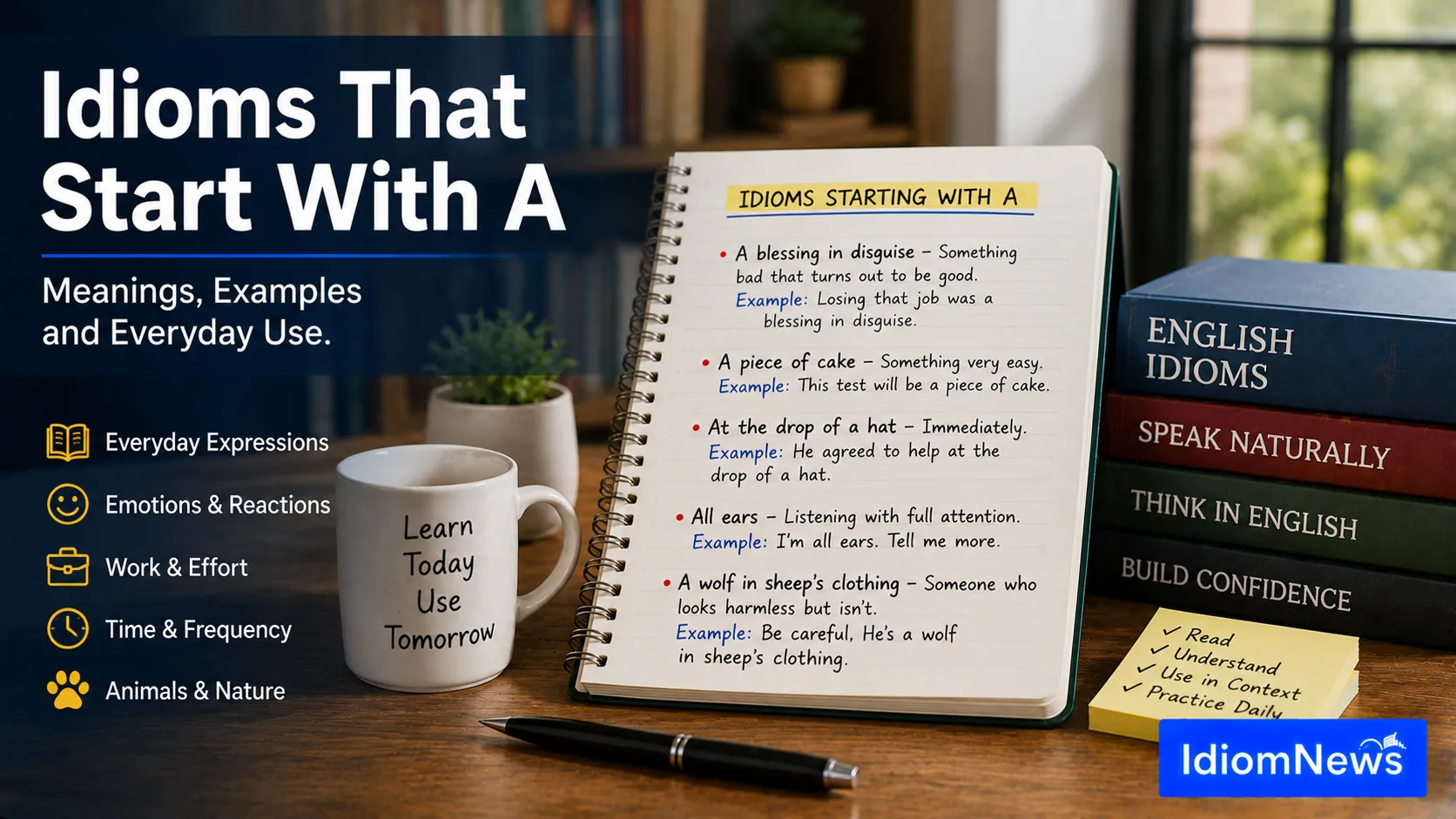
Idioms That Start With A: A Complete List With Meanings
Alphabetical idiom lists solve a real, specific problem: sometimes you remember the first letter of a phrase but not the exact wording, or you’re building a structured reference and need idioms organized systematically rather than by theme.
This collection focuses specifically on idioms with A, gathering commonly used expressions that begin with this letter, each paired with a clear meaning and example sentence to make the list genuinely useful rather than just a name-only reference.
This format works well for teachers building alphabetical vocabulary lessons, students working through structured idiom study, or anyone who simply prefers browsing reference material in a predictable, organized order.
Rather than grouping idioms by theme, as many collections do, this alphabetical approach makes lookup faster when you already have a partial idiom in mind and need to confirm its exact meaning or wording.
By the end of this piece, you’ll have a solid, alphabetically organized reference of idioms starting with A, ready to use for study, teaching, or quick lookup.
Why Organize Idioms Alphabetically?
Alphabetical idiom lists are organized by the first letter of the phrase, making them useful for quick lookup when you already know or partially remember an idiom’s wording. Unlike theme-based collections, alphabetical lists work best as a reference tool, particularly for confirming a specific idiom’s exact meaning rather than browsing for new phrases by topic.
Idioms Starting With A: Everyday Expressions
- A blessing in disguise – Something that seems bad at first but turns out to be beneficial. “Losing that job was a blessing in disguise; it led to a much better opportunity.”
- A dime a dozen – Something very common and not particularly valuable. “Cheap plastic toys like that are a dime a dozen.”
- A drop in the bucket – A very small amount compared to what’s actually needed. “That donation is just a drop in the bucket compared to the total cost.”
- A piece of cake – Something very easy to do. “Don’t worry about the exam; it’ll be a piece of cake.”
- A picture is worth a thousand words – An image can communicate more effectively than a lengthy description. “I could explain the damage, but honestly, a picture is worth a thousand words.”
These common idioms appear frequently enough in everyday conversation to be useful starting points for learners at almost any level.
Idioms Starting With A: Emotions and Reactions
- All ears – Fully listening and paying attention. “Go ahead and explain the plan; I’m all ears.”
- At the end of your rope – Feeling completely out of patience or options. “After the third delay, she was at the end of her rope.”
- Add fuel to the fire – To make an already difficult situation worse. “Bringing up the past mistake just added fuel to the fire during the argument.”
- A weight off your shoulders – A feeling of relief after resolving a problem. “Finishing that project was a huge weight off my shoulders.”
These idioms work well for describing emotional states and reactions with more color than plain adjectives alone.
Idioms Starting With A: Work and Effort
- Above and beyond – Doing more than what’s expected or required. “She went above and beyond to make sure the event ran smoothly.”
- Ahead of the curve – More advanced or prepared than what’s typical for the current time. “The company stayed ahead of the curve by adopting new technology early.”
- All hands on deck – A situation requiring everyone’s participation and effort. “We need all hands on deck to meet this deadline.”
- Add insult to injury – To make a bad situation even worse, often through an additional unfair action. “Losing the game was bad enough, but the referee’s bad call really added insult to injury.”
These idioms commonly appear in workplace conversations, describing effort, teamwork, and challenging situations.
Idioms Starting With A: Time and Frequency
- At the drop of a hat – Immediately, without hesitation. “He agreed to help at the drop of a hat.”
- Around the clock – Continuously, all day and night. “The team worked around the clock to finish the project on time.”
- After the fact – Something happening or being discovered after an event has already occurred. “We only found out about the mistake after the fact.”
Time-related idioms starting with A frequently describe urgency, continuity, or timing relative to a specific event.
Idioms Starting With A: Animals and Nature
- A wolf in sheep’s clothing – Someone who appears harmless but isn’t. “Be careful with him; he’s a wolf in sheep’s clothing.”
- At a snail’s pace – Moving or progressing very slowly. “The construction project has been moving at a snail’s pace.”
- A bird in the hand is worth two in the bush – It’s better to keep what you already have than risk it for something potentially better but uncertain. “I’ll take the guaranteed offer since a bird in the hand is worth two in the bush.”
Animal-based idioms tend to carry vivid, memorable imagery, making them especially useful for building strong recall through visualization.
Expert Insights: When Alphabetical Lists Work Best (And When They Don’t)
Alphabetical idiom lists serve a specific, practical purpose: quick lookup when you already have partial knowledge of a phrase, rather than open-ended discovery of new expressions by topic.
This format works particularly well for reference purposes, crossword puzzles, or confirming the exact wording of an idiom you’ve partially remembered but aren’t fully certain about.
However, alphabetical organization doesn’t naturally group related concepts together the way thematic lists do, meaning learners specifically trying to build vocabulary around a particular topic, like emotions or work idioms, may find theme-based collections more directly useful for active study.
Combining both approaches, using alphabetical lists for reference and thematic lists for structured learning, tends to offer the most complete, flexible resource for different study needs and situations.
Common Mistakes People Make With Alphabetical Idiom Lists
Mistake 1: Assuming alphabetical order groups similar meanings together
Idioms starting with the same letter often have completely unrelated meanings. Alphabetical order organizes by spelling, not by theme or concept.
Mistake 2: Using alphabetical lists as a primary study method
While useful for reference, alphabetical lists don’t naturally reinforce related concepts the way thematic grouping does, making them less ideal for structured vocabulary building alone.
Mistake 3: Overlooking idioms that don’t start with “A” literally
Some idioms include the word “a” within the phrase but don’t begin with it, like “once in a blue moon.” These wouldn’t appear in a true alphabetical “A” listing.
Mistake 4: Expecting comprehensive coverage from a single list
Given how many idioms exist starting with any single letter, no single list, including this one, captures every possible expression comprehensively.
Practical Steps to Use This List Effectively
- Use this list as a reference, confirming specific idioms rather than attempting to memorize the entire collection at once.
- Pair alphabetical lookup with thematic study, using both approaches together for a more complete learning strategy.
- Practice writing your own example sentences for idioms you want to actively incorporate into your vocabulary.
- Bookmark or save this list for quick reference when you encounter an unfamiliar “A” idiom elsewhere.
- Cross-reference with thematic collections if you want to study idioms specifically tied to emotions, work, or another particular topic.
Frequently Asked Questions
Q: What are some common idioms that start with A?
A: Frequently used examples include “a piece of cake” (something easy), “a blessing in disguise” (a hidden benefit), and “at the drop of a hat” (immediately). These appear regularly across casual conversation and writing.
Q: Why organize idioms alphabetically instead of by theme?
A: Alphabetical organization works best for quick reference lookup, particularly when you already know or partially remember an idiom’s wording, rather than for open-ended browsing by topic or concept.
Q: Are there idioms that start with A but relate to completely different topics?
A: Yes. Idioms starting with A cover many unrelated themes, including emotions, work, time, and animals, since alphabetical order groups phrases by spelling rather than meaning.
Q: Should I memorize this entire list at once?
A: It’s generally more effective to focus on a small group of idioms at a time, practicing each with your own example sentences, rather than attempting to memorize an entire alphabetical list in one sitting.
Q: Is this list comprehensive of all English idioms starting with A?
A: No single list can comprehensively cover every idiom starting with a specific letter, given how many exist. This collection focuses on commonly used, practical examples rather than exhaustive coverage.
Q: Can alphabetical idiom lists help with word games or puzzles?
A: Yes, alphabetical organization works particularly well for crossword puzzles, word games, or any situation where you need to quickly locate a specific idiom by its first letter.
Q: Should I use alphabetical or thematic idiom lists for studying?
A: Both serve different purposes well together. Thematic lists tend to work better for structured vocabulary building, while alphabetical lists work best as a quick reference tool for confirming specific phrases.
Bringing It All Together
Idioms starting with A span a wide range of everyday topics, from emotions and work to time and animals, offering a genuinely useful reference point whether you’re studying, teaching, or simply looking up a partially remembered phrase.
While alphabetical organization won’t group related concepts together the way thematic lists do, it offers real practical value specifically for quick, targeted lookup.
Bookmark this collection for reference, and pair it with thematic study when you’re focused on building vocabulary around a specific topic. Between both approaches, you’ll have a genuinely well-rounded way to expand your command of English idioms.

[…] Read More: Idioms That Start With A: Meanings & Examples […]