

Pictures for Idioms: Why Visuals Make Figurative Language Click
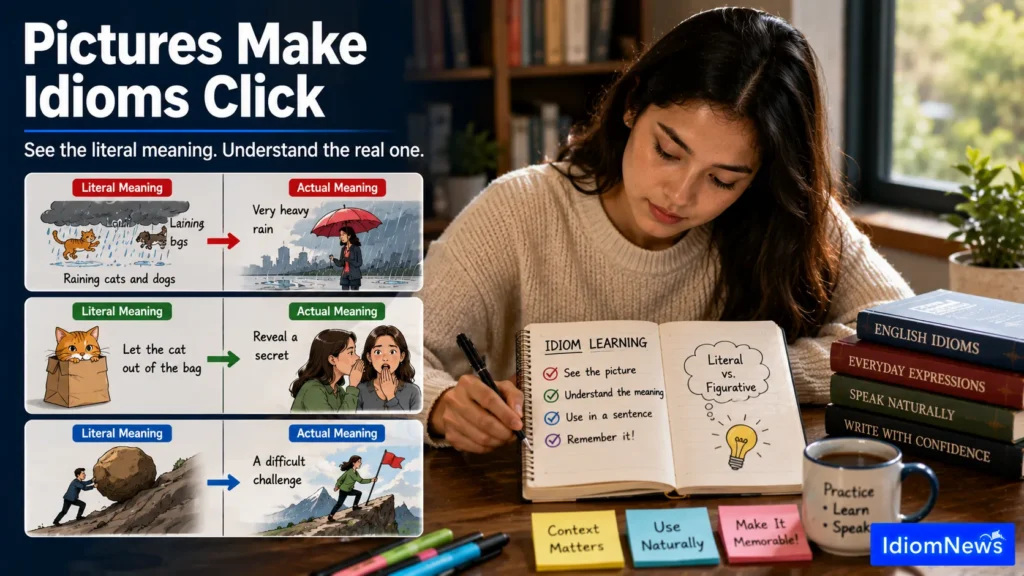
A teacher explains that “raining cats and dogs” means heavy rain, and half the class nods along politely without really grasping it. The same teacher then shows a simple two-panel image, animals falling from clouds next to a person getting soaked in a downpour, and suddenly the confused looks turn into genuine laughs of recognition.
Pictures for idioms work because they solve a specific problem that words alone often can’t: showing the literal absurdity of a phrase right next to its real meaning, making the gap between the two instantly, visually obvious.
This matters enormously for ESL teachers, parents helping young children, curriculum designers, and anyone creating learning materials where figurative language needs to click quickly and memorably, rather than through repeated verbal explanation alone.
Understanding what makes an idiom picture actually effective, not just decorative, helps you create or choose visual materials that genuinely support learning rather than just adding a nice image beside a definition.
By the end of this piece, you’ll know exactly what makes pictures for idioms effective, how to create or find strong ones, and how to use them well in teaching or self-study.
Why Pictures Work So Well for Teaching Idioms
Pictures for idioms work by visually contrasting an idiom’s literal meaning with its actual figurative meaning, making the non-literal nature of the phrase immediately clear rather than requiring lengthy verbal explanation. This visual contrast leverages how idioms function: the humor or memorability often comes specifically from the gap between the literal image and the real meaning, a gap that pictures can show far more efficiently than text alone.
The Two Main Types of Effective Idiom Pictures
Not all idiom pictures work the same way. Understanding the two main effective formats helps you create or choose visuals that actually support learning.
- Literal-versus-figurative comparison images: These show the idiom’s literal meaning (often absurd or humorous) directly beside its actual, figurative meaning, making the contrast the central teaching point.
- Single-scene contextual images: These show the idiom used correctly within a realistic scene, like two people shaking hands after “breaking the ice” at a networking event, helping learners connect the phrase to a real-world situation rather than its literal wording.
Both formats serve different purposes: comparison images work well for initial introduction and humor-driven memorability, while contextual images work well for reinforcing appropriate real-world usage.
What Makes a Strong Literal-Versus-Figurative Comparison Image
The most effective comparison images share a few consistent features that make the literal-versus-figurative contrast land clearly.
- Clear, simple visual style: Overly detailed or cluttered images can obscure the specific contrast being taught.
- Obvious labeling: Including the idiom’s text alongside each panel prevents confusion about which image represents which meaning.
- Genuinely absurd literal interpretation: The more visually striking the literal interpretation is, the more memorable the contrast becomes.
- Recognizable figurative scene: The figurative side should show a clearly relatable, everyday situation, not an abstract or overly artistic interpretation.
Idioms with especially vivid, absurd literal meanings, like “it’s raining cats and dogs” or “let the cat out of the bag,” tend to make particularly strong candidates for this comparison format, since the literal interpretation is naturally visual and memorable.
Where to Find or Create Pictures for Idioms
Several practical options exist for teachers, parents, and learners who want quality idiom pictures without starting entirely from scratch.
- Educational publisher resources: Many ESL and children’s education publishers offer idiom picture books or printable worksheet sets specifically designed for classroom or home use.
- Custom illustration commissions: For specific, curated idiom lists, commissioning simple illustrations tailored to your exact teaching needs offers the most precise fit.
- AI image generation tools: These can quickly produce literal-versus-figurative comparison images for common idioms, though results should be reviewed carefully for accuracy and appropriateness before classroom use.
- Student-created illustrations: Having students draw their own literal interpretations of idioms as a classroom activity combines visual learning with active, hands-on engagement.
Choosing between these options often depends on your specific context: classroom teaching, homeschooling, self-study, or curriculum development each favor slightly different approaches.
Using Idiom Pictures Effectively in Teaching
Simply showing a picture isn’t enough on its own. A few specific practices make idiom pictures significantly more effective as teaching tools.
- Show the picture before revealing the meaning: Letting students guess or discuss what they think is happening builds engagement before you confirm the actual figurative meaning.
- Pair the image with a full example sentence: This connects the visual directly to natural, real-world usage, not just an isolated phrase.
- Encourage students to create their own comparison images: Active creation reinforces understanding more deeply than passive viewing alone.
- Revisit the same images periodically: Since idioms benefit strongly from repeated exposure, returning to previously used pictures reinforces long-term retention.
Using pictures as a starting point for discussion, rather than a standalone, passive visual, significantly strengthens their teaching value.
Expert Insights: Why Visual Contrast Specifically Supports Idiom Retention
Idioms present a unique cognitive challenge: understanding requires holding two meanings in mind simultaneously, the literal words and the actual figurative sense, and recognizing the gap between them. Visual materials that explicitly show this contrast directly support the specific cognitive skill idioms require, rather than simply presenting information passively.
This differs from how pictures support ordinary vocabulary learning, where an image typically shows a single, direct meaning. Idiom pictures work best specifically because they show two meanings side by side, mirroring the exact mental comparison a learner needs to make internally.
Educators working with visual or younger learners often find that idiom comparison images accelerate understanding significantly compared to verbal explanation alone, since the contrast becomes immediately, visually obvious rather than requiring abstract reasoning to construct independently.
This is part of why idiom picture books and comparison-style visual materials have remained a consistently popular teaching tool across ESL classrooms and children’s language education, despite the wide availability of purely text-based idiom resources.
Common Mistakes People Make With Idiom Pictures
Mistake 1: Choosing overly abstract or artistic illustrations
Highly stylized or abstract images can obscure the specific literal-versus-figurative contrast that makes idiom pictures effective in the first place.
Mistake 2: Skipping text labels on comparison images
Without clear labeling, learners may not immediately understand which panel represents the literal meaning and which represents the figurative one.
Mistake 3: Using pictures without accompanying example sentences
An isolated image, without a full sentence showing natural usage, misses an opportunity to reinforce how the idiom actually functions in real communication.
Mistake 4: Choosing idioms with weak or unclear literal imagery
Not every idiom translates well into this visual comparison format. Idioms with vague or non-visual literal meanings work less effectively as picture-based teaching tools.
Practical Steps to Use Pictures for Idioms Effectively
- Select idioms with strong, vivid literal imagery, prioritizing phrases where the literal-versus-figurative contrast is visually striking.
- Choose or create clear, simply styled images, avoiding overly detailed or abstract illustrations.
- Label each panel clearly, ensuring learners know which image represents the literal meaning versus the figurative one.
- Pair each image with a full example sentence, reinforcing natural, real-world usage alongside the visual.
- Use images as a discussion starting point, encouraging learners to guess or discuss meaning before confirming the answer.
- Revisit previously used images periodically, reinforcing long-term retention through repeated exposure.
Frequently Asked Questions
Q: Why are pictures effective for teaching idioms?
A: Pictures work well because idioms require understanding a gap between literal and figurative meaning. Visual comparisons make that gap immediately obvious, which is often more effective than verbal explanation alone, especially for younger or visual learners.
Q: What idioms work best for picture-based teaching?
A: Idioms with vivid, absurd literal imagery, like “let the cat out of the bag” or “raining cats and dogs,” work especially well, since their literal interpretation is naturally visual and memorable.
Q: Should idiom pictures include text labels?
A: Yes, generally. Clear labeling helps learners immediately understand which part of the image represents the literal meaning and which represents the actual figurative meaning being taught.
Q: Are AI-generated images good for creating idiom pictures?
A: They can work well for quickly producing comparison images, though results should be reviewed carefully for accuracy and appropriateness before using them in classroom or educational materials.
Q: Can students create their own idiom pictures as a learning activity?
A: Yes, and this often works especially well. Having students draw their own literal interpretations actively reinforces understanding more deeply than simply viewing pre-made images.
Q: Do idiom pictures work for adult learners too, not just children?
A: Yes. While often associated with children’s education, literal-versus-figurative comparison images can effectively support adult ESL learners as well, particularly for building quick, memorable recognition of common idioms.
Q: Should pictures replace example sentences when teaching idioms?
A: No, they work best together. Pictures show the literal-versus-figurative contrast clearly, while example sentences reinforce how the idiom actually functions naturally within real communication.
Bringing It All Together
Pictures for idioms work because they make an otherwise abstract cognitive task, recognizing the gap between literal and figurative meaning, immediately visible and often genuinely funny. This visual clarity supports faster, more memorable learning than verbal explanation alone typically achieves.
Choosing idioms with strong, vivid imagery, pairing images with clear labels and example sentences, and using pictures as a discussion tool rather than a passive visual all strengthen their teaching value significantly.
The next time you’re teaching or learning an idiom that isn’t quite landing through words alone, try picturing it, literally. That visual contrast might be exactly what makes the meaning finally click.
Read More: Idioms Example: Find the Right Idiom Fast

[…] Read More: Pictures for Idioms: Visual Learning Guide […]